Air opens with a montage of the 80s. Ronald Reagan is President. MTV is actually playing music. Wall Street is full of millionaires. Sylvester Stallone is singing with Dolly Parton for some reason. Because the specific year is 1984, people are nervously giving George Orwell’s book the side-eye. Everyone wants an expensive car. Everyone wants a big house. Everyone wants the world to know how rich and successful and special they are.
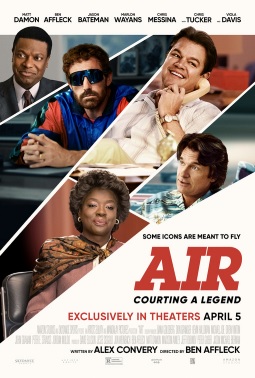
What no one wants is a pair of Nike basketball shoes. All of the major players are wearing Adidas and Converse while Nike is viewed as being primarily a company that makes running shoes. CEO Phil Knight (played by Ben Affleck) is considering closing down the basketball shoe division. Sonny Vaccaro (Matt Damon), however, has a plan that he thinks will save the division. Instead of recruiting three or four low-tier players to wear and endorse Nike shoes, Sonny wants to spend the entire division’s budget on just one player. Sonny is convinced that a young Michael Jordan is destined to become one of the best players in the history of basketball and he wants to make a shoe that will be specifically designed for Jordan.
The problem is that Michael Jordan doesn’t want to have anything to do with Nike because Nike is not viewed as being a cool brand. Jordan wants to sign with Adidas, though he’s considering other offers as well. He also wants a new Mercedes. Even though everyone tells Sonny that he’s wasting his time and that he’ll be responsible for a lot of people losing their jobs if he fails, Sonny travels to North Carolina to make his pitch personally to Jordan’s mother (Viola Davis).
For it’s first 50 minutes or so, Air feels like a typical guy film, albeit a well-directed and well-acted one. Almost all of the characters are former jocks and the dialogue is full of the type of good-natured insults that one would expect to hear while listening to a bunch of longtime friends hanging out together. For all the pressure that Sonny is under, the underlying message seems to be one of wish fulfilment. “Isn’t it great,” the film seems to be saying, “that these guys get to hang out and talk about sports all day?” When Sonny runs afoul Michael Jordan’s agent, David Falk (Chris Messina), one is reminded of the stories of temperamental film executives who spent all day yelling at each other on the telephone. The efforts to sign Jordan feel a lot like the effort to get a major star to agree to do a movie and it’s easy to see what attracted Damon and Affleck to the material. Even though the majority of the film takes place in the Nike corporate offices, it deals with a culture that Damon and Affleck undoubtedly know well.
But then Jason Bateman delivers a great monologue and the entire film starts to change. Despite his reluctance to sign with Nike, Michael Jordan and his family have agreed to visit the corporate headquarters. Sonny has a weekend to oversee the creation of the shoe that will hopefully convince Jordan to sign. When Sonny shows up for work, he’s excited. But then he has a conversation with Rob Strasser (Jason Bateman), the head of marketing. Strasser talks about his divorce and how he only sees his daughter on the weekends. Every weekend, Rob brings his daughter the latest free Nike stuff. His daughter now his 60 pairs of Nike shoes. Rob admits that, even if he loses his job, he’ll probably still continue to buy Nike shoes because that’s now what his daughter expects whenever she sees him. Rob compares Sonny’s plan to the Bruce Springsteen song Born in the USA, in that the tune sounds hopeful but the lyrics are much darker. If the plan succeeds, Nike will make a lot of money. If it fails, Rob and everyone in the basketball division will be out of a job and that’s going to effect every aspect of their lives. Rob points out that Sonny made his decision to pursue only Michael Jordan without thinking about what could happen to everyone else. Sonny says that success requires risk. Rob replies that Sonny’s words are spoken, “like a man who doesn’t have a daughter.”
It’s an honest moment and it made all the more powerful by Bateman’s calm but weary delivery of the lines. It’s the moment when the film’s stakes finally start to feel real, even though everyone knows how the story eventually turned out. As well, it’s in this moment that the film acknowledges that the Air Jordan legacy is a complicated one. Rob talks about how the shoes are manufactured in overseas sweatshops. Later, when discussing whether or not Michael Jordan should get a percentage of the sales, Jordan’s mother acknowledges that the shoes aren’t going to be cheap to purchase. They’re going to be a status symbol, just as surely as the Mercedes that Jordan expects for signing with the company. Air becomes much like that Springsteen song. On the surface, it’s a likable film about a major cultural moment, full of dialogue that is quippy and sharply delivered without ever falling into the pompous self-importance of one of Aaron Sorkin’s corporate daydreams. But, under the surface, it’s a film about how one cultural moment changed things forever, in some ways for the better and in some ways for the worse.
It’s an intelligent film, one the creates a specific moment in time without ever falling victim to cheap nostalgia. Matt Damon gets a brilliant monologue of his own, in which he discusses how America’s celebrity culture will always attempt to tear down anyone that it has previously built up. Ben Affleck plays Nike’s CEO as being an enigmatic grump, alternatively supportive and annoyed with whole thing. As for Michael Jordan, he is mostly present in only archival footage. An actor named Damian Delano Young plays him when he and his parents visit Nike’s corporate headquarters but, significantly, his face is rarely show and we only hear him speak once. In one of the film’s best moments, he shrugs his shoulders in boredom while watching a recruitment film that Nike has produced to entice him and, because it’s the first reaction he’s shown during the entire visit, the audience immediately understands the panic of every executive in the room.
Air is a surprisingly good film. It’s currently streaming on Prime.



 Through the Shattered Lens