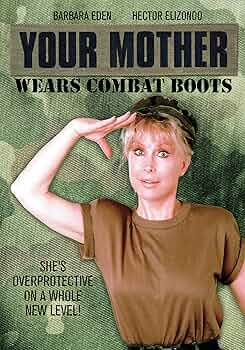
Your Mother Wears Combat Boots (1989, directed by Anson Williams)


Jimmy Anderson (David Kaufman) drops out of college and enrolls in the Army without telling his mother.  He wants to go through basic training and then do Parachute airbone training at Fort Benning, just like his father did before he died in Vietnam.  When Barbara Anderson (Barbara Eden) finds out what her son has done, she rushes down to Georgia to try to stop him.  When she discovers that Jimmy has already entered Fort Benning, Barbara assumes the identity of an AWOL trainee so that she can enter the base.  All she wants to do is track down her son and convince him to leave.  However, Sgt. Charlie Burke (Hector Elizondo) fully expects Barbara to complete her training and, in a few weeks time, to jump out of an airplane.

Probably the most interesting thing about this made-for-TV comedy is that no one seems to find it strange that a 58 year-old woman claims to have just completed basic training.  Barbara Eden looked great in this movie and she put a good deal of energy to going through all the usual Private Benjamin routines but she was still clearly too old to have ever recently enlisted in the Army and, even if she wasn’t in her 50s, the fact that she doesn’t know how to salute nor does she understand any of the basic army terminology used by Sgt. Burke should have been dead giveaways that she wasn’t who she was claiming to be.  That could have been funny if the movie had acknowledged Barbara’s age or maybe even had her act shocked that she was somehow getting away with her ruse.  Instead, the movie itself doesn’t seem to understand how strange it would be for a 58 year-old woman to show up for Parachute training.  The movie never finds the right balance between comedy and sentimentality but Barbara Eden gives it her all and the dependable Conchata Ferrell scores some laughs as a specialist who “eats recruits for breakfast.”

This film was directed Anson Williams, a.k.a. Potise from Happy Days. Ron Howard and Henry Winkler weren’t the only directors to come out of that show.

Retro Television Reviews: The Feminist and the Fuzz (dir by Jerry Paris)


Welcome to Retro Television Reviews, a feature where we review some of our favorite and least favorite shows of the past!  On Sundays, I will be reviewing the made-for-television movies that used to be a primetime mainstay.  Today’s film is 1971’s The Feminist and The Fuzz!  It  can be viewed on YouTube!

At first glance, Jane Bowers (Barbara Eden) and Jerry Frazer (David Hartman) don’t have much in common.

Jerry is a cop, though he’s attending night school with the hope of someday becoming a lawyer.  Jerry is an old-fashioned law and order man.  He expects the law to be followed.  He’s also the type who definitely believes that there are clear differences between men and women.  As he explains it, there are some thing that men are just better at.  Jerry is dating Kitty (Farrah Fawcett), who works as a waitress at the local Playboy Club.

Dr. Jane Bowers is a pediatrician and a proud feminist, one who takes it personally when a cop like Jerry refuses to give her a parking ticket just because she’s a woman.  She wants to be treated as an equal in all matters.  She’s dating Wyatt Foley (Herb Edelman), an attorney who still lives with his mother and who constantly goes out of his way to let everyone know that he’s an ally.  Jane’s best friend is Dr. Debby Inglefinger (Jo Anne Worley), who has decided that it’s time to lead a protest at the Playboy Club.

The only thing that Jerry and Jane have in common is that they both desperately need an apartment but apparently, apartments were not easy to find in San Francisco in the early 70s.  Fortunately, a hippie (Howard Hesseman) has just been evicted from his apartment because the landlord (John McGiver) didn’t like the fact that he was constantly having overnight guests.  Jane and Jerry both end up at the apartment at the same time, with Jane getting offended by Jerry’s refusal to give her a traffic ticket.  (Jerry makes the mistake of saying that he’s going to let her off “with a warning.”  He wouldn’t give a warning to a man!  Seriously, though, who in their right mind would actually demand a ticket?  Those things cost money.)  Even though they take an instant dislike to each other, Jane and Jerry still decide to pretend to be husband and wife so that they can rent the apartment together.  With their busy schedules, they figure that they’ll never have to see each other.  They won’t even know the other is around.

Of course, it doesn’t work out like that.  Jane allows Debby to hold a consciousness raising meeting at the apartment.  (Future director Penny Marshall appears as a participant.)  Meanwhile, Jerry lets a prostitute (Julie Newmar) stay at the apartment, just to keep her off of the streets for the night.  The landlord is getting suspicious.  So, for that matter, is Jane’s father (Harry Morgan).  And, as you probably already guessed, Jerry and Jane are falling in love.

With its hippies and its militant feminists and its jokes about the Playboy Club, The Feminist and the Fuzz is a film that practically yells, “1971!”  Unfortunately, script’s attempt to turn the film’s rather predictable plot into a Neil Simon-style jokefest never quite works.  The “humorous” dialogue feels forced and the film’s 75-minute run time doesn’t do it any favors, as we never really have the time to get to know Jerry or Jane as human beings.  Instead, they just remain “The Fuzz” and “The Feminist.”  As a result, it’s not that easy to care about whether or not they actually get together.  Some of the supporting performances are amusing.  Barbara Eden manages to avoid turning Jane into a caricature of a humorless activist but poor David Hartman is stiff as a board and in no way convincing as a veteran cop.

The main thing I took away from this movie is that the Playboy Clubs were exceptionally tacky.  Way back in 2011, NBC actually tried to air a drama series that took place at a Playboy Club in the 60s.  (This was when every network was trying to come up with the next Mad Men.)  The pilot started with creepy old Hugh Hefner assuring the viewers that, “Everybody who was anybody wanted to be a member of the club.”  I mean, seriously?  What a strange world.

Retro Television Reviews: Return of the Rebels (dir by Noel Nosseck)


Welcome to Retro Television Reviews, a feature where we review some of our favorite and least favorite shows of the past!  On Sundays, I will be reviewing the made-for-television movies that used to be a primetime mainstay.  Today’s film is 1981’s Return of the Rebels!  It  can be viewed on YouTube!
Mary Beth Allen (Barbara Eden) used to be the wife of the leader of Rebels, Arizona’s toughest motorcycle gang.  She’s now a widow and she operates a Colorado River campground.  Her teenager daughter, Amy (Deanna Robbins), has got a crush on a local boy named K.C. Barnes (Patrick Swayze) and that’s a problem because K.C. is kind of a jerk.

Every weekend, K.C. and his gang descend on the campground and proceed to have a good time, redneck-style.  They set up a few kegs of beer.  They water ski.  They play loud music.  They get into fights.  They drive their vans all over the property.  They are so disruptive that Mary Beth is losing customers.  For reasons that are not quite clear, the police refuse to help her.  For some reason, K.C. seems to be determined to drive Mary Beth out of business.  And when I say “for some reason,” what I mean is that there’s absolutely no reason for K.C. to be as obnoxious as he is.  It’s not like he owns a rival campground or anything.  He’s not going to gain a thing by running Mary Beth out of business.  K.C.’s only motivation seems to be that he’s a jerk.  Unfortunately, he’s played by a young Patrick Swayze, who was a bit too likable to be believable as someone who would be a jerk just for the Hell of it. Swayze smirks and sneers and laughs whenever Mary Beth yells at him but, up until the last few moments of the film, he still comes across more as being an overgrown teenager who is too dumb to realize how annoying he’s being than a true villain.  When K.C. does suddenly reveal himself to be a true villain, it’s a bit jarring.  It’s like seeing the neighborhood bully suddenly pick up a gun and rob a bank.  Swayze’s character was definitely bad but he didn’t seem that bad,

Regardless of K.C.’s level of villainy, his antics are threatening to put Mary Beth out of business.  She goes into the city and pays a visit on Sonny (Don Murray).  Sonny used to be a member of the Rebels.  Now, he’s a fairly successful auto mechanic.  He’s also always been in love with Mary Beth.  When he finds out that Mary Beth needs help, he decides that it’s time to get the old Rebels back together so that they can put some young punks in their place. 

The problem, of course, is that some of the old Rebels are really, really old.  Al Williams (Robert Mandan) was once the most fearsome dude on a motorcycle but now he sells used cars and collapses after he’s challenged to run down to the end of the street.  Mickey Fine (Jamie Farr) is now more concerned with taking care of his family than riding motorcycles.  Jay Arnold Wayne (Christopher Connelly) is a wealthy businessman who …. well, he doesn’t get much of a personality beyond that.  “Wild” Bill Karp (Michael Baseleon) is still wild but he’s also middle-aged and out-of-shape.  

Can Sonny get the gang back together before K.C. takes over the campground?  And even if he can, will he able to gather enough former Rebels to take on K.C.’s surprisingly large gang?  Seriously, when K.C. and his gang show up at the campground, K.C. appears to be leading a convoy.  It’s almost as if the entire population of Arizona is following K.C. around for the weekend.

As you may have already guessed, Return of the Rebels struggles to find a consistent tone.  On the one hand, the battle between the old bikers and the young rednecks is a dangerous one and the film tries to generate some suspense over whether everyone will survive.  On the other hand, the film’s cast is full of sitcom veterans who often deliver their lines as if they’re waiting for a laugh track to punctuate their point.  On the one hand, Patrick Swayze’s gang is supposed to be dangerous.  On the other hand, they’re Patrick Swayze’s gang.  For a bunch of delinquents, it seems like all they really want to do is spend the weekend water skiing and drinking beer.  Obviously, beer and motorboats don’t always go well together but Swayze and his friends still never come across as being quite as dangerous as they’re supposed to be.

Return of the Rebels is a film about getting old.  The members of the Rebels have all found success but all of them are nostalgic for their days of being “outlaw” bikers and they get one final chance to show everyone what they can do.  It’s not a bad theme but again, the film can never quite make up its mind how seriously it wants us to take either the Rebels or Swayze’s gang.  It’s a bit of a mess.  That said, the scenery was gorgeous and I’m enough of a country girl that I definitely got a little thrill out of watching scenes of various pickup trucks and vans driving through the river.  I have a weakness for rebels and reformed bikers.  It’s an amiable film, even if it doesn’t make much sense in the end.
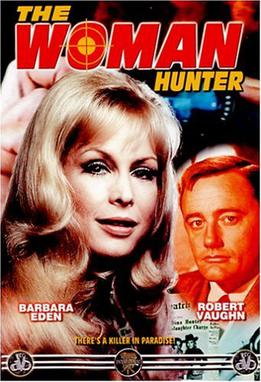
The Woman Hunter (1972, directed by Bernard L. Kowalksi)


Recovering from a traffic accident and having being recently acquitted on charges of vehicular manslaughter, wealthy socialite Diane Hunter (Barbara Eden) heads down to Acapulco with her businessman husband, Jerry (Robert Vaughn).  Diane wants to get away from the publicity of her case and relax but all Jerry seems to care about is business.  When she meets another American named Paul Carter (Stuart Whitman), Paul presents himself as being an artist.  But as Paul seems to be growing more and more obsessed with Diane and Jerry, Diane becomes convinced that Paul may have more sinister motives.  Is Diane right or is she having another breakdown?

The Woman Hunter is a quickly paced made-for-TV thriller that would probably have worked better if the two men in Diane’s life had been played by different actors.  Stuart Whitman and Robert Vaughn were both good actors but they were also so often cast in villainous roles that, as soon as they appear, everyone will know better than to trust either one of them.  The film’s big twist can be guessed just by the fact that Robert Vaughn is playing Diane’s husband.

Whitman seems bored with his role while Vaughn does his usual sleazy businessman routine.  He’s good at it but it’s a role that he played so often that it’s impossible to be surprised when it’s revealed that he’s less than trustworthy.  Barbara Eden gives a good performance and is really the main reason to watch this movie.  After being typecast as a genie in a bottle, Eden goes out of her way in The Woman Hunter to show that she was capable of doing so much more and, for the most part, she succeeds.  She’s sexy, sympathetic, and does just a good enough job portraying Diane’s mental instability that it does at least seem believable that she could be imagining all of the danger around her.  (Or, at least, it would be believable if the men in her life weren’t all portrayed by veteran screen villains.)

The Woman Hunter is forgettable but it was shot on location in Acapulco so at least everyone involved got a nice trip out of the deal.