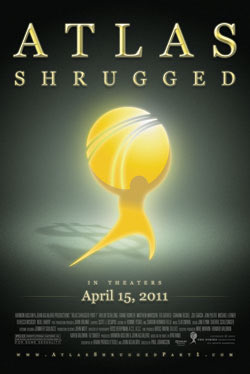
Film Review: Atlas Shrugged Part Three (dir by J. James Manera)


In 2014, the Atlas Shrugged trilogy came to a close with Atlas Shrugged Part III: Who Is John Galt?  As you can probably guess from the title, this is the movie that finally revealed the elusive character of John Galt.

Unfortunately, after all the time spent discussing the character over the past two movies, there’s really no way that the actual John Galt could possibly live up to all the hype.  John Galt, the man who stopped the motor of the world and who is the world’s greatest living engineer, turns out to be a sensitive lumberjack type who has founded his own scenic village in Galt’s Gulch.  He’s manly and handsome and chivalrous and he’s a bit dull.  Kristoffer Polaha, who plays the character, is a perfectly pleasant and likable actor but there’s nothing about his screen presence or his performance that suggests that he’s the man who has figured out how to save civilization from the regulatory state.  As a character, Galt works best as a literary creation, someone who the reader can imagine for themselves.  When seen on screen, he’s a bit of a letdown.

Taking over the role from Taylor Schilling and Samantha Mathis, Laura Regan plays Dagny Taggart as an overworked businesswoman who really needs a vacation.  (Of the three actresses who played the character, only Mathis was credible as the dynamic Dagny of Ayn Rand’s original novel.)  Having crashed her plane in the mountains at the end of the second film, Dagny is nursed back to health by John Galt and the inhabitants of Galt’s Gulch.  Dagny is shocked to discover that most of her old friends are now living in Galt’s Gulch.  As they explain, they’re on strike and they’re no longer going to serve a government that is looking to control and ultimately destroy them.  Unfortunately, the film presents Galt’s Gulch as being a bit of a dull place, one that is not even livened up the presence of pirate Ragnar Danneskold (Eric Allan Kramer).  It’s the type of place where Dagny can visit the local farmer’s market and recuperate in a taste-fully decorated bed and breakfast, all while falling in love with her hunky host.  If the first two Atlas Shrugged films now feel somewhat prophetic, the third one feels like a Libertarian-themed Hallmark movie.

Atlas Shrugged: Part III feels a bit rushed.  Apparently, no one from the cast and crew of either the first or the second film returned to work on Atlas Shrugged: Part III and it feels quite a bit different from the previous two films.  Whatever one may think of the way the first two films presented the effects of government regulation, they were effective because they specifically showed the consequences.  The audience actually saw two trains collide due to incompetent management.  The audience saw the government showing up and forcefully taking over Rearden Metal.  The third film relies on a narrator, one who tells us what happened instead of letting us see it with our own eyes.  We hear about a bridge collapsing but we don’t see it.  We hear about union thugs forcefully taking over a factory but we don’t see them.  We hear about out-of-control government bureaucrats but, as opposed to the first two films, we don’t really get to spend much time with them and, when we do, they’re far more cartoonish in their villainy than they were in the first two films.  John Galt does get to deliver his speech to the world but it’s in a truncated form and the film’s decision to then cut to Sean Hannity, Glenn Beck, and Ron Paul all praising the speech on television not only goes against the film’s depiction of a country where public dissent is suppressed but it also reminds the audience that the film’s outlook has more in common with Fox News than Ayn Rand.

As previously mentioned, the third film has a totally different cast from the first two films.  Greg Germann is enjoyably over-the-top as the unhinged James Taggart but, otherwise, the new cast fails to make much of an impression, with some of them only showing up for a few brief seconds before disappearing from the story.  Rob Morrow plays Hank Rearden but is only seen for less than a minute.  By sidelining one of the book’s most important characters, Atlas Shrugged: Part III also drops the whole storyline about Hank’s affair with Dagny.  While I guess that makes it easier for the film to then have Dagny and John Galt hook up, it still feels a bit unfair to the people who actually watched the entire trilogy.

Considering that both Parts I and II have improved with the passage of time, Part III is a rather disappointing ending for the trilogy.  Upon watching, John Galt would probably be disappointed but not surprised.

Film Review: Atlas Shrugged, Part II (dir by John Putch)


2012’s Atlas Shrugged: Part II picks up where Part I left off.

The time is still the near future.  (Part I specifically set the story as taking place five years into the future.  Part II declines to use a specific date but it does feature some news personalities playing themselves so it’s still clearly only meant to be a few years from 2012.)  The economy has gotten even worse.  The poor are only getting poorer while the rich are getting richer.  Under the direction of Head of State Thompson (Ray Wise) and his main economic advisor, Wesley Mouch (Paul McCrane), the government has nationalized nearly every business.  Halfway through the film, Thompson declares a national emergency and uses the Fair Share Law to invoke Directive 10-289.  All inventors, businessmen, and other creative people are required to sign their patents over to the government and to stop trying to develop now techniques.  Wages are frozen.  No one can be fired and no one can be hired.  Creative thinking is discouraged.  Asking questions or expressing doubt is forbidden.  People are encouraged to snitch on anyone not following the Directive.  Thompson and Mouch insist that it’s for the “good of the people,” and anyone who disagrees runs the risk of being dragged into court and sent to prison for ten years.  Meanwhile, gas now costs $42.00 a gallon.  One of the funnier moments of the film features someone paying $865.72 to fill up a truck.

Dagny Taggart (Samantha Mathis), the Vice President of Taggart Transcontinental Railways, is still trying to discover who invented an experimental motor that she found hidden away in a mine.  The motor could potentially change the way that goods are transported but it appears to be missing one component.  Unfortunately, all of the great scientists and inventors have been vanishing, with many of them leaving behind notes that ask, “Who is John Galt?”  Meanwhile, Dagny’s lover, Hank Rearden (Jason Beghe), fights to protect Rearden Metal from being taken over by the government and Dagny’s brother, James (Patrick Fabian), sells out to Wesley Mouch with the end result being that there’s no one left at Taggart Transcontinental with the intelligence or the experience necessary to keep two trains from colliding in a tunnel.

Given that Ayn Rand herself was an atheist who wrote very critically of religion, it’s interesting how much of Atlas Shrugged: Part II feels like one of those evangelical films where the Rapture comes and the entire world falls apart because all of the believers have suddenly vanished.  In the case of Atlas Shrugged, the world falls apart because all of the creatives and all of the leaders of industry and all of the innovative thinkers have abandoned it so that they can create a new community with John Galt.  (They’ve “stopped the motor of the world.”)  In many ways, this is the ultimate in wish fulfillment, a way of declaring, “They’ll miss me when I’m gone!”  Indeed, the majority of people who keep a copy of Rand’s novel displayed on their bookcase do so because they believe that they would be one of the lucky ones who was approached by Galt.  No one expects that they’ll be the person left behind to try to run the railroad.  It’s a bit like how like the most strident Marxist activists always assume they’ll be the ones organizing the workers as opposed to being a worker themselves.

Not surprisingly, the same critics who attacked Part I didn’t care much for Atlas Shrugged Part II.  When I first saw it, I thought the film was a bit too long and I was annoyed that, with the exception of a few minutes at the end, the film didn’t really seem to move the story forward.  At the same time, just as with the first film, I appreciated the fact that the second film was proudly contrarian in its portrayal of the government as being inherently incompetent.  After all, this was 2012, back in the “good government” era, when a lot of people still reflexively assumed that the government was staffed only by hyper-competent policy wonks who knew what they were doing and who were only concerned with making sure that “the trains ran on time,” to borrow an old expression.

Rewatching the film this weekend, I have to say that I actually appreciated Atlas Shrugged Part II a bit more than the first time I watched it.  Yes, Part II was still a bit too long and the domestic drama between Hank and his wife fell flat but Part II is still a marked improvement on the first film.  Some of that is because Part II had a higher budget than Part I and, as a result, it didn’t look as cheap as the first film.  The corporate offices looked like actual corporate offices and the factories looked like real factories.  Secondly, the second film had an entirely different cast from the first film.  Samantha Mathis, Jason Beghe, and especially Patrick Fabian were clear improvements on the actors who previously played their roles.  That’s especially important when it comes to Mathis and Beghe because, as opposed to the first film, Part II convinces the viewer that  Dagny and Hank actually are as important as they think they are.  When the trains collide in the tunnel, the viewer never doubts that Mathis’s Dagny could have prevented the disaster if not for the government’s attempts to force her out of her own company.  As well, the viewer never doubts that Beghe’s Hank would fight to the end to protect his business, even if it means prison.  One wouldn’t have necessarily believed that while watching the first film.

Finally, having lived through the COVID era, the film’s portrait of government overreach and incompetence feels a lot more plausible when watched today.  One doesn’t have to be a fan of Rand’s philosophy or agree with her solutions to see the parallels between Directive 10-289 and the policies that led to children being kept out of schools and numerous small business having to shut their doors.  In an era when most people’s faith in governmental institutions has been broken to such an extent that it might never be fixed in our lifetime, Atlas Shrugged Part II resonates.  Whereas the film once felt subversive, now it feels downright prophetic.

Film Review: Atlas Shrugged, Part One (dir by Paul Johansson)


The year is 2016.  A global depression has crippled the world’s economy.  While the middle class struggles to exist from day to day, the poor are getting poorer and the rich are getting richer.  Across the world, countries are nationalizing their industries, instituting price controls, and passing burdensome regulations.  Though the government officials and the academics claim that all of this is being done “in the name of the people”, it’s hard not to notice that the people are the one who are suffering as a result.  It’s also hard not to notice that most of the regulations seem to result in the bureaucrats getting not only more powerful but also wealthier.  Throughout the world, people who have started businesses or who have otherwise stood up to the government are vanishing without a trace.  In the shadows people ask, “Who is John Galt?”

Because gasoline now costs $37.00 a gallon, railroads have made a big comeback.  But the government, which claims to know what’s best and to be infallible, has done a terrible job maintaining the nation’s railways.  Dagny Taggart (Taylor Schilling), the vice president of Taggart Transcontinental Railways, is determined to rebuild the aging tracks with Rearden Metal, a new type of metal that is somehow both stronger and lighter than steel.  The inventor of the new metal is Hank Rearden (Grant Bowler).  And while that may sound like a good plan that will preserve the the nation’s supply chain, the government is angry that Rearden will not hand Rearden Metal over to them.  When Dagny’s weaselly brother, James (Matthew Marsden), announces that Taggart Railways will continue to use an inferior metal, Dagny goes into business for herself.  Despite the attempts of the government to stop them with bad publicity and excessive regulation, Dagny and Hank construct the John Galt Line.  Unfortunately, the success of the John Galt Line does not matter to Wesley Mouch (Michael Lerner, giving the film’s best performance), the former corporate lobbyist-turned-economics czar.  Mouch only sees the success of others as being a threat to his own power.

Meanwhile, people like oil tycoon Ellis Wyatt (Graham Beckel, giving the film’s second-best performance) continue to ask, “Who is John Galt?”

The first part of a trilogy of films based on the Ayn Rand novel of the same name, Atlas Shrugged Part One was released in 2011.  At that time, it received overwhelmingly negative reviews.  That, in itself, wasn’t really a shock.  There was no way that a Libertarian-themed film released at the height of the “good government” era was going to get positive reviews.  To some, it was a bigger shock that the film itself didn’t do particularly well at the box office but, again, it should have been expected.  I think Libertarians always tend to overestimate the amount of people who have 1) read Ayn Rand and 2) liked what they read.

Myself, I thought the film suffered due to its low-budget and the bland performances of Taylor Schilling and Grant Bowler in the lead roles.  At the same time, I felt that the film accomplished what it set out to do, in that it entertained the anti-government folks while annoying the MSNBC crowd.  (That said, I doubt anyone from the latter group voluntarily watched the film.)  With everything that has happened over the past seven years, it can be easy to forget just how idealized the government was in 2011.  In 2011, we were continually told that the solution to every problem could be found in a government agency populated by wonky bureaucrats.  It was like being trapped in a never-ending Aaron Sorkin fanfic.  Whatever flaws Atlas Shrugged Part One had, there was something enjoyably subversive about the film’s suggestion that the government was staffed by fools and aspiring authoritarians.  The film may have been heavy-handed when it came to portraying the greed and the stupidity of its villains but one could argue that it was no more heavy-handed than the typical Hollywood film.  It’s just, in this case, the villains of Atlas Shrugged Part One were the people who would have been the heroes of any other film.

Of course, when viewed today, Atlas Shrugged lands a bit differently.  Now that we’ve lived through the COVID era, the film’s portrayal of arrogant bureaucrats and politicians barking out orders and claiming that anyone who questions them is an enemy of the people no longer feels quite as over-the-top.  As well, it’s no longer easy to laugh off the idea of corporations working hand-in-hand with the government or the supply chain being disrupted.  The film itself still comes across as being a bit silly with its attempts to recreate the world of the rich and powerful on a very limited budget but it’s definitely more relatable today than it was in 2011.  Much of what originally felt subversive about this film now feels a bit prophetic.  If the film were released today, it would probably appeal to a mix of anti-government activist and transcontinental rail enthusiasts.  The critic wouldn’t be any nicer but it would definitely do better at the box office.

Film Review: The Fountainhead (dir by King Vidor)


I don’t know if I’ve ever seen Gary Cooper look as miserable in any film as he did in the 1949 film, The Fountainhead.

In The Fountainhead, Gary Cooper plays Howard Roark.  Roark is an architect who we are repeatedly told is brilliant.  However, he’s always has to go his own way, even if it means damaging his career.  At the start of the film, we watch a montage of Howard Roark losing one opportunity after another.  He gets kicked out of school.  He gets kicked out of the top design firms.  Howard Roark has his own vision and he’s not going to compromise.  Roark’s a modernist, who creates sleek, powerful buildings that exist in defiance of the drab, collectivist architecture that surrounds them.

Howard Roark’s refusal to even consider compromising his vision threatens the rich and the powerful.  A socialist architecture critic with the unfortunate name of Ellsworth Toohey (Robert Douglas) leads a crusade against Roark.  And yet, even with the world against him, Roark’s obvious talent cannot be denied.  Dominique Francon (Patricia Neal) finds herself enthralled by the sight of him working in a quarry.  Fellow architect Peter Keating (Kent Smith) begs Howard to help him design a building.  Newspaper publisher Gail Wynard (Raymond Massey) goes from criticizing Howard to worshipping him.

Have I mentioned that Howard Roark doesn’t believe in compromise?  If you have any doubts about this, they’ll be erased about halfway through the movie.  That’s when Roark responds to a company altering one of his designs by blowing up a housing project.  Roark is arrested and his subsequent trial soon turns into a debate between two opposite philosophies: individualism vs. collectivism.

So, let’s just start with the obvious.  Gary Cooper is all wrong for the role of Howard Roark.  As envisioned by Ayn Rand (who wrote both the screenplay and the novel upon which it was based), Roark was meant to be the ideal man, a creative individualist who has no doubt about his vision and his abilities.  Cooper, with his down-to-Earth and rather modest screen persona, often seems to be confused as to how to play such a dynamic (some might say arrogant) character.  When Roark is meant to come across as being uncompromising, Cooper comes across as being mildly annoyed.  When Roark explains why his designs must be followed exactly, Cooper seems to be as confused as the people with whom Roark is speaking.  It doesn’t help that the 47 year-old Cooper seemed a bit too old to be playing an “up-and-coming” architect.  In the book, Roark was in his 20s and certainly no older than his early 30s.  Cooper looks like he should be relaxing in a Florida condo.

Who, among those available in 1949, could have been convincing in the role of Howard Roark?  King Vidor wanted Humphrey Bogart for the role but if Cooper seemed to old for the part, one can only imagine what it would have been like with Bogart instead.  Henry Fonda probably could have played the role.  For that matter, William Holden would have been an interesting pick.  Montgomery Clift and John Garfield would have been intriguing, though Garfield’s politics probably wouldn’t have made Ayn Rand happy.  If Warner Bros. had been willing to wait for just a few years, they could have cast a young Marlon Brando or perhaps they could have let Douglas Sirk make the movie with Rock Hudson and Lana Turner.  (Or, if you really wanted to achieve peak camp, they could have let Delmer Daves do it with Troy Donahue and Sandra Dee.)

If you can overlook the miscasting of Gary Cooper, The Fountainhead‘s an entertaining film.  King Vidor directs the film as if it’s a fever dream.  The film’s dialogue may be philosophical but the visuals are all about lust, with Pat Neal hungrily watching as a shirtless Gary Cooper breaks up rocks in the quarry and Vidor filling the film with almost fetishistic shots of phallic Howard Roark designs reaching high into the sky.  If Cooper seems confused, Neal seems to be instinctively understand that there is no place for underplaying in the world of The Fountainhead.  The same also holds true of Robert Douglas, who is a wonderfully hissable villain as the smug Ellsworth Toohey.  Interestingly, the film ends with a suicide whereas the novel ended with a divorce because, under the production code, suicide was apparently preferable to divorce.  I guess that’s 1949, for you.

Because America is currently having a socialist moment, there’s a tendency among critics to be dismissive of Ayn Rand and her worship of the individual above all else.  Rand’s novels are often dismissed as just being psychobabble, despite the fact that, in some ways, they often seem to be borderline prophetic.  (Barack Obama’s infamous “You didn’t build that!” speech from 2012 could have just as easily been uttered by Ellsworth Toohey or one of the many bureaucrats who pop up in Atlas Shrugged.)  Here’s the thing, though — as critical as one can be of Rand’s philosophy, there’s still something undeniably appealing about someone who will not compromise their vision to the whims of the establishment.  It’s goes beyond politics and it gets to heart of human nature.  We like the people who know they’re talented and aren’t afraid to proclaim it.  (Modesty, whether false or sincere, is a huge turn off.)  We like the people who take control of situations.  We like the people who are willing to say, “If you don’t do it my way, I’m leaving.”  In a way, we’re all like Dominique Francon, running our hands over architectural models while trying to resist the temptation to compromise and accept something less than what we desire.  We may not want to admit it but we like the Howard Roarks of the world.

Even when they’re played by Gary Cooper.

Scenes I Love: BioShock “Little Sisters: Rescue or Harvest”


BioShockLittleSisters

With today’s release of Irrational Games’ latest title, Bioshock Infinite, I look back with some fondness to the first game in the series: BioShock.

It was a game that blew most everyone away with it’s ease of gameplay, unique art direction and, most important of all, a story that made people think that gaming was close to reaching the level of art for the genre. It was a game that dared to use as one of it’s themes Ayn Rand’s own take on the philosophy of Objectivism. It was a game about choices. A game that put the player into making the moral choice of rescuing the creepy Little Sisters or harvesting them for a rare resource that meant killing them.

I’ve played the game so many times and have made choices both good and bad, but it was always difficult even knowing how things already turned out to make that first decision to either “rescue” or “harvest”. Below are the version of this very scene that fully sold the game and it’s story to me the first time I played it way back in 2007.

Harvest

Rescue

BioShock 2 Official Launch Trailer


[YOUTUBE=http://www.youtube.com/watch?v=_YTh_-C6HKI]

On February 9th we shall the see the release of the well-anticipated sequel to the critical hit and fan-favorite FPS game from Take-Two’s 2K Studios. I am speaking of BioShock. The brainchild of game developer Ken Levine, BioShock was a FPS game which combined fast-paced action with a thoroughly engaging story of Objectivism and the philosophy born out of Ayn Rand’s writings. I would say that this is the game which EA’s upcoming Dante’s Inferno owes it’s existence on.

BioShock 2 continues the the series where it left off at the end of the first game. The setting will be an even more dilapidated and run-down Rapture with Splicers having turned even more mutant-like through abuse of gene-theraphy and ADAM use. This time around the game will have the player play as a Big Daddy who will either rescue and save or harvest the Little Sisters from the first game. A Big Sister will be the one who will pose the biggest threat to this Big Daddy and the player.

One other additional change from the first game for this sequel will be the inclusion of multiplayer gameplay over Xbox Live and PSN. While some have been excited by this inclusion of an online mutiplayer to the game I feel that it doesn’t really fit the series. I see the BioShock franchise in almost the same vein as BioWare’s own Mass Effect series. A game franchise which stand on great storytelling with some very good to great gameplay mechanics built around said storytelling. In the end, I’m still going to be buying this game even if I don’t try the multiplayer option.

Official Site: BioShock 2