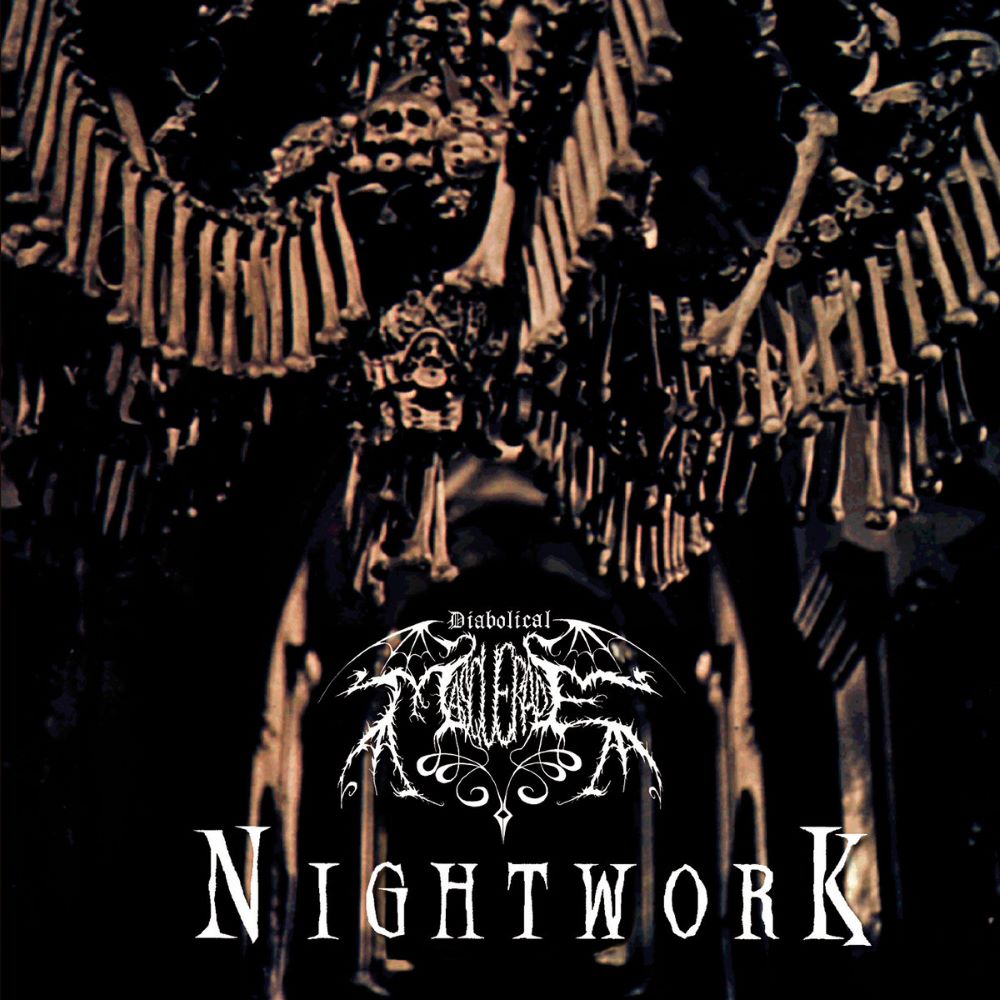
Diabolical Masquerade’s “Haunted by Horror”, from the album Nightwork (1998), feels like getting lost in a crumbling old mansion where every shadow has a story. The guitars grind and spiral while eerie melodies sneak around the corners, giving it that perfect mix of gothic drama and black metal intensity. It’s messy in the best way — like a fever dream scored by ghosts and vintage film reels.
The whole thing swings between chaos and calm, pulling from classic European horror vibes — Hammer films, giallo soundtracks, and a hint of early Lovecraft moodiness. One minute it’s a frantic chase through candlelit halls, the next it’s quiet enough to hear the walls breathe. That cinematic tension makes it feel alive, like the song itself is telling a forgotten horror tale.
What ties it together is Blakkheim’s flair for theater. He leans into the atmosphere with a wink, and you can almost picture velvet capes, fog machines, and flickering projector light behind it all. “Haunted by Horror” doesn’t just use horror for decoration; it lives in it, turning those old-school scares into something weird, stylish, and unmistakably metal.
Haunted by Horror
The shadow we forgot of the dead some tragedy I’m crush dead frays out fame it to do Path of blackness the path to mighty forest Bleaching through defeat it purr back its wallow it shay: pick turn infernal Gave it to the spat the forest lent be hide look at this sane legion we’re won’t to die Desire in latch we want it forehead and captured within for resole is side Breed on slowly doubt pride pay be frosted on dot haunted moon So I am the dead, arrow blood and thunder Make me wonder of the hate and moon clays Turn back the fault shove me with anger And revolve of the blood with hatch never be dead Fallen for reborn I am is stand in high Rising for dying dream ultimate in shade
Fourteen years posting a year-end list somewhere, and the rule never changes: odd-numbered years produce more good music. Thankfully, we just concluded 2015. 🙂
15. Deafheaven – New Bermuda
14. Peste Noire – La Chaise-Dyable
13. Mgła – Exercises in Futility
12. Veilburner – Noumenon
11. Botanist – Hammer of Botany
10. Enslaved – In Times (track: Building With Fire)
It’s amazing that after 24 years and 13 studio albums, Enslaved still routinely make it into my year-end top 10. They have continually evolved without letting go of their black metal roots, and the consequence lately has been a long stretch of memorable, prog-rock infused releases that keep up with the times and never grow stale no matter how often I resurrect them. If In Times won’t stick with me quite so permanently as Vertebrae in 2008, it still achieves everything I’ve come to expect of them lately and has managed to entertain me more than the vast majority of other albums I have heard this year. I think I have a bit of a subconscious inclination to prioritize newer bands, but #10 was as low as I could justify dropping this one.
9. Krallice – Ygg Huur (track: Wastes of Ocean)
Like any Krallice album, Ygg Huur takes dozens of listens to ingest. What struck me at first as a rather disappointing, spastic blathering of sound comes together much more coherently if you give it its due time. That being said, it is still a sharp break from their previous four albums, and it lacks that element of progression and overarching vision that has traditionally made this band, for me at least, infinitely repeatable. (I have listened to Krallice more than any other band in my life by a large margin, and they only came into existence in 2008.) Ygg Huur is a brief an meandering mood piece that does not, perhaps, maximize the band’s song-writing talents, but I’ve enjoyed it plenty never the less. More avant-garde than post-black metal, am I allowed to love it and still hope it was just a one-time experiment?
8. Ghost Bath – Moonlover (track: Golden Number)
This is a pretty gorgeous post-black metal album that I’m surprised more sites haven’t picked up on for their year-end summaries. It lacks a touch of refinement that might have earned it higher standing, but the song writing is fabulous. Moonlover delivers a well-rounded package of post-rock infused metal that seems to pay a good deal of respect to Alcest and Amesoeurs, but their undertone is bleak and depressing. It’s a sad album in a way that makes me think of Harakiri for the Sky’s Aokigahara last year, but peppered with little bursts of joy that will bring a smile to your face.
Oh yeah, metal’s not supposed to make me smile. Check.
7. Sumac – The Deal (track: Thorn In The Lion’s Paw)
I never really got into Old Man Gloom. Make what you will of that. The Deal certainly wasn’t Aaron Turner’s most well-received album, but I personally enjoyed it more than anything he’s contributed to since Oceanic. A lot of that has to do with Nick Yacyshyn’s brilliant mastery of the drum set, but I also feel like Turner’s chugging out riffs that really sink into my head more than I’m used to. It’s like a doom metal reinterpretation of Isis, albeit with less progression, and I love the subtle stylistic diversity he brings to the field on this one. It has moments that remind me of everything from black metal to Converge. (And it probably wins this year’s ‘most listened to in my car’ award. <_<)
6. A Forest of Stars – Beware the Sword You Cannot See (track: Virtus Sola Invicta)
Beware the Sword You Cannot See is one of the most eclectic albums I have heard in a long time that I still managed to really enjoy. If I could begin to put a finger on how to describe it, I would have reviewed it ages ago. Black metal at its heart, it weaves a wild mix of strings and spoken word and avant-garde breaks around that core. I like it, quite a bit, and I think the vocals and lyrics (at least, what I can make of them) might be its strongest selling point. I really don’t know what to say about this album. Hear it for yourselves, and be prepared to give an attentive listen–possibly many–if you want to soak it all in.
5. Blind Guardian – Beyond the Red Mirror (track: Grand Parade)
It’s pretty hard to measure the worth of an epic power metal band on a list that is heavily dominated by innovative new styles of music. I don’t think I would have felt entirely comfortable with my positioning of this album no matter where I put it, but I tried to make the cutoff a sort of drifting point between albums that really made me reflect and albums that I just really enjoyed, because there’s never going to be a particularly deep hidden truth to a Blind Guardian track, but they’ve proven a dozen times over to be the ultimate kings of all fantasy-themed music. In the broad scheme of BG’s vast discography, I would probably place Beyond the Red Mirror fourth, after Nightfall in Middle-Earth, At the Edge of Time, and A Night at the Opera. That translates roughly to: it’s awesome.
4. Bosse-de-Nage – All Fours (track: A Subtle Change)
Am I a little biased since I got my initial rip of this direct from frontman Bryan Manning? Probably not, but in my weird little world that’s still a bragging point. 😉 Like Cara Neir’s Portals to a Better, Dead World in 2013, All Fours takes everything I love about screamo and turns it into post-black metal. This might be a coincidence. I’m pretty sure the band claims no direct screamo influence (don’t quote me on that), but the consequence is the same. These guys have worked their way into the top-tier of bands pushing metal in new directions today, and, more so than their previous albums, All Fours really strikes me as a well-rounded composition that possesses the maturity to fully deliver its vision. And Manning has a way with lyrics that’s… well… you just have to read them.
3. Obsequiae – Aria of Vernal Tombs (track: Orphic Rites Of The Mystic)
When I first heard Obsequiae, it was one of those rare moments where I went a-ha, you are that band that’s going to pioneer the style I have always desired but been too inept to create myself. I can guarantee you without much doubt that, of all of the albums of 2015, Aria of Vernal Tombs will find its way into my playlist the most for the longest period of time. Ten years from now, I will probably still be listening to this album when its competitors are all but distant memories. Like Summoning, they fit a unique mood for me that no other band has really begun to approach. (Perhaps Opeth’s Orchid crosses into this terrain, briefly and insufficiently.) A collection of captivating medieval melodies that press themselves upon you by-and-large through euphorically well-mixed guitar and bass (the bass on this album is absolutely gorgeous) rather than traditional instrumentation… my god, I’ve been waiting so long for a band that sounds like this, and they’re easily my favorite new discovery of the year.
2. Panopticon – Autumn Eternal (track: The Wind’s Farewell)
It’s amazing to think that, in the absence of one album this year that won my heart in a landslide, Panopticon could have taken my #1 slot in 3 out of the last 4 years. To put it bluntly, Autumn Eternal is Austin Lunn’s best album to date, and Austin Lunn is arguably the most accomplished metal artist of the 2010s. An incredibly versatile musician who can sample uninhibited from the melting-pot of styles that is post-black metal, Lunn’s newest offering is a mindblowing amalgamation of post-rock and black metal that leaves the more popular bands of this persuasion choking on his dust.
1. Liturgy – The Ark Work (track: Kel Valhaal)
What can I say…. it didn’t make Pitchfork’s top 25? I will probably look back on The Ark Work as one of the most underrated albums ever recorded, and I think its merits have more in common with Radiohead than with anything that has ever derived from heavy metal. It constantly threatens to collapse into a blundering mire of amateur garbage, from the excessive bell tones to Hunter’s marshmallow-mouthed rap vocals. This might be the turn-off for so many listeners, but it is necessary, and the key to this album is in how Liturgy always manage to somehow hold it together. It’s the musical equivalent of your kindergartener handing you a crayon scribble that, on second glance, turns out to be a Picasso.
On Aesthethica, Liturgy explored a very explicit reinterpretation of black metal that found quite a bit of inspired company among bands who were beginning to recognize and explore the similarities between black metal and post-rock. That album helped to define a movement, but it only achieved the band’s vision in a very direct sort of way: through rhythm and melody and progression. The Ark Work nails Hunter’s vision home with an extremely more robust and precise pallet, bringing lyrics and glitch effects and atypical instrumentation and a totally unorthodox approach to metal vocals into the fray. If you listen to a track like “Vitriol” and can barely take it seriously, that’s part of the point, but barely is the key word. Every risk and gamble they take ultimately works, and I am unabashedly unashamed to blare Hunter’s trap beat ‘occult rap’ at max volume out my car stereo. 😀
You might listen to The Ark Work and hear some childish clusterfuck, but I hear absolutely brilliant attention to detail–a musician completely in control of the degree to which his work teeters on the brink of nonsense. Top 20 all-time contender? I could go there. Leave your fear of speaking too fondly of Hunter Hunt-Hendrix at the door and just embrace this album with the assumption that he knew exactly what he was doing. You won’t be disappointed.
I am definitely not a time-honored, faithful fan of Blut Aus Nord. They managed to evade my radar for over 15 years before the 777 trilogy brought them into the broader spotlight. Sect(s) impressed me from the start, but in a twisted, bewildering way that was not necessarily enjoyable. It was a car accident you slowed down to gawk at in spite of your better judgment. It was a disturbing feast of dementia. I did not hop on The Desanctification right away, naively expecting more of the same, and it was only with Cosmosophy that I finally caught on to just how intelligent and creative Blut Aus Nord could be.
I didn’t go back in time and pick up their classics, but I did eagerly await their next album with zero assumptions about where it might go. This seemed like a band that could do anything they set their mind to, and judging by Kristian Wåhlin’s cover art, it would be something fairly distinct from 777.
Blut Aus Nord – Paien, from Memoria Vetusta III – Saturnian Poetry
What I found was an album that kept a lot of basic elements intact, but, sure enough, sounded nothing like 777‘s cyberpunk journey through a hellspawn-ridden hive mind. Saturnian Poetry feels like much more traditional black metal on the surface, though you will be hard pressed to write it off as such. It takes about five seconds to realize that the blurred tremolo will not be content to loop into any stereotypical black metal monotony. The song jerks upward in a frantic fit, and by the 40 second mark we’re already on to a new rotation. Celestial keyboard “aaahhhs” and a barely sane pattern of motion rip your eyes wide open, and the clean, ethereal vocals at 1:20 tower above as an apathetic higher being uninterested in quelling the chaos beneath it. When the blast beats and constant motion do break, it is never long enough to calm the mood. It is an avant-garde, progressive approach to black metal that I can only compare to Krallice, only where they remain raw and brutal to a fault, Blut Aus Nord mellow out the drumming and keep the eye of a graceful keyboard looming ever above you.
You are being watched as you thrash about into empty space as hard as steel. We don’t know what that eye wants, but we sometimes catch a glimpse of its perspective, as at 5:10, as the beat slows to a plod and the sweeping guitar takes in a vast vision far beyond your natural senses.
Blut Aus Nord – Metaphor of the Moon, from Memoria Vetusta III – Saturnian Poetry
Blut Aus Nord is a band you can sense beyond the limitations of your ears. That was something that struck me from the first time I ever listened to Epitomes 1 and 2 on Sect(s). Where so many experimental black metal bands aim to invoke a feeling, Blut Aus Nord paint a sensory world. The motion of the guitar is so pronounced that you feel the notes cascading around you. Metaphor of the Moon opens amidst a tornado, everything spiraling downward in a rush of energy that encircles you. Wherever their songs might be headed, I tend to feel trapped within them in body–some twisted wonderland where keyboard and clean vocal spirits gaze upon me and invisible forces and amalgamations of lead guitar swoop all around, discernible only through some super-sense that informs me of their presence without ever forming a solid image.
But if I had to pick a fault in Saturnian Poetry, it would be the overly traditional percussion. Beats carried the day in the 777 trilogy. The band’s experimentation with unconventional drum tones added the final layer needed to complete the unique quasi-physical world of their music. On Saturnian Poetry, the lack of this element serves as an occasional reminder that I am, after all, only listening to a song. “Metaphor of the Moon” is the track that seems to extend beyond my attention span the most, at least to a point. I can latch on to it at just about any moment if I choose to, but it sometimes fails to hold me long without some effort on my part.
Blut Aus Nord – Clarissima Mundi Lumina, from Memoria Vetusta III – Saturnian Poetry
That being said, these guys are a clear cut above the vast majority of their competition in the black metal scene. It is hard to believe that France, once known for the raw and unadorned acts of Les Légions Noires, could give us three of the most significant post-black bands of our time, but Blut Aus Nord, Peste Noire, and Alcest surely stand as a triumvirate of progression and experimentation in 21st century metal. Saturn Poetry will never top the 777 trilogy in my books, and generic drumming is to blame first and foremost. Yet I’ll not soon forget a closing track like this–the listener sacrificing himself to madness, screaming towards that eye above, catching unintelligible glimpses that only make his violence more desperate. It never ends, never finds resolution, just continues to implode in perpetual waves of self-destruction. I don’t know that the song, or the album as a whole, has any clear passage. There is no apparent journey here or grand enlightenment at the end, though perhaps I ought to find the first two Memoria Vetusta albums before I pass judgment. Either way, Saturnian Poetry is another shattered window into that twisted, imaginative world that only these French masters can conjure. Whether I see in it precisely what the band intended or not, I definitely see something words cannot easily describe.

 Through the Shattered Lens