Decade of last.fm scrobbling countdown:
36. The Mountain Goats (846 plays)
Top track (37 plays): Home Again Garden Grove, from We Shall All Be Healed (2004)
Featured track: Fault Lines, from All Hail West Texas (2002)
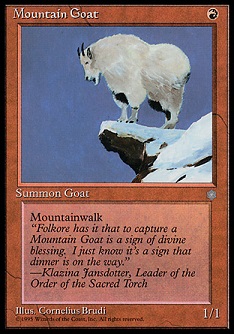
Back in my later high school days, when my early obsession with metal music coexisted with an active participation in games like Magic: The Gathering and Dungeons & Dragons, I remember stumbling across a 1/1 beast in Ice Age that I became bound and determined to name a pseudo-grim heavy metal band after:
I was very briefly disappointed to find that a band had already beaten me to the punch on that one. One of the things that makes John Darnielle an awesome person, though, is the very real possibility that this is no coincidence and he took his band name from M:tG too. (Probably not, given that his first album came out in 1994, but you never know.) This guy has made a guest appearance on an Aesop Rock hip-hop album and written an acoustic love song set to a Marduk black metal concert in the same year; his appreciation for the awkward and out-of-place couples with an above-average awareness of other musical scenes to conjure a constantly befuddling self-image. The first time I saw him live, before I was very aware of his works, I wasn’t sure if I ought to take the dialogue between each track as stand-up comedy or legitimate commentary by someone who was hopelessly socially inept. In retrospect, it was more the former, but the heart-felt sincerity Darnielle packs into everything he says or writes is both a quintessential part of the act and a reflection of who he really is–someone both incredibly aware and controlling of his public image and just a little bit legitimately weird. He has made his claim to fame writing sentimental solo acoustic songs with over-the-top lyrics and awkward subject matters that are simultaneously heart-felt and tongue-in-cheek. He has cultivated his awkwardness into some of the best solo acoustic albums recorded since Bob Dylan.
Lately, The Mountain Goats have evolved from a solo project to more of a full band. Last time I went to their show the audience had expanded from about a hundred to a few thousand, and Darnielle was hamming up the rock-star image with a shit-eating grin on his face the whole time. I absolutely love this guy and his works, and while I can’t say that I’ve kept up with him consistently over the years (his discography is massive), I’ve certainly listened to him enough to rank in my top 50 most played artists of the past decade. Here are the lines to Fault Lines, to give you some idea of his brilliantly bizarre lyrics:
Down here where the heat’s so fine
I’ll drink to your health and you drink to mine
As we try to make the money we scored out in Vegas hold out for a while
We drink vodka from Russia
We get our chocolates from Belgium
We have our strawberries flown in from England
But none of the money we spend seems to do us much good in the end
I got a cracked engine block, both of us do
Yeah the house, the jewels, the Italian race car
They don’t make us feel better about who we are
I got termites in the framework, so do you
Down here where the watermelon grows so sweet
Where I worshiped the ground underneath of your feet
We are experts in the art of frivolous spending
It’s gone on like this for three years I guess
And we’re drunk all the time, and our lives are a mess
And the deathless love we swore to protect with our bodies
is stumbling across its bleak ending
But none of the rage in our eyes
Seems to finish it off where it lies
I got sugar in the fuel lines, both of us do
Yeah the fights and the lies that we both love to tell
Fail to send our love to its reward down in hell
I got pudding for a backbone, and so do you
La la la la! Hey hey!
Decade of last.fm scrobbling countdown:
37. Drudkh (841 plays)
Top track (67 plays): Fate, from The Swan Road (2005)
Ukraine was my gateway into black metal. My earliest exposure to bm in general was met with a closed mind; I remember picking up IX Equilibrium not long after it came out, hearing nothing but distortion and blast beats, and wondering what all the fuss was about, as if its brilliant classical component was non-existent. But somehow Nokturnal Mortum’s Goat Horns blew my mind on first exposure, when I was still a teenager rocking out to In Flames, Opeth, Iced Earth and the like. That pagan spirit screaming murder beneath a wall of chaos struck me with more force than “satanic” or “progressive” bm ever would, then or now. I spent a substantial chunk of my paychecks at The End Records in the years that followed, and I was not searching for “black metal” so much as “Ukraine”. The consequence was that I got to enjoy bands like Drudkh, Hate Forest, and Astrofaes before it was “cool” to do so. (Let’s face it, hype always influences our perspective on a band in one way or another, whether we like to admit it or not.)
Drudkh quickly became my second favorite band in that scene after Nokturnal Mortum, and what I have heard in them over the years is nothing like the steady degradation from Forgotten Legends downward that supposedly “old school” fans are inclined to proclaim. I don’t know why so many people see Drudkh as a one-track band. Perhaps it is because the rate at which they release new material softens perception of the major shifts in their evolution as artists. Handful of Stars (2010) was the only album on which fans actually had to stop and go “wait, is this still Drudkh?”, and the band answered that question decisively with the Slavonic Chronicles EP. But if you listen to Drudkh as a band who played the same solid thing for four or five albums and then got too successful and lost their touch, you’re fairly misguided. It’s true that their first three albums have a lot of similarities. I sort of feel as though their vision on all three was roughly the same, with Swan Road (2005) marking the point at which they had enough recording experience to really make their sound fully capture that vision. The band has rarely repeated the same sound since. Blood in Our Wells (2006), my personal favorite, was a tremendous shift in favor of their pagan undertones, with songs like “Solitude” and “Eternity” crushing the listener through anthems more than atmospherics. Songs of Grief and Solitude (2006) was perhaps the best folk interlude album in black metal since Ulver famously did it, and Estrangement (2007) completely revisioned their sound, replacing characteristic deep plods with rabid, shrill blast beats and grittier production. Microcosmos (2009) was a significant change in production towards the other end of the spectrum, and I rather doubt the gut-wrenching quality of “Ars Poetica” (a song I still think has an almost screamo vibe to it at the climax) would have hit home so forcefully otherwise.
Drudkh’s trip to France on Handful of Stars (2010) may have left some fans disgusted, but it would be frankly stupid to call a band so consistently open to change “sell-outs” the moment their vision failed to reflect stereotypical expectations of aggression, masculinity, whatever the fuck tr00 cvlt dandies demand. And anyone who thinks Eternal Turn of the Wheel (2012) was some grand return to the good old days is in stark denial of the (I think quite intentional) persistent French influence underlining this newest chapter in their discography.
If I seem to be taking a defensive stance here, it might be in part because I’m arguing against my own initial inclinations. I’ve made the shallow mistake of blowing off Drudkh as washed up many times before, and I never fail to regret it once I’ve given the album in question substantially more time to grow on me. (My initial review here of Eternal Turn of the Wheel was cautiously negative. Today I would say it’s great.) I think over the years I’ve developed some boneheaded stereotype of Ukraine as a third world nation–an opinion based mainly on Ukrainian Americans whose pseudo-heritage reeks of self-debasing Cold War propaganda and “world music” zines. (“Only my American non-profit organization can preserve the endangered culture of our pathetic, eternally oppressed, utopianly pacifistic Slavic ancestors! I’ll give you a cultural awareness award and my new Carpathian-Caribbean fusion cd! Buy my shitty handicrafts! Send money!”) I try to forget about it and remind myself that these people are the ultimate American idiots with no actual connection to the people they pretend to represent, but I still find it hard at times to give Slavic musicians the intellectual credit they deserve. Roman Saenko and co are actually among the most intelligent musicians of our generation, and when I remind myself of that and revisit their discography, I realize again that it has been consistently solid from start to finish.
Decade of last.fm scrobbling countdown:
38. Split Lip Rayfield (789 plays)
Top track (46 plays): Thief, from Never Make It Home (2001)
Featured track: Barnburner, from Split Lip Rayfield (1998)
I chose the soundtrack to my four years in Texas appropriately: 92.5 The Outlaw. Poor San Antone lost its favored child–the only country station in the area that focused specifically on bands from Texas and the surrounding region–about a year after I left. (The owners thought they could make more money by instead offering another ultra-right Rick Perry-worshipping neo nazi talk show station.) Well, I didn’t actually ever hear Wichita, Kansas-based Split Lip Rayfield on The Outlaw anyway, oddly enough, but I did stumble upon them while listening to last.fm radio playlists of Texas country bands. It’s not like I’d never heard boisterous, edgy folk music before; the stuff The Outlaw was spinning had more balls than half the heavy metal out there. But to hear it in bluegrass was still a bit of a novelty to me at the time, and to hear it with this degree of technical proficiency blew me away.
They/their label unfortunately seems to have fallen pray to that fallacy that non-mainstream file sharing diminishes revenue–as if people just randomly buy albums from groups they’ve never heard without sampling a track or two first–so I can’t offer any studio selections, but the live video I’m showcasing here was one of the first recordings of the band I ever heard. In retrospect, it was a huge influence on my own personal guitar style. A bit of guitarist and singer Kirk Rundstrom’s total disregard for any supposedly necessary point of transition from acoustic to electric guitar has resonated in everything I’ve written or performed since. Sad to say, he tragically passed away of esophageal cancer right around the time I started listening to them. Rest in peace.
Decade of last.fm scrobbling countdown:
39. Camera Obscura (786 plays)
Top track (228 plays): Country Mile, from Let’s Get Out of This Country (2006)
Featured track: Razzle Dazzle Rose, from Let’s Get Out Of This Country (2006)
The presence of Camera Obscura on my decade-spanning last.fm charts might be the only fluke in this series. They basically got here because I listened to “Country Mile” on repeat for about 12 hours one day. Let’s Get Out of This Country is the only album I’ve really listened to extensively in their discography (they just released their fifth last month), and while I did get the pleasure of seeing them live once, I can’t say I know much about the band. But I do think this album is absolutely delightful–a little hidden ray of light in my mostly heavier music collection that warmed my heart the first time I heard it and still does today. Its retro vibe feels oddly more authentic than any of the actual classic pop sounds it replicates, made fresh by a heavy dose of 2000s indie aesthetics and Tracyanne Campbell’s angelic vocals. Let’s Get Out of This Country takes me back in time so vividly that I swear I remember growing up surrounded by the wallpaper on the album’s cover. It’s flooded with innocent ennui, played out in front of a kitchen window on a rainy Saturday afternoon. Its depression is refreshing and nostalgic, replaying some childhood memory in which boredom seemed to be the worst thing life had to offer.
Decade of last.fm scrobbling countdown:
40. Ensiferum (782 plays)
Top track (38 plays): One More Magic Potion, from Victory Songs (2007)
Ensiferum descended on metal in 2001 with a force sufficient to crush any lingering doubts that folk metal was a genre in its own right. Their self-titled debut coincided with the first instance in which I was aware enough of metal music to fully recognize the birth of something new, and for that I’ll always view them with a sense of nostalgia. When I was first encountering the likes of Finntroll and Thyrfing, metal in general was still something of a novelty for me. The fledgling trend towards incorporating folk-centric fantasy and pagan themes graced my ears uncontextualized and thus timeless. When I first heard Ensiferum, I finally realized that this was an emergent process. The clerics of musical trendiness had been persuaded to change allegiance, and Odin and Thor would have their day in place of Satan for a time.
Ensiferum’s discography is not the sort of thing that ought to necessarily make them the hallmark of that glorious and now fading trend we call folk metal. Their history is a bit more rocky, oscillating between excellence and something less. Iron (2004) frankly bored me, and I could never quite get beyond the feeling that From Afar (2009) was a collection of Victory Songs (2007) b-sides–outstanding to be sure, but extremely similar and never quite as perfect. Unsung Heroes (2012) stands taller, I think, and its negative reviews are likely a consequence of a forgivably weak ending and single-minded fans looking for Victory Songs 3.0. But no, it’s not consistency of quality that makes “Ensiferum” one of the first names to pop into my head when I think of folk metal. It’s more a matter of timeliness–of peaking when it mattered most. Ensiferum (2001) sounds a little washed out now, but it was a triumph in its day, and it appeared at the cusp of the genre’s transition from an underground pulsation to a self-declared musical movement. Victory Songs (2007), their best album (I think most fans can agree to this), emerged at the pinnacle of the genre, when the original artists were coming into their mid-career highs and the best of the bandwagoners were leaving their marks. It was supported by a grand-slam of folk metal tour bar none here in North America the following year: Ensiferum playing in the USA for the first time, closing for a mind-blowing opening line-up of Eluveitie, Týr, and Turisas at Paganfest 2008.
Unsung Heroes (2012) appeared in time to claim ownership of folk metal’s end. I’ve been getting the sad feeling lately that 2011 marked the style’s grand last hurrah. It was a loaded year for metal, with a huge number of releases. The new trend away from earthy folk towards ethereal post-black was ever present, 2000s legends duking it out for album of the year with metal newcomers like Krallice, Liturgy, Altar of Plagues, and Deafheaven–those bands I’ll wax nostalgic about ten further years from now. Ensiferum got their two cents in a year late, in a sense, but perhaps this amounts to the honor of writing the final post-script. Sure, folk metal bands aren’t going away, but the spark of collective musical inspiration has moved elsewhere. Ensiferum happened to leave their greatest marks in the opening chapter, climax, and epilogue.
I’ll leave you with a really beautiful song from Unsung Heroes: Burning Leaves.
Decade of last.fm scrobbling countdown:
41. Our Lady Peace (765 plays)
Top track (30 plays): Angels Losing Sleep, from Healthy in Paranoid Times (2005)
We are all entitled to a guilty pleasure or two. I would humor calling Our Lady Peace mine, but only if we agree to restrict their cause for lameness to the lyrics. Their popularity, especially as those “Canadian softies” emerging amidst much heavier U.S. trends, overshadows the fact that they are absolutely amazing. Raine Maida’s voice is capable of making anything sound great, and capable of making me not give a shit about singing a falsetto at the top of my lungs at traffic lights with my windows down. Even as I was signing the final divorce papers with my radio in the late 90s and letting my affair with Napster and heavy metal be known, I was probably listening to 1999’s Happiness…is Not a Fish That You Can Catch more than any other album on the market. I’ve definitely listened to it more than most other 1990s albums–even the grunge greats–in my more informed years to follow.
How people have experienced OLP over the years probably varies drastically depending on where you’re from. The late 1990s and early 2000s marked the final days of musical segregation, with Americans barely having a clue who Radiohead, Blur, and Muse were. (Didn’t one of them do that “woo-hoo” song?) The U.S. and Canada were a bit more in sync, but Our Lady Peace was definitely not the overhyped megaband down here that my Canadian friends recall. They were just “that band that did Clumsy and Superman’s Dead”. The singles on Happiness received minimal air time, and the only song since that I’ve really heard extensively here was “Somewhere Out There” (Gravity, 2002). (I can’t honestly speak for their last three albums of course. Maybe “Angels Losing Sleep” was huge–it deserves to be–but I hadn’t listened to mainstream radio in years by then.) My main point here is that, while OLP might have been played to the point of annoyance in Canada, down here they were presented modestly enough to not face serious media pollution. I had a better opportunity to engage them by choice–and choose which songs I liked best.
Our Lady Peace are a band that has definitely catered to the radio single. Even on their first album, Naveed (1994), a few tracks stood out as decisively more catchy than the status quo. Their albums by and large are never perfect; there are plenty of second-rate tracks in their discography. What they have really accomplished throughout their career is a consistency of top-notch quality among the handful of main focus tracks they produce for a given album. They are a band better set to a playlist, and even as recently as Burn Burn in 2009 they’ve pumped out new material worthy of that mix. (“Signs of Life”, “Paper Moon”–featured above) Happiness…is Not a Fish That You Can Catch remains, I think, their best album by far, because it is the only one for which I can safely say there are no downer tracks. Every song on that album could be a single. But I really do enjoy the full discography, and I have a tendency to queue it up from start to finish when I’ve got a long project to work on at home. Something about the more ho-hum tracks projects a sort of humility on the big picture–the sense that these guys are down to earth, not supernaturally brilliant in the sense of contemporaries like Smashing Pumpkins and Pearl Jam. Their lyrics are frequently incredibly lame, but that’s the only major fault I hear in a band that was perhaps a bit too successful to be appreciated for their real worth.
Our Lady Peace: a guilty pleasure? Maybe, but I’ll keep singing along.
Decade of last.fm scrobbling countdown:
42. Burzum (756 plays)
Top track (42 plays): Key to the Gate, from Det Som Engang Var (1993)
I remember watching some comedy in the early 90s where a cave man frozen in ice gets thawed out and has to adapt to life in modern Los Angeles. I don’t really remember any details about it, except that it was bad. This has pretty much been Varg Vikernes’s fate since being released from prison in 2009, and no one ought to feel the least bit sorry for him. Varg ultimately made his name known through his crimes, not his music, but he used to deliver a sound to match. There is a tinge of the deranged in classic Burzum. Albums like Det Som Engang Var carry such a lasting appeal because they simultaneously capture the pagan spirit of early 1990s black metal and the air of madness that overtook the scene, landing many of its participants in coffins or jail. Varg’s first new recording after his release, Belus, was sufficiently better than anyone expected to open the door for a potential second chance at a successful musical career. But after more than a decade with no means to record, Varg let his longing for creative expression take him, pumping out five new albums in the four years that followed with little quality control, coupled with an endless sea of writings. The overwhelming majority of this material was ho-hum, and for any other aging artist this would be fine. Plenty of other later-career heavy metallers have earned sufficient respect in their younger years to maintain a fan base as their capacity for greatness dwindled. Plenty of revolutionary thinkers have maintained a right to social commentary extending beyond their original mode of expression. But no one respects Varg Vikernes nor views him as a revolutionary, and no one really should. In spite of the quality of his early albums, he remained rightly subject to criticism, leaving prison to run head first into a sea of high expectations and further demands for proof of talent. He failed to rise to the occasion, and now no one cares. He is busy writing treatises and filming documentaries that no one will ever grant the time of day. He is chugging out album after album that most of us will never bother listening to. Sorry Count Grishnackh. It is too late for your opinions to ever matter.
We can certainly continue to derive enjoyment from select Burzum material while rolling our eyes at any mention of its creator, but for me Varg is a bit of a disappointment. Black metal is something of the thinking man’s sledgehammer–a genre which oddly entangles disgust for intellectualism with ideas which require a great deal of formal dialogue to express in other-than-artistic ways. But if the fault lines of egotism render my favorite forms of music necessarily esoteric, I have always preserved the hope that some musician might have something intelligent to say about it. Varg runs his mouth ceaselessly, and I think it a shame that nothing substantive has ever come out of it. No one has ever been in a greater position to serve as the spokesman for the genre than Varg Vikernes, granted for all of the wrong reasons. The murder of Euronymous and Varg’s outrageous, self-incriminating comments which followed propelled him to a level of stardom that his music alone could have never achieved. Sure, he was entirely at odds with the genre; he could never, unlike artists such as Ihsahn, point to unlawful actions in the early 90s scene as an immature expression of an entirely justifiable state of mind. But he had the one thing no other black metal artist could hope to achieve: extensive public attention beyond his niche genre.
I guess I hoped that more than 15 years in prison would have given him the opportunity to grow up a little. I thought maybe he would fess up to having been a dumb-shit teenager who ruined the Norwegian scene by letting his emo jealousy of Euronymous get in the way of his commitment to its values. I thought he might very carefully and very professionally take his time crafting an outstanding album as proof that he was moving on to bigger and better things. Belus succeeded in buying time, but Fallen and the works that followed proved beyond a doubt that the dumb-shit teenager was nothing more than an educated, bearded, dumb-shit adult. He never acknowledged his debt to metal–and his potential for adding a substantial new flame to a musical movement that has since rapidly left him in the dust. In short, it irks me that a man of so many words, once returned to the spotlight in 2009, had so little to say and show for it. Nevertheless, classic Burzum has stood the test of time and remains a quintessential example of the sound that swept Scandinavia in the early 1990s and continues to influence countless bands today.
Decade of last.fm scrobbling countdown:
43. Neutral Milk Hotel (727 plays)
Top track (81 plays): Holland, 1945, from In the Aeroplane Over the Sea (1998)
Featured track: In the Aeroplane Over the Sea (full album)
When you listen to a really diverse and enormous catalog of music, terms like “favorite” can seem more cheap than they really are. We are bombarded, after all, with trite Rolling Stones style top 100 whatever lists for which half the entries are predetermined without any serious consideration whatsoever and the remainder are entirely arbitrary. I like to think that this Top 50 series contains sufficient factual restraints to avoid these shortcomings–that the inclusions are genuine in a manner that avoids momentary whims and degeneration to name recognition. (You won’t find any Led Zeppelin, Beatles, or Pink Floyd in this house.) But I also like to think that that the dozens–maybe hundreds–of musical entities I have described as a “favorite” here on Shattered Lens have been sufficiently qualified to bear weight. I don’t typically speak of unequivocal favorites. I point out what I like best under a well-defined set of conditions.
So read this as it stands: In the Aeroplane Over the Sea is my favorite album. At some point in the late 1990s, Jeff Mangum became possessed by some superhuman muse long enough to compose 40 minutes of poetic euphoria.
I don’t know that any prose description could fully capture the depth of this album. It is a mesh of beautiful poetic metaphors that only slowly begin to reveal themselves over dozens of listens. It does follow a loose chronology that is sufficiently cryptic to allow for multiple but similar interpretations. The album begins with a reflection on an innocent childhood and the narrator’s first sexual experience (presumably with her–or possibly his–step-brother, the “King of Carrot Flowers”) in an environment of domestic tension that they were at the time oblivious to. The scene then fades into the past like a movie, the The King Of Carrot Flowers Pts. Two And Three presenting a bizarre first-hand account of the experience of being born–some sacred moment followed by an explosion of chaos as the narrator first boldly proclaims her existence in total disregard to the good and bad around it. (Garbage bins? Dead dogs?) The title track which follows seems to hark back to the scene of the opening song from the perspective of the innocent in awe of the mysteries of life, embracing her young lover and dreamily “laughing out loud” at “how strange it is to be anything at all.”Two-Headed Boy is the first track in which the lovers start to grow up. The childish “King of Carrot Flowers” has become a metaphorical misfit, one head clinging to youth and the other being forced into the hardships of adulthood. Their physical love is expressed in passionate desperation, aware that their innocence is fleeting: “In the dark we will take off our clothes, and they’ll be placing fingers through the notches in your spine and when all is breaking everything that you can keep inside.” The narrator ultimately assures him that their innocence is eternal, lying in wait for the moment that he can overcome his recognition of the hardships of life, and then she gets up and leaves: “Two-Headed Boy, there’s no reason to grieve. The world that you need is wrapped in gold silver sleeves left beneath Christmas trees in the snow. I will take you and leave you alone, watching spirals of white softly flow over your eyelids, and all you did will wait until the point when you let go.”
At this point, an instrumental interlude marks the passage of time into the middle third of the album. A blundering plod titled The Fool, it seems to capture the cast’s development into typical adults, overcome by petty concerns and squabbles. This new stage is not immediately spelled out, however. Instead, Mangum introduces the elusive ‘voices in his head’ characters in the plot, beginning with Anne Frank and her friend or lover. Holland, 1945 rocks out in a peculiarly up-beat fashion. It seems to be narrated by a holocaust survivor reflecting on the loss of Anne. Unlike the Two-Headed Boy, the narrator here is peculiarly optimistic and remains positive even while presenting such cutting lines as “it’s so sad to see the world agree that they’d rather see their faces filled with flies, all when I wanted to keep white roses in their eyes.” Prevented by tragedy from ever experiencing a traditional passage into mundane adulthood, the narrator remains at once innocent and fully aware of one of the 20th century’s greatest atrocities. The next track is beautiful but hard to place in context. We meet the “Communist Daughter”, a woman placed in another 20th century nightmare, and the imagery is completely inverted. The ocean is filled with seaweed and the white mountain peaks are not blanketed in snow but stained with semen, while the industrial wasteland around her is beautiful–the “cars careen from the clouds”, and “the bridges burst and twist about”. Oh Comely presumably returns to the original cast, and it hits rock bottom. Narrated, I think, by the adult successor of the Two-Headed Boy, it captures an intense bitterness towards some former lover–probably not the step-sister–and towards life in general. The narrator describes Comely as having been raised by a broken family in a trailer park and blundering into one bad relationship after another in search of elusive happiness, sleeping with men who make shallow promises in order to take advantage of her: “Oh Comely, all of your friends are now letting you blow, bristling and ugly, bursting with fruits falling out from the holes of some bratty bright and bubbly friend you could need to say comforting things in your ear. But oh Comely, there isn’t such one friend that you could find here standing next to me; he’s only my enemy. I’ll crush him with everything I own. Say what you want to say and hang for your hollow ways.” The narrator goes on to reflect on his own relationship with Comely and those moments when their love felt sincere, and then the song gives way from bitterness to lament. Voices of the past speak out in the narrator’s head: Anne’s lover describes her miserable death and regrets being unable to save her, while another voice calls to his dear Goldaline, claiming to be trapped “inside some stranger’s stomach” and promising to return her to a place where “there is sun and spring and green forever”.
The album then moves on to what I would consider its third and final movement–three tracks of inspiring beauty that describe the narrator–possibly the adult King of Carrot Flowers/Two-Headed Boy–reaching that “point where you let go” described in Two-Headed Boy and abandoning his bitterness to embrace life again. Ghost is something of an awakening. The narrator realizes that the ghost of Anne lives within him with her youthful spirit intact, and with it a sort of universal, eternal innocence shared among all of us though often forgotten with age. Suddenly the optimism of Holland, 1945 makes sense. “One day a New York city baby, a girl, fell from the sky from the top of a burning apartment building fourteen stories high. When her spirit left her body, how it split the sun. I know that she will live forever. All goes on and on and on. She goes, and now she knows she’ll never be afraid to watch the morning paper blow into a hole where no one can escape.” Her spirit will never fall into that hole of adult drudgery–and the narrator can at last climb back out of it. The next track is an instrumental celebration of this. The closing track, Two-Headed Boy Pt. 2, is by far my favorite on the album. The narrator finally grasps what is important in life. He makes amends with the people who were once close to him–his misguided father, a wayward brother, perhaps a former sister-in-law–acknowledges the breaking point where the innocence of their relationships was lost, and encourages the Two-Headed Boy to appreciate the simple things in life while they last and not be bitter at their parting:
Daddy please hear this song that I sing. In your heart there’s a spark that just screams for a lover to bring a child to your chest that could lay as you sleep and love all you have left, like your boy used to be, long ago, wrapped in sheets warm and wet.
Blister please, with those wings in your spine, love to be with a brother of mine. How he’d love to find your tongue in his teeth, in a struggle to find secret songs that you keep wrapped in boxes so tight, sounding only at night as you sleep.
In my dreams you’re alive and you’re crying, as your mouth moves in mine, soft and sweet. Rings of flowers ’round your eyes, and I’ll love you for the rest of your life.
Brother see, we are one in the same. And you left with your head filled with flames, and you watched as your brains fell out through you teeth. Push the pieces in place. Make your smile sweet to see. Don’t you take this away. I’m still wanting my face on your cheek.
And when we break we’ll wait for our miracle.
God is a place where some holy spectacle lies.
When we break, we’ll wait for our miracle.
God is a place you will wait for the rest of your life.
Two-Headed Boy, she is all you could need. She will feed you tomatoes and radio wires, and retire to sheets safe and clean. But don’t hate her when she gets up to leave.
Decade of last.fm scrobbling countdown:
44. Peste Noire (721 plays)
Top track (65 plays): Ballade cuntre les anemis de la France, from Ballade cuntre lo Anemi francor (2009)
Peste Noire is probably the most French thing to ever happen to metal. Famine has frankly stated, if the interview excerpts I saw were properly translated, that he intentionally aims to make his music as terrible and possible. This is something quite successfully achieved in the nearly unlistenable L’Ordure à l’état Pur, released two years ago. That album seems to me a big “fuck you” to everyone who failed to give Ballade cuntre lo Anemi francor an abysmal rating on Encyclopaedia Metallum. Its unprecedented levels of tastelessness successfully mock modern consumerism through an acute awareness of that about popular culture which inclines us to lose all faith in humanity. (Famine even traded in his traditional black metal/skinhead garb for a nu metal image in the packaging.) Maybe Ballade cuntre lo Anemi francor, released in 2009, was intended to be a parody too, but in that instance Famine let his actually incredible song-writing abilities and aesthetic awareness get in the way of producing anything which can honestly be regarded as terrible. I am rather inclined to call it one of my favorite albums of all time.
One of the most interesting people I have ever had the pleasure of knowing was a highly educated skinhead obsessed with extremely racist, nationalistic bands in the punk/skinhead/RAC sphere. He didn’t share any of their ideologies in the slightest, but he was able to set aside disgust in what they stood for and tap into the sort of raw emotion that drove average working-class individuals to proclaim such extreme views. Ballade cuntre lo Anemi francor might be said to mock this sort of music by maintaining the emotional appeal while deflating the fictionalized history typically necessary for its evocation. It embraces French nationalism as a parody, presumably. At least, it presents a raw, ugly image of the past that hardly meets the standard conditions for pride or beauty. Yet Famine’s vulgar vocals and lo-fi, distorted, “black and roll” instrumentation come coupled with an intense feeling of nostalgia that persists throughout the album. The parody, if it can be called a parody, stems from the presentation of nostalgia for something grotesque, but towards this end Famine committed his artistic talents without restraint. It is a nostalgic ode to a sick, sinister past, juxtaposing musical representations of unjustifiable violence and intolerance to a feeling of warmth and comfort. On the one hand it is deliciously dark, and on the other it is a legitimate embrace of nationalism in its most honest clothes. Ballade cuntre lo Anemi francor is an album that has always fucked with my head, and I love it dearly.
Decade of last.fm scrobbling countdown:
45. 東野美紀 (Miki Higashino) (705 plays)
Top track (31 plays): Beautiful Golden City, from Suikoden (1995)
Ms. Higashino is the first of a handful of video game music composers to have risen through my ranks over the years, thanks almost entirely to her beautiful contributions to the soundtracks of Genso Suikoden I and II. (Funny, I would rank Suikoden II in a three way tie for my favorite video game ever, and all three relevant composers made it onto the charts.) Her discography is small but compelling, showcasing an appreciation for traditional Asian and European folk music that rarely surfaces with such force among her contemporaries. Paying special attention to Japanese and Irish folk in particular, she managed to imbue the first two Suikoden titles with a lively earthiness ideal for an unprecedented model of gameplay made possible by the Playstation. The Suikoden games eschewed fantasy in the raw for an appeal to political and military strife in which the hero moves from town to town gathering an army and waging war along grey lines, the quintessential naivete of the RPG hero being frequently exploited to generate scenarios in which the moral high ground stood open to debate. If the main plots centered around those characters most aware of war’s many faces, the hero and the bulk of his officers–108 recruitable characters in all–were simple folk, fighting for personal reasons without a grasp of the big picture. Miki Higashino’s success in the Suikoden soundtracks rested in her ability to score appropriate music for the simple majority–those characters with deep ties to the land, who lacked a grand vision and swallowed whole the political propaganda which cast their homes and country in jeopardy. Songs like Beautiful Golden City capture what the majority of the Suikoden cast fought to preserve.
Higashino has a long history in the video game music industry in spite of her short list of works. She composed her first two soundtracks–Gradius and Yie Ar Kung-Fu–in 1985, at the surprisingly young age of 17. Yie Ar Kung-Fu in particular reveals that Higashino bore an appreciation for folk music from the very beginning of her career. I’ll leave you with the NES version of this remarkably early score.
 Through the Shattered Lens