Eager to get away from her abusive father (Sig Ruman), Connie Heath (Jane Bryan) keeps making the mistake of hanging out with the ultimate bad friend, Hilda Engstrom (Sheila Bromley). Hilda steals a dress from where they work and when the dress is torn, Hilda lets Connie take the blame. When the dress’s owner (Susan Hayward, making her film debut) insists on pressing charges, insurance investigator Neil Dillon (Ronald Reagan) helps Connie get off the hook and out of jail.
Having not learned her lesson, Connie continues to hang out with Hilda and her new boyfriend, Tony Rand (Anthony Averill). This time, Connie gets caught up in a bank robbery. Will Neil be able to get her out of another jam?
63-minutes long, Girl on Probation is a Warner Bros. B-movie. Ronald Reagan is surprisingly mellow as someone falling in love with a woman who keeps getting framed for his crimes she didn’t commit. Sheila Bromley steals the show as the out-of-control dangerous blonde who tells a priest, “I’m about to meet your boss.” The main problem with the film is that Connie is incredibly stupid. How many times can one person be framed? Jane Bryan, who played Connie, ended her acting career when she got married but she and her millionaire husband later helped to bankroll Reagan’s first political campaign and both of them were members of his unofficial “kitchen cabinet” when he was governor of California.
The movie has never been released on DVD and is hard to find. It plays on TCM occasionally, which is where I saw it. Online, the only place it appears to be streaming, ironically enough, is on a Russian site.
Business tycoon Mr. Wallace (Reginald Barlow) is sick and tired of his hard-drinking, hardy-partying son refusing to act in a responsible manner. Hoping to teach Dick Wallace about the value of hard work, Mr. Wallace sends Dick to a small town with instructions to collect a debt from the local preacher (Alec B. Francis). Dick, however, is more interested in the preacher’s daughter, Marion (Evelyn Knapp). After Dick finally convinces Marion that he’s not as bad his reputation, they got married. Mr. Wallace is disgusted and refuses to meet his new daughter-in-law, convinced that she’s a golddigger. Without revealing his true identity, Marion gets a job as Mr. Wallace’s private secretary and attempts to repair the relationship between father and son.
This is a creaky romantic comedy from the early days of sound film and it would probably be forgotten if not for the fact that Dick Wallace is played by John Wayne. Wayne was 26 when he played Dick Wallace and already a screen veteran, though most of his roles had been in B-westerns and had featured Wayne riding a horse and carrying a gun. Wayne actually gives a pretty good performance as Dick. He’s better and more natural here than he was in many of the singing cowboy films that he was making at the time and this film suggests an alternate timeline where Wayne become known as a romantic comedy star instead of a screen cowboy. Wayne is especially good in the early scenes, when he’s still a no-good, hard-drinking, no-account lout. I get the feeling he enjoyed not having to be the upright hero for once.
His Private Secretary definitely shows its age but it’s worth watching for a chance to see a young John Wayne in an unexpected role.
1932’s The Red-Haired Alibi tells the story of Lynn (Merna Kennedy).
When we first meet Lynn, she is working at a store in Manhattan. She has red hair. The film is in black-and-white but we have no doubt that her hair is red because every single character who meets her mentions that she has red hair and she continually reminds people that she has red hair. Everyone seems to be so stunned to meet a redhead! And I have to say that this is the most realistic part of this movie. I have red hair. I’ve had complete strangers tell me that they like my hair. I’ve also had complete strangers ask me if I’m a natural redhead (and I am!) and some other things that I’m not going to repeat here. Personally, I love having red hair. I’m a member of the proud 2%. I don’t care if some people claim that people with red hair don’t have souls. When you’ve got red hair, what else do you need?
As for the movie, Lynn meets a charming man named Trent Travers (Theodore van Enz). Trent offers to give Lynn a job, away from the drudgery of working in sales. Trent will pay Lynn to be his companion at night. And since this is a pre-code film, Red-Haired Alibi is pretty open about what that means. Lynn agrees. Trent is handsome and rich and who couldn’t use the money during the Great Depression? I imagine the film’s audience agreed. One thing that always comes through in these Depression-era pre-code films is that morals don’t really matter when you’re struggling to pay your rent and not starve to death.
The problem is that Trent is a gangster. Trent spends his nights committing crimes and then using Lynn as his alibi. Eventually, Lynn realizes that she’s gotten herself into a dangerous situation. The police suggest to her that she should get out of town before Trent takes things too far. (I guess they didn’t have witness protection in 1932.)
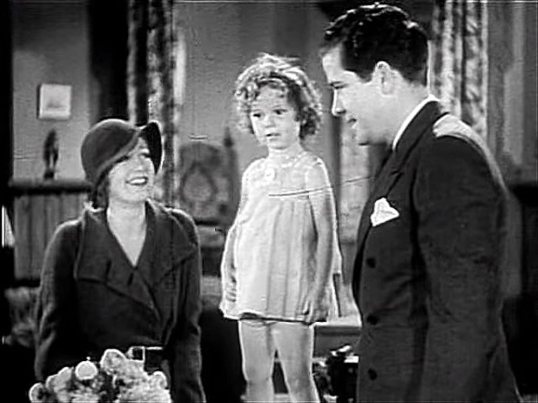
Lynn flees New York and builds a new life for herself in White Plains. She meets a charming widower named Bob Wilson (Grant Withers). They marry and settle into a life of domestic bliss. Lynn becomes the stepmother to Bob’s young daughter (played by Shirley Temple, in what is believed to have been her film debut). Everything seems to finally be perfect for Lynn. Or at least it does until Trent shows up….
The Red-Haired Alibi is a generally well-acted but somewhat slow 1930s melodrama. Comparing this film to some of the other films of the early 30s, it’s a relief to see a cast that knows how to deliver dialogue in the sound era but director Christy Carbanne sometimes struggles to maintain the sort of narrative momentum necessary to make a film like this compelling. The ending feels a bit silly but, at least during the pre-code era, there wasn’t a need to try to punish Lynn for having a less-than-perfect past.
Dancer and former silent actress Merna Kennedy was best-known for her work with Charlie Chaplin and she gives a likable performance as Lynn. Two years after making this film, she married Busby Berkley and retired from acting. Tragically, she died of a heart attack in 1944, when she was only 36 years old.
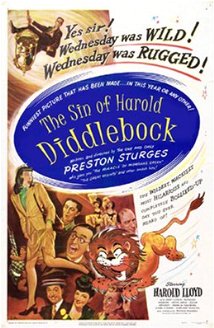
The 42nd film in Mill Creek’s Fabulous Forties box set was a 1947 comedy called The Sin of Harold Diddlebock.
As a classic film lover, I really wish that The Sin of Harold Diddlebock was better than it actually is. The film was a collaboration between two of the biggest names in cinematic comedy history: director/writer Preston Sturges and legendary actor Harold Lloyd. In fact, this was the first film that Sturges directed after leaving the studio system so that he could make bring his unique brand of satire to life without having to deal with interference. He managed to convince Harold Lloyd to come out of retirement to star in the movie and the film even works as a quasi-sequel to one of Lloyd’s most beloved silent comedies, The Freshman. In a perfect world, The Sin of Harold Diddlebock would have been a comedy masterpiece that would have perfectly shown off the talents of both men.
Unfortunately, that’s really not the case. The Sin of Harold Diddlebock is consistently amusing but it’s never quite as funny as you want it to be. This is one of those films that sounds like it should be hilarious but, when you actually watch it, you see that the film is oddly paced and Lloyd never seems to be fully invested in his role. I suppose the natural inclination would be to blame this on interference from the notoriously eccentric Howard Hughes, who co-produced the film with Sturges. After Harold Diddlebock failed at the box office, Hughes withdrew it and spent three years personally reediting the film before re-releasing it under the title Mad Wednesday. However, by most reports, Hughes wasn’t really the problem. If Wikipedia is to be believed (and God do I hate starting any sentence with that phrase), Lloyd and Sturges did not have a good working relationship. As sad as that is, it’s also understandable. Geniuses rarely work well together.
The Sin of Harold Diddlebock does get off to a good start, seamlessly incorporating the last reel of The Freshmen with footage shot for Harold Diddlebock. (Somewhat sweetly, the film starts with a title card informing us that the what we are about to see was taken from The Freshman.) After college freshman Harold Diddlebock scores the winning touchdown in a football game, impressed advertising executive J.E. Waggleberry (Raymond Walburn) offers Harold a job. However, Harold wants to finish college so Waggleberry tells Harold to look him up in four years.
Four years later, recently graduated Harold goes to Waggleberry for a job and discovers that J.E. Waggleberry has totally forgotten him. Harold ends up working in the mailroom but is told that, as long as he is ambitious and smart, he will easily move up in the company. 22 years later, Harold is still working in the mailroom. He is secretly in love with Miss Otis (Frances Ramsden). Of course, he was also in love with each of Miss Otis’s six older sisters, all of whom worked at the company before the current Miss Otis. Harold bought an engagement ring when the oldest Otis sister was with company. Years later, he’s still carrying it with him and dreams of giving it to the current Miss Otis.
However, that might be difficult because Harold has just been fired. J.E. Waggleberry feels that Harold’s unambitious attitude is setting a bad example. As severance, Harold is given a watch and $2,946.12.
The normally quiet and reserved Harold reacts to losing his job by doing something very unusual for him. He goes to a bar and, with the help of a con man (Jimmy Conlin) and a bartender (Edgar Kennedy), he gets drunk. The bartender even creates a special drink called the Diddlebock. Harold drinks it and wakes up two days later, wearing a huge cowboy hat and owning a bankrupt circus…
And it only gets stranger from there….
While The Sin of Harold Diddlebock doesn’t quite work, I appreciated the fact that it not only created its own surreal world but that it just kept getting stranger and stranger as the film progressed. It was Harold Lloyd’s final film and there’s even a scene where he and a lion end up on the edge of a skyscraper that’s almost as good as the famous comedic set pieces from his silent classics. It’s a pity that the film doesn’t really come together but I’d still recommend seeing it just for history’s sake.
For those following at home, Lisa is attempting to clean out her DVR by watching and reviewing 38 films by the end of today!!!!! Will she make it? Well, it depends on whether or not she can finish the review below!)
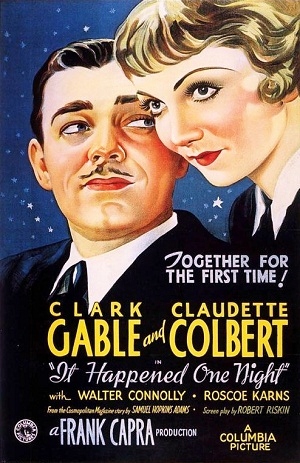
Before I talk too much about the 1934 film It Happened One Night, I want to tell a story about legs.
I’ve always been insecure about having a slightly large nose and once, when I was 17 years old, I was giving my mom a hard time about the fact that I had basically inherited it from her. I was going on and on and being fairly obnoxious about it. (Yes, believe it or not, I can occasionally be obnoxious…)
Finally, my mom held up her hand and said, “Yes, you got your nose from me but you also got my legs so stop crying!”
And you know what? I glanced down at my legs and I realized that she was right and that made me feel a lot better. Ever since then, I’ve taken a lot of pride in having a good pair of legs.
Now, you may be asking yourself what that has to do with It Happened One Night. Well, It Happened One Night is one of the ultimate “good legs” movies. That’s because It Happened One Night features the famous scene in which Claudette Colbert teaches Clark Gable the proper way to hitchhike. (If I ever take up hitchhiking, I’m planning on using the same technique.)
That’s the scene that It Happened One Night is justifiably famous for. However, It Happened One Night is more than just a film about hitchhiking.
It’s also a romance, one that features Claudette Colbert at her wackiest and Clark Gable at his sexiest. Reportedly, the sell of undershirts plummeted after Clark Gable took off his shirt and revealed that he wasn’t wearing one.
It was one of the first road movies and it was such a success that it remains influential to this very day. Any time you watch a movie that features two seemingly different characters getting to know each other on a road trip, you’re watching a movie that exists because of It Happened One Night. (And yes, that includes Tom Hardy and Charlize Theron in Mad Max: Fury Road.)
Frank Capra won his first Oscar for directing this film and It Happened One Night remains one of his most likable and least preachy films. Just compare the unpretentious, down-to-Earth style of It Happened One Night to Meet John Doe.
Perhaps most importantly, It Happened One Night was the first comedy to win the Oscar for best picture. It Happened One Night is a film that announces that a film doesn’t have to be a self-serious, pretentious epic to be great. Before the victory of It Happened One Night, the top prize was exclusively reserved for films like Cimarron and Calvalcade. (Seriously, just try watching some of those early winners today.) It Happened One Night‘s Oscar victory was a victory for the future of entertainment.
(By the way, as I sit here typing up this review, I keep accidentally typing It’s A Wonderful Life instead of It Happened One Night. That’s the power of Frank Capra.)
It Happened One Night tells the story of Pete Warne (Clark Gable). Pete is an out-of-work reporter. Though he may be down on his luck, he’s still confident and lovably cocky in that way that only Clark Gable could be. While riding on a bus from Florida to New York, Pete recognizes one of his fellow passengers as Ellie Andrews (Claudette Colbert), an heiress who has recently eloped with a buffoonish big game hunter named King Westley (Jameson Thomas). Ellie’s father wants to get the marriage annulled and has people all over the country searching for his daughter. Pete agrees not to call Ellie’s father if Ellie will agree to give him an exclusive story when she meets up with Westley in New York.
For the rest of the film, we follow Pete and Ellie as they cross the United States, spending awkward nights in motel rooms, getting kicked off of buses, and hitchhiking. Ellie gives lessons on how to get a car to stop. Pete delivers a long monologue on the proper way to undress before going to bed. Along the way, Pete and Ellie fall in love. It also becomes obvious that Ellie’s father is right about Westley only marrying her for her money.
They also meet a large cast of increasingly eccentric characters. Whether they’re dealing with the passengers on the bus or the cranky people staying at a rest stop or a motorist who won’t stop singing, Pete and Ellie do noy meet anyone who doesn’t have at least one odd quirk. Like many classic screwball comedies, It Happened One Night takes place in a world where everyone — from a bus driver to a desk clerk to a group of women waiting to use a shower at a rest stop — has something to say about everything. Some of the film’s funniest moments come from watching the normally smooth Pete have to deal with the increasingly crazy world in which he’s found himself.
(For her part, Ellie is at her happiest when things are at their strangest. Ellie’s the best.)
The other great moments come from simply watching Gable and Colbert interact. They have an amazing chemistry and it comes through in their performances. It’d odd to read that apparently neither Gable nor Colbert were happy to be cast in It Happened One Night because their performances are so much fun to watch. A love story only works if you love the characters and the love story in It Happened One Night definitely works.
As I stated above, It Happened One Night was the first comedy to win Best Picture. Beyond that, it was also the first movie to win all of the top 5 Oscars: Picture, Director, Actor, Actress, and Adapted Screenplay. (Those were also the only 5 nominations that It Happened One Night received.) For once, the Academy got it right. It Happened One Night remains a delightful film.
(Oh my God, y’all, I did it! That’s 38 films reviewed in 10 days and my DVR now has space to record all sorts of things! And making it all the better is that I finished this project by reviewing a truly wonderful comedy like It Happened One Night!)
“This is the story of two men who met in a banana republic. One of them never did anything dishonest in his life except for one crazy minute. The other never did anything honest in his life except for one crazy minute. They both had to get out of the country.”
— The Great McGinty (1940)
For today’s final entry in Shattered Politics, we take a look at how elections are won north of the Mason-Dixon Line.
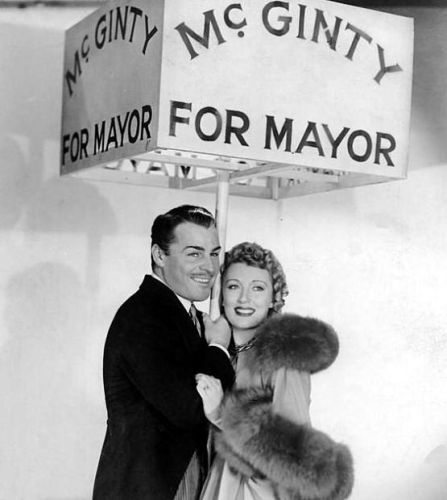
The Great McGinty begins in a bar located in an unnamed country in South America. Tommy Thompson (Louis John Heydt) attempts to shoot himself but is stopped by philosophical bartender Dan McGinty (Brian Donlevy). Tommy explains that he can never return to the United States because, in one moment of weakness, he stole some money. McGinty replies that he can never return to the U.S. either. Why? “I was the Governor of a state, baby…” McGinty replies.
In flashback, McGinty explains how he came to power. One day, while standing in a soup line, the homeless McGinty was approached by a local political operative (William Demarest) and offered $2.00 on the condition that he vote for a certain mayoral candidate. McGinty agrees and then proceeds to vote 37 times. When McGinty demands $74.00 for his efforts, he’s taken to the headquarters of the Boss (Akim Tamiroff, giving a wonderfully comedic performance).
The Boss is impressed with McGinty and, despite the fact that the two of them are constantly getting into fights with each other, he employs McGinty as a collector. Eventually, he also arranges for McGinty to be elected alderman and then, running as a reform candidate, mayor.
Along the way, the Boss arranges for McGinty to get married. McGinty’s wife (Muriel Angelus) originally has little respect for McGinty but, after they marry, she starts to realize that McGinty is not quite as bad as she originally assumed. Eventually, she’s even impressed enough that she even stops seeing her boyfriend, George (Allyn Joslyn).
Meanwhile, the Boss arranges for McGinty to be elected governor. However, once McGinty has won the election, he declares that he’s going to run an honest administration. How does that turn out? Well, it should be noted that the film opens with McGinty tending bar in South America…
The Great McGinty is a lot of fun and it’s interesting to think that this unapologetically sardonic look at American politics came out just a year after Mr. Smith Goes To Washington. Imagine if Mr. Smith Goes To Washington had been told from the point of view of Edward Arnold’s Boss Taylor and you can guess what The Great McGinty is like.
If nothing else, The Great McGinty serves as a great reminder that political cynicism existed long before any of us cast our first vote.
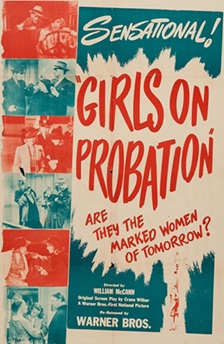 Eager to get away from her abusive father (Sig Ruman), Connie Heath (Jane Bryan) keeps making the mistake of hanging out with the ultimate bad friend, Hilda Engstrom (Sheila Bromley). Hilda steals a dress from where they work and when the dress is torn, Hilda lets Connie take the blame. When the dress’s owner (Susan Hayward, making her film debut) insists on pressing charges, insurance investigator Neil Dillon (Ronald Reagan) helps Connie get off the hook and out of jail.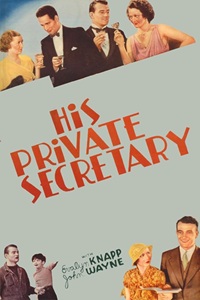
 Through the Shattered Lens