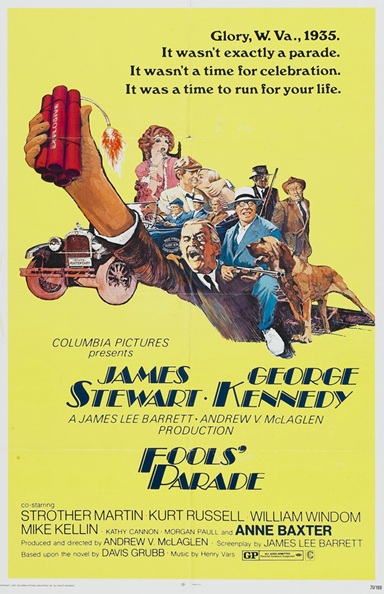
1971’s Fools’ Parade opens in 1935.
Three men are released from the West Virginia state penitentiary and given a train ticket out of town by the prison captain, Council (George Kennedy). The men are a bank robber named Lee Cottrill (Strother Martin), a young man named Johnny Jesus (a young Kurt Russell), and a courtly older man named Mattie Appleyard (James Stewart). Despite his polite tone of voice and his folksy manner, Appleyard is actually the most notorious of the three men being released. Convicted of murdering two men, Appleyard has spent the past 40 years in prison. Both Appleyard and Cottrill are looking to go straight. Every day of his sentence, Appleyard worked and earned money. Along with a glass eye, Appleyard leaves prison with a check for $25,000 dollars. Appleyard plans to cash the money at the bank and then open a store with Cottrill.
Unfortunately, Appleyard has been released at the height of the Great Depression. The streets are full men desperately looking for work. People will do anything to feed their families or to make a little extra money. Salesman Roy K. Sizemore (William Window) transports guns and dynamite. Willis Hubbard (Robert Donner) works as a conductor on the train. Aging prostitute Cleo (Ann Baxter) offers to sell the virginity of her adopted daughter, Chanty (Katherine Cannon). Junior Killfong (Morgan Paull) sings on the radio and occasionally takes on deadlier work with his friend, Steve Mystic (Mike Kellin). As for Captain Council, he’s decided that he’s going to make his money by ambushing the train carrying the three men that he has just released from prison. After killing the men, Council will cash Appleyard’s check himself.
Of course, it doesn’t quite work out as simply as Council was hoping. Willis Hubbard has a crisis of conscience and lets Appleyard, Cottrill, and Johnny know what Council is planning. The three men narrowly make their escape but Council frames Appleyard for a murder that he didn’t commit. Now wanted once again, the three men must not only get the money but also clear their names. It won’t be easy because, as Hubbard explains, they may be free from the penitentiary but now, they’re trapped in “the prison of 1935.”
Fools’ Parade really took me by surprise. I watched it because it featured two of my favorite actors, James Stewart and Kurt Russell. And both Stewart and Russell give very good performances in the film. Stewart was always at his best when he got a chance to hint at the melancholy behind his folksiness and the young Kurt Russell plays Johnny with a sincerity that makes you automatically root for him. For that matter, the normally sinister Strother Martin is very likable as Lee Cottrill, a bank robber who is still struggling with the idea of going straight. But, beyond the actors, Fools’ Parade is a genuinely sad portrait of desperate people trying to survive. At one point, Sizemore and Cottrill watch as their train passes a camp of people who have been displaced by the Great Depression and it’s even implied that the villainous Council has some regret over what he’s become. (There’s a small but poignant scene in which Council and Cleo acknowledge the passage of time and, for a minute, the viewer realizes these two people were, at one time, maybe as idealistic and optimistic as Johnny.) It’s a well-acted film, one in which moments of humor are mixed with moments of true sadness. I may have picked the film for Jimmy and Kurt but, in the end, the film’s story and performances drew me in. The 63 year-old Stewart proved that he could still give a memorable performance and the 20 year-old Kurt Russell proved that he was a future star in the making. If you haven’t seen it, this is definitely a film to check out.
 Through the Shattered Lens