Brad reviews NOWHERE TO RUN (1993), starring Jean-Claude Van Damme!


In NOWHERE TO RUN, Jean-Claude Van Damme plays Sam Gillen, a recently escaped convict who finds himself hiding on the outer edges of a rural farm owned by widowed mother Clydie Anderson (Rosanna Arquette) and her two children, Mookie and Bree (Kieran Culkin and Tiffany Taubman). Through a variety of circumstances, Sam learns that a ruthless developer, Franklin Hale (Joss Ackland), and his enforcer Mr. Dunston (Ted Levine), are trying to force all of the farmers to sell their land, using violence if necessary. When bad guys show up one night and threaten Clydie and her kids, Sam emerges from the woods and kicks their asses. Soon Sam finds himself fighting off more of Hale’s goons, romancing the beautiful widow and becoming more emotionally connected to the kids. With his past closing in, Sam decides to do whatever it takes to protect Clydie and her kids, even if that costs him his freedom.

The late 80’s and early 90’s saw the emergence of two new action stars… Steven Seagal and Jean-Claude Van Damme. As a constant patron of our local video stores, I was there at the beginning of their careers and rented each of their new movies as they became available. Van Damme would establish himself in hit films like BLOODSPORT (1988), KICKBOXER (1989), DEATH WARRANT (1990) and UNIVERSAL SOLDIER (1992). As a big fan, I found myself in a movie theater in January of 1993 to watch his latest film, NOWHERE TO RUN. 

With a plot that resembles an old western… a man corrupted by wealth tries to force a widow off her land until a kind-hearted drifter steps in… NOWHERE TO RUN isn’t trying to reinvent the action genre, but it does give Van Damme a different kind of role. His Sam Gillen isn’t a wisecracking action hero or an unstoppable martial artist. Rather, he’s a flawed man with a particular set of skills who’s looking for redemption. I think Van Damme plays that soulful weariness better than most would give him credit for. Rosanna Arquette brings a credible presence to this genre film that helps sell the relationship between her and Van Damme, and the presence of her kids, also amps up the stakes and gives the story a genuine sense of vulnerability. When Sam decides to fight back, it’s not to protect himself, but to protect people worth standing up for. That motivation helps make the film more engaging than you might normally expect from an early 90’s action film. 

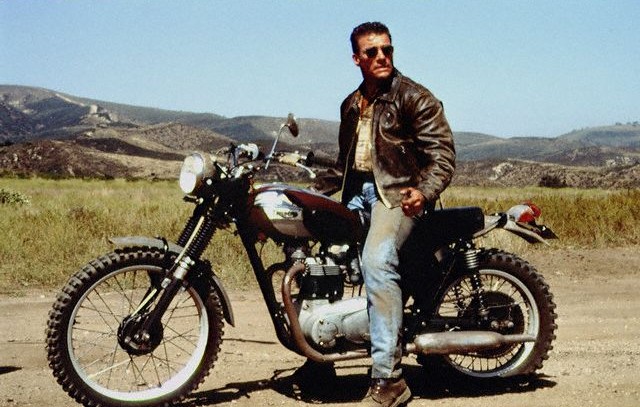
Speaking of action, NOWHERE TO RUN doesn’t feature a ton of action, but what it does have is effective. The early sequence where Van Damme’s character initially steps in to help the terrorized family is especially strong. There are several additional fight sequences and a prolonged motorcycle chase to provide some entertainment, but don’t expect wall-to-wall action or you could be disappointed. Joss Ackland (LETHAL WEAPON 2) and Ted Levine (THE SILENCE OF THE LAMBS) are suitably nasty villains so we definitely want to see them get their comeuppances, and the film effectively obliges. I also like the fact that NOWHERE TO RUN is set out on a rural farm. This setting enhances its “western” feel, and I certainly appreciate that unique element for an action film of this era. 

At the end of the day, I enjoyed NOWHERE TO RUN when I watched it in the movie theater back in 1993, and I enjoyed it again today. It’s certainly not flashy and action packed like HARD TARGET or TIMECOP, but it is a solid, and surprisingly emotional Van Damme film. I recommend it. 
James Bond Film Review: Licence to Kill (dir. by John Glen)


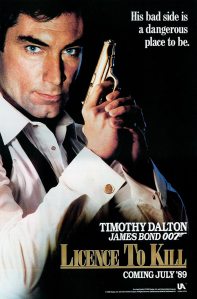
Licence to Kill, which was initially released in 1989, was the 16th “official” James Bond film.  It was also the second and the last one to feature Timothy Dalton in the role of James Bond.  This is the one where Felix Leiter gets eaten by a shark, Bond resigns from MI6, and ends up going to Central America in search of revenge.  Sad to say, it’s also one of my least favorite of the Bond films.

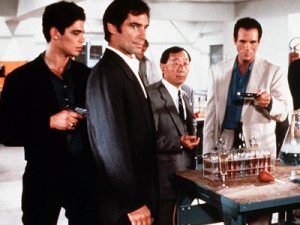
Licence to Kill starts out with Bond in Florida, attending the wedding of his best friend, Felix Leiter (played by David Hedison, who previously played the role in Live and Let Die).  However, before going to ceremony, Felix and Bond take a few minutes to arrest notorious drug lord Franz Sanchez (Robert Davi).  With the help of a crooked DEA agent (played by a wonderfully smarmy actor named Everett McGill), Sanchez escapes from custody.  Accompanied by his psychotic henchman Dario (Benecio Del Toro), Sanchez gets his revenge by killing the new Mrs. Leiter and feeding Felix to a shark.  When Bond discover the barely alive Felix, he also discovers a note that (in a scene borrowed from the novel Live and Let Die) reads, “He disagreed with something that ate him.”

Investigating on his own, Bond discovers that Sanchez’s partner in Florida is the wonderfully named Milton Krest (played by a brilliantly sleazy Anthony Zerbe).  Soon, James Bond is on a mission of vengeance that involves tracking down and killing every member of Sanchez’s organization.  However, M (Robert Brown) doesn’t like the idea of his best secret agent killing the entire population of Florida.  Bond responds by resigning from the service and heading to Central America on his own.

In typical Bond film fashion, James Bond manages to infiltrate Sanchez’s organization and Sanchez soon takes a liking to the man who has vowed to kill him.  Along the way, Bond romances both Sanchez’s abused mistress Lupe (Talisa Soto) and an ex-CIA agent named Pam Bouvier (Carey Lowell) and the viewers learn that Sanchez’s criminal enterprise not only involves drugs but also a crooked TV preacher (played by Las Vegas mainstay Wayne Newton) as well.

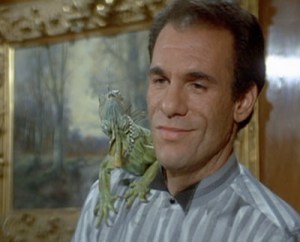
Let’s start with the positive.  Robert Davi, playing the role of Franz Sanchez, makes for a memorable villain.  Along with the silky charm and hints of madness that we’ve come to expect from Bond villains, Davi brings an almost perverse edge to the character.  Every line of dialogue that he delivers is practically dripping with decadence.  Whether he’s doting on his pet iguana, his main henchman Dario, or poor Lupe, Sanchez makes for a dangerously charismatic and compelling villain, one that feels like he would have been at home in one of Ian Fleming’s original novels.  Wisely, Davi plays his role almost as if he was playing James Bond and, as a result, the scenes that he shares with Dalton all have a crackling energy to them that is missing from the film as a whole.

In fact, almost all of the villains are compelling in this film, from Franz Sanchez all the way down to the lowliest henchman.  As played by a very young Benicio Del Toro, Dario is all smoldering intensity and arrogant swagger.  Smuggler Milton Krest is played by veteran character actor Anthony Zerbe and he gets one of the bloodiest death scenes in the history of the series.  However, I have to admit that my favorite bad guy was Sanchez’s business manager, Truman-Lodge (played by Anthony Starke).  Truman-Lodge is just so enthusiastic about the business opportunities that came along with allying oneself with evil that it’s rather infectious.

With such a memorable collection of bad guys, it’s a shame that the film didn’t provide them with any goals worthy of their evil talents.  In previous (and future) Bond films, far less interesting villains have still come up with plans to allow them to take over the world.  Even Moonraker‘s Hugo Drax was able to overcome his lack of personality and come up with a diabolical intergalactic scheme.  Meanwhile, Franz Sanchez — one of the most complex and impressive Bond villains of all time — is simply content to sell drugs and feed people to sharks.  It feels almost disrespectful to Davi’s performance that Sanchez’s goals are, ultimately, so boring.

And, in the end, I think that’s the main problem that I have with Licence to Kill.  The film feels so predictable.  There’s nothing about it that makes it comes across as a story that could only have been about James Bond.  Instead, it feels like the type of standard action/revenge film that always seems to come out every summer.  The film’s hero might be an Englishman named James Bond but he could just as easily be an American named Jake Sully.

According to Sinclair McKay’s invaluable history of the Bond franchise, The Man With The Golden Touch, Licence to Kill was specifically written to compliment Timothy Dalton’s more “realistic” interpretation of the Bond character.  As Dalton played Bond as grim and serious, Licence to Kill is a grim and serious film.  Innocents and villains alike die in bloody agony and, the few times that Dalton does smile, the expression looks so unnatural that you worry that his face is about to split in half.  Unfortunately, along with being grim and serious, Dalton’s Bond is also remote and uncharismatic and, with the exception of Robert Davi, he doesn’t have any chemistry with anyone else in the cast.  (Carey Lowell brings a lot of energy to the role of Pam but Dalton’s Bond never seems to be that into her.)  Dalton simply doesn’t make for a very compelling hero and, as a result, Licence to Kill ends up feeling like an empty collection of occasionally impressive stunts.

Licence to Kill holds a few dubious distinctions.  It was the least financially succesful of all the Bond films and it was also the last Bond film to be produced by Albert Broccoli and directed by John Glen.  It was also the last to feature Robert Brown in the role of M and, of course, it was also the last to feature Timothy Dalton in the role of James Bond.  (That’s not all that shocking when you consider just how miserable and bored Dalton seems to be in this film.)  Over the next six years, the Bond franchise would be mired in a lawsuit between Eon productions and producer Kevin McClory and when James Bond finally did return, he would do so in the form of Pierce Brosnan.

We’ll be taking a look at Goldeneye tomorrow.