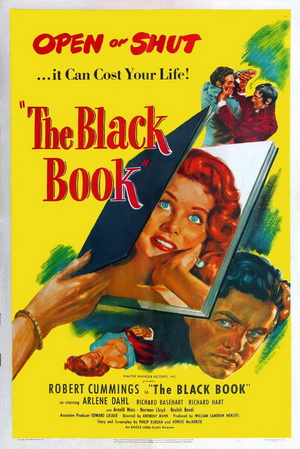
The third film in Mill Creek’s Fabulous Forties box set was 1949’s The Black Book, which was also released under the title Reign of Terror.
The Black Book takes place during the French Revolution. It is, to quote Dickens, both the best of times and the worst of times. Actually, mostly it’s just the worst of times. The Black Book portrays revolutionary France as being a dark and shadowy country, one where the only things that hold the people together are paranoia and terror. It’s a country where anyone can be executed at any moment and where power mad tyrants excuse their excesses by saying that they are only doing the people’s will. Considering that the The Black Book was made in 1949, its vision of revolutionary France can easily been seen as a metaphor for Nazi Germany or Communist Russia. Or perhaps even America at the start of the Red Scare.
(It’s probably not a coincidence that the Nazis also had a document known as the Black Book, one that listed everyone who was to be arrested and executed if Hitler succeeded in conquering Great Britain.)
Maximilien Robespierre (Richard Basehart, giving a disturbingly plausible performance that will make you think of more than a few contemporary political figures) is on the verge of having himself declared dictator of France. Unfortunately, his little black book has disappeared. Inside that black book is the name of everyone that he is planning to send to the guillotine. If the book ever became public, then Robespierre would be the one losing his head.
Robespierre summons a notorious prosecutor named Duval (Robert Cummings) to Paris and gives him 24 hours to track down the book. He gives Duval the authority to imprison and interrogate anyone in France. He also informs Duval that, if the book is not found, Duval will be the next to lose his head.
However, what Robespierre does not know is that Duval is not Duval. He is Charles D’Aubigny, a rebel against the Revolution. Charles murdered Duval and took his place. Now, Charles has to find the book without his own identity being discovered. Not only do some of Robespierre’s allies suspect that Duval may not actually be Duval but some of Charles’s former allies also start to suspect that Charles may secretly be working for Robespierre, even as he claims that he’s trying to bring him down. At times, even the viewer is unsure as to who is actually working for who.
Oh my God, this is such a good film! In fact, it was so good that I was surprised that I hadn’t heard of it before watching it last night. The chance to discover a hidden gem like The Black Book is the main reason why I continue to take chances on Mill Creek box sets.
The Black Book was definitely made on a very low-budget but director Anthony Mann (who is best known for directing several landmark westerns) uses that low-budget to his advantage. There’s little spectacle to be found in this historical epic but then again, there was little spectacle to be found in the reign of terror. This is a film that takes place in shadowy rooms and dark, almost claustrophobic streets. It’s a historical film that looks and plays out like the most cynical of film noirs. Despite the fact that all of these well-known French figures are being played by very American actors, the cast all does an excellent job of capturing the fear and desperation of people living under oppression. The subtext of The Black Book was undoubtedly clear in 1949 and it’s just as clear today. Fanaticism remains fanaticism, regardless of when it happened or what ideology is used to justify it.
There is a somewhat awkward moment towards the end of the film when a French army officer is asked for his name.
“Bonparte,” the officer replies, “Napoleon Bonaparte.”
“I’ll remember that name,” someone snarkily replies.
But, other than that one moment (which immediately made me think of Titanic‘s infamous “Something Picasso” line), The Black Book is an intelligent and effective thriller. And because it’s in the public domain, you watch it below!



 Through the Shattered Lens