Now that the awards for the best of 2025 have been handed out, it’s time to think about what might be nominated next year!
Below are my first set of Oscar predictions for 2026! What am I basing these predictions on? Nothing but instinct, wild guesses, and hopeful thinking. Take them with a grain of salt. If nothing else, we’ll look back on these a year from now and we’ll laugh. Or, we’ll be amazed at my cognitive abilities.
Over the course of his long and distinguished career, Harvey Keitel has only been nominated once for an Academy Award.
And, amazingly enough, he wasn’t nominated for any of the films for which he is best remembered. He wasn’t nominated for Mean Streets or Taxi Driver or any of his other collaborations with Martin Scorsese. He wasn’t nominated for playing the Wolf in Pulp Fiction or Mr. White in Reservoir Dogs. He was not nominated for The Piano. He certainly wasn’t nominated for baring his soul in Bad Lieutenant. Instead, Harvey Keitel’s only nomination was for playing real-life gangster Mickey Cohen in the 1991 Best Picture nominee Bugsy.
Bugsy was one of the many films to be made about the life of Bugy Siegel, the reputedly psychotic gangster who left New York for Hollywood and who later helped to create the wonderland of Las Vegas. In both the movie and real-life, Siegel was gunned down by his former associates, who felt that he was recklessly wasting their money out in the middle of the desert. It’s generally agreed that the order to murder Siegel was given by Lucky Luciano and Meyer Lansky, two of Siegel’s long-time friends and business partners. In Bugsy, Lansky was played by Ben Kingsley. Kingsley was also nominated for Best Supporting Actor. Unfortunately, whenever two actors from the same film are nominated for an Oscar, they usually end up canceling each other out. That’s what happened in the case of Bugsy, with both Kingsley and Keitel losing the Oscar to City Slickers‘s Jack Palance.
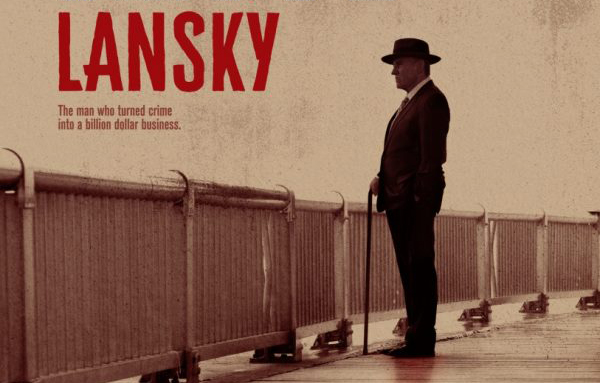
30 years after Busgy, Harvey Keitel once again acted out of the story of the death of Bugsy Siegel. Except, things time, Keitel played Meyer Lansky, Mickey Cohen was nowhere to be seen, and the film was called Lansky.
Of course, there’s more to Lansky than just the falling out with Bugsy Siegel. As you can tell from the film’s title, it attempts to deal with Lansky’s entire life. The film starts in 1979, with a friendly but terminally ill Meyer Lansky meeting with a writer named David Stone (Sam Worthington). David desperately needs the money that would come from writing the only authorized biography of Meyer Lansky. Lansky, knowing that he’s dying, wants to tell his story. Of course, Lansky has a few conditions. David can only publish the book after Lansky has died and David is not to talk to anyone about anything that Lansky tells him. David agrees.
From there, the film jumps back and forth in time. We watch the young Lansky (played by John Magaro) as he teams up with Lucky Luciano (Shane McRae) and Bugsy Siegel (David Cade) to change the face of organized crime. Along the way, he gets involved in the casino business, the CIA, and the Cuban revolution, and he fights Nazis at home and abroad. Lansky turns organized crime into a business and, as a result, becomes known as “the Mob’s accountant.” The FBI hounds him for almost his entire life, determined to discover where he’s hidden the millions of dollars that he’s rumored to have earned through his crimes.
While Lansky tells his story to David, the two of them form a slightly uneasy friendship Lansky is friendly and curteous but, as becomes clear as the film progresses, he’s still as capable of ordering a murder as ever. David, meanwhile, is being pressured by the FBI. They want him to become an informant and to press Lansky for information on where he’s hiding his money.
Lansky is a film that requires some patience. The first hour or so is a bit messy, with the film awkwardly trying to strike a balance between the flashbacks and the scenes of David talking to Lansky. At times, the film becomes a bit of an odd buddy picture, with Lansky offering David some unexpected life advice. However, once the FBI starts pressuring David, things pick up. The arrival of the FBI adds some much needed tension to the film’s storyline. As you watch the main agent (played by David James Elliott) pressure David into becoming an informant and essentially put his life at risk, it’s hard not to contrast Lansky with the men who are determined to put him away. Lansky may be a criminal but he has a code of ethics and, most importantly, he doesn’t harass innocents. The FBI, though, has no problem with bullying and manipulating informants and witnesses, all in the name of trying to figure out where a dying man is hiding his money. When the attention shifts from Lansky telling his story to Lansky outwitting the FBI, the film takes on an entirely new feel. When a smug FBI agent flies all the way to Israel in search of Lansky’s money, it’s impossible not to cheer a little when he gets outsmarted.
Due to the film’s flashback structure, Harvey Keitel is not in as much of Lasnky as you might expect. And yet he dominates the entire film. He perfectly captures both Lansky’s determination and his grim humor. Even facing death, Lansky is determined to keep control over every situation. In the film’s most powerful moments, he discusses what it’s like to be an outsider in America. Lansky knows that, as a Jew, he’ll never be fully accepted by the establishment. So, instead of begging for hand-outs, Lansky created his own establishment, one that operated in the shadows but which ultimately proved to be as successful as any corporation. When Lansky discovers that the American government is pressuring Israel to refuse to grant Lansky citizenship, Keitel perfectly captures both Lansy’s pain and his defiance. It all leads to a haunting final scene of Lansky on the beach. Appropriately enough, Meyer Lansky is alone.
Lansky is a both a portrait of a fascinating life and a tribute to the talent of Harvey Keitel. It may require some patience but that patience will be rewarded.
(Lisa is currently in the process of trying to clean out her DVR by watching and reviewing all 40 of the movies that she recorded from the start of March to the end of June. She’s trying to get it all done by July 10th! Will she make it!? Keep visiting the site to find out!)
The 19th film on my DVR was Jack of The Red Hearts, which I recorded off of the Lifetime Movie Network on April 27th.
I have to admit that I was a little bit surprised as I watched Jack of the Red Hearts. While it seemed to have a typical Lifetime premise — a runaway fakes her identity and moves in with a troubled family — it didn’t feel like a typical Lifetime film. For one thing, the cast was made up of actors like Soul Surfer‘s AnnaSophia Robb, The Bling Ring‘s Israel Broussard, and the X-Men‘s Famke Janssen. None of these people are exactly big stars but they’re still not Lifetime regulars. While the premise may have been Lifetime-friendly, the portrayal of an 11 year-old autistic girl (played by Taylor Richardson) definitely seemed a bit more realistic than one would usually expect from a made-for-TV movie. Finally, there were more than a few occasions when it was obvious that some of the dialogue had been overdubbed, in order to make the language more appropriate for television.
So, I did some research and I discovered that Jack of the Red Hearts was not originally made for Lifetime. Instead, it’s an indie film that was directed by Janet Grillo and written by Jennifer Deaton, both of whom drew on their own experiences of raising an autistic child. Jack of the Red Hearts did the festival circuit in 2015 and even got a very limited theatrical release back in February.
Jack of the Red Hearts tells the story of Jack (AnnaSophia Robb), an 18 year-old high school drop out who is on probation. When we first meet Jack, she’s helping her younger sister, Coke (Sophia Anna Caruso), break out of foster care. AnnaSophia and Sophia Anna are both totally believable as sisters and their scenes together are so believable that you even forgive the fact that they’re named Jack and Coke. Jack wants to take care of her sister but she’s broke and she’s homeless. In order to rescue Coke from the foster home, Jack has to get a job and enough money to rent an apartment.
And what better way to get a job than by stealing someone else’s identity! After Jack sees some flyers asking “Are you good with children?,” she shows up at the home of Kay (Famke Janssen) and Mark (Scott Cohen). Jack claims that her name is Donna and that she’s the nanny that Kay previously hired over the telephone. Despite having neither training nor a high school degree, Jack is soon taking care of autistic Glory (Taylor Richardson).
Glory is nonverbal and sometimes violent and her family, while loving, struggles to adjust to not only her behavior but also their inability to understand what the world is like for her. (The film occasionally tries to show us the world through Glory’s eyes and it works a lot better than you might expect.) When Jack initially reacts to Glory’s behavior by snapping at her and occasionally getting rough (at one point, she slaps away Glory’s hand when Glory suddenly tries to grab food off her plate), you wince but at the same time, you understand Jack’s frustration. Richardson, who is not autistic in real life, fully commits herself to the role and the film deserves a lot of credit for not sentimentalizing her condition or its effect on her family. Unlike most Lifetime films, this one takes place in a frequently cluttered and chaotic house and Kay is portrayed as literally being on the verge of a neurotic meltdown.
Though it takes a while, Jack starts to care about Glory and finally, she even starts to make some progress with Glory. And again, it should be pointed out that the film does not portray Jack as a miracle worker, though Jack does watch The Miracle Worker on television at one point. The progress is slow but, the film says, it is progress and that’s the important thing. Jack also develops an attraction to Glory’s brother, Robert (Israel Broussard). Robert, however, is the only member of the family to suspect that Jack may not be telling the truth about who she is…
Because Jack of the Red Hearts was on the Lifetime Movie Network, I kept waiting for the scene in which Jack would either seduce Kay’s husband or try to kidnap Glory. Thankfully, that scene never came, though the film still has its share of melodramatic moments. Jack of the Red Hearts is, in many ways, a predictable film but it’s also an achingly sincere film and Robb, Broussard, Janssen, and especially Taylor Richardson all give excellent and empathetic performances.
This is a sweetly well-intentioned and bravely unsentimental film and definitely one to keep an eye out for.
As I was writing up my review of Shark Night 3D, I found myself thinking about Soul Surfer, another film that came out earlier this year and also featured a character losing an arm to a shark. Oddly enough, both Shark Night and Soul Surfer feature supporting performances from former American Idol contestants. (Carrie Underwood has a small supporting role in Soul Surfer.) Beyond that, however, the two films couldn’t be any more different.
Soul Surfer is based on the true story of Bethany Hamilton, a surfer who, back in 2003, lost her arm to a shark. I can still remember when this happened because, despite the fact that I live in one of the most land-locked parts of the country, it really, really freaked me out. I have a morbid fear of somehow losing a limb whether by shark attack, car accident, or Jigsaw Killer. (I guess, in my case, car accident would be the most likely possibility.) I couldn’t help but look at the endless footage of a seemingly cheerful Hamilton being interviewed without wondering how I would react if the same thing happened to me. Would I be able to stay as positive as Hamilton? I hope I could but, to be honest, I probably wouldn’t.
That’s one reason why I avoided seeing Soul Surfer when it was first released to theaters and instead only saw it once it showed up On Demand and I was looking for a movie to watch before bedtime. Once I actually saw it, I was surprised to discover that Soul Surfer is an effective (if predictable) film that is occasionally even touching.
The film opens with some truly beautiful scenes set in Hawaii and rather quickly establishes Bethany Hamilton (played here by AnnaSophia Robb) as a normal teenage girl who just happens to be a very talented surfer. Hamilton loses her arm about thirty minutes in and the rest of the film is devoted to her struggle to come to terms with both the loss of her arm and her newfound fame. The film ends with Hamilton’s triumphant return to competetive surfing and, in its undeniably sincere and old-fashioned way, it makes for an undeniably touching moment. Robb is likable as Hamilton though the film’s true heart and soul is provided by Dennis Quaid and Helen Hunt. They play Hamilton’s parents and both of them prove they are capable of making even the most mawkish of lines effective.
Soul Surfer was popular with audiences but got slammed by critics who complained that the film was 1) predictable and 2) far too manipulative. I would say that these critics are missing the point and their criticism has more to do with their own need to show off their cynical credentials than anything they may have actually seen on-screen.
Yes, Soul Surfer is emotionally manipulative and yes, the film is predictable but so what?
The important thing is that the film works.
That’s a lot more than you can say for the much more cynical Shark Night 3D.



 Through the Shattered Lens