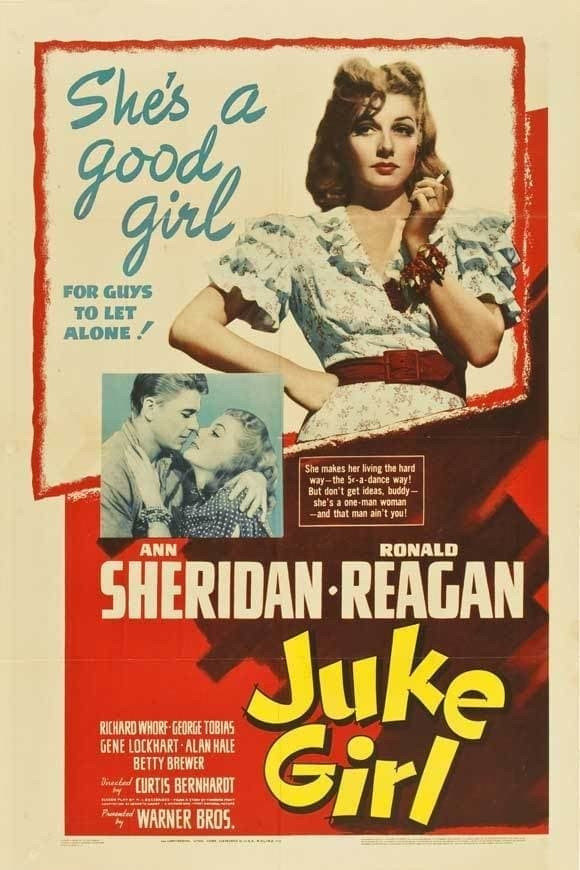
Juke Girl (1942, directed by Curtis Bernhardt)


Farm workers Steve (Ronald Reagan) and Danny (Richard Whorf) arrives in Florida, looking for work.  The whole town is controlled by the corrupt Henry Madden (Gene Lockhart) but the honest Steve would rather work for Nick (George Tobias), who treats his workers fairly.  While Steve romances Lola Mears (Ann Sheridan), who works at a “juke joint,” he also tries to organize the other workers into demanding better conditions.  When Madden frames Steve and Lola for a murder, the entire town turns against them.

This is not a bad Warner Bros. melodrama.  As with a lot of Warner Bros. films, the heroes are the poor workers who have found themselves exploited by wealthy men like Madden.  As played by Ronald Reagan, Steve is no radical firebrand.  He is just someone who wants the workers to get a fair shake and who wants to help decent bosses like Nick make a living despite the efforts of Madden to put them out of business.  As was so often the case with his movies, Reagan is an affable hero without ever actually being compelling.  Gene Lockhart is the dependably hateful villain and the cast is full of dependable character actors, including Faye Emerson, Alan Hale, Howard Da Silva, and Fuzzy Knight.

Ann Sheridan is really the main reason to Juke Girl and she’s as sexy and tough as ever.  There’s a reason why this movie was named for her character’s profession, even though its really only a minor part of the film.  Sheridan is the main attraction here and she gives a strong performance as a bad girl who is actually good underneath it all.  Her character worries that settling down with Steve will mean a lifetime of struggling to make ends meet but she sees that Steve is worth it by the end of the movie.  The town may not be worthy of either of them but Steve and Lola are meant to be together.

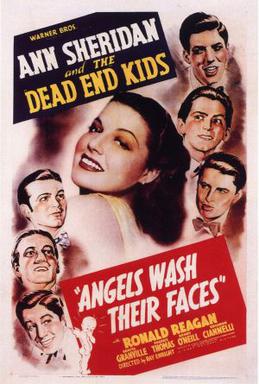
Angels Wash Their Faces (1939, directed by Ray Enright)


Gangster William Kroner (Bernard Nedell) and his henchman Martino (Eduardo Ciannelli) frame teenager Gabe Ryan (Frankie Thomas) for setting several buildings on fire.  Because Gabe has just gotten out of reform school and is a member of a local neighborhood gang, they know that no one will believe him or his sister, Joy (Ann Sheridan).

What Kroner and Martino did not count on were the Dead End Kids (Billy Halop, Bobby Jordan, Leo Gorcey, Gabriel Dell, Huntz Hall, and Benard Punsley).  They’re not going to sit by while the adults send their friend to jail.  Plus, one of their friends was killed in one of the fires.  The kids are out for revenge and sympathetic district attorney Pat Remsen (Ronald Reagan) is on their side.

As a publicity stunt, the city is holding an election for “Kid Mayor.”  The Kid Mayor gets to run the city for a week.  What could go wrong?  Billy Halop decides to run for Kid Mayor so that he can order the arrest of Kroner and then beat a confession out of him.

Angels Wash Their Faces was one of the last of the studio-made Dead End Kid films.  After this one, they would be sent down to Poverty Row and their films would be more obviously comedic.  Angels Wash Their Faces starts out as a juvenile delinquent drama, with Gabe struggling to rebuild his life and keep on the right track.  Then it becomes a goofy comedy, with Billy Halop running for mayor and unleashing vigilante justice on the bad guys.  I’m not sure that any city would actually give the “kid mayor” the power to lock people up.  Whoever came up with the idea of a kid mayor should be run out of politics.

On the positive side, Ann Sheridan is beautiful.  Future president Reagan is his usual friendly self.  On the negative side, the movie, overall, lacks the edge that made the first few Dead End Kids films memorable and the Dead End Kids themselves seem to be pretty much interchangeable.  Huntz Hall would have made a better mayor.


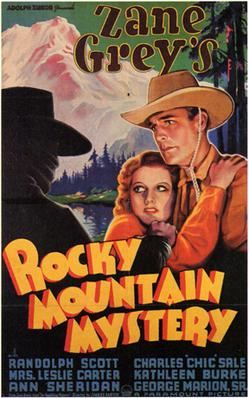
Rocky Mountain Mystery (1935, directed by Charles Barton)


Larry Sutton (Randolph Scott) is an engineer who has been sent to take over operations at a radium mine that is owned by the Ballard family.  Previously, Larry’s bother-in-law was in charge of the mine but he has disappeared and is suspected of having murdered the foreman at the Ballard Ranch.  With Jim Ballard (George F. Marion) on his deathbed and being cared for by the foreman’s wife (Caroline Dudley, credited as Mrs. Leslie Carter), Ballard’s nieces (Ann Sheridan and Kathleen Burke) and nephew (Howard Wilson) have come to the ranch to find out about their inheritance.

Soon, a cloaked figure starts to murder Ballard’s heirs, one-by-one.  Working with eccentric Deputy Sheriff Tex Murdock (Chic Sale), Larry tries to discover the identity of the killer and keep the mine from falling into the wrong hands.

Rocky Mountain Mystery is unique in that it is a Randolph Scott western that takes place in what was then modern times.  Even though both Larry and Tex prefer to ride horses, the murderer tries to escape in a car, people use phones, and the entire plot revolves around a radium mine.  The film mixes the usual western tropes of grim heroes, eccentric lawmen, and valley shoot-outs with a dark mystery that actually holds your attention while you’re watching the film.  Always ideally cast in these type of films, Randolph Scott is both tough and intelligent as Larry Sutton.  He may be a cowboy but he’s a detective too.  Scott gets good support from a cast of familiar faces.  Ann Sheridan is especially good as the niece who knows how to handle a rifle.

These B-westerns can be a mixed bag but Rocky Mountain Mystery held my attention with a plot that was actually interesting and a strong performance from Randolph Scott.  Watch it and see if you can guess who the identity of the Ballard Ranch murderer.

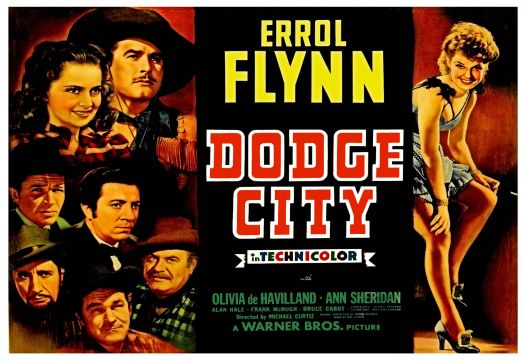
Ride the Trail to DODGE CITY with Errol & Olivia (Warner Brothers 1939)


gary loggins's avatarcracked rear viewer

1939 has been proclaimed by many to be Hollywood’s Greatest Year. I could make a case for 1947, but I won’t go there… for the moment. Be that as it may, 1939 saw the release of some true classics that have stood the test of time, including in the Western genre: DESTRY RIDES AGAIN, JESSE JAMES, STAGECOACH , and UNION PACIFIC. One that doesn’t get a lot of attention anymore is DODGE CITY, the 5th screen pairing in four years of one of Hollywood’s greatest romantic duos, heroic Errol Flynn and beautiful Olivia de Havilland.

DODGE CITY was Warner Brothers’ biggest hit of 1939, and the 6th highest grossing picture that year, beating out classics like GOODBYE MR. CHIPS, GUNGA DIN, NINOTCHKA, and THE WIZARD OF OZ. It’s a rousing actioner with plenty of romance and humor thrown in, shot in Glorious Technicolor by Warners’ ace director Michael Curtiz

View original post 530 more words

30 Days of Noir #22: Woman On The Run (dir by Norman Foster)


Like many film noirs, this 1950 film opens with a murder.

On a dark night in San Francisco, a man attempts to blackmail an unseen person called “Danny Boy” and gets shot for his trouble.  The gunshot is heard by a frustrated painter, named Frank Johnson (Ross Elliott), who is out walking his dog.  Frank sees the dead body being pushed out of a car and then catches a shadowy glimpse of the killer.  When the killer open fires on him, Frank runs for it.

Like a good citizen, Frank goes to the police but, when he learns that the victim was due to testify against a local gangster, Frank panics and vanishes.  When Inspector Ferris (Robert Keith) goes to see Frank’s wife, Eleanor (Ann Sheridan), he’s shocked to discover that Eleanor isn’t shocked by Frank’s disappearance and that she doesn’t seem to care one way or the other.  As Eleanor explains it, Frank is a notorious coward and, years ago, their once strong marriage became a loveless charade.  Frank’s vanished and Eleanor doesn’t care.

Or does she?

While it quickly becomes obvious that Eleanor is telling the truth about not knowing where Frank is, she’s not being totally honest about no longer caring about him.  For instance, when she learns that Frank has been hiding a heart condition from her, Eleanor goes to the doctor to pick up his medicine, just in case he should happen to come by the house.  Of course, it’s not always easy to get out of the house, especially now that the police are watching Eleanor.

Eleanor wants to track down Frank without involving the police and it seems like there’s only one person who is interested in helping he do that..  Played by Dennis O’Keefe, this person is a tough reporter and he says that he wants to do an exclusive story on Frank.  He offers to help Eleanor track him down and he even says that he’ll pay $1,000 for the chance to interview Frank.  The reporter and Eleanor are soon searching San Francisco, retracing Frank’s day-to-day life and discovering that Frank loved Eleanor more than she ever realized….

What’s that?  Oh, did I forget to mention the reporter’s name?

His name is Danny.

That’s right.  Eleanor is trying to find Frank so that she can save his life and working with her is the one man who wants to kill him!

Needless to say, this leads to a great deal of suspense.  On the one hand, you’re happy that Eleanor is rediscovering how much she loves Frank.  On the other hand, you spend almost the entire movie worried that Eleanor is going to lead Danny right to him.  Shot on location in San Francisco and featuring all of the dark shadows and tough dialogue that one could possibly hope to get in a film noir, Woman On The Run is an underrated suspense gem.  Full of atmosphere and steadily building suspense, Woman on the Run features a great and acerbic performance from Ann Sheridan and a genuinely exciting climax that’s set at a local amusement park.  Seriously, roller coasters are super scary!

Woman on the Run was directed by Norman Foster.  If you’ve recently watched The Other Side of the Wind on Netflix, you might recognize the name.  A longtime friend of Orson Welles, Foster played the role of Billy Boyle in Welles’s final film.

Embracing the Melodrama #9: Kings Row (dir by Sam Wood)


Kings Row“Where’s the rest of me!?” — Drake McHugh (Ronald Reagan), upon waking up to discover that his legs have been amputated, in Kings Row (1942)

It is with that line that the 1942 best picture nominee Kings Row earns its place in film history.  The formerly carefree and rich Drake had lost all of his money due to a crooked banker.  However, instead of feeling for himself, Drake got a job working for the railroad and finally started to show that he was capable of acting like a mature, responsible adult.  However, when Drake was injured in a boxcar accident, he had the misfortune to be taken to the sadistic Dr. Gordon (Charles Coburn).  Gordon felt that it was his duty to punish those who he considered to be wicked and that’s exactly how he felt about about Drake.  So, despite the fact that Drake had once been in love with Gordon’s daughter, Gordon proceeded to chop of Drake’s legs.

It’s just another day in Kings Row.

Of course, to an outsider, Kings Row looks like your typically calm and pleasant community.  But behind closed doors, this small town is full of sordid secrets.  Only those who have grown up in Kings Row understand the truth.  Only they can understand how Drake McHugh could end up losing his legs.

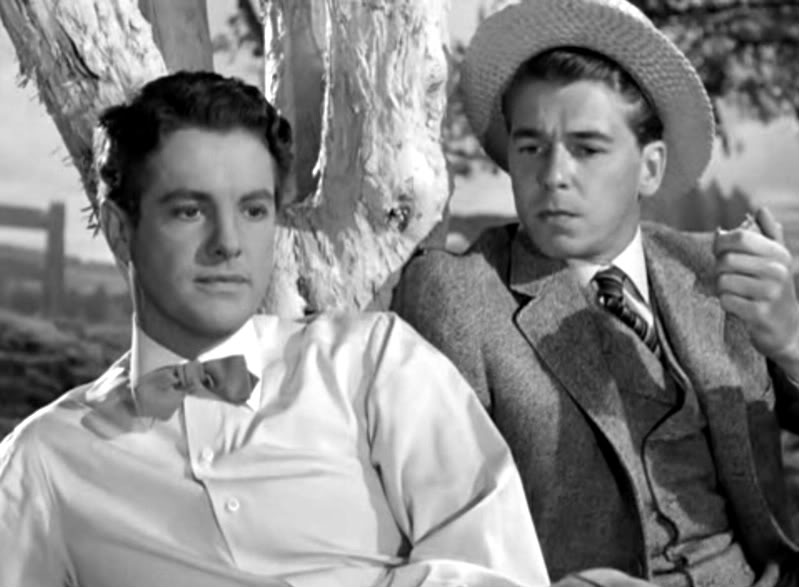
When they were both growing up at the turn of the century, Drake’s best friend was Parris Mitchell (Robert Cummings).  While Drake was pursuing Dr. Gordon’s daughter, and being loved from afar by Randy Monaghan (Ann Sheridan), Parris was studying to be a doctor under the tutelage of Kings Row’s other doctor, Dr. Alexander Tower (Claude Rains).  While Dr. Tower appeared to be a much nicer man than Dr. Gordon, he definitely had his eccentricities.  For instance, there was the wife who was reportedly confined somewhere in the house and never allowed to leave.  And then there was Dr. Tower’s daughter, Cassandra (Betty Field).  Dr. Tower was very protective of Cassandra, perhaps too protective.  How would Dr. Tower react when Parris, his best student, started to develop romantic feelings towards Cassandra?

Again, it’s just another day in Kings Row.

So, by now, it should be pretty obvious that Kings Row is one of those films that deals with big secrets in small towns.  That, of course, is a theme that was explored by films that were made long before Kings Row.  What made Kings Row unique is that it was perhaps the first film to actually portray that evil as specifically existing and thriving because of the repressive nature of a small town.  Whereas other films had featured outsiders bringing bad habits to an otherwise innocent and idyllic community (and be sure to watch Hitchcock’s Shadow of a Doubt if you want a perfect example of this), Kings Row suggested that the very nature of its setting is what led to all of the melodrama.  The film suggests that evil men like Dr. Gordon can specifically thrive in a town like Kings Row because his fellow townspeople aren’t willing to risk the placid surface of their existence by exposing him.  As such, Kings Row serves as a template for all of the sin-in-a-small-town films and TV shows that have followed.

Beyond the film’s historical importance, Kings Row holds us pretty well as entertainment.  As the film’s hero, Robert Cummings is a bit on the bland side but, fortunately, he’s surrounded by an excellent cast of character actors.  It’s a bit of a cliché to say that Claude Rains was perfectly cast because, seriously, when wasn’t Claude Rains perfectly cast?  But, in the role Dr. Tower, Claude Rains is perfectly cast.  Charles Coburn makes for a perfectly terrifying villain.  Ann Sheridan is likable and sympathetic as the woman who tries to help Drake recover after Dr. Gordon takes away his legs.  And finally, you’ve got future President Ronald Reagan in the role of Drake McHugh.  Reagan is usually dismissed a being a pretty boring actor (and I really haven’t seen enough of his films to say one way or the other) but he gave a great performance in Kings Row.

And that’s why, even beyond its historical significance, Kings Row is still a film that is more than worth watching.

KingsRowFRIENDS-1