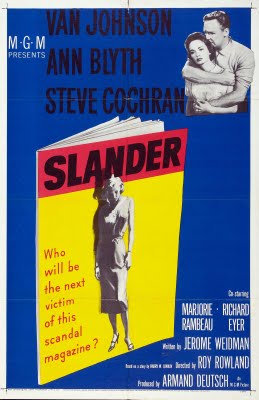
Film Review: Slander (dir by Roy Rowland)


slander poster

Slander, much like A Cry In The Night, is a B-movie from the 1950s that I recently discovered via Turner Classic Movies.  It’s appropriate that both of these relatively obscure films recently aired on TCM because both Slander and A Cry In The Night serve as interesting time capsules of the decade in which they were made.

To truly appreciate Slander, you have to know that, during the 1950s, Hollywood was terrified of magazines with names like Confidential, Exposed, and Private Affairs.  These were the magazines that claimed to tell the “sordid” truth about Hollywood.  In the 1950s, image was everything and one well-placed story that suggested that an actor or actress was a drug user, a former criminal, a communist, or — gasp! — gay, could end a career.  In the 50s, Hollywood filmmakers viewed the tabloids with the same loathing that they currently feel towards the paparazzi.  Slander was Hollywood’s attempt to expose the tabloids.  Perhaps that’s why it’s appropriate that Slander, in many ways, feels like a 50s version of Paparazzi.

Slander opens with tabloid magazine editor H.R. Manley (Steve Cochran) looking over him empire of scandal and searching for someone to destroy.  From the minute that we see Steve Cochran with his slicked back hair and hear him delivering his lines through permanently clenched teeth, we know that H.R. Manley is a bad guy.  Indeed, Cochran was best known for playing gangsters and that’s how he plays H.R. Manley.  It’s not subtle but it’s definitely entertaining.

Manley wants to destroy Mary Sawyer, an actress who is never seen but who we are assured is America’s sweetheart (or, as Manley puts it, “Everyone thinks she’s practically a nun, right?”) .  Manley becomes convinced that children’s entertainer Scott Martin (Van Johnson) has some damaging information on Mary.  When Scott refuses to betray his friend, Manley sets out to destroy Scott by revealing that, before he become America’s most beloved puppeteer, Scott served time in prison on an armed robbery conviction.

(To understand just how ludicrous this revelation is, you have to understand that Scott is played by Van Johnson who was pretty much the epitome of the fresh-faced, likeable, All-American optimist in the 50s.)

Despite the pleas of his wife (played by Ann Blyth), Scott refuses to give into blackmail.  Soon, Scott Martin is on the cover of the Manley’s magazine.  In the great tradition of the 50s social problem film, this leads to the most melodramatic conclusion possible.

Watch, in amazement, as Scott’s son reacts to the scandal of his father being a former criminal by running out in the middle of the street and getting hit by a car.

Try to look away as Manley’s drunken mother (played by Marjorie Rambeau) considers killing her own son in order to end the evil of the tabloid press.

Listen, in shock and regret, as Scott goes on television and gives an overwrought speech in which he tells us that if we’ve ever read a tabloid magazine then we are responsible for his son’s death.

Or, as one extra says when he spots Scott and his wife walking down the street, “Maybe people will stop reading those tabloids…”

It’s a bit too overwrought for its own good but I have to say, as someone who looks forward to going to the doctor specifically so she can read the copies of US Weekly that he keeps in the waiting room, I enjoyed Slander.  The film is melodramatic and totally over-the-top and, as a result, it’s also a lot of fun.  If for no other reason, the film is worth watching just for the chance to enjoy Steve Cochran’s incredibly sleazy portrayal of the apparently soulless tabloid editor.

Slander shows up on TCM occasionally but it’s also available for viewing on YouTube.  Or, if you’ve got 81 minutes to kill, you can watch it below.

Lisa Marie Goes Down On Mildred Pierce (dir. by Michael Curtiz)


A quick note: By titling this post “Lisa Marie Goes Down On Mildred Pierce” I have now not only proven that there’s no dare I will not accept but I’ve also won a small but useful sum of cash.  Never let them tell you that blogging doesn’t pay off.

Like a lot of people, I was looking forward to HBO’s remake of Mildred Pierce, featuring Kate Winslet in the role made famous by Joan Crawford.  And I hate to say it but, as hard as I’ve tried, I simply can not get into this remake.  Maybe it’s because the remake’s director, Todd Haynes, has apparently decided to use five hours to tell the exact same story that the original film told in less than two.  All I know is that the HBO version has, so far, been slow, ponderous, and ultimately a rather dull affair.

As I attempted to stay awake through the remake, I found myself wondering how the original 1945 film compared to the remake.  Fortunately, I just happened to have the original on DVD.  As well, by watching the original Mildred Pierce, I could continue my current mission to see every single film ever nominated for best picture.  (Joan Crawford won the Oscar for Best Actress for her performance as Mildred but the film itself lost Best Picture to Billy Wilder’s The Lost Weekend.)

 Mildred Pierce opens with the murder of sleazy playboy Monty Beragon (Zachary Scott).  Monty’s wife, Mildred (Joan Crawford), responds to the murder by attempting to frame her ex-business partner, the equally sleazy Wally Fay (Jack Carson).  However, the police arrest Mildred’s 1st husband, the well-meaning but really, really dull Bert (Bruce Bennett).  This leads to Mildred going to the police in an attempt to clear Bert’s name.  As the police interrogate Mildred, she tells them (and the film uses flashbacks to show us)  how she went from being a dissatisfied housewife to a succesful businesswoman to finally becoming Monty’s wife.  Through it all, Mildred is motivated by the need to take care of and spoil her manipulative daughter Veda (Ann Blyth).

Seen now, Mildred Pierce is an artifact of different time but, as a secret history nerd, I happen to love studying artifacts.  Like many of the films of the late 40s, Mildred Pierce‘s melodramatic plot serves as a reflection of a culture that, in the wake of World War II, was no longer as smugly complacent about how the world worked.  As I watched Mildred Pierce, the thing I immediately noticed was just how much the film seemed to be suspended between pre-War and post-War culture.  It’s the type of film that goes out of it’s way to acknowledge Mildred’s role as a “new woman” but, at the same time, still finds time to include numerous “comedic” scenes of various men leering at Mildred’s ankles. 

(Actually, I guess they were supposed to be staring at her legs but, since this was the 40s, this could only be represented by an occasional flash of ankle.  Personally, my ankles are okay but I like my legs better.)

Mildred Pierce is often cited as being a forerunner to feminist cinema and I have to admit I have some issues with that.  Yes, the film does acknowledge that a woman can be tough and that a woman can be a succesful businesswoman.  However, the film’s message ultimately seems to be that mothers who work will ultimately raise daughters who will become burlesque dancers and potential killers.  Mildred Pierce doesn’t so much celebrate female independence as much as it fears it.  If only Mildred had remained married to boring and predictable Bert than Veda would never have ended up as a murder suspect.

The question of ideology aside, the original Mildred Pierce remains an entertaining example of old school melodrama.  Director Michael Curtiz was one of those “craftsmen” who, in the 30s and 40s, seemed to direct hundreds of films without ever really establishing any sort of unique style of their own.  Instead, they simply used whichever style that would be most efficient towards dramatizing the script.  For Mildred Pierce, Curtiz imitated the style of a B-movie film noir.  It’s a good approach for this story even if Curtiz doesn’t seem to understand  the shadows of noir quite as well as his contemporaries Billy Wilder or Robert Siodmak.

Of course, Mildred Pierce is best known as the film that won Joan Crawford an Oscar.  I haven’t seen many of Crawford’s films (though I have seen Faye Dunaway playing her in Mommie Dearest) and I’ve got an unapologetic girlcrush on Kate Winslet but I honestly have to say that I prefer Crawford’s version of Mildred to Winslet’s.  Because, as much as I idolize Kate Winslet, she doesn’t seem to so much be playing Mildred Pierce as much as she’s observing her.  Crawford, meanwhile, sank her perfectly manicured nails into the role and pretty much refused to let go until she got her Oscar.  Crawford plays Mildred as a woman so obsessed with survival that she seems to be perfectly willing to destroy the rest of the world if that’s what it takes.  To be honest, it’s really not a great acting job but it certainly is fun to watch. Technically, Winslet gives the better performance but Crawford is a lot more entertaining.

(That said, I still love Kate and I actually would probably fall at her feet and say, “Thank you,” if I ever met her in real life because she’s really one of my heroes.  Physically, I developed early and I had to deal, at way too early an age, with a combination of a physical maturity and emotional immaturity.  By the time I was 13, I was so totally overwhelmed by the insecurity and uncertainty but then I read an interview with Kate Winslet in which she said, “I like having tits and an ass.”  And that, to be honest, was the first time I had ever come across anyone saying that it was okay to like your body.  So, anyway, the point of all that is that I love Kate Winslet.)

Crawford pretty much dominates the entire film but a few of the other performers do manage to make an impression.  As Mildred’s ex-husband, Bruce Bennett is pretty boring but the other men in Mildred’s life are well-played by Jack Carson and Zachary Scott.  Scott especially was well-cast as the type of guy that we always says we’re done with just to end up hooking up with them whenever we’re at our weakest.  As Veda, Anne Blyth gives such a driven and intense performance that you actually believe that she could be the daughter of Mildred Pierce.

In the end, Mildred Pierce isn’t really a great film but it is a lot of fun and that’s a definite improvement on the current remake.