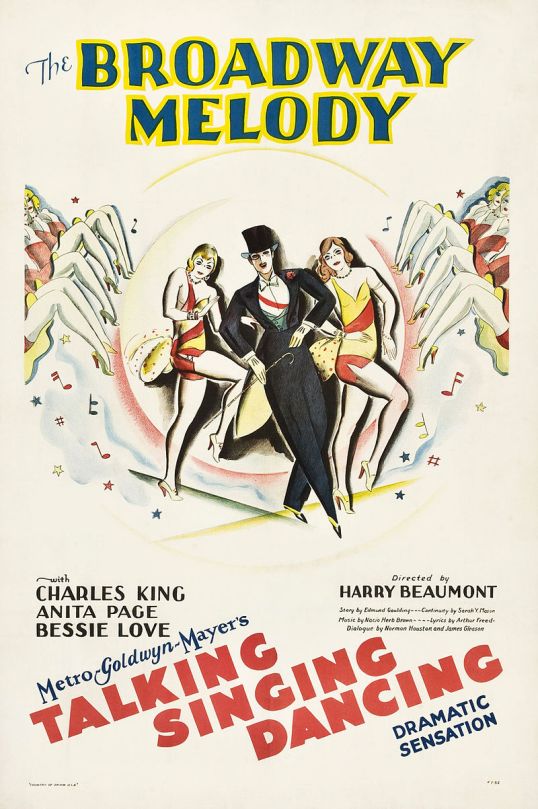
Lisa Reviews An Oscar Winner: The Broadway Melody (dir by Harry Beaumont)


broadway_melody_poster

Oh, The Broadway Melody.

Where to begin?

First released way back in 1929, The Broadway Melody is a historically significant film.  You really can’t talk about the development of film — especially sound film — without taking at least a few minutes to acknowledge The Broadway Melody.  It was the 2nd film to ever win the Oscar for Best Picture (or Best Production, as it was called back then) and it was the first sound film to win the Oscar.  (In fact, it would be 83 years before another silent film won Best Picture and it’s debatable whether or not The Artist can really be considered a silent film in the same way that Wings was silent film.)  It was also the first musical to win best picture and some people consider it to be the first true musical to have ever been produced.  It was such a huge box office success that it could be argued that The Broadway Melody is responsible for nearly every musical that followed it.

To say that The Broadway Melody tells a familiar story would be an understatement.  I’ve read a few reviews that have suggested that the clichés in this film really weren’t clichés until after The Broadway Melody was released but I’ve seen enough silent films to know that this is not the case.  It tells the story of two sisters who want to be stars.  After spending years working in vaudeville, they’ve been invited to perform in a revue that’s being produced by Francis Zanfield (Eddie Kane).

(I assume that Zanfield was meant to be a stand-in for Florence Ziegfeld, himself the subject of a later Best Picture winner, The Great Ziegfeld.)

The sisters are Hank (Bessie Love) and Queenie (Anita Page).  Hank is the driven one.  Hank is the one with the raw talent and she’s also the one who best understands how the business of entertainment works.  Her younger sister, Queenie (Anita Page), may not have Hank’s drive or quite the same level of talent but she does have beauty.  Guess who finds the most success?

Songwriter Eddie Kearns (Charles King) is engaged to marry Hank but soon, both he and Queenie find themselves falling in love.  Not wanting to hurt her sister, Queenie instead runs off with a notorious playboy named Jock Warner (Kenneth Thomson).

As I stated previously, The Broadway Melody has not aged well.  The fact that it’s one of the first sound films just allows contemporary viewers to hear the creakiness of the plot.  As impressive as sound film was to audiences in 1929, it’s obvious today that the cast and crew of The Broadway Melody were still struggling to figure out how to work with the new technology.  As a result the performances are still a bit too broad, which only serves to make the film seem even more melodramatic than it actually is.  As for the songs, they’re not particularly memorable.  I always enjoy backstage musicals but Broadway Melody is no 42nd Street.

I did appreciate the relationship between Bessie Love and Anita Page.  That was one of the few things about the film that felt real to me, perhaps because I have three older sisters.  Interestingly enough, when Anita Page died in 2008, she was the last surviving attendee of the first Academy Awards ceremony.

The Broadway Melody was named the Best Picture of 1929.  This was the year that the winners were selected by a committee and there were no official nominations.  Though the notes from the meeting indicate that there was some consideration given to awarding the Best Actress Oscar to Bessie Love, Best Picture was the only Oscar that The Broadway Melody received.
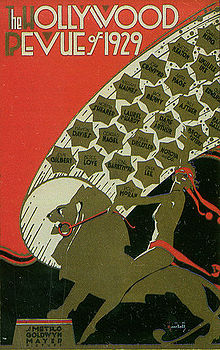
Lisa Reviews An Oscar Nominee and It’s Damn Important: The Hollywood Revue of 1929 (dir by Charles Reisner)


220px-The_Hollywood_Revue_of_1929_(film)_poster

Last night, I really needed a break from thinking about this stupid, asinine presidential election that we have coming up here in the U.S.  Fortunately, TCM provided me with one by showing The Hollywood Revue of 1929!

The Hollywood Revue of 1929 is probably one of the most obscure film to ever be nominated for best picture.  It’s a plotless collection of songs and comedy bits, all performed by actors who were under contract to MGM.  In fact, the movie might be best described as a two-hour commercial for MGM.  The message of the film seems to be: “Now that movies have sound, look what MGM can do!”

With the exception of Greta Garbo and Lon Chaney, every MGM star makes an appearance in Hollywood Revue.  Everyone sings a song and does a dance, even if some of them are better singers and dancers than others.  The revue is hosted by Conrad Nagel (who looks very dapper in a tux but still seems to be strangely uncomfortable with his hosting duties) and Jack Benny (who plays his violin and gets annoyed every time he’s interrupted by an MGM stock player).  Joan Crawford (who Nagal describes as being “one of my favorites”) sings, “Got A Feeling For You,” and she may be off-key but you can’t help but appreciate the fact that she’s doing her best.  Buster Keaton does a dance.  Laurel and Hardy perform a magic act that doesn’t go very well.  Marion Davies does a tribute to the military and I’m sure that, somewhere, William Randolph Hearst was smiling.  Chorus girls sit in the background and smile at the camera and, as someone who knows what it’s like to be in the chorus, I enjoyed watching as a few of the smarter and braver ones attempted to steal the audience’s attention away from the headliners.

At one point, Jack Benny reached into his suit jacket and revealed that a miniature version of actress Bessie Love was apparently living in the pocket.  He held Bessie in the palm of his hand and proceeded to have a conversation with her and all I could think about was the end of Mulholland Drive, when that tiny old couple cornered Naomi Watts in her apartment.  When Benny placed Bessie on the ground, she grew to normal height and sang a song.

During the second half of the film, silent screen star John Gilbert plays the balcony scene from Romeo and Juliet, opposite Norma Shearer.  First he does it in Shakespeare’s words and then he does it again in 1929 language.  Lionel Barrymore directs them.  Interestingly enough, Shearer (who was married to The Hollywood Revue‘s producer, Irving Thalberg) would later play Juliet in 1936’s Romeo and Juliet.  Barrymore, though best remembered as Mr. Potter from It’s A Wonderful Life, actually was a prominent film director in 1929 and would even invent the boom mic.  As for Gilbert, legend has it that the Hollywood Revue was the first time that audiences actually heard him speak and they were so unimpressed with his voice that his career ended.  Having now seen Gilbert speak — well, he didn’t have the greatest or sexiest voice but he still sounded better than Jean Hagen did in Singin’ In The Rain.

Speaking of Singin’ In the Rain, that song was specifically written for Hollywood Revue!  The entire cast sings it at the end of the film.

Seen today, there’s something charming about how old-fashioned and corny The Hollywood Revue is.  I imagine that some people will laugh at it but, honestly, it’s still more entertaining than that stupid live version of The Sound of Music that they put on TV two years ago.  The Hollywood Revue is basically the classic film equivalent of a high school talent show, where everyone does their best and a good deal of the charm comes from seeing how silly it all is.  If you love TCM, you’ll enjoy seeing all the Golden Age performers trying to do their best.  If you don’t love TCM, then go to Hell.

The Hollywood Revue is usually listed as being a nominee for best picture.  Actually, the truth is a little bit more complicated.  For the 2nd annual Academy Awards, there were no nominees.  Instead, the awards were determined by a select committee and only the winners were announced.  Much like the Cannes Film Festival, no film received more than one award.  Broadway Melody (which starred Hollywood Revue‘s Bessie Love) was named best picture.

However, notes were kept of the committee’s meeting and those notes indicate that Hollywood Revue was considered as a possible pick for best picture.  Hence, Hollywood Revue is considered to be a best picture nominee even though there were no official nominees that year.

Anyway, if you’re a classic film lover, keep an eye out for Hollywood Revue the next time that it shows up on TCM!