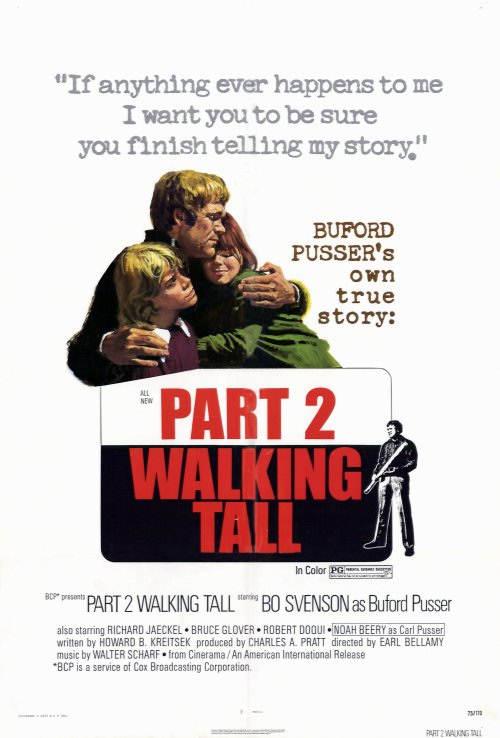
 The 1975 southern melodrama Walking Tall Part 2 opens with a voice over telling us that we’re about to see more of the true of story Sheriff Buford Pusser, the Tennessee lawman who carried a big stick, battled the Dixie Mafia, and whose wife was killed in an ambush. Pusser, we learn, died under suspicious circumstances shortly after the release of the film Walking Tall.
Mere hours before he died, Pusser had signed a contract to play himself in Walking Tall Part 2. As a result of Pusser’s car “accident,” the film’s producers were forced to cast an actor as the lawman. Now, it would have made sense to, once again, give the role to Joe Don Baker. After all, he played the role in Walking Tall and I imagine that to most audiences at that time, he was Buford Pusser. However, for whatever reason, Baker was not given the role for a second time. Instead, the role was given to Bo Svenson and, while Svenson does not necessarily do a bad job in the role, he’s still no Joe Don Baker. The difference between Baker and Svenson is the difference between someone being a redneck and someone just pretending.
The film opens almost immediately where Walking Tall ended. Terribly wounded in the ambush that took his wife’s life, Buford is in the hospital and his face is covered in bandages. Townspeople gather outside both his room and his farm and they wonder whether he’ll run for reelection as sheriff. Someone else mentions that Buford has had massive facial reconstructive surgery.
Finally, the bandages are removed and we discover that Buford has turned into Bo Svenson. Now, Svenson and Baker do have enough facial similarities that you can force yourself to believe that surgery could lead to Baker having Svenson’s features. I mean, this isn’t like Mark Ruffalo taking over the role of Bruce Banner from Edward Norton. At the same time, it’s hard not to wonder how reconstructive surgery could have led to Buford Pusser becoming a blonde or, for that matter, apparently growing by 5 inches between Walking Tall and Walking Tall Part 2.
Anyway, Buford’s out of the hospital and, of course, he’s reelected as sheriff. One thing that quickly becomes apparent is that everyone in the world totally loves Buford Pusser. I lost track of how many characters specifically walked up to Buford to tell him that he was a great man and a great sheriff. Nobody complains about Buford’s habit of ignoring civil liberties while enforcing the law. Instead, everyone cheers for him.
(And, just in case the viewer is uncomfortable with the sight of the very white Buford taunting the mostly black moonshiners that he spends the film arresting, Buford’s black deputy constantly says stuff like, “Buford, you’re my kind of sheriff!”)
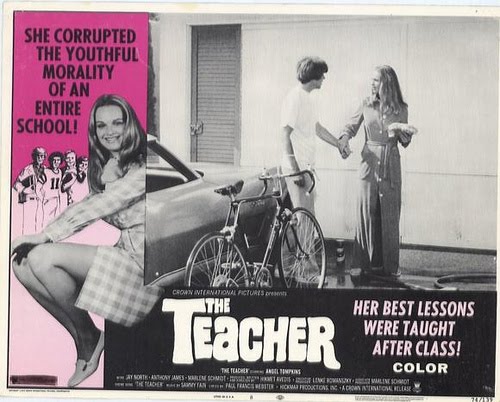
The only people who don’t like Buford are the local crime lords. They still want Buford dead so they hire a race car driver (Richard Jaeckel) to kill him. The race car driver’s girlfriend (Angel Tompkins) attempts to hit on Buford but Buford has no interest in her. Buford’s about enforcing the law and avenging his wife…
Walking Tall Part 2 is a pretty standard film. Whereas the original Walking Tall had a raw and unpredictable vibe to it, the sequel is predictable and boring. On the plus side, the film was made on location in rural Tennesee and some of the countryside is nice to look at.
As for Buford Pusser, he died before Part Two was released but the character would return in Walking Tall — The Final Chapter.

 Through the Shattered Lens