International Horror Film Review: Conquest (dir by Lucio Fulci)


First released in 1983, Conquest takes place in a mystical land, one where humans, dolphins, and sheep live alongside witches, werewolves, and zombies.  It’s a place of magic, evil, and multiple decapitations.  As the film begins, a young man named Ilias (played by Andrea Occhipanti, who also appeared in Lucio Fulci’s The New York Ripper) has just turned 18 and is heading out on his first quest.  His father gives him a magic bow, which shoots laser-like arrows.  Illias boards a raft and sails off to do whatever people do on quests.  To be honest, it’s always strange to me that people in films like this always want to go on quests.  I mean, it never turns out well.

Ilias finds himself in a land that is ruled by Ocron (Sabrina Sian), a naked witch who spends her time fondling a snake and snorting what appears to be cocaine.  During one of her drug binges, Ocron has a vision of a faceless man who carries a magic bow.  She realizes that the man could potentially destroy her and end her reign of evil.  She orders her werewolf soldiers to take a break from their usual routine of killing cave people so that they can scour the land and destroy the man with the bow.

Fortunately, Ilias has made a new friend!  Mace (Jorge Rivero) is a wandering outlaw who claims that he doesn’t care about anyone but who takes an instant liking to Ilias.  Soon, Mace and Ilias are inseparable as they walk through the countryside together, stopping only to kill a hunter and steal his food …. wait, that doesn’t sound very heroic.  Mace’s argument is that hunters themselves are not heroic but still, it really does seem more like cold-blooded murder than anything else.  It’s a weird scene but, then again, this Italian film is a weird movie.

Eventually, Ilias decides that his destiny is to destroy Orcan.  Though Mace doesn’t think that it’s a good idea to cross the most powerful witch in this strange world, he does agree to escort Ilias to the seashore.  (One gets the feeling that if Conquest had been released more recently, as opposed to 1983, Ilias and Mace would have launched a thousand ships.)  But things get complicated on the way, with both Ilias and Mace going through several different changes of heart.  Of course, they also run into zombies, underground monsters, and super-intelligent dolphins….

Conquest was directed by Lucio Fulci, the Italian filmmaker who was responsible for some of the most visually striking and narratively incoherent horror films ever made.  With Zombi 2, Fulci launched the Italian zombie boom.  With The Beyond trilogy, Fulci directed three of the most intriguingly surreal horror films ever made.  With The New York Ripper and Don’t Torture A Duckling, Fulci took the giallo genre to its logical and most disturbing conclusion.  Fulci made blood-filled films, ones in which the overall plot was never as important as the set pieces.  That’s certainly the case of Conquest, which pays homage to the old sword-and-sorcery films while also including zombies and a few rather graphic torture scenes.  (The scene in which one person is literally split in half is shocking, even by the standards of Fulci.)  And yet there’s an odd earnestness to Conquest, as both Ilias and eventually Mace are horrified by Ocran’s cruelty and willing to risk their lives to put an end to it.  The friendship between Ilias and Mace comes out of nowhere but the film takes it seriously and, as a result, the final scenes are far more emotional than you might expect from a director of Fulci’s reputation.  It’s tempting to consider Conquest as a bit of a prequel to The Beyond trilogy.  Perhaps we’re looking into the Beyond itself and discovering that, even in that disturbing world, there are people who are willing to risk their lives to battle evil.

Conquest was not one Fulci’s box office successes, which is a bit of a shame as it really does seem to be a film that he put his heart into.  Unfortunately, Conquest was followed by the controversy surrounding The New York Ripper and the critical failure of Manhattan Baby.  Fulci’s career went into decline and he soon found himself directing stuff like Aenigma.  It’s a shame but I think many of Fulci’s so-called failures are ready to be rediscovered and reappraised.  That’s certainly the case with Conquest.

The TSL’s Grindhouse: Bolero (dir by John Derek)


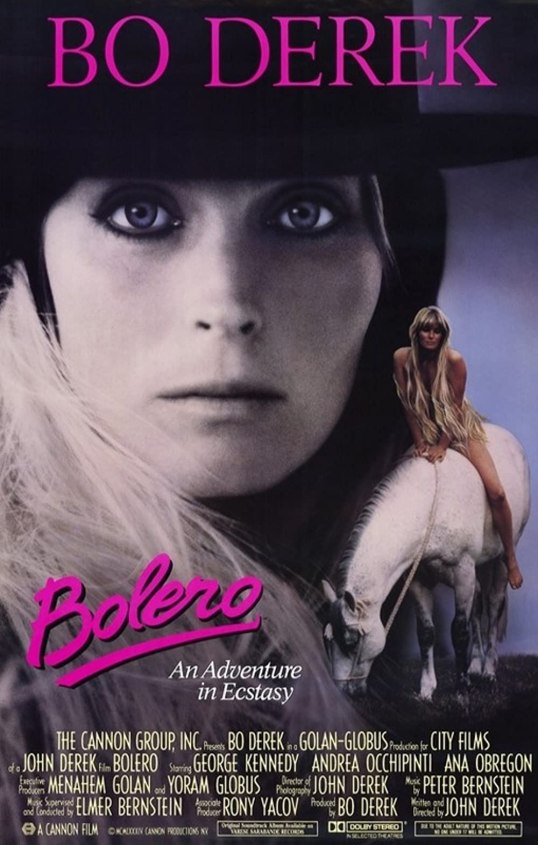
The 1984 film, Bolero, tells the story of  Ayre “Mac” MacGillvary (Bo Derek) and her best friend, Catalina (Anna Obregon).  They’re young, they’re rich, they’ve just graduated from college, and, despite the fact that they both appears to be in their early 40s, they’re determined to lose their virginities to the most perfect lovers that they can find.

Because the film is taking place in the 1920, Mac and Catalina first travel to the Middle East in hope of finding a Rudolph Valentino-style sheik.  Accompanying them is Mac’s chauffeur and protector, Cotton (a clearly embarrassed George Kennedy).  Though Mac does manage to find a sheik (played by Greg Benson), her efforts to lose her virginity to him prove to be a failure.  Though the Sheik is willing, he indulges a bit too much with his hookah and ends up passing out right before the consummating the act.

Well, if a sheik can’t do it, how about a bullfighter?  Mac and Catalina leave the Middle East for Spain and it’s there that Mac catches the eyes of Angel (Andrea Occhipinti), a celebrated bullfighter.  Mac decides that Angel will be the one to take her virginity but it turns out that, once again, nothing as is easy as it should be.  It turns out that Angel already has a lover and he’s been with her since she was a teenager.  And a 14 year-old Gypsy named Paloma (played by Olivia d’Abo) has already decided that she is going to be Angel’s next lover, which is incredibly icky even before the film makes it even ickier,  

While Mac is trying to seduce Angel, Catalina is trying to seduce a Scottish attorney named Robert Stewart (Ian Cochrane).  “What do you wear under your skirt?” Catalina asks.  “It’s a kilt!” Stewart yells because he’s Scottish.  Anyway, Catalina eventually does get an answer to her question so yay Catalina!

As for Mac, she does eventually manage to win Angel’s attention but then …. OUCH!  Angel gets gored by a bull and yes, he gets wounded exactly where you think that he gets wounded.  Suddenly, Angel can no longer get it up but fear not.  “We’re going to make that thing work,” Mac says, before she then takes up bullfighting herself.  It all eventually leads to a scene that makes heavy use of dry ice and a neon light that misspells the word ecstasy. 

Bolero is one of those sex-obsessed films that tries so hard to be erotic that it actually goes in the opposite direction and becomes so firmly anti-erotic that one gets the feeling it could be used as a torture device in a George Orwell novel.  “The Anti-Sex League sentences you to watch Bolero!”  A huge part of the problem is that, even though everyone in the film is certainly attractive, there’s still next to no chemistry between Bo Derek and any of her potential lovers.  The film was directed by Bo’s then-husband, John Derek and, somewhat perversely, John continually films her in the least flattering ways possible.  John also tries to introduce some humor into the film — at one point, it turns into a silent film, complete with title cards — but it all falls flat.  Finally, the gored bullfighter is played by a very handsome Italian actor named Andrea Occhipinti who I immediately recognized as being the same actor who played the killer in Lucio Fulci’s The New York Ripper.  Though it was a bit unfair to Occhipinti (whose likable blandness was exactly what made him such a subversive choice to play the killer in Fulci’s film), I was worried every moment that Mac was left alone with him.  (Occhipinti is now one of Italy’s most respected film producers.) 

Produced by Cannon Films, Bolero was apparently a huge flop when it was released.  Bolero was considered to be so bad that it led to MGM announcing that they would no longer help to distribute any other Cannon Films.  I can’t really blame MGM.  Even when viewed decades later, Bolero is a dull romp that’s fit only for the Anti-Sex League.

Review: A Blade In The Dark (dir. by Lamberto Bava)


If you’re lucky, you remember your first time.  I know I do.  I was 17 years old and I was trying very hard to convince myself that I was an adult.  It had been less than a year since I was first diagnosed as being bipolar and I was still struggling to understand what that truly meant about me.  My days were spent wondering if I was crazy or if I was just misunderstood.  In the end, I just desperately wanted to be loved.  As for the event itself, I remember being more than a little anxious and, once things really got going, pleasantly surprised.  However, the main thing I remember is thinking to myself, “Wow, that’s a lot of blood.”

Yes, everyone should remember the experience of seeing their first giallo as clearly as I do.

Over the years, I’ve read a lot of different definitions of what a giallo is and none of them have really managed to capture what makes this genre of film so strangely compelling.  The simplest and quickest definition is that a giallo is an Italian thriller.  Typically (though not always), the film features a protagonist who witnesses and then proceeds to investigate a series of increasingly gory murders.  Often times, solving the murders means uncovering some dark and sordid sin of the past and, just as often, the film’s “hero” turns out to be as damaged a soul as the killer.  However, the plot is rarely the important in a giallo film.  What’s important is how the director chooses to tell the story.  When I watch the classic giallo films of the 60s and 70s, I get a sense of a small group of directors who were all competing to say who could come up with the most startling camera angle, who could pull off the bloodiest death scene, and who could pull off the most audacious tracking shot.  Giallo is a uniquely Italian genre of film, an unapologetic opera of mayhem and murder.  For the most part, the films seems to have a polarizing effect on viewers.  You either get them or you don’t.  (From my own personal experience, I think it helps if you come from a Catholic background but, again, that’s just my opinion.)

My first giallo was Lamberto Bava’s 1983 shocker, A Blade in the Dark.

The protagonist of A Blade in the Dark is Bruno, a popular young composer who has been hired to score a horror movie.  The film’s director has arranged for Bruno to stay in an isolated villa while he works.  Every night, Bruno sits in front of his piano and searches for the perfect note.  Occasionally, his actress girlfriend calls him from the other side of Italy and demands to know if he’s cheating on her.  He’s not despite the fact that he has two attractive neighbors who tend to come by at the most inconvenient of times and who make cryptic comments about the woman who lived at the villa before him.  Bruno would probably be even more frustrated if he knew that, on most night, he’s being watched by someone outside hiding outside the villa.  One night, Bruno listens to the movie’s soundtrack and hears a menacing voice whispering on the recording.  Meanwhile, the mysterious watcher begins to brutally murder anyone who has any contact with Bruno.

(Despite all these distractions, Bruno continues to vainly try to create the perfect score.  Much like Kubrick’s Shining, A Blade in the Dark is as much about the horrors of the artistic process as it is about anything else.)

As it typical of most giallo films, the plot of A Blade in the Dark makes less and less sense the more that you think about it.  However, this is a part of the genre’s charm.  One doesn’t watch a giallo for the story.  One watches to see how the story is told and that is where A Blade in the Dark triumphs.  Wisely, director Lamberto Bava keeps things simple.  Working with a small cast and one main set, Bava fills every scene with a palpable sense of dread and uneasiness.  As Bruno finds himself growing more and more paranoid, so does the audience.  Watching the movie, you feel that anyone on the screen could die at any moment and, for the most part, that turns out to be the case.

A Blade in the Dark is probably best known for the brutality of its violence.  Even after repeat viewings, the murders are still, at times, difficult to watch. In the most infamous of them, one of Bruno’s neighbors is killed while washing her hair over a sink.  The violence here is so sudden and so much blood is spilled (and spurted) that its easy to miss just how well-directed and effectively shocking this scene really is.  In this current age of generic cinematic mayhem, the violence of A Blade In The Dark still packs a powerful punch.

(The scene is so effective that, for quite some time after seeing it, I actually got uneasy whenever I found myself standing in front of a sink.  A Blade in the Dark does for the bathroom sink what Psycho did for showers.)

Bruno is played by Andrea Occhipinti, an actor whose non-threatening, Jonas Brotheresque handsome earnestness was used to great effect by Lucio Fulci in the earlier New York Ripper.  Since I’ve only seen the dubbed version, it’s difficult to judge his performance here.  He’s never quite believable as a great composer though you could easily imagine him writing whatever syrupy ballad that James Cameron chooses to play at the end of his next blockbuster.  However, Occhipinti does have a likable enough presence that you don’t want to see him killed and that’s all that the film really requires anyway.

A far more interesting presence in the cast is that of Michele Soavi.  Soavi plays Bruno’s landlord and, even with limited screen time and even with his dialogue dubbed into English, Soavi is such a charismatic presence that he dominates every scene that he’s in.  Before being cast, Soavi was already serving as Bava’s assistant director on Blade in the Dark and, of course, he later went on to have a significant directorial career of his own.  Soavi is perhaps best known for directing one of the greatest films of the 1990s, Dellamorte Dellamore.

While Soavi would go on to great acclaim, the same cannot be said of this movie’s director.  Among fans of Italian horror, it’s become somewhat fashionable to be dismissive of Lamberto Bava.  It’s often pointed out that the majority of his filmography is actually made up of cheap knock-offs that he made for Italian television (and, admittedly, A Blade in the Dark started life as a proposed miniseries).  Most of the credit for Bava’s most succesful film — Demons — is usually given to producer Dario Argento.  Perhaps the most common complaint made about Lamberto Bava is that he isn’t his father, Mario Bava.  With films like Blood and Black Lace, Lisa and the Devil, Black Sabbath, and Bay of Blood, Mario Bava developed a deserved reputation for being the father of Italian horror and Lamberto is often accused of simply trading in on his father’s reputation.

It’s true that Lamberto Bava is no Mario Bava but then again, who is?  Blade in the Dark was Lamberto’s second film (as a director) and its a tightly constructed, quickly paced thriller.  Bava makes good use of the vila and creates a truly claustrophobic atmosphere that keeps the viewer on edge throughout the entire film.  Even when viewed nearly three decades after they were filmed, the film’s murders are still shocking in both their violence and their intensity.  There’s a passion and attention-to-detail in Bava’s direction here that, sadly, is definitely lacking in his later films.  If most of Bava’s film seem to be the work of a disinterested craftsman, A Blade in the Dark is the  work of an artist.