Cleaning Out The DVR #33: Heaven Can Wait (dir by Ernst Lubitsch)


(For those following at home, Lisa is attempting to clean out her DVR by watching and reviewing 38 films by the end of today!!!!!  Will she make it?  Keep following the site to find out!)
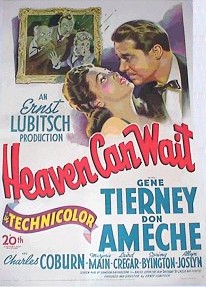
Heavencwaitposter

The 1943 film Heaven Can Wait opens with a 70 year-old man named Henry Van Cleve (Don Ameche) stepping into an opulent drawing room and having a conversation with a refined but menacing man known as His Excellency (Laird Cregar).  From their conversation, it quickly becomes obvious that Henry has recently died and His Excellency is in charge of Hell.  Most people who come to see His Excellency do so because they want to argue that they do not belong in Hell and they usually end up falling through a convenient trap door.  However, Henry is there to argue that, after living an enjoyable but dissolute life, he belongs in Hell.

Henry tells the story of his life.  He tells how he was born into great wealth and influenced by his down-to-Earth grandfather (Charles Coburn).  As a young man, he spent most of his time chasing after showgirls bur eventually, he met the beautiful and kind-hearted Martha (Gene Tierney).  He immediately fell in love with Martha but, unfortunately for him, she was engaged to his cousin (Allyn Joslyn).  Henry, however, used his considerable charm to convince her to elope with him.

(It helps, of course, that Henry’s cousin was totally and completely obnoxious, in the way that rival suitors often are in films like this.)

And, for 25 years, Henry was happy with Martha.  It took him a while to settle down and, at one point, Martha even left him as a result of his affairs.  However, they always got back together and Henry eventually did settle down, even going so far as to prevent his son from running off with a showgirl of his own.  It was only after Martha herself died that Henry, who always felt he didn’t deserve her love, returned to his old ways.

And, Henry argues, it’s because he was unworthy of his wife that he deserves to spend an eternity in Hell.  Does His Excellency agree?

Well, it would certainly be a depressing movie if he did.

One of the great things about TCM’s 31 Days of Oscar is that it gave me a chance to discover several films from director Ernst Lubitsch, films like The Smiling Lieutenant, The Love Parade, Ninotchka, and Heaven Can Wait.  Of those four Lubitsch films, Heaven Can Wait is probably the least substantial but it’s still an undeniably entertaining and nicely romantic film.  This is one of those films that you watch because the sets look wonderful, the costumes are to die for, and the performers are all pleasant to watch.  It’s pure entertainment, a crowd-pleaser in the best sense of the word.

In fact, tt was such a crowd-pleaser that it was nominated for best picture of the year.  However, it lost to the ultimate crowd-pleaser, Casablanca.
Shattered Politics #6: The Great McGinty (dir by Preston Sturges)


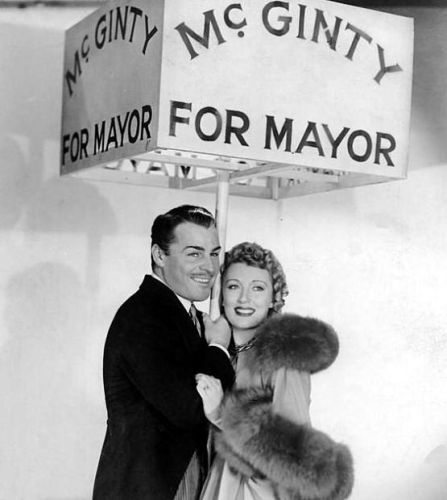
donlevy-angelus-mcginty_opt-1

 “This is the story of two men who met in a banana republic. One of them never did anything dishonest in his life except for one crazy minute. The other never did anything honest in his life except for one crazy minute. They both had to get out of the country.”

— The Great McGinty (1940)

For today’s final entry in Shattered Politics, we take a look at how elections are won north of the Mason-Dixon Line.

The Great McGinty begins in a bar located in an unnamed country in South America.  Tommy Thompson (Louis John Heydt) attempts to shoot himself but is stopped by philosophical bartender Dan McGinty (Brian Donlevy).  Tommy explains that he can never return to the United States because, in one moment of weakness, he stole some money.  McGinty replies that he can never return to the U.S. either.  Why?  “I was the Governor of a state, baby…” McGinty replies.

In flashback, McGinty explains how he came to power.  One day, while standing in a soup line, the homeless McGinty was approached by a local political operative (William Demarest) and offered $2.00 on the condition that he vote for a certain mayoral candidate.  McGinty agrees and then proceeds to vote 37 times.  When McGinty demands $74.00 for his efforts, he’s taken to the headquarters of the Boss (Akim Tamiroff, giving a wonderfully comedic performance).

The Boss is impressed with McGinty and, despite the fact that the two of them are constantly getting into fights with each other, he employs McGinty as a collector.  Eventually, he also arranges for McGinty to be elected alderman and then, running as a reform candidate, mayor.

Along the way, the Boss arranges for McGinty to get married.  McGinty’s wife (Muriel Angelus) originally has little respect for McGinty but, after they marry, she starts to realize that McGinty is not quite as bad as she originally assumed.  Eventually, she’s even impressed enough that she even stops seeing her boyfriend, George (Allyn Joslyn).

Meanwhile, the Boss arranges for McGinty to be elected governor.  However, once McGinty has won the election, he declares that he’s going to run an honest administration.  How does that turn out?  Well, it should be noted that the film opens with McGinty tending bar in South America…

The Great McGinty is a lot of fun and it’s interesting to think that this unapologetically sardonic look at American politics came out just a year after Mr. Smith Goes To Washington.  Imagine if Mr. Smith Goes To Washington had been told from the point of view of Edward Arnold’s Boss Taylor and you can guess what The Great McGinty is like.

If nothing else, The Great McGinty serves as a great reminder that political cynicism existed long before any of us cast our first vote.

http://www.youtube.com/watch?v=Nari4b23l6A

Shattered Politics #2: They Won’t Forget (dir by Mervyn LeRoy)


they_won_t_forget-582401011-large

The title of the 1937 film They Won’t Forget works on many levels.

It describes the reaction of a small Southern town, following the brutal murder of teenager Mary Clay (played, in her film debut, by Lana Turner).  The town won’t forget Mary and they won’t forget the terror caused by her murder.  They also won’t forget that local teacher Robert Hale (Edward Norris) was accused of the crime.

The district attorney, Andrew Griffin (Claude Rains), hopes that the people of his state won’t forget his efforts to see Griffin convicted of that crime.  Griffin wants to be elected to the U.S. Senate and he knows that the high profile case could be just what his career needs.

The Governor (Paul Everton) knows that, if he steps into the case and acts on his suspicion that Hale is innocent, the voters of his state will never forget.  And they certainly won’t be willing to forgive.

And, on a larger level, the title lets us know that the South and the North will never forget the Civil War and the conflict between the two regions.  The film opens with three elderly veterans of the Confederate Army, preparing to march in the town’s annual Confederate Memorial Day parade and admitting to each other that, after all these years, it’s difficult to remember much about the war other than the fact that they’re proud that they fought in it.

It’s while the rest of the town is busy watching Griffin and the governor ride in the parade that Mary Clay is murdered.  It’s easy to assume that Hale was the murderer because Hale was one of the few townspeople not to go to the parade.  You see, Hale is originally from New York City.  When he’s accused of murder, it’s equally easy for Griffin and tabloid reporter William A. Brock (Allyn Joslyn) to convince the town people to blame this Northern intruder for both the murder of Mary Clay and, symbolically, for all of the post-Civil War struggles of the South itself.

Meanwhile, up North, Hale is seen as a victim of the South’s intolerance.  A high-profile lawyer (Otto Kruger) is sent down to defend Hale but, as quickly becomes clear, everyone involved in the case is more interested in refighting the Civil War than determining the guilt or innocence of Andrew Hale.

They Won’t Forget is a hard-hitting and fascinating look at politics, justice, and paranoia.  It’s all the more interesting because it’s based on a true story.  In 1913, a 13 year-old girl named Mary Phagan was murdered in Atlanta.  Leo Frank was accused and convicted of the murder.  (In Frank’s case, he was born in Texas but was also Jewish and had previously lived in New York before moving to Atlanta, all of which made him suspicious in the eyes of many.)  On the word of a night watchmen, who many believe was the actual murderer of Mary Phagan, Leo Frank was convicted and sentence to death.  After spending days reviewing all of the evidence and growing convinced that Frank had been wrongly convicted, Georgia’s governor committed an act of political suicide by commuting Frank’s sentence to life imprisonment.  Leo Frank was subsequently lynched and the man who had prosecuted the case against him was subsequently elected governor.

Well-acted and intelligently directed, They Won’t Forget is probably one of the best films of which few people have heard.  Fortunately, it shows up fairly regularly on TCM and, the next time that it does, be sure to watch.  It’s a great film that you won’t easily forget.