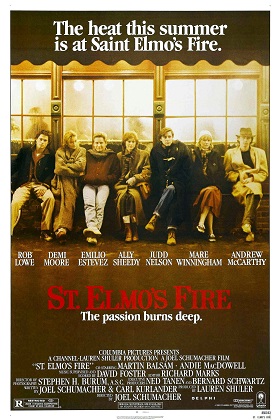
Embracing the Melodrama Part II #73: St. Elmo’s Fire (dir by Joel Schumacher)


St_elmo's_fire

Oh my God!  Aren’t rich, white people just like the worst!?

Actually, usually I would never say something like that.  I usually find class warfare to be tedious and I personally think poor people can be just as annoying as rich people.  I had no interest in the whole Occupy Wall Street thing and I once referred to V For Vendetta as being V For Vapid.

No, I may not be much of a class warrior but then again, that may be because I never met any of the characters at the center of the 1985 film St. Elmo’s Fire.  Seriously, if anything could turn me into a slogan-spouting, window-smashing revolutionary, it would be having to deal with any of the self-centered, entitled characters in St. Elmo’s Fire.

St. Elmo’s Fire is about a group of seven friends, three of whom are played by actors who co-starred in The Breakfast Club.  These friends all met at and are recent graduates from Georgetown University.  St. Elmo’s Fire follows them as they laugh, love, drink, do drugs, and try to figure out what they want to do with the rest of their lives.

For instance, there’s Billy (Rob Lowe), who has big hair and wears one dangling earring.  Billy was in a fraternity and spends most of the movie wishing that he still was.  Billy also plays the saxophone and he has a wife and a kid who he has pretty much abandoned … well, you know what?  I like Rob Lowe.  He seems like a fun guy and his DirectTV commercials were all classics but oh my God, does he ever give a bad performance in St. Elmo’s Fire.  Some of it is because Billy is not a very likable character.  He’s supposed to be the rough-around-the-edges, secretly sensitive rebel type but ultimately, he just comes across as being a loser.

And then there’s Jules (Demi Moore), who does too much cocaine and, as a result, finds herself fearing that she’s on the verge of being sold into a sexual slavery.  Jules doesn’t get to do much other than be rescued by the other characters.  Fortunately, when it looks like the group is drifting apart, Jules attempts to commit suicide and brings everyone back together.  Way to be a plot device, Jules!

Wendy (Mare Winningham) is the sweet but insecure virgin who has a crush on Billy.  Wendy works as a social worker and ends up getting insulted by the very people that she’s trying to help.  Winningham gives one of the film’s better performances but you can’t help but feel that Wendy deserves better friends.

Speaking of good performances, Andrew McCarthy also gives a pretty good one.  McCarthy plays Kevin Dolenz, the idealistic writer who everyone is convinced is gay because he hasn’t had sex in 2 years.  However, Kevin is actually in love with his best friend’s girlfriend.  As written, Kevin runs the risk of coming across as being insufferably moralistic but McCarthy gives a likable performance.  He turns Kevin into the nice guy that we all want to know.

And then there’s the Breakfast Club alumni.

Alec Newberry (Judd Nelson) was the vice-president of the Georgetown Democrats but now, because it pays better, he’s taken a job working for a Republican senator.  Alec’s girlfriend is Leslie (Ally Sheedy).  Alec obsessively cheats on Leslie, claiming that he can’t be loyal to her unless she’s willing to marry him.  The group of friends is largely centered around Alec and Leslie though it’s never really clear why.  Alec and Leslie are boring characters and, as a result, they’re a boring couple.

And then there’s Kirby (Emilio Estevez).  Estevez gives a likable performance but he often seems to be appearing in a different movie from everyone else.  Kirby is working on his law degree and he’s in love with a hospital intern named Dale (Andie MacDowell).  Unfortunately, Dale isn’t as interested in Kirby as he is in her so Kirby responds by stalking her and trying to change her mind.  There’s an earnestness and sincerity to Kirby that makes you like him, even if his behavior is actually rather creepy.

As for the film itself — well, it’s directed by Joel Schumacher and there’s a reason why Schmacher has the reputation that he does.  As a director, Schumacher is good at gathering together an attractive cast but he has close to no idea how to tell a compelling story.  St. Elmo’s Fire plods along, dutifully telling its story but providing little insight or surprise.

If you’ve read some of my previous reviews, you’re probably expecting this to be the point where I argue that St. Elmo’s Fire works as a time capsule.  But, honestly, this film doesn’t have enough insight to really work as a time capsule.  I mean, if you love 80s hair and 80s fashion, you might enjoy St. Elmo’s Fire but, then again, you could always just do a google image search and have the same basic experience.
Embracing the Melodrama Part II #69: Bad Boys (dir by Rick Rosenthal)


Bad_Boys_(1983_film_poster)First off, I am not about to review the Michael Bay film where Will Smith and Martin Lawrence shoot people and blow things up.  Instead, this Bad Boys is a film from 1983 where Sean Penn doesn’t shoot anyone but that’s mostly because he can’t get his hands on a gun.  And, at one point, a radio does blow up.  So, perhaps this Bad Boys has more in common with the Michael Bay Bad Boys than I originally realized.

Anyway, Bad Boys is about Mick O’Brien (Sean Penn), who is a 16 year-old criminal from Chicago.  One night, when one of his crimes goes wrong, Mick’s best friend (Alan Ruck) is killed and Mick accidentally runs over the brother of rival gang leader, Paco (Esai Morales).  Mick is sent to juvenile detention where he and his sociopathic cellmate, Horowitz (Eric Gurry), team up to overthrow the two “leaders” of their block, Viking (Clancy Brown, with scary blonde hair) and Tweety (Robert Lee Rush).  Meanwhile, Paco is arrested for raping Mick’s girlfriend, JC (Ally Sheedy), and soon finds himself living on the same cell block as Mick.

And it all leads to … violence!

(In the movies, everything leads to violence.)

Bad Boys is one of those films that seems to show up on cable at the most random of times.  I’ve never quite understood why because it’s not like Bad Boys is a particularly great film.  It’s hard to see anything about this film that would lead a programmer to say, “Let’s schedule 100 airings of Bad Boys!”  If anything, it’s the epitome of a good but not that good film.  On the one hand, you have to appreciate a film that attempts to take a serious look at both juvenile crime and the true life consequences of tossing every “lawbreaker” into a cell and locking the door.  People fetishize the idea of punishing criminals but they rarely consider whether those punishments actually accomplish anything beyond satisfying society’s obsessive need for revenge.  (And it’s interesting to note that the problems of 1983 are not that much different from the problems of 2015.)  On the other hand, Bad Boys is way too long, heavy-handed, and repetitive.  This was one of Sean Penn’s first roles and, much like the film itself, he’s good without being that good.  Watching his performance, you get the feeling that James Dean would say, “Nice try.”

However, the film is saved by two actor.  First off, there’s Clancy Brown as the stupid but intimidating Viking.  With his bad skin, blonde hair, and a permanent snarl on his face, Brown makes Viking into a character who is both ludicrous and scary.  And then there’s Eric Gurry as the small and demonic Horowitz.  According to his imdb page, Gurry long ago retired from acting but anybody who sees Bad Boys will never forget him.

Back to School #39: The Breakfast Club (dir by John Hughes)


breakfast-club-2

Dear Mr Vernon,

We accept the fact that we had to sacrifice a whole saturday in detention for whatever it was we did wrong. But we think you’re crazy to make us write an essay telling you who we think we are. You see us as you want to see us – in the simplest terms, in the most convenient definitions. But what we found out is that each one of us is a brain, and an athlete and a basket case, a princess and a criminal.

Does that answer your question?

Sincerely yours,

The Breakfast Club.

— Brian’s essay from The Breakfast Club (1985)

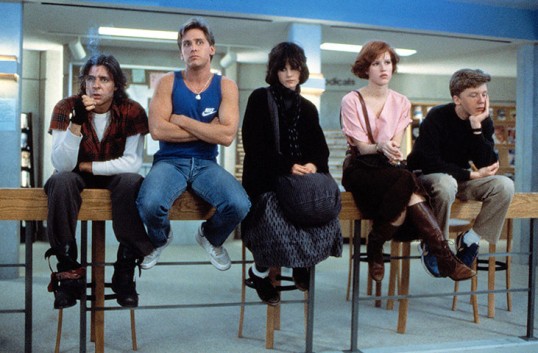
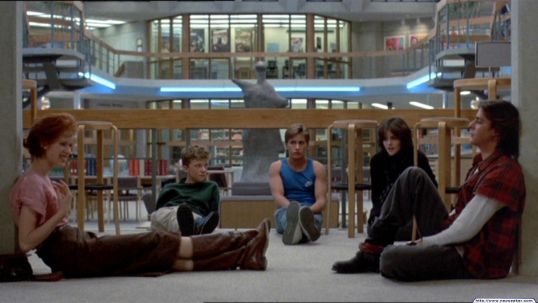
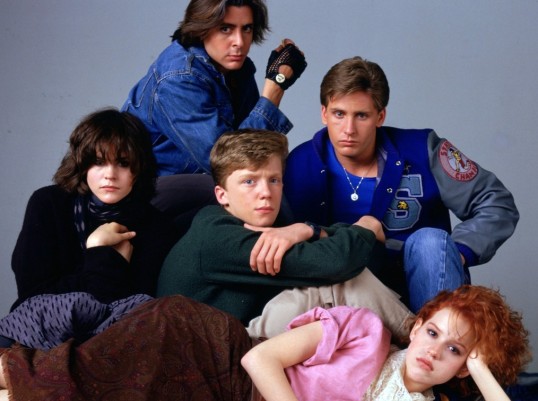
 That’s one thing that has always bothered me about The Breakfast Club.  The film, of course, is famous for being about five different high school students who are forced to spend a Saturday in detention with each other.  Over the course of the day, they start off as antagonists, separated by their own preconceived notions of who they are.  But, as the day progresses, they talk and they bond and they discover that they all have more in common than they might think.  And, at the end of the film, “basket case” Allison (Ally Sheedy) pairs off with “athlete” Andy (Emilio Estevez) and “criminal” Bender (Judd Nelson) pairs off with “princess” Claire (Molly Ringwald).  And while Claire is busy giving Allison a makeover and Bender is thinking about how iconic he’ll look when he raises his fist while leaving the school, “brain” Brian gets to write everyone’s essay.

Originally, all five of them were supposed to spend their time in detention writing individual essays about how they’re going to be better students and citizens.  But, in the end, only one essay is turned in and Brian is the one who writes it.  It’s always seemed a bit unfair to me that, while everyone else was getting to reveal a new side of his or herself, Brian was basically doing everyone’s schoolwork.  I know it can be argued that this shows that the other students finally appreciate Brian’s intelligence but everyone already knew he was smart.  In the end, Brian is the one who articulated what they all discovered during that Saturday detention but he also seems to be the one who gained the least from the experience.

The-Breakfast-Club-1985-001

But, at heart, The Breakfast Club is a deeply ambiguous movie.  That’s one reason why, despite the fact that it was initially released the same year that I was born, the film still feels relevant today and why it remains one of the most popular high school films ever made.  Everyone can relate to at least one of the five students and I imagine that when most people watch it, they wonder how they would react to an aggressive character like John Bender or how they would handle the horrific story that Andy tells when asked what he did to get sentenced to detention.  And, at the end of the film, everyone wonders if any of the new friendships and relationships would actually last longer than a weekend.  When Bender asks Claire how she’s going to act if Brian approaches her on Monday, we all know what will probably actually happen if he does.  At the end of the film, you’re happy that they got that Saturday together because you know that, once Monday comes, it’s going to be like it never happened.

the_breakfast_club_2

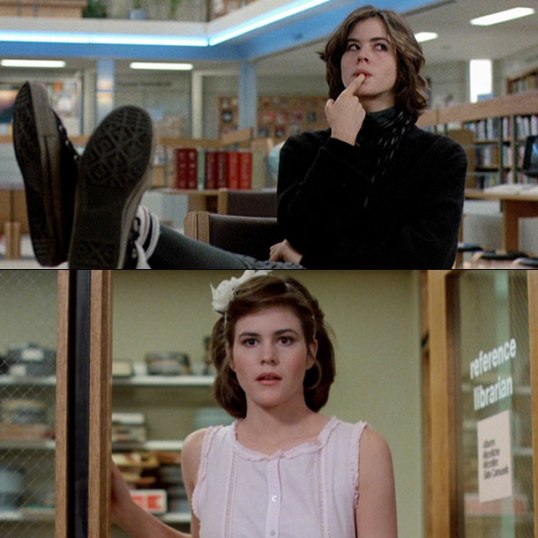
I’ve watched The Breakfast Club a handful of times.  Whether I relate the most to Claire or to Allison usually depends on my mood. I think that a lot of people want to relate to Allison because, for much of the movie, Claire is unapologetically selfish and spoiled.  But, if we’re honest with ourselves, we have to admit that we’re all a lot more like Claire than any of us want to admit.

It’s also easy to relate to Allison because she’s not really a very well-drawn character.  While the other characters all come from an easily identifiable group, Allison is just there.  She’s a collection of strange quirks that don’t always have a clear motivation and, in the end, the only reason Allison works as a character is because Sheedy does such a good job playing her.  At the end of the film, Claire gives Allison a makeover and I have to admit that it always kind of breaks my heart to see how Allison goes from being strange to being very conventional.

Makeover

(In Susannah Gora’s excellent book You Couldn’t Ignore Me If You Tried, Sheedy is quoted as saying that she didn’t feel very happy about it either.  According to her — and she’s correct — the only thing that really redeems this scene is the fact that Allison doesn’t quite pull off her new look.  She’s still a little awkward and you realize that she may have just been humoring Claire.)

As for the males, Anthony Michael Hall gets a lot of the laughs and Judd Nelson gets the best lines but Emilio Estevez gives the best performance.  We already know that Brian is insecure despite being intelligent and we expect that Bender is angry because he’s got an abusive father.  But when Andy explains why he, an otherwise nice and likable guy, committed a horrific act of bullying, it’s an amazing scene and Estevez plays it perfectly.

Estevez

In fact,  both Estevez and Sheedy are so good that I’ve decided that Andy and Allison did stay together after detention.  Eventually they got married and, right now, they’re living in a pretty house in the suburbs of Chicago.  Bender and Claire, however — there’s no way that lasted!

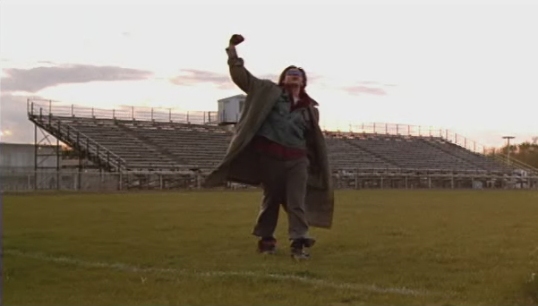
But, regardless of what happened on Monday, there’s no way your heart can’t soar a little when Bender lifts that fist above his head.

Bender and his fist