International Horror Film Review: The Night Digger (dir by Alistair Reid)


The 1971 British film, The Night Digger, revolves around three people.

Maura Prince (Patricia Neal) lives in a dilapidated mansion out of London. She has never married and spends almost all of her time taking care of her blind mother, Edith (Pamela Brown). Edith goes out of her way to make sure that Maura will never have the courage to leave her and find happiness on her own. However, with the mansion falling apart around them, it’s becoming obvious that Maura cannot take care of the entire place on her own. That’s when a mysterious but handsome man named Billy Jarvis (Nichols Clay) rides up on his motorcycle and asks if the women need a handyman.

Billy has a dramatic story about his past, claiming that he lost almost everything that he owned as the result of a fire in a barn, one which also led to the death of his mother. Billy is charming and handsome and he ride a really impressive motorcycle and he looks good in a leather jacket.  He represents youth but he’s also the epitome of the rebel without a cause, the sensitive but inarticulate Marlon Brando of The Wild One or the biker played by Peter Fonda in The Wild Angels.  Some may look at him and only see a somewhat seedy character on a motorcycle but others look at him and see someone who is running from something and needs someone to take care of him.  They see the soul of poet within the body of a drifter, someone who needs to escape from his past and who can also provide a better future.  He’s the rebel without a cause, the one that everyone dreams about, even if some of those dreams are dreamt in secret.  Though one may have rode a bicycle and the other was knight of the round table, there is much Nicholas Clay’s future performance as Lancelot in John Boorman’s Excalibur to be found in his performance in The Night Digger.  Much like a groundkeeper in a D.H. Lawrence novel, he represents the secret and potentially dangerous earthy sensuality of Britain.

As a result, You certainly can not blame Maura for starting to fall in love with him. Nor can you blame Edith for wanting to have an athletic young man around as there have been stories about a madman who stalks the night, killing women. The Traveling Maniac, some have taken to calling him. Complicating the matter, though, is the fact that Billy just happens to be The Traveling Maniac. With Maura falling in love with him, will she discover the truth or will she become his next victim?

The Night Digger took me by surprise. I wasn’t expecting much from this film when I watched it last year but it turned out to be rather clever and suspenseful thriller, one that told its story with a good combination of black humor and emotional honesty. Atmospherically directed by Alistair Reid and featuring a trio of excellent lead performances, The Night Digger was compelling compelling thriller, a gothic horror story with a great ending. This is definitely one to keep an eye out for!
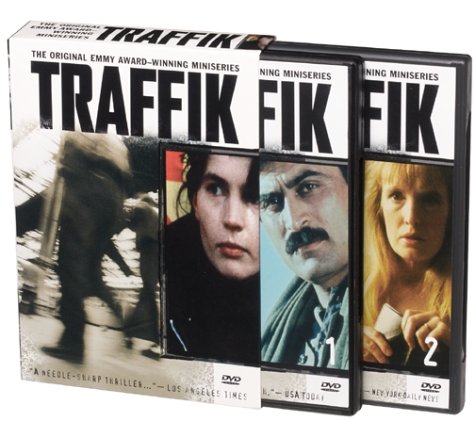
Miniseries Review: Traffik (dir by Alistair Reid)


First aired in 1989 and running a total of six episodes, Traffik is a British miniseries that takes a look at the War on Drugs.

British minister Jack Lithgow (Bill Paterson) has negotiated a treaty with Pakistan.  The UK will send increased aide to Pakistan if the government will crack down on the heroin trade.  In theory, it sounds like a good idea.  Pakistan will get extra cash while joining the effort to stop the flow of heroin into Europe.  In reality, it harms the poor farmers in Pakistan.  After soldiers destroy his village’s poppy fields, Fazal (Jamal Shah) is left with no way to support his family.  He travels to the city, where he gets a job with drug lord Tariq Butt (Talat Hussain).  It’s a job that Fazal has to take in order to feed his family but it’s also a job that puts his family’s safety at risk.

After the heroin in processed in Pakistan, it is smuggled into Europe by men like Karl Rosshalde (Juraj Kukura), a German businessman whose company is a front for his operations.  When two German police detectives (Fritz Müller-Scherz and Tilo Prückner) arrest Jacques (Peter Lakenmacher), one of Karl’s couriers, it looks like Karl might finally being going to prison.  However, Karl’s British wife, Helen (Lindsay Duncan), proves herself to be just a ruthless as he was when it comes to running his operations.

Even with Karl on trial, the drug trade continues.  The heroin that is processed in Pakistan and smuggled through Germany eventually ends up in the UK, where it is used to by Caroline (a very young Julia Ormond), the teenage daughter of Jack Lithgow.  When Caroline runs away from home, Jack searches the streets and back alleys of London and, for the first time, he starts to understand the futility of Europe’s war on drugs.

If Traffik sounds familiar, that’s because it served as the basis for Steven Soderbergh’s 2000 film, Traffic.  When I watched Traffik this week, I was actually surprised to see how closely Soderbergh’s film stuck to the plot of the miniseries.  The only difference, beyond shifting the action from Europe to North America, is that Soderbergh replaced the farmer’s storyline with a story involving Benicio del Toro as a Mexican policeman.  That’s a bit of shame, actually.  Traffic is one of my favorite Soderbergh films but it is a bit cop-heavy.  The people who actually do the day-to-day work in the drug trade, as opposed to the drug lords, aren’t really represented in Soderbergh’s film.  As the British miniseries shows, people like Fazal end up working in the drug trade not because they’re evil but because they literally have no other choice.  It’s either work for someone like Tariq or starve to death.

As I mentioned earlier, Traffic is one of my favorite Soderbergh films.  Considering that I usually find Soderbergh’s films to be hit-or-miss, it’s actually kind of remarkable just how effective Traffic is.  The original miniseries, however, is superior to the film in every way.  Some of that is because the miniseries has six hours to explore its world whereas Soderbergh had to cram a lot of incidents into 147 minutes.  Beyond that, the miniseries succeeds because director Alistair Reid takes a straight-foward, no frills approach to telling his story.  Even at his best, Soderbergh has a tendency to be a bit pretentious.  Even though Traffic deals with real-life issues, it never allows you to forget that you’re watching a film.  Traffik, on the other hand, tells its story with an almost documentary-style immediacy.  One need only compare the scenes where Bill Paterson searches for Julia Ormond in Traffik to the scenes where Michael Douglas searches for Erika Christensen in Traffic to see not only the differences between Reid and Soderbergh’s style but also to see why Reid’s more gritty style works better for the story that’s being told.  Whereas Soderbergh can’t resist framing Christensen with a blonde halo when she’s finally rescued by Douglas, Traffik leaves little doubt that Ormond has been through Hell and that, even if she does eventually beat her addictions, she’ll be carrying the scars of her experience for the rest of her life.  Whereas Traffic ended on a note of hope, Traffik ends with the realization that there is no perfect solution.

Traffic and Traffik are both good looks at the destructiveness of both drug abuse and the efforts to treat drug addiction as a crime.  Both are worth watching.