Film Review: Exodus (dir by Otto Preminger)


First released in 1960 and based on a novel by Leon Uris, Otto Preminger’s Exodous is two films in one.

The first half of the film takes place in Cyprus in the days immediately following World War II.  A young war widow named Kitty (Eva Marie Saint) is sightseeing when she learns of the Karaolos Internment Camp, where the British are interning thousands of Jewish refugees who demand to be allowed to go to the land that will eventually become the State of Israel.  Kitty visits with General Sutherland (Ralph Richardson), who oversees the camp and who is rumored to secretly be Jewish because of his relatively benevolent attitude towards the internees.  Disgusted by the anti-Semitism displayed by many of the British officers (one of whom is played by Kennedy in-law Peter Lawford), Kitty volunteers at the camp and learns about the Holocaust from those who survived it.  She also meets Ari Ben Caanan (Paul Newman), a former officer in the British army.  Ari manages to get control of a cargo ship, one that is renamed Exodus.  Six hundred refugees stage a hunger strike, vowing that they will willingly starve to death rather than be returned to Europe.

The second part of Exodus takes place in what will become the modern State of Israel.  It follows Ari, Kitty, and several of the passengers of the Exodus as they adjust to life and continue to fight for a land of their own, despite the opposition of the British and much of the rest of the world.  Karen (Jill Haworth) is a young woman who searches for her father, a brilliant man who has been driven into a nearly catatonic state by the horrors of the Holocaust.  Dov Landau (Sal Mineo) is an explosives expert who survived Auschwitz as a Sonderkommando and who was repeatedly raped by the guards at the camp.  Dov joins the Irgun, a paramilitary organization that the British consider to be terrorists.  Leading the Irgun is Ari’s uncle, Akiva (David Opatoshu), and Dov soon finds himself being targeted by both the British and the Arabs who, despite the moderating efforts of men like Taha (John Derek, who would later direct Ghosts Can’t Do It), want to violently force the Jews out of the land.

Legend has it that, after a private screening on Exodus, comedian Mort Sahl turned to director Otto Preminger and said, “Otto, let my people go.”  And it’s true that Exodus is a very long film.  Preminger, who started out making film noirs like Laura, spent the latter part of his career making “important” epics and, like many Golden Age directors struggling to compete with television and the 60s counterculture, he tended to make long, star-studded films that dealt with current events and which pushed the envelope just enough to be controversial without actually being radical.  However, I would argue that the three-hour running time of Exodus is justified.  To understand why Ari, Dov, Karen, and the other passengers of the Exodus would rather risk their lives by staying in what will become the State of Israel, one has to understand both what they went through to get there and also the anti-Semitism that they faced even in post-World War II Europe.  If Exodus were made today, it would be a mini-series.  Since it was made in 1960, it was instead a 3-hour film with an intermission.

Exodus holds up relatively well, with the sprawling action anchored by the presence of a cast of familiar faces.  Paul Newman and Eva Marie Saint bring a good deal of movie star glamour to scenes that would have otherwise just been dry exposition.  The film’s heart truly belongs to Jill Haworth and Sal Mineo, both of whom bring two life characters who have very differing views of the world.  Karen remains an optimist, one who is convinced that people can live together.  Dov, fueled by his own guilt and anger, has no room for negotiations and compromises.  Mineo received his second and last Oscar nomination for his performance in Exodus, though he lost to Peter Ustinov’s showy turn in Spartacus.  Exodus itself was clearly made with a hope for Oscar glory.  While Exodus did pick up a handful of nominations, it was left out of the five movie Best Picture slate.  The Academy only had room for one historical epic and they went for John Wayne’s The Alamo.  The eventual winner was The Apartment, the best of the nominated films.  (Indeed, even if Exodus had taken the Alamo’s spot, The Apartment would still be the best of the nominees.)  The Oscars aside, Exodus remains a good example of the type of epic filmmaking that once defined the Hollywood studios.
Shattered Politics #47: Agency (dir by George Kaczender)


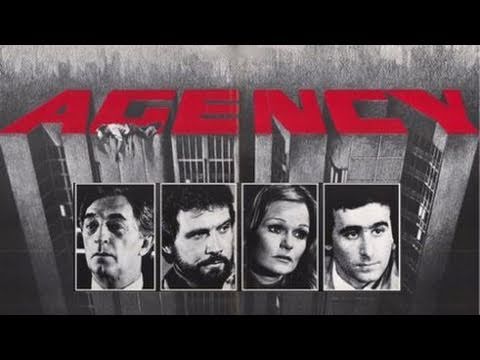
Agency

“Who are the other two lugs on this poster? And who’s the dame? Baby, I just don’t give a damn…” Robert Mitchum in Agency.

Like a lot of writers who occasionally have issues when it comes to balancing ambition with time management, I’ve discovered that it helps if I listen to music while I write.  For instance, while writing the majority of the reviews for Shattered Politics, I’ve been listening to Big Data’s Dangerous.

And that choice of music has actually turned out to be extremely appropriate.  No, not just because it’s dangerous to write about politics.  But also because the official music video for Dangerous deals with advertising and, more specifically, how sex and violence are used to sell everything from shoes to politicians.

Now, I don’t know about you but, whenever I see that video, I feel like I’m ready to put on a sports bra, running shorts, and of course my Big Data running shoes so that I can take control and headbutt my way through life!  A good commercial can do that.  (And don’t even get me started on what I’m going to do to the next person I see eating a hot dog…)

Interestingly enough, the 47th film that I’m reviewing for Shattered Politics also deals with the power of advertising.  First released in 1980, Agency stars Robert Mitchum as Ted Quinn, the mysterious new owner of a major ad company.  Out of all of the old school movie stars, Robert Mitchum is one of my favorites because he was not only a great actor but he was also a very honest one.  If he didn’t give a damn about a role, he wasn’t going to try to fool the audience otherwise.  Instead, he was going to deliver his lines and kind of smirk with his eyes, his way of subliminally asking the audience, “Are you actually watching this shit?”  And while this may have led to Mitchum giving several performances that were unworthy of his talent, it also means that if you see Robert Mitchum actually invested in a role than that means the film must be something really special.

Unfortunately, Agency is not one of those “something really special” films.  And Mitchum’s bored performance reflects that fact.

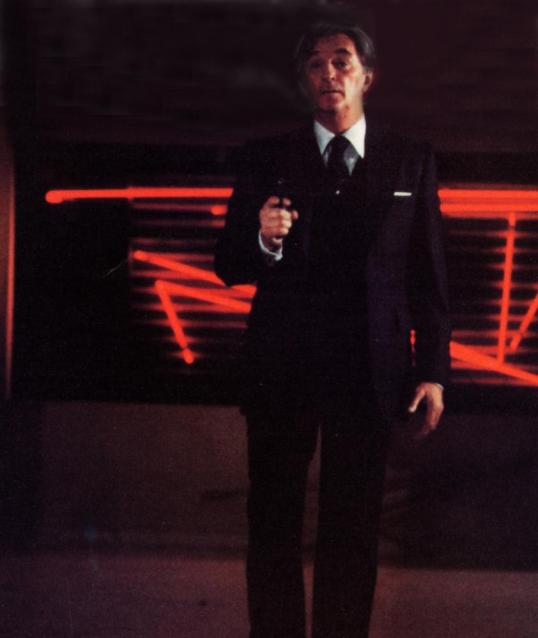
"Just try to make me care." Robert Mitchum in Agency.

“Just try to make me care.” Robert Mitchum in Agency.

Anyway, under Ted Quinn’s leadership, the ad agency is doing commercials for all the usual clients.  The movie starts with one of those commercials — a leather-themed, disco-scored short film extolling the virtues of No Sweat deodorant.  And then there’s also the big chocolate energy drink commercial.  However, copywriter Sam Goldstein (Saul Rubinek) suspects that Ted might have sinister motives.  After a right-wing  candidate comes out of nowhere to win a seat in the U.S. Senate, Sam suspects that the deodorant commercial may have contained subliminal messages…

That’s right!  It’s exactly like that episode of Saved By The Bell where Zack Morris brainwashed Mr. Belding by giving him that subliminally-spiked tape of the Beach Boys.

Well, before you can say “Zack Morris is a blonde Tom Cruise,” Sam has been murdered and it’s up to Sam’s best friend, Philip Morgan (Lee Majors), to reveal the truth about Ted’s sinister agenda…

Like many U.S.-set thrillers from the 1980s, Agency was actually a Canadian film.  Montreal stands in for an unnamed American city where it frequently snows and the supporting cast is full of actors with noticeable Canadian accents.  Mind you, that’s not a complaint.  I love Canada, I love Canadians, and I especially love Canuxploitation films.

That said, Agency is probably one of the least interesting Canadian thrillers that I’ve ever sat through.  (I should add, of course, that I saw Agency on a very low-quality DVD that was released by Miracle Pictures.  And I really do have to say that this was absolutely one of the worst transfers that I’ve ever seen.  It appears that the DVD was copied from an old VHS tape.)  It’s not so much that it’s a terrible film as much as it’s just not a very interesting one.  With the exception of Rubinek, the actors go through the motions with little enthusiasm and the story plods along.  Maybe back in 1980, the whole idea of subliminal advertising seemed exciting and relevant.  But seen today, it just all seems incredibly silly.

So, in the end, Agency did not make me want to headbutt my way through life.

Sorry.

(I still love you, Canada!)

(And you too, Robert Mitchum!)

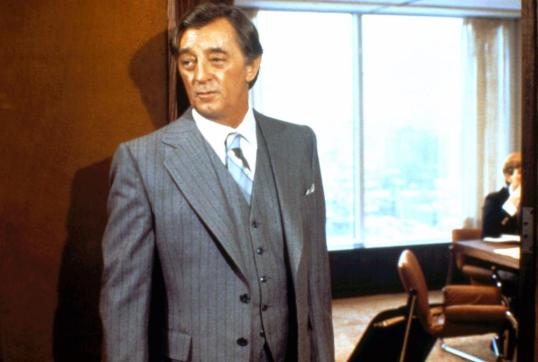
"Baby, I just don't give a damn."  Robert Mitchum in Agency.

“Baby, I just don’t give a damn.” Robert Mitchum in Agency.