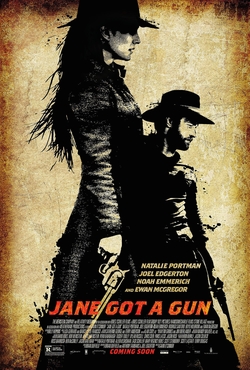
Film Review: Jane Got A Gun (dir by Gavin O’Connor)


Jane_got_a_Gun_Poster

Jane Got A Gun, which was released with little fanfare in January and is now available on Netflix, could just as easily have been called This Bishop Boys Are Coming And Who Gives A Fuck?

In fact, I like that title better than Jane Got A Gun.  As far as I’m concerned, I am no longer reviewing Jane Got A Gun.  Instead, I am going to tell you about a film called The Bishop Boys Are Coming And Who Gives A Fuck?

The film is a western, taking place shortly after the end of the Civil War.  (Isn’t it interesting how every western recently produced has taken place shortly after the Civil War?  Way to avoid awkward historical truths, Hollywood.)  Jane (Natalie Portman) lives on an isolated farm, with her daughter and her husband, Bill Hammond (Noah Emmerich, who is wasted both figuratively and literally).  Hammond used to be an outlaw but now, he’s a pretty good guy.  But the Bishop Boys are still after him!

Who are the Bishop Boys?

Well, John Bishop is Ewan McGregor.  He’s an evil businessman and a bounty hunter and he used to be in love with Jane but now it seems that he mostly just wants to collect the bounty that’s on Hammond’s head.  I love Ewan McGregor but, as we all should have learned from his performance in Haywire, he doesn’t make the most convincing villain.  McGregor is one of those actors who radiates an inner humanity.  No actor falls in love as convincingly as Ewan McGregor.  That’s what makes him a compelling actor but it also means that he’s totally miscast as a bounty hunting sociopath.

Anyway, the Bishop Boys end up putting five bullets in Hammond so he goes home to die.  “The Bishop Boys are coming,” he says and Jane has to prepare for the upcoming siege.  Fortunately, her surly neighbor, Dan (Joel Edgerton, who seems to be bored with the whole thing), just happens to be her former fiancée and he’s still in love with her, though he tries to hide his love behind bitterness and pithy one-liners.  It also turns out that Dan was a hero in the Civil War but he’s weary of violence.

Don’t worry, though!  Dan is still willing to kill.  After all, not much would happen in the movie if Dan wasn’t willing to shoot people…

Anyway, The Bishop Boys Are Coming And Who Gives A Fuck only lasts for 98 minutes but there’s a lot of hints that there was originally supposed to be a lot more to the movie than actually showed up on screen.  We get a few lengthy flashbacks, all of which hint at a story that actually explores what it means to be a woman in a patriarchal society and which, if properly handled, would have made The Bishop Boys Are Coming And Who Gives A Fuck the feminist western that it’s attempting to be.  Watching this movie, you get the feeling that a lot of the original storyline was either not filmed or left on the cutting room floor.

To be honest, I really wanted this to be a great movie or, at the very least, a decent showcase for Natalie Portman, who was one of my favorite actresses even before Black Swan.  However, I officially gave up on this film after 50 minutes.  That was around the time that Dan started to ramble about life, death, and doin’ the ratt thang.   It was all just so clichéd and the rest of the film wasn’t any better.

The Bishop Boys Are Coming And Who Gives A Fuck? did receive some attention because its screenplay was included in the Black List, which claims to be an annual survey of the best unproduced screenplays in Hollywood.  The Black List is one of the greatest con jobs ever perpetrated by the film industry.  While it’s true that American Hustle and The King’s Speech appeared on the Black List, a typical Black List screenplay usually turns out to be something like The Beaver, Broken City, or Cedar Rapids.  You can add The Bishop Boys Are Coming And Who Gives A Fuck? to the long line of Black List scripts that became utterly forgettable movies.

Embracing the Melodrama Part II #120: We Need To Talk About Kevin (dir by Lynne Ramsay)


We Need To Talk About KevinThis is a historic occasion!

Two months and one week ago, I started on this journey that we call Embracing the Melodrama, Part II.  At the time, I announced that I would be reviewing 126 film melodramas and that I would get it all done in 3 weeks.  Well, I was 6 weeks off as far as the timing was concerned but I am going to reach the 126 mark.

(And then I’m going to pass out and sleep for a year…)

We started this series by taking a look at the 1927 silent classic Sunrise and now, 119 reviews later, we have reached the disturbing 2011 film, We Need To Talk About Kevin.

We Need To Talk About Kevin tells the story of Eva (Tilda Swinton).  Eva was once a very successful travel writer, who explored the world and lived a life of total independence and sophistication.  Now, however, she has a demeaning job at a travel agency.  She lives in a dilapidated house that is the frequent target of vandals.  Everyone in town views her as a pariah, either deliberately avoiding her or greeting her with open hostility.

You see, Eva is the mother of a teenager named Kevin (Ezra Miller) who is currently in prison.  One day, Kevin locked all of his high school classmates in the gym and, using a bow and arrow set that was given to him by his father, Franklin (John C. Reilly), Kevin proceeded to kill or maim them all, one-by-one.  When Kevin finally surrendered to police, he looked over at his mother and he smirked.

We Need To Talk About Kevin unfolds in flashback as Eva looks back on her former life and tries to understand how her son could do something so evil.  From the time that Kevin was a baby, Eva suspected that there was something wrong with her son and found it impossible to bond with him.  While Franklin spoiled him and refused to accept that there was ever anything wrong, Eva went the opposite direction.  When Eva became more and more convinced that Kevin was evil, Franklin refused to listen to her.

And, make no mistake about it, Kevin is evil.  For the majority of the film, he is one of the most evil characters that you’ve ever seen.  (It’s even suggested — though thankfully never shown — that he may have deliberately blinded his little sister.)  We, like Eva, wonder if Kevin was born evil or if he became evil as the result of the way he was raised but there’s no doubt that he’s evil.

And then, one day, Eva goes to visit her son in prison and we see a different Kevin.  Kevin is about to turn 18, which means that he’ll be transferred to an adult prison.  Kevin admits that he’s scared.  In this scene, the cocky and hateful Kevin is one.  This new Kevin has shaved off his previously unruly mop of hair.  His face is bruised and he has a cut above his eye, suggesting that, within the walls of the justice system, he’s no longer the attacker but instead the one being attacked.  He no longer smirks or glares at his mother.  Instead, he looks lost and vulnerable.

And, at first, I actually felt sorry for Kevin when I saw that scene.  I guess it was maybe my own maternal instinct coming out or maybe my own tendency to feel compassion for those who have no freedom.  But, at that moment, I felt as if maybe Kevin finally understood that what he did was wrong.  Just like Tilda Swinton’s Eve, I suddenly felt compassion for this hateful creature…

Until, of course, it occurred to me that the only time that Kevin showed any fear or regret was when it came to his own situation.  As scared as Kevin is, Kevin never expresses any regret over what he did.  Instead, he’s scared for himself and upset that he no longer has control of his situation.  Though the film never states it, that’s classic sociopath behavior.  (One is reminded of the BTK Killer, who unemotionally talked about those he killed but then cried when talked about having to spend the rest of his life in prison.)

At that point, I realized that Kevin hadn’t changed at all.  Much like Eve, I wanted to believe that Kevin had changed because that, at least, would give the story some sort of closure.  But, unfortunately, the Kevins of the world can never change.  We may not know how someone like Kevin is created, whether he’s born evil or becomes evil due to circumstances.  But we do know that evil can never change.  That’s the burden that both Eve and the audience must carry.

We Need To Talk About Kevin is a lot like Million Dollar Baby.  It’s well-directed and fiercely well-acted but, at the same time, it’s so sad and disturbing that I don’t know that I’ll ever be able to watch it again.  There are a few moments of very dark humor, mostly connected to just how oblivious everyone, with the exception of Eve, is to Kevin’s evil.  But make no mistake, this is a seriously dark film.

http://www.youtube.com/watch?v=TGjjK5SMbJA

(For those keeping track, that’s 120 reviews down and 6 to go.)