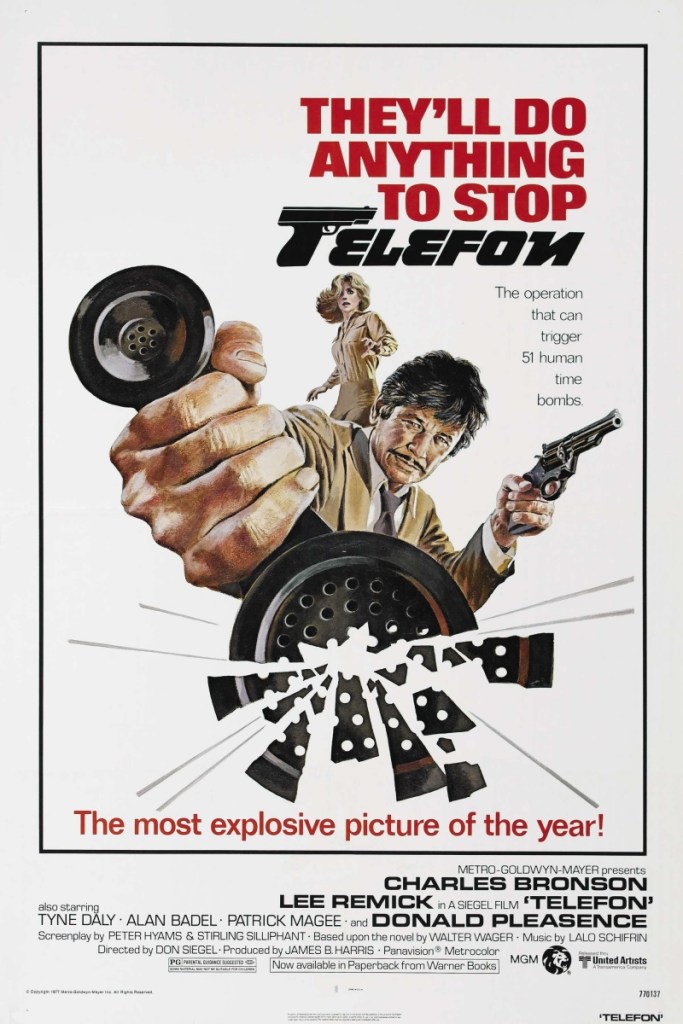
TELEFON – Charles Bronson plays a KGB agent in a movie that inspired The Naked Gun and Tarantino’s Death Proof!


When I was a kid, FOX-16 out of Little Rock, Arkansas would have “Charles Bronson weeks” where every night they’d show a different Bronson film.  I saw several of his films for the first time during those weeks and TELEFON was one of those movies.  I remember really enjoying it that first time I saw it, and I’ve always carried that positive feeling with me.  

The plot of TELEFON is pretty interesting.  In a nutshell, Charles Bronson is Russian KGB agent, Grigori Borsov, who’s been sent to the United States to stop radical Russian Nicolai Dalchimsky (Donald Pleasance), before he can set off more hypnotized human time bombs.  Lee Remick is a beautiful Russian agent (double agent?) who helps him with his mission.  

I personally think TELEFON is an underrated Charles Bronson film, and it seems like a movie that has almost been forgotten.  This is strange to me because it had quite the pedigree at the time of production.  Bronson was a huge star at the time, and the director was Don Siegel, the man behind such classics as DIRTY HARRY, ESCAPE FROM ALCATRAZ, and THE SHOOTIST.  The cast is exceptional as well, with Bronson being joined by the likes of Donald Pleasance, Lee Remick, Tyne Daly, Sheree North and Patrick Magee. The screenplay was co-written by Peter Hyams, who would go on to direct such excellent films as OUTLAND, THE STAR CHAMBER, and RUNNING SCARED.  My point of sharing all of this is that true professionals were at work in front of, and behind the camera, and they created a damn fine Cold War thriller.  I was glad that Shout Factory put out a nice blu ray of the film in January of 2024.  Hopefully film enthusiasts will begin discovering the film again.  

With that said, TELEFON isn’t a perfect film and I do have a few small complaints.  First, Charles Bronson doesn’t appear in the film until we’re already 21 minutes deep.  That’s a long time for me to have to wait for the man!  Second, Bronson and Remick don’t have a lot of sexual chemistry.  She’s beautiful and he oozes masculinity, but somehow it doesn’t really extend to a real connection between their characters.  That’s one of the reasons I like it when Bronson works with his wife Jill Ireland.  That chemistry is usually there between them.  Third, Donald Pleasance wears several wigs and looks kind of dorky at times.  Fourth, Sheree North wears a housecoat during her section of the film.  If you’ve seen her in BREAKOUT with Bronson from a couple of years earlier, you understand just what a missed opportunity that was.  Finally, Tyne Daly is so good in her small role, but she ultimately just kind of exits the film.  I’d have liked even more of her.  These are small complaints, with the exception of Bronson’s entrance & North’s wardrobe choice, that I don’t really hold against the movie.  

The last thing that I want to mention is that there are a couple interesting pop culture references to TELEFON in movies that came out later.  First, the writers of THE NAKED GUN borrowed the plot about hypnotized human time bombs in their own plot to assassinate the visiting Queen of England.  Certain scenes are taken directly from TELEFON.  I remember watching THE NAKED GUN in theaters in the late 80’s and wondering if I was the only person who realized this fact.  Second, in DEATH PROOF, Quentin Tarantino used the major plot device of quoting the Robert Frost poem “Stopping by Woods on a Snowy Evening” in order to trigger something. In TELEFON, it was human time bombs.  In DEATH PROOF, it was human lap dances.  God bless Quentin Tarantino!
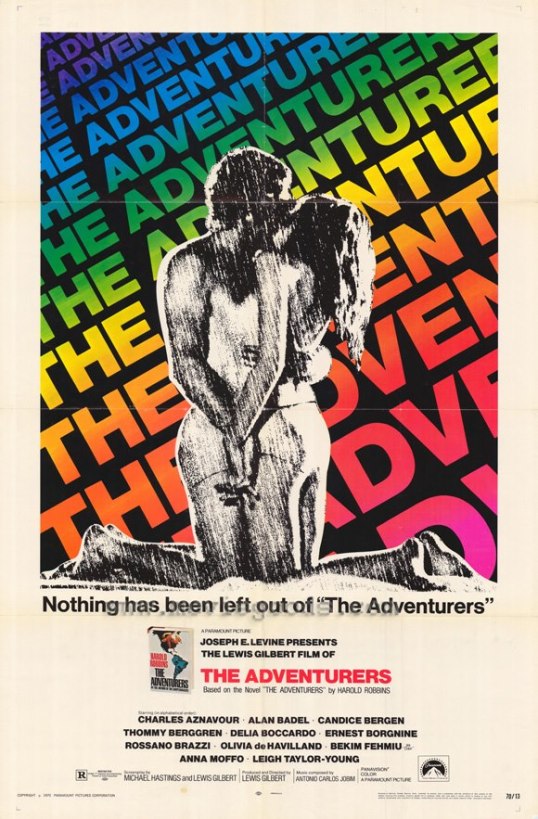
Film Review: The Adventurers (dir by Lewis Gilbert)


The 1970 film, The Adventurers, is a film that I’ve been wanting to watch for a while.

Based on a novel by Harold Robbins, The Adventurers was a massively expensive, three-hour film that was released to terrible reviews and even worse box office.  In fact, it’s often cited as one of the worst films of all time, which is why I wanted to see it.  Well, three weeks ago, I finally got my chance to watch it and here what I discovered:

Yes, The Adventurers is technically a terrible movie and Candice Bergen really does give a performance that will amaze you with its ineptitude.  (In her big scene, she sits in a swing and, with a beatific look on her face, begs her lover to push her “Higher!  Higher!”)

Yes, The Adventures is full of sex, intrigue, and melodrama.  Director Lewis Gilbert, who did such a good job with Alfie and The Spy Who Loved Me, directs as if his paycheck is dependent upon using the zoom lens as much as possible and, like many films from the early 70s, this is the type of film where anyone who gets shot is guaranteed to fall over in slow motion, usually while going, “Arrrrrrrrrrrrgh….”  A surprisingly large amount of people get shot in The Adventurers and that adds up to a lot of slow motion tumbles and back flips.  Gilbert also includes a sex scene that ends with a shot of exploding fireworks, which actually kind of works.  If nothing else, it shows that Gilbert knew exactly what type of movie he was making and he may have actually had a sense of humor about it.  That’s what I choose to believe.

Despite the fact that The Adventurers is usually described as being a big-budget soap opera, a good deal of the film actually deals with Latin American politics.  For all the fashion shows and the decadence and the scenes of Candice Bergen swinging, the majority of The Adventures takes place in the Latin American country of Cortoguay.  If you’ve never heard of Cortoguay, that’s because it’s a fictional country.  Two hours of this three-hour film are basically devoted to people arguing and fighting over who is going to rule Cortoguay but it’s kind of impossible to really get to emotionally involved over the conflict because it’s not a real place.

Ernest Borgnine plays a Cortoguayan named — and I’m being serious here — Fat Cat.  Seriously, that’s his name.  And really, how can you not appreciate a movie featuring Ernest Borgnine as Fat Cat?

Fat Cat is the guardian of Dax Xenos (Bekim Fehmiu).  Dax’s father is a Cortoguayan diplomat but after he’s assassinated by the country’s dictator, Dax abandons his home country for America and Europe.  While he’s abroad, Dax plays polo, races cars, and has sex with everyone from Olivia de Havilland to Candice Bergen.  He also gets involved in the fashion industry, which means we get two totally 70s fashion shows, both of which are a lot of fun.  He marries the world’s richest heiress (Bergen) but he’s not a very good husband and their relationship falls apart after a pregnant Bergen flies out of a swing and loses her baby.

Throughout it all, Fat Cat is there, keeping an eye on Dax and pulling him back to not only Cortoguay but also to his first love, Amparo (Leigh Taylor-Young), who just happens to be the daugther of Cortoguay’s dictator, Rojo (Alan Badel).  In fact, when Fat Cat and Dax discover that an acquaintance is selling weapons to Rojo, they lock him inside of his own sex dungeon.  That’s how you get revenge!  And when Dax eventually does return to Cortoguay, Fat Cat is at his side and prepared to fight in the revolution.  Incidentally, the revolution is led by El Lobo (Yorgo Voyagis), who we’re told is the son of El Condor.

The Adventurers is melodramatic, overheated, overlong, overdirected, and overacted and, not surprisingly, it’s eventually a lot of fun.  I mean, the dialogue is just so bad and Lewis Gilbert’s direction is so over the top that you can’t help but suspect that the film was meant to be at least a little bit satirical.  How else do you explain that casting of the not-at-all-Spanish Bekim Fehmiu as a Latin American playboy?  Candice Bergen plays her role as if she’s given up any hope of making sense of her character or the script and the rest of the cast follows her lead.  Ernest Borgnine once said that The Adventurers was the worst experience of his career.  Take one look at Borgnine’s filmography and you’ll understand why that’s such a bold statement.

The Adventurers is three hours long but it’s rarely boring.  Each hour feels like it’s from a totally different film.  It starts out as Marxist agitprop before then becoming a glossy soap opera and then, once Fat Cat and Dax return home and get involved in the revolution, the film turns into “modern” spaghetti western.  It’s a film that tries so hard and accomplishes so little that it becomes rather fascinating.

And, if nothing else, it reminds us that even Fat Cat can be a hero….


A Movie A Day #175: Telefon (1977, directed by Don Siegel)


Across America, strange things are happening.  Seemingly ordinary, middle-aged citizens are, without explanation, attacking formerly top secret government facilities.  The attackers are from all different walks of life.  One was an auto mechanic.  Another was a priest.  There was even a housewife who, after blowing up a power station, committed suicide with a poison pill that the KGB stopped issuing a decade ago.  Before launching their attacks, each one of them received a phone call in which a Russian man recited a poem by Robert Frost.

The Americans may not understand what is happening but the Soviets do.  Immediately after the Cuban Missile Crisis, the KGB planted sleeper agents across the United States.  They hypnotized and brainwashed the agents so thoroughly that they no longer remember that they are agents.  The Frost poem was the trigger designed to activate the agents, all of whom were meant to attack what were then valuable parts of America’s infrastructure.  With the arrival of détente, the program was abandoned and the sleeper agents were simply left behind in the United States.  But now, a former hardliner (Donald Pleasence), is activating the agents one by one.  Because he has a photographic memory, KGB colonel Charles Bronson is sent to the United States to track down and kill Pleasence before the United States discovers the truth about what is happening.  Lee Remick, as an American KGB agent, is assigned to work with him but is also ordered to kill him once the assignment has been completed.

That Telfon is one of Charles Bronson’s better post-Death Wish films is largely due to the presence of Don Siegel in the director’s chair.  As a director who specialized in intelligent genre films and who helped to make Clint Eastwood one of the world’s biggest stars with Dirty Harry, Coogan’s Bluff, The Beguiled, and Escape from Alcatraz, Don Siegel was the ideal director to bring out the best in Bronson.  Like St. Ives, Telefon features Bronson in an uncharacteristically cerebral role.  For once, he spends more time analyzing clues than he does shooting people and Bronson is surprisingly credible as a man with a photographic memory.

As directed by Siegel, Telefon is almost a satire of the type of violent action films that Bronson usually made for directors like Michael Winner. In Telefon, both the bad guys and the good guys are equally clueless.  All of the KGB sleeper agents are dumpy and middle-aged and the film continually emphasizes that they’ve all been brainwashed to attack targets that are no longer strategically important.    Donald Pleasence, playing one of his raving villains, wears a blonde, Beatles-style wig for much of the film.

Though the ending is a let down, Telefon is still one of the best of Bronson’s late 70s films.