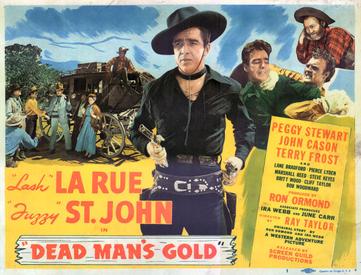
Dead Man’s Gold (1948, directed by Ray Taylor)


Jim Thornton (Britt Wood) has discovered a gold mine so he writes to his old friends, Lash LaRue (Lash La Rue) and Fuzzy (Al St. John), asking them to come help him guard it.  When Lash and Fuzzy arrive, Jim is nowhere to be found.  With the help of Jim’s niece (Peggy Stewart), they discover that Jim’s been murdered.  It doesn’t take a genius to realize that the murder was carried out by Conway (Jason Cason) and his men and that’s a good thing because a genius is something you will never find in a Lash La Rue western.  However, Lash suspects that Conway was following someone else’s orders.  He and Fuzzy set up a trap to reveal the true identity of the mastermind.

Lash dresses in all black and often uses a whip instead of a gun but this is still a standard B-western.  Historically, it’s important because it was the first movie that La Rue made with producer Ron Ormond.  Ormond later went from producing Lash La Rue films to directing them and Lash’s career never really recovered.  (Ormond, whose non-Lash LaRue films included Mesa of Lost Women and If Footmen Tire You, What Will Horses Do?, was never much of a director.)  Fortunately, Dead Man’s Gold was directed by the dependable Ray Taylor, who keeps the action moving and crafts an adequate if not exactly memorable western.

There is one cool scene in Dead Man’s Gold, in which Lash uses his whip to knock a shot glass out of a bad guy’s hand.  Let’s see The Lone Ranger do that!
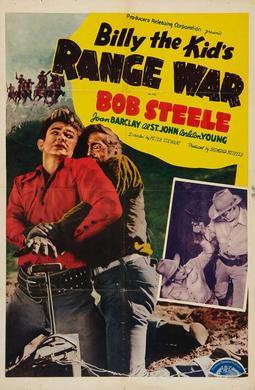
Billy The Kid’s Range War (1941, directed by Sam Newfield)


Billy the Kid was a big damn hero.

At least that’s the claim of Billy The Kid’s Range War, in which Billy (played by middle-aged Bob Steele) is a do-gooder with a comedic sidekick named Fuzzy (Al St. John) and a hankering to help Ellen Gorman (Joan Barclay) bring a new stagecoach line to town.  Williams (Karl Hackett) does want to the Gorman family to success so he hires Buck (Rex Lease) to dress up like Billy the Kid and ride a horse that looks like Billy the Kid’s and commit crimes, like killing Ellen’s father.  Framed for all those crimes that he didn’t commit and with his best friend (Carleton Young) ordered to arrest him, Billy decides to go under cover so that he can clear his good name.  Someone pretending to be Billy the Kid got him into this mess.  Now, Billy’s going to get out of it by pretending to be someone else.

The action is pretty standard for a B-western.  Mostly, it’s interesting to see a movie where Billy the Kid is actually a nice guy who gets framed.  No wonder a whole generation grew up with no idea about true history of the American frontier.  Sam Newfield directed a handful of Billy the Kid films and the capable Bob Steele starred in most of them but this is the only one that I’ve sat down and watched and it actually left me missing the production values of the Johnny Mack Brown films.  For fans of these type of westerns, there’s the promise of seeing familiar actors like George Cheseboro and Ted Adams doing there thing.  Even the outstanding character actor Milton Kibbee makes an appearance.  For those who do not like westerns, this film is not going to change their minds.

Despite the promise of the title, there is no range war in this movie.  There’s just Billy the Kid, trying to clear his good name.

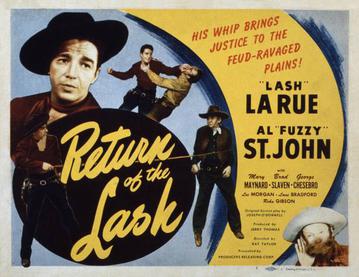
Return of the Lash (1947, directed by Ray Taylor)


There’s another range war brewing on the frontier.  Big Jim Kirby (George Chesebro) knows there’s plans for a new railroad so he wants to steal the land from the ranchers so he can make a fortune off a selling it.  Kirby calls in everyone’s mortgage, knowing they’ll never be able to pay.  Rancher Tom Grant (Buster Slaven) reaches out to Cheyenne Davis (Lash LaRue, a look alike for Humphrey Bogart)) and Fuzzy Q. Jones (Al St. John) for help.  Cheyenne raises the money but then he makes the mistake of trusting Fuzzy to deliver it.  Fuzzy takes a knock to the noggin and now, he’s got amnesia.  Where’s the money?

This is a standard B-western and you know the drill.  Big Jim’s henchmen don’t want that money to get paid.  Cheyenne is on the side of the angels.  Fuzzy provides comic relief.  Lash LaRue appeared in several B-westerns.  He never became as big a star as some of his contemporaries but he did have a gimmick that made him memorable.  Most westerns stars used guns.  LaRue had a bullwhip.  When LaRue was first offered the role of Cheyenne, he lied and said he could crack a whip.  After he struggled to teach himself, tiny production company PRC hired a professional trainer.  That was a huge expense for a poverty row studio but it paid off because LaRue became proficient with the whip and he had a surprisingly long career.  He was born Alfred LaRue.  The studio came up with the Lash nickname.  Many western stars, like Johnny Mack Brown, played characters who shared their name.  Lash almost always played Cheyenne Davis.

Lash LaRue’s movies were cheap and never that memorable.  In this one, Lash barely appears and most of the action is carried out by Al St. John as Fuzzy.  But Lash LaRue did play an important part in Hollywood history when he briefly came out of retirement to teach Harrison Ford how to crack a whip for a little film called Raiders of the Lost Ark.

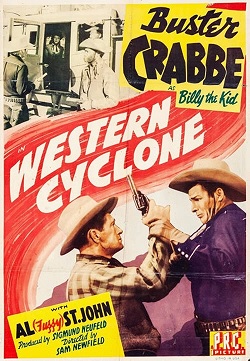
Western Cyclone (1943, directed by Sam Newfield)


Feeling that the old west has become a dangerous place, law-abiding gunslinger Billy the Kid (Buster Crabbe) fakes a stagecoach robbery and pretends to kidnap the governor’s daughter, all to show him that the west needs more law enforcers.  The governor is so impressed by Billy’s ruse that he agrees to stand tough on crime.  This upsets Dirk Randall (Glenn Strange, who also played Frankenstein’s monster is some of the later Universal horror films), a businessman who has been funding the criminals in order to make the governor look weak so that Randall could defeat him in the next election.

Randall orders one of his men to pull a gun on Billy while Billy is leaving the local saloon.  Billy pulls and fires his own gun in self-defense but it’s Randall who actually kills the man by shooting him in the back and then running off in the confusion.  Because the man was shot in the back, Billy is accused of murder, arrested, and sentenced to death in record time.  With Billy in jail, it falls to his comic relief sidekick, Fuzzy Jones (Al St. John), to prove that Billy didn’t actually fire the shot that killed the man.

By most accounts, Billy the Kid was a nasty piece of work who would kill anyone who look at him in the wrong way but, in the 30s, the character was the hero of a series of 42 Westerns that all featured him as a hero and a valued member of the community.  (Originally, Bob Steele played Billy.  Buster Crabbe took over the role with the seventh film.)  Western Cyclone was the 17th Billy the Kid film and, as long as you’re not a stickler for historical accuracy, it’s an entertaining B-western.  The plot is formulaic but Crabbe was a good hero, Strange was a diabolical villain, and, for once, Al St. John got to play an important role in resolving the film’s story.  Fuzzy Jones did some impressive detective work.  The real Billy the Kid probably could have used someone like Fuzzy in his corner.