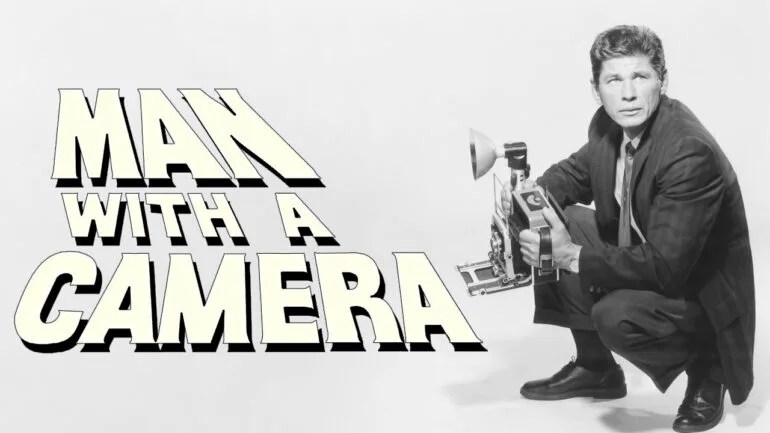
MAN WITH A CAMERA (TV Series) – starring Charles Bronson – S1, E5: Turntable  


This episode opens with Mike Kovac (Charles Bronson) visiting an illegal gambling den operated by Walter Bradman (Dennis Patrick). Kovac takes a picture of Bradman with a small camera he’s placed inside of a cigarette lighter. You see, an honest lawyer named John Payson (Logan Field) is running for governor on a platform of shutting down these types of criminal establishments, and Kovac thought this might make for an interesting story in the current political environment. But Bradman catches him taking the picture, and just when it looks like he might forcibly take the camera and film from Kovac, Bradman decides to let him go. It seems that Bradman has bigger plans for Kovac as he happens to know that Kovac is going to the Payson’s household to take family pictures the very next day. Bradman has an inside person in the Payson household, his girlfriend Miss Hollis (Phyllis Avery), and he plans to steal the negatives. They will then use Miss Hollis’ ex-con dad Clyde Bosser (Addison Richards) to create fake composite pictures that pretend to show Payson in the gambling den and hanging out with women other than his wife. He’s hoping that a little blackmail might get Payson off his back, but as you might imagine with Mike Kovac on the case, the plan falls apart and nobody is safe! 

“Turntable” is a solid episode of MAN WITH A CAMERA. There are several reasons I enjoyed it. The presence of Charles Bronson in the lead is always at the top of the list. His down-to-earth charisma anchors the series and this episode in such a way that there’s always something worth watching on screen. He does get to beat up a couple of guys and that’s very fun for me. Dennis Patrick is good as the den boss. He’s very confident and cocky until his plan starts falling apart. Once he begins to panic, things really start to get interesting. The story is also intriguing, as it deals with doctoring photos for nefarious purposes, a novel concept in 1958, but something that’s all too common these days. The composite pictures created as part of this episode are actually kind of funny to look at, and it makes you wonder how some of them could have fooled anyone! I’ve mentioned before that I like episodes where Kovac’s dad Anton (Ludwig Stossel) has an important part. In this episode, he helps his son put together an important piece of the puzzle so I liked that. On the negative side, I didn’t like the political angle. John Payson’s gubernatorial candidate is made to look like an angel, and we all know how that usually works out in the political arena. Honestly, I’m sick of politics in general, and I like to watch TV and movies to get away from that kind of stuff.

Overall, “Turntable” is a solid episode with an intriguing story, a few good performances, and a scene that actually caught me by surprise. That doesn’t happen very often! 
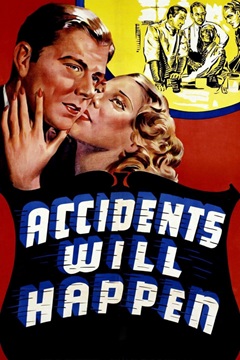
Accidents Will Happen (1938, directed by William Clemens)


Eric Gregg (Ronald Reagan) is an insurance claims adjuster who works hard, always has a cheerful attitude, and is inexplicably married to a greedy, dishonest woman named Nona (Sheila Gregg).  When Nona, sick of not being able to afford to live like a rich person, starts claiming to be a witness to accidents that didn’t really happen, it leads to Eric losing his job.  Eric is also dumped by Nona, who heads off to Reno.  Luckily, Patricia (Gloria Blondell), who works as the candy counter clerk at Eric’s office building, is just as eager to hook up with Eric and he is with her.

But what’s this?  Soon, Eric and Patricia are running insurance scams of their own and Eric is being recruited into a gang of fraudsters that’s led by Blair Thurston (Addison Richards).  Has Eric gone bad or does he have something else up his sleeve?

Accident Will Happen is one of the many B-movies that Ronald Reagan made before he briefly became a star as the result of Knute Rockne — All American and Kings Row.  It’s only 62 minutes long and the story moves quickly. The plot features a pretty obvious twist and it ends with some courtroom theatrics that I doubt anyone could have gotten away with in real life.  As with most of his B-performances, Reagan is likable even if there’s not much depth to his character.  Watching him hit bottom and then climb back up is satisfying because Reagan is so affable in the role.  Accidents Will Happen also stands out for its portrayal of an unhappy marriage, with Eric not realizing how miserable and greedy Nona is until she leaves him when he needs her the most.  Luckily, Gloria Blondell (who was the sister of Joan Blondell) is cute and perky and a far better match for our Reagan.  In the end, Ronald Reagan defeats insurance fraud as surely as he defeated the Soviets in the Cold War.

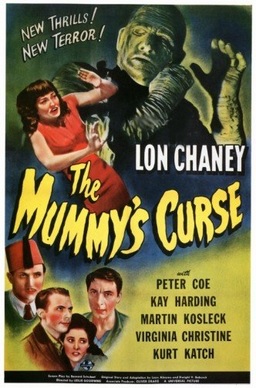
Horror Film Review: The Mummy’s Curse (dir by Leslie Goodwins)


When last we checked in with Kharis the Mummy, he was running into a swamp in Massachusetts, carrying the reincarnation of Princess Ananka with him.  Chasing after him were the standard towns people with torches and guns.  It’s not a Universal horror film without angry villagers, even if the movie itself is taking place in Mapleton, Massachusetts.

Upon entering the swamp, both Kharis and Ananka sunk under the water, traumatizing Ananka’s boyfriend but apparently bringing Kharis’s reign of terror to an end.

Well, not so fast!

The 1944 film, The Mummy’s Curse, opens with the townspeople talking about how Kharis continues to haunt the old swamp, so much so that most of the locals refuse to work in the swamp.  Oddly enough, though, the townspeople are suddenly a mix of Cajuns and gypsies.  (The film even opens with a gypsy woman singing a song in a bar.)  The swamp has now become a bayou.  We are repeatedly told that the film is taking place in the same location as the previous Mummy films but suddenly, that location has changed from Massachusetts to Louisiana.

As for the plot of The Mummy’s Curse, it all centers around the swamp.  The Southern Engineering Company (and that really doesn’t sound like a Massachusetts company) is draining the swamp.  The locals are worried that draining the swamp will bring back the curse of the mummy.  Two representatives from the Scripps Museum show up and announce that they want to search the drained swamp for the remains of the mummies.  Dr. James Halsey (Dennis Moore) is typical of the archeologists who tend to show up in these Mummy films.  Meanwhile, his associate is Dr. Ilzor Zandeeb (Peter Coe) who — surprise! — is that latest Egyptian high priest to come to America to try to recover the bodies of Kharis and Princess Ananka.

Ananka (Virginia Christie) is the first to emerge from the swamp, though she has no memory of who she is.  When she is discovered on the side of the road by Prof. Halsey and his love interest, Betty (Kay Harding), they allow her to stay at their camp on the edge of the swamp.  Everyone is really impressed by the fact that this amnesiac knows so much about ancient Egypt.  Eventually, Kharis (Lon Chaney, Jr., again tightly wrapped in bandages) eventually emerges from the swamp as well, determined to protect Ananka.

The Mummy’s Curse was the final film to feature Lon Chaney, Jr. as Kharis.  Unfortunately, it’s pretty forgettable and certainly not a satisfying conclusion to the story of one of Universal’s original monsters.  A good deal of the film’s 60-minute running time is taking up with flashbacks to previous Mummy films and it seems like it takes forever for Kharis to actually get around to spreading the usual mummy mayhem.  Though it may be too much to ask for too much continuity from these films, the sudden switch from Massachusetts to Lousiana is distracting for those of us who have actually invested the time to watch the previous Mummy films.  One gets the feeling that, by the time this film went into production, no one involved really cared that much about poor Kharis and his never-ending mission to protect his princess.

Previous Universal Horror Reviews:

  1. Dracula (1931)
  2. Dracula (Spanish Language Version) (1931)
  3. Frankenstein (1931)
  4. Island of Lost Souls (1932)
  5. The Mummy (1932)
  6. The Invisible Man (1933)
  7. The Bride of Frankenstein (1935)
  8. Dracula’s Daughter (1936)
  9. Son of Frankenstein (1939)
  10. Black Friday (1940)
  11. The Invisible Man Returns (1940)
  12. The Mummy’s Hand (1940)
  13. The Wolf Man (1941)
  14. Ghost of Frankenstein (1942)
  15. Invisible Agent (1942)
  16. The Mummy’s Tomb (1942)
  17. Frankenstein Meets The Wolf Man (1943)
  18. Son of Dracula (1943)
  19. House of Frankenstein (1944)
  20. The Invisible Man’s Revenge (1944)
  21. The Mummy’s Ghost (1944)
  22. House of Dracula (1945) 
  23. Creature From The Black Lagoon (1954)

Badlands of Dakota (1941, directed by Alfred E. Green)


This B-western takes place in the legendry frontier town of Deadwood.  It’s a town that’s patrolled by General George Custer (Addison Richards) and which is home to Wild Bill Hickok (Richard Dix) and Calamity Jane (Frances Farmer).  When outlaw Jack McCall (Lon Chaney, Jr.) and his gang start disguising themselves as Sioux and start robbing stagecoaches, young homesteader Jim Holliday (Robert Stack) is appointed town marshal.  Unfortunately, Jim’s older brother, Bob (Broderick Crawford), has gotten involved with McCall and his gang.  Bob has also never forgiven Jim for marrying Anne (Ann Rutherford), the woman that Bob loved.  Jim struggles to get the town to take him seriously.  When Jim tries to put out a fire that’s threatening to burn down several businesses, the citizens laugh at him and shoot a hole in the water hose.  No one said that the people of Deadwood were smart.  Ann wants to leave town but McCall and his gang are growing more brazen in their attacks and when one of Jim’ mentors is murdered, Jim has no choice but to get justice and revenge.  Meanwhile, the real Sioux grow tired of being blamed every time a stagecoach is robbed and they launch their own attack on the town.

Though the plot may be predictable, Badlands of Dakota is memorable for the cast that was assembled to bring its familiar story to life.  Along with those already mentioned, the cast also includes Andy Devine as a saloon owner, Hugh Hubert as the town drunk, Fuzzy Knight as the town’s stagecoach driver, and the folk band, The Jesters, as the town’s entertainment.  They all do their part to bring the town of Deadwood to life.  Frances Farmer steals the film with her tough and unsentimental portrayal of Calamity Jane and Lon Chaney, Jr. is an effectively hard-edged villain.  This was one of Robert Stack’s first films and he’s appropriately stiff and upright as Jim.  Jim is the only honest man in Deadwood, which also means that Jim is fairly boring when compared to everyone else around him.  It’s also difficult to accept him as being Broderick Crawford’s younger brother, though Crawford does a good job of portraying the personal betrayal that Bob feels when he discovers that Jim has married Anne.

Not surprisingly, Badlands of Dakota plays havoc with history.  This is especially true when it comes to Addison Richards’s sober and reasonable portrayal of a middle-aged General Custer.  (The real-life General Custer died when he was only 36 and could reportedly be slightly erratic.  Not to mention, Custer died the same year that Deadwood was founded so it’s doubtful that he ever visited the city, much less had a personal friendship with Wild Bill Hickok and Calamity Jane.)  Still, there’s a lot here to entertain fans of B-westerns.  Along with all of the familiar faces in the cast, there’s also a sequence with an out-of-control stage coach that makes good use of rear projection and the film’s final gun battle is exciting and well-directed.  It’s a quick 76 minutes, full of all the action and bad history that a western fan could hope for.

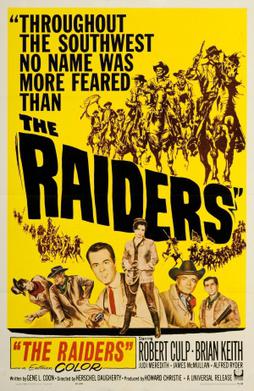
The Raiders (1963, directed by Herschel Daughtery)


In the years immediately following the Civil War, seven Texas cattleman, led by Col. John McElroy (Brian Keith), try to drive their cattle into Missouri.  The terrains proves treacherous and the local Pawnees refuse to allow the cattlemen to pass through their land without paying a hefty fee for the right.  McElroy and his followers go to Fort Hays and demands that the local railroad magnate, Huntingon Lawford (Addison Richards), extend his line into Texas.  When both Lawford and martinet Calvary officer Capt. Benton (Alfred Ryder) refuse to help, McElroy and his man start sabotaging the railroad’s western expansion.

This brings them into conflict with Wild Bill Hickok (Robert Culp), Buffalo Bill Cody (Jim McMullan), and Calamity Jane (Judi Meredith), all of whom are working for the railroad!  Hickok is an old friend of McElroy’s and Cody is sympathetic to McElroy’s cause but will they be able to broker a peace between the two sides?  When Captain Benton plans to lure McElroy into a trap where he and his friends will fired on with a Gatling gun, it’s up to Cody and Hickok to try to prevent a massacre.

The Raiders starts out as a downbeat look at a cattle drive in the years when America was still trying to rebuild from the devastation of the Civil War.  Brian Keith was one of those actors who was always ideally cast in westerns and war movies and he’s convincing as the tough but fair-minded McElroy.  If the film had just been about McElroy, it would have been a good B-western.  Instead, it brings heavily fictionalized versions of Wild Bill Hickock, Buffalo Bill Cody, and Calamity Jane into the story.  Robert Culp, Jim McMullan, and especially Judi Meredith all overact in their roles and a lot of time is wasted on subplots like Calamity Janes being in love with Wild Bill and Buffalo Bill trying to prove himself to the older man.

The Raiders started out as a made-for-TV movie and it appears that it was a pilot for a proposed TV show about Calamity Jane and the Bills.  (Brian Keith is even listed in the credits as being a “special guest star.”)  When the pilot wasn’t picked up, the film was given a theatrical release but The Raiders still has the flat look and unimaginative editing of a television show.  No matter how authentic Brian Keith’s performance might be, he can’t make up for the fact that the majority of the film was clearly shot on a studio backlot.

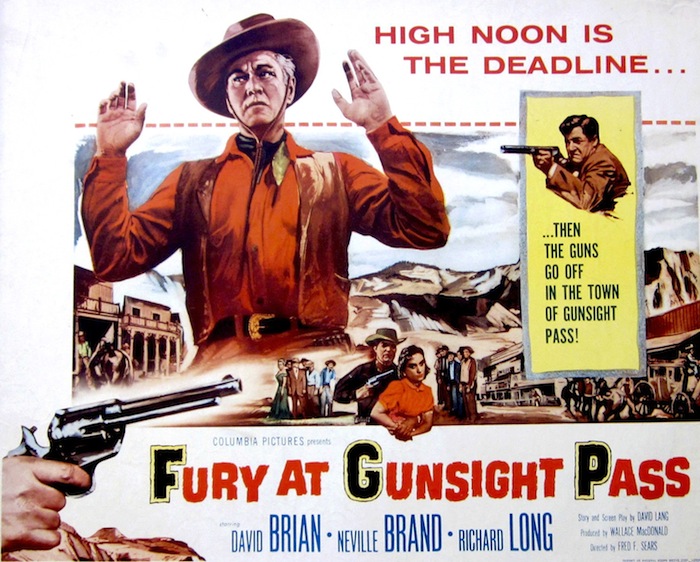
Fury At Gunsight Pass (1956, directed by Fred F. Sears)


Old west outlaws Whitey Turner (David Brian) and Dirk Hogan (Neville Brand) are plotting on robbing the bank in the town of Gunsight Pass.  They’ve even got an inside man to help them get away with the loot, local undertaker Peter Boggs (Percy Helton).  Peter is eager to make some money and get away from his nagging wife (Katherine Warren).  However, the robbery doesn’t go as planned.  Whitey attempts to betray Dirk, there’s a huge shoot out, and several people are killed, including the bank president (Addison Richards).  Whitey and his half of the gang are captured while Dirk barely escapes.

Because a satchel of money is missing, Dirk rescues Whitey from the posse and they return to the town of Gunfight Pass, determined to hold the entire town hostage until they get their money.  While a huge dust storm blows through the town, the citizens of Gunsight Pass start to turn on each other, accusing one another of having stolen the money for themselves.  The now dead bank president is accused of being a part of the robbery and it falls to his son (Richard Long) to try to not only clear his name but to also save the town from Dirk and Whitey.

Fury at Gunsight Pass is a nice discovery, an intelligent B-western that’s about more than just gunfights and money.  Though David Brian and Neville Brand are both convincing as the two gang leaders, the movie is mostly about the citizens of the town and how quickly they all turn on each other.  The citizens of this town make the ones from High Noon seem brave and supportive.  All it takes is a little fear and greed for everyone to turn on each other.  The film has such a cynical view of human nature that, in 1956, it probably couldn’t have gotten away with it if it had been anything other than a B-movie.

Fred F. Sears directed a lot of B-westerns, the majority of which were fairly undistinguished programmers.  Fury At Gunsight Pass is an exception to that rule and probably the best film that Fred Sears ever directed.  It’s a well-acted and well-directed movie that will take even the most experienced B-western fan by surprise.

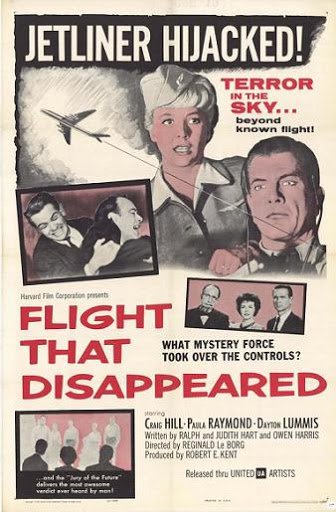
18 Days of Paranoia #1: The Flight That Disappeared (dir by Reginald Le Borg)


Way back in the early days of the site, I did a series of reviews called 31 Days of Paranoia, in which I reviewed films about mysteries, cover-ups, and conspiracies.  Unfortunately, because I wasn’t all that disciplined about posting during the early days of the Shattered Lens, my 31 Days of Paranoia ended up being something like 24 days.  Still, it was a lot of fun and, historically, it was important because it was the very first “themed” series of reviews that I had ever done.  Shattered Politics, Embracing the Melodrama, Back to School, Sprin Breakdown, and all the rest started with 31 Days of Paranoia.

So, with this being the 10-year anniversary of the Shattered Lens’s founding and Spring Breakdown wrapping itself up tomorrow, I figured why not return to where it all started.  From now til April, please enjoy …. 18 Days of Paranoia!

We begin with:

The 1961 film, The Flight That Disappeared, deals with an airplane that …. wait for it …. disappears!

What’s happened to Trans-Coast Airways Flight 60?  When it first took off from Los Angeles, everything seemed fine.  It was carrying a small but well-behaved group of middle-aged people to Washington D.C.  The pilots all seemed like good professionals.  The two flight attendants were busy serving people coffee and having conversations about whether or not one of them would ever get married.  She had every right to be concerned, of course, seeing as how she was in her 20s and still unmarried and childless, despite the fact that this film was made in 1961.

It doesn’t take too long for something strange to happen.  The plane suddenly starts to climb upward, eventually going up over 10 miles high in the sky.  The pilots can’t do anything to get the plane to come back down.  Due to the lack of oxygen, some of the passengers start to pass out.  One passenger panics and opens a door, out of which he promptly falls.  Oddly, this doesn’t create the whole vacuum effects that we always see in other movies where a window or a door is opened while a plane is in the air.  Stranger still, no one thinks to close the door afterwards.  Was this intentional or was it just crappy filmmaking?  It’s hard to say.

Why is the plane being lifted up into the air?  Could it have something to do with the three atomic scientists who are all on the plane?  One of them, Dr. Morris (Dayton Lummis), is wearing glasses and has a van dyke beard so you know he’s smart!  It turns out that Dr. Morris has been working on the Beta Bomb, which is apparently the most powerful atomic bomb ever built.  I kept waiting for someone to ask Dr. Morris why it was called the Beta Bomb and not the Alpha Bomb or the Omega Bomb or the Big Scary Bomb or the …. well, seriously, anything would be better than Beta Bomb!  Everyone in the movie says, “Beta Bomb,” in a tone that’s meant to communicate reverence but it just sounds too much like “Beta Male” for me to really take it seriously.

But, again, who is responsible for the flight climbing?  Is it the Russians?  Is it aliens?  Is it some enemy of the American way?  While everyone else on the plane is passed out, the three scientists find themselves awake.  Their watches are no longer running and, despite the fact that they appear to be alive, their hearts are no longer beating.  Are they dead?  Or have they been transported to the future where they will now be put on trial for the crime of developing the Beta Bomb?

Of course, the thing with being put on trial in the future is that it provides the perfect defense for making weapons in the present.  “Hey,” a smart defense attorney would say, “you’re still alive in the future and you’ve got time travel technology so what are you bitching about?”  But the jurors explain that they’re actually the ghosts of the people who would have been born in the future if not for the Beta Bomb which …. what?  So, is the plane in the future or is it in the afterlife?  The film itself doesn’t seem to be sure.

I’m probably making it sound like this is a more intriguing film than it actually is.  This movie is about 72 minutes long and all the stuff with the people in the future takes place during the final 10 minutes.  That means that the film is essentially just 60 minutes of people saying, “We’re still climbing.”  From a historical point of view, it’s an interesting example of people being paranoid about the arms race.  (If the film were made today, the future the ghostly jurors would be the souls of people who were not born in the future due to climate change.)  From an entertainment point of view, it’s a forgettable dud.

Horror Film Review: The Walking Dead (dir by Michael Curtiz)


In this 1936 film (which has absolutely no relation to the AMC zombie show), Boris Karloff plays John Ellman.  John Ellman is perhaps one of the unluckiest guys ever.  Seriously check this out:

John Ellman was once an acclaimed concert pianist.  However, he was wrongly convicted of killing his wife and spent ten years in prison.  Now that he’s finally been paroled, he can’t get anyone to hire him.  Meanwhile, the judge who originally sent him to prison is in the news for having defied the mob and sentenced a well-known gangster to prison.  The mob is out for revenge but, rather than take the fall themselves, they’d rather frame a patsy.  And who could be a better patsy than a man who everyone already knows has a grudge against the judge?

Nolan (Ricardo Cortez), a crooked lawyer, arranges for Ellman to be given a job.  Ellman is told that he simply has to spy on the judge for a few nights to determine whether the judge is having an extramarital affair.  Ellman agrees and soon finds himself being set up.  The gangsters kill the judge and plant the body in Ellman’s car.  Ellman is arrested and sentenced to die.  It doesn’t matter that there are witnesses who know that Ellman’s innocent.  No one is willing to cross the mafia.

Ellman is convicted and promptly executed but his story isn’t over.  A scientist named Dr. Beaumont (Edmund Gwenn, who later played the man who might be Santa Claus in Miracle on 34th Street) knows that Ellman is innocent.  He takes Ellman’s body and, through an artificial heart and a bunch of other science-y things, he manages to revive Ellman.  John Ellman lives again!  Of course, he’s a bit of a zombie now and he doesn’t have any memory of his former life.  And yet, he instinctively knows who set him up to be executed and he sets out for revenge.

What’s interesting is that Ellman doesn’t kill anyone.  Even after he’s revived and presumably has no concept of right and wrong, John Ellman remains a rather passive zombie.  For the most part, the racketeers die because of how they react to the sight of the previously dead Ellman coming towards them.  For that matter, Beaumont isn’t the typical mad scientist that you might expect to turn up in a film like this.  He’s a benevolent man who was simply doing what he thought was the right thing.  Though the film ends with a warning about playing God, one can’t hep but get the feeling that, unlike Frankenstein, the film is overall very supportive of the idea of reviving the dead.

Directed by Michael Curtiz (who also did Casablanca, Mildred Pierce, The Adventures of Robin Hood, and countless other classic films), The Walking Dead is a combination horror/gangster film.  The film’s plot is a bit too convoluted for its own good but, overall, The Walking Dead works because of Boris Karloff’s performance.  He’s poignantly pathetic as the living John Ellman and then rather chilling as the vengeance-driven, recently revived Ellman.  The film’s most effective scenes are the ones where he just stares at his enemies, fixing them with a gaze that takes no prisoners and offers no hope.  It’s a great performance that elevates an otherwise uneven film.

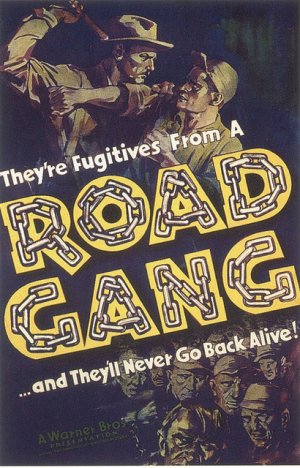
Lisa Cleans Out The DVR: Road Gang (dir by Louis King)


I was going to start this review with a quote from Gandhi: “A nation’s greatness is measured by how it treats its prisoners.”  That was something that I first heard from a perpetually stoned ex-seminarian who used to live in a trailer park in Lake Dallas.  I always figured that, being as stoned as he usually was, he probably knew what he was talking about but, upon doing research for this review, I have discovered that Gandhi actually didn’t say that.  What Gandhi said was, “A nation’s greatness is measured by how it treats its weakest members.”  Fortunately, it’s the same basic idea and, regardless of how you phrase it, it’s a quote that perfectly encapsulates the message of the 1936 film, Road Gang.

Road Gang tells the story of Jim (Donald Woods) and Bob (Carlyle Moore, Jr.).  Bob is fun-loving.  Jim is more serious and engaged to marry heiress Barbara Winston (Kay Linaker).  Jim and Bob live in an unnamed Southern state (though I’m going to assume that the state is supposed to be Georgia, just because).  Jim has just written an article that exposes the corruption of political boss, J.W. Moett (Joe King).  The article is so good that both Jim and Bob have been offered jobs in Chicago!  There’s a lot of corrupt political figures who can be exposed in Chicago!

However, while driving up north, Jim and Bob are arrested on trumped-up charges.  At first, Jim and Bob laugh off Moett’s desperation but, unfortunately, another criminal happens to be breaking out of jail at the same time that Jim and Bob arrives for booking.  That criminal kills the arresting officer and then forces Jim and Bob to drive him across the state.  Eventually, the police recapture the three of them.  However, the escaping criminal is killed and Jim and Bob are arrested as accessories.  Under the advice of their lawyer, Mr. Dudley (Edward Van Sloan), they plead guilty and accept a deal.  What they don’t know is that Dudley works for Moett and that, as a result of pleading guilty, they are going to be sentenced to five years in a prison camp.

Okay, so the film gets off to a pretty melodramatic start.  And, to be honest, the entire film is extremely melodramatic.  A lot of time is devoted to Barbara trying find evidence that Jim and Bob were set up, something that is made difficult by the fact that Barbara’s father, like Mr. Dudley, works for Moett.  Fast-paced and not-always-logical, this is a B-movie, in every sense of the term.

And yet, as melodramatic as it is, Road Gang is deadly serious when it comes to portraying the brutality of the prison camp.  From the minute that Bob and Jim arrive, they find themselves at the mercy of the corrupt warden and his sadistic guards.  The prisoners are largely used as slave labor and subjected to punishments that are often arbitrary and extreme.

Road Gang doesn’t flinch when it comes to portraying why prison often not only fails to rehabilitate but also helps to transform minor offenders into hardened criminals.  There’s a disturbing scene in which Jim, Bob, and the other prisoners are forced to listen as another prisoner is whipped.  The crack of the whip and his howls of agony explode across the soundtrack in a symphony of pain and sadism.  Jim and Bob have two very different reactions to being in prison.  One survives.  One allows himself to be killed rather than take one more day in confinement.

Road Gang is often compared to I Am A Fugitive From A Chain Gang.  Actually, beyond the theme of a fatally compromised justice system, there is no comparison.  The angry and fact-based I Am A Fugitive From A Chain Gang is a hundred times better and, quite frankly, Donald Woods was no Paul Muni.  However, Road Gang still has its moments of power.  Decades after it was made, the issues it raises continue to be relevant.  Do we send people to prison to rehabilitate them or to punish them and are the two goals mutually exclusive?  And how can we say that someone has “paid his debt to society” when, even after a prisoner serves his time, the stigma of having been imprisoned closes and locks most doors of opportunity?

Road Gang shows up occasionally on TCM.  There’s where I recorded it on January 23rd of this year.

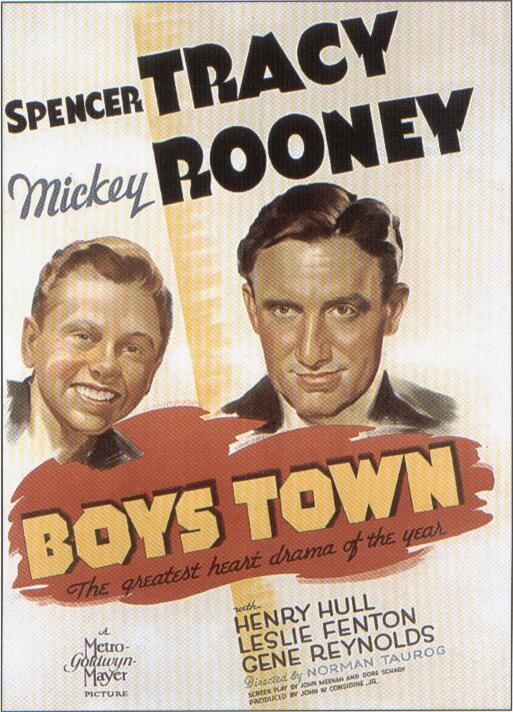
Lisa Reviews An Oscar Nominee: Boys Town (dir by Norman Taurog)


boys_town

Before writing about the 1938 film Boys Town, I want to share a story that might be false but it’s still a nice little story.  Call this an Oscar Urban Legend:

Boys Town is about a real-life community in Nebraska, a home for orphaned and homeless boys that was started by Father Edward Flanagan.  In the film, which was made while Father Flanagan was still very much alive, he was played by Spencer Tracy.  Boys Town was a huge box office success that led to the real Boys Town receiving a lot of favorable publicity.  When Tracy won his Oscar for Boys Town, his entire acceptance speech was devoted to Father Flanagan.

However, a problem arose when an overeager PR person at MGM announced that Spencer Tracy would be donating his Oscar to Boys Town.  Tracy didn’t want to give away his Oscar.  He felt that he had earned it through his acting and that he should be able to keep it.  Tracy, the legend continues, was eventually persuaded to donate his Oscar on the condition that he would get a replacement.

However, when the replacement arrived, the engraving on the award read, “Best Actor — Dick Tracy.”

That’s a fun little story, one that is at least partially true.  (Tracy’s Oscar — or at least one of them — does currently reside at the Boys Town national headquarters.)  It’s also a story that, in many ways, is more interesting than the film itself.

Don’t get me wrong.  Boys Town is not a bad movie.  For me, it was kind of nice to see a movie where a priest was portrayed positively as opposed to being accused of being a pederast.  In a way, Boys Town serves as a nice counterbalance to Spotlight.  But, with all that said, there’s not a surprising moment to be found in Boys Town.  It’s pretty much a standard 1930s juvenile delinquency melodrama.

The movie opens when Father Flanagan giving last rites to a man who is about to be executed.  (Boys Town takes a firm stand against the death penalty, which is one of the more consistent and laudable stands of the modern Church.)  The man says the he never had a chance.  From the time he was a young boy, he was thrown into the reform school system.  Instead of being reformed, he just learned how to be a better criminal.  Father Flanagan is so moved by the doomed man’s words that he starts Boys Town, under the assumption that “there’s no such thing as a bad boy.”

Father Flanagan’s techniques are put to the test when Whitey Marsh (Mickey Rooney ) arrives.  Whitey is angry.  He’s rebellious.  He tries to run away every chance that he gets and, during one such escape attempt, he even gets caught up in a bank robbery.  Can Father Flanagan reach Whitey and prove that there’s no such thing as a bad boy?

Well, you already know the answer to that.  As I said, there’s really nothing surprising to be found in the plot of Boys Town.  It’s just not a very interesting movie, though there is a great shot of a despondent Whitey walking past a several lines of former juvenile delinquents, all kneeling in prayer.  As Father Flanagan, Spencer Tracy is the ideal priest but his role is almost a supporting one.  Believe it or not, the film is dominated by Mickey Rooney, who gives a raw and edgy performance as the angry Whitey Marsh.

(That said, it’s hard to take Whitey seriously as a future gangster when he’s always wearing a bowtie.  Then again, that may have been the height of gangster style in 1938.)

Boys Town was nominated for best picture but lost to You Can’t Take It With You.