Ten Years #24: Radiohead


http://www.youtube.com/watch?v=3SZ1WpzBr9E

Decade of last.fm scrobbling countdown:
24. Radiohead (1,176 plays)
Top track (35 plays): Knives Out, from Amnesiac (2001)

It should come as no surprise that Radiohead made it onto my decade top 50 chart somewhere. The dominant album on that list might be a little less common: Amnesiac (2001) took the title with a modest margin over Hail to the Thief (2003) and OK Computer (1997). This is no accident–no single weekend of Winamp stuck on repeat. Since pretty much the week it was released, Amnesiac has been my favorite Radiohead album.

It would be a bit silly to argue that Amnesiac is their best. Just as Radiohead are too unique to really be compared to any other band, pretty much every album they’ve released since The Bends (1995) has resided in a world of its own. OK Computer certainly offers the broadest appeal, and Kid A (2000) seems to get the most praise from the more eclectic, aesthetically minded fans, but it’s the consistent vibe of Amnesiac that grabs me most. From start to finish, it glides on a sea of glass beneath an inebriated night sky. While the individual tracks are stellar at every turn, the sum of its parts come nowhere near the whole, and I can rarely bring myself to listen to them out of their intended order. There’s some calming chill that sets across the whole 45 minutes, and a spirit of motion that I did not experience again until “Bloom” (The King of Limbs, 2011).

That being said, of course OK Computer and Hail to the Thief are unrivaled masterpieces, of course In Rainbows (2007) and The King of Limbs are worlds above the average for a band late in their career, and of course The Bends redefined the limits of rock in its day. The only album in their discography that you might justifiably find some fault with is Pablo Honey (1993), and that’s only when you measure it by the standard Radiohead set and maintained for the two decades to follow. In the most general sense, weighing all factors evenly, they might rightly be regarded as the greatest band to ever exist. That’s not lofty praise; it’s an opinion that a good many experienced music critics are prepared to agree with. But to the question of how Radiohead became my 24th most listened to band of the past 10 years, and not say, my 50th, I point without hesitation to Amnesiac.
Ten Years #25: Cracker


Decade of last.fm scrobbling countdown:
25. Cracker (1,162 plays)
Top track (52 plays): Big Dipper, from The Golden Age (1996)
Featured track: One Fine Day live, originally from Forever (2002)

Most people my age have heard Cracker, but they might not remember the name. You know, Cracker, that two-hit wonder from the early 90s that wrote “Low” and “Teen Angst (What the World Needs Now)”. Like most of you, I never bothered actually picking up a Cracker album while they were popular. They only stumbled into my discography through an impulse buy when I saw their first Best Of compilation, Garage D’Or (2000), near a checkout register in Best Buy. I thought, “Oh, greatest hits? I thought they only had two,” and I picked it up to see what I was missing. For a while afterwards I was convinced that they must have had a dozen radio singles that I was just a little too young to remember, but the truth of it sank in over time: One of the greatest rock bands of my generation had slipped through the cracks.

Well, my obsession with Cracker ran for a year or two before I eventually forgot about them, and they might have been lost to me forever if I hadn’t happened to find myself in San Antonio, Texas, with a car for the first time in two years and nothing better to do with it. I did a last.fm search on upcoming gigs in Austin, saw Cracker were playing that evening, and took off. Any band would have sufficed, but these guys blew me away. Their performance defied anything you might expect out of aging rock stars. With an intimate connection to the music and the audience, it was as if they had just recorded the material yesterday; They were overlooked American legends in their prime playing in a venue small enough to make eye contact. To top it off, they even offered a tip of the hat to a semi-local country legend. (They covered Ray Wylie Hubbard’s “Up Against the Wall, Redneck Mother”.) I’ve gone out of my way to catch Cracker live every time they’ve played near me since, and I’m never disappointed.

I will never know why Cracker were not as successful as Pearl Jam or Tom Petty or any of the other rock legends I grew up with, because I honestly think they’re on par. David Lowery’s lyrical whit and sardonic vocals pair up perfectly with Johnny Hickman’s tasteful blues rock guitar to create one of the most readily identifiable and creative duos in the business.

Song of the Day: Tool – H.


http://www.youtube.com/watch?v=3iXMhphebGI

For those of you who have yet to get the memo, music industry giants in 2013 decided that it was time for the 1990s to be cool again. I’m pretty goddamn stoked about it myself, and I hope the sort of neo-grunge/alternative that’s going to be really popular 3-4 years from now inspires a lot of talented musicians to crawl out of the woodwork and start producing quality uncastrated rock again. In the meantime, I’ve been dusting off my neigh-forgotten guitar and revisiting a lot of the bands from my high school days to see if they were really as great as I remembered. (Alice in Chains? Check. Rage Against the Machine? Holy mother of Check. Sublime? Bzzzz, back to the “nostalgia” m3u and dusty jewel case with you.)

There have been a few 90s bands that never really left my playlist all this time. Smashing Pumpkins’ catalog from Siamese Dream though Machina kept on rolling like they were all just released yesterday. Pearl Jam and Nirvana still found their way into Winamp from time to time. And I never quit listening to Tool. My Tool selection for the past decade though has consisted almost exclusively of the Opiate EP and Undertow–those nostalgic recordings that were inevitably rolling in the background every time I ever skipped school to play paintball, experimented with a new drug (I haven’t done any “drugs” since high school, but I must say tripping on shrooms completely changed my perspective on life in a positive way), or got drunk when it was still a novel experience.

When I was a teenager though, it was never Opiate or Undertow that I listened to at home. They were the party albums that all of my friends would play ad pleasant nauseam. In private, I listened to Ænima. I’d all but forgotten about it until a week ago. I’ve kept it on repeat while engaging in the oh-so-rebellious task of remodeling my kitchen, and wow… Fast-forward from having naively experienced a few hundred mass-marketed bands to having researched and intelligently engaged thousands of different acts, I have to say Ænima remains one of the greatest recordings I have ever heard.

Right now I’m peaking on Pushit. It was, alongside Jimmy and Third Eye, one of the tracks I pretty much ignored as a kid, and I’m now hearing it in a new light as one of the most overwhelming tracks on the album. I want to showcase H. though, because it was my favorite Tool song prior to the release of Lateralus (the way I connected with the lyrics to Lateralus’ title track at the time is difficult to describe and sadly lost to me now), and because I do still regard it as my favorite track on the album (Ænema comes pretty close).

The way Maynard’s vocals interplay with the instrumentation is absolutely beautiful; I think Ænima represents Tool’s peak as innovative song-writers, bridging the gap between their earlier edginess and their later brooding experimentalism, and no song captures that quite so extensively as H. The crushing chorus acts as cement to piece together Maynard’s vocals and Adam’s guitar at their most mutually fragile peak. The lyrics present a simple clash between emotions and wisdom under a veil so deliciously esoteric that it might feel personally and uniquely relevant to each individual listener in a legitimately different way:

What’s coming through is a lie.
What’s holding up is a mirror.
What’s singing songs is a snake,
Looking to turn my piss to wine.
They’re both totally void of hate,
But killing me just he same.
The snake behind me hisses what my damage could have been.
My blood before me begs me, open up my heart again.
And I feel this coming over like a storm again.
Venomous voice tempts me, drains me, bleeds me,
Leaves me cracked and empty,
Drags me down like some sweet gravity.
The snake behind me hisses what my damage could have been.
My blood before me begs me open up my heart again.
And I feel this coming over like a storm again.
I am too connected to you to slip away, fade away.
Days away I still feel you, touching me, changing me,
Considerately killing me.
Without the skin,
Here beneath the storm,
Under these tears,
The walls came down.
At last the snake has drowned,
And as I look in his eyes,
My fears begin to fade,
Recalling all of the times
I could have cried then.
I should have cried then.
As the walls come down,
And as I look in your eyes,
My fear begins to fade,
Recalling all of the times
I have died,
and will die.
It’s alright.
I don’t mind.
I am too connected to you to slip away, fade away.
Days away I still feel you, touching me, changing me,
And considerately killing me.

Ten Years #41: Our Lady Peace


Decade of last.fm scrobbling countdown:
41. Our Lady Peace (765 plays)
Top track (30 plays): Angels Losing Sleep, from Healthy in Paranoid Times (2005)

We are all entitled to a guilty pleasure or two. I would humor calling Our Lady Peace mine, but only if we agree to restrict their cause for lameness to the lyrics. Their popularity, especially as those “Canadian softies” emerging amidst much heavier U.S. trends, overshadows the fact that they are absolutely amazing. Raine Maida’s voice is capable of making anything sound great, and capable of making me not give a shit about singing a falsetto at the top of my lungs at traffic lights with my windows down. Even as I was signing the final divorce papers with my radio in the late 90s and letting my affair with Napster and heavy metal be known, I was probably listening to 1999’s Happiness…is Not a Fish That You Can Catch more than any other album on the market. I’ve definitely listened to it more than most other 1990s albums–even the grunge greats–in my more informed years to follow.

How people have experienced OLP over the years probably varies drastically depending on where you’re from. The late 1990s and early 2000s marked the final days of musical segregation, with Americans barely having a clue who Radiohead, Blur, and Muse were. (Didn’t one of them do that “woo-hoo” song?) The U.S. and Canada were a bit more in sync, but Our Lady Peace was definitely not the overhyped megaband down here that my Canadian friends recall. They were just “that band that did Clumsy and Superman’s Dead”. The singles on Happiness received minimal air time, and the only song since that I’ve really heard extensively here was “Somewhere Out There” (Gravity, 2002). (I can’t honestly speak for their last three albums of course. Maybe “Angels Losing Sleep” was huge–it deserves to be–but I hadn’t listened to mainstream radio in years by then.) My main point here is that, while OLP might have been played to the point of annoyance in Canada, down here they were presented modestly enough to not face serious media pollution. I had a better opportunity to engage them by choice–and choose which songs I liked best.

Our Lady Peace are a band that has definitely catered to the radio single. Even on their first album, Naveed (1994), a few tracks stood out as decisively more catchy than the status quo. Their albums by and large are never perfect; there are plenty of second-rate tracks in their discography. What they have really accomplished throughout their career is a consistency of top-notch quality among the handful of main focus tracks they produce for a given album. They are a band better set to a playlist, and even as recently as Burn Burn in 2009 they’ve pumped out new material worthy of that mix. (“Signs of Life”, “Paper Moon”–featured above) Happiness…is Not a Fish That You Can Catch remains, I think, their best album by far, because it is the only one for which I can safely say there are no downer tracks. Every song on that album could be a single. But I really do enjoy the full discography, and I have a tendency to queue it up from start to finish when I’ve got a long project to work on at home. Something about the more ho-hum tracks projects a sort of humility on the big picture–the sense that these guys are down to earth, not supernaturally brilliant in the sense of contemporaries like Smashing Pumpkins and Pearl Jam. Their lyrics are frequently incredibly lame, but that’s the only major fault I hear in a band that was perhaps a bit too successful to be appreciated for their real worth.

Our Lady Peace: a guilty pleasure? Maybe, but I’ll keep singing along.

Review: Torche – Harmonicraft


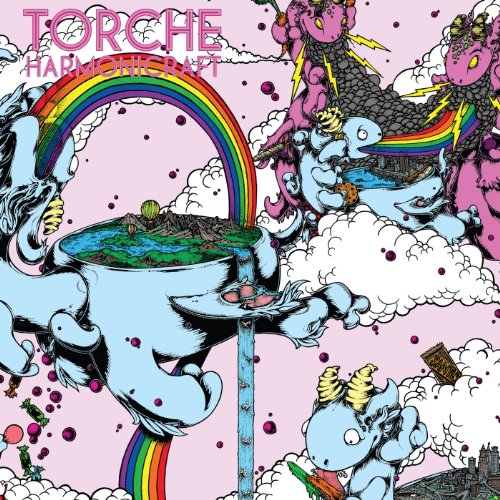
In 2008, I thought of Torche as the most poppy stoner metal on the market. By 2012, the attributes have reversed. You won’t hear anything quite as doomy as Meanderthal’s title track, Pirhaña, or Sandstorm. That crushingly deep guitar still accompanies most of the tracks, it just doesn’t ever become the drawing point of the songs. On Harmonicraft, a catchy melody is job number one, and the results are tremendously effective. From the cover art on down, this is and will likely remain one of the most instantly appealing albums of 2012, and it exhibits a sort of songwriting ethos which hasn’t been very prevalent since the 90s.

Harmonicraft’s introductory song, Letting Go, certainly doesn’t mesmerize the way Triumph of Venus did. But unlike Grenades, Kicking requires no epic lead in:


Kicking

Kicking introduces what will be the style and attitude for the entire album, and it amounts to nothing short of 1990s alternative rock. That occasional Foo Fighters vibe Meanderthal gives off was no accident, but it wasn’t necessarily a product of any direct “influence” either. I think the similarities you might draw to various 90s bands result from Torche’s mindset. Calling Torche “90s rock” is a little ambiguous of course, this being 2012. I suppose one could more directly observe that they took a stoner/post-rock sound and made it bright and bubbly, leading to a sort of “stoner pop” novelty. But when you apply the term “pop” to anything but teen idols you’re being just as vague, and furthermore, though Harmonicraft might seem new from a stoner metal perspective, it feels to me refreshingly nostalgic.


Snakes Are Charmed

Frankly, attempting to categorize Harmonicraft does it a disservice. It’s not a band trying to perfect or expand upon x musical style. It expresses more freedom than that. It harkens back to a time when heavier bands emphasized their own individuality, genres be damned. And that’s why it reminds me of rock in the 90s. I wouldn’t even call it metal, any more than I would call Nirvana or The Offspring punk. And as such, I think it stands at the forefront of music today.

The new standard is synthesis. Metal has been pulling it off lately, especially last year, with bands like Falconer putting a professional gloss on the best of many sub-genres rolled into one, while Liturgy, Deafheaven, and company were forging a more personal if sometimes less formidable approach to the same. Here, Torche are bringing it back to rock. Songs like Snakes Are Charmed have all of the immediate appeal of an instant radio staple, yet rather than repeating something stale, they reinvigorate rock through their more contemporary roots. You hear the stoner/doom and post-rock influences not as those styles, but rather as integrated elements of what it is to be a good rock band. The 90s took the metal and punk subspecies defined in the 80s and made it happen. Now here’s a band getting the job done with musical developments of the last 10 to 15 years.

If there’s any one band I could really compare it to, I’d say Boris.


Walk It Off

I actually forgot that Torche and Boris released a split in 2009 and toured together until after I drew the connection. In Walk It Off the influence is most apparent. Wata’s style is hers alone, but you can definitely feel the sort of inspiration she brings bleeding over into Steve Brooks’ own solos. (Or perhaps Andrew Elstner’s. I don’t actually know who plays lead.) But perhaps even more noteworthy, the more I listen to this track the more I feel that, above all else, the solo really resembles Billy Corgan.


Roaming

And this all amounts to a really awkward way of going about an album review. Sometimes that’s inevitable. No amount of describing Harmonicraft from a metal perspective can do it justice, because it really isn’t a metal album. It is, on the one hand, an immediately and undeniably appealing compilation of catchy tunes which utilize various recent musical movements, mostly within the metal sphere of influence, to accomplish the delivery, and on the other hand, a sign of hope. It excites me to see that this trend towards emphasizing synthesis instead of genre expansion is beginning to spill out of metal and into more accessible rock. I’ll be disappointed if Harmonicraft ends up my favorite album of the year. It’s not that kind of album. It bears no strong message in and of itself–lacks the depth of a masterpiece. But if it could, by some twist of fate, become 2012’s most influential creation, I’d not complain.