The dream has to end somewhere. Science fiction seems to agree on that. Futuristic technology produces what biology could not: logic-based systems so functional and adept at survival that humanity becomes obsolete. Whether we assimilate into a borg colony or a zerg hive mind, imagination is pretty screwed. Our best bet might be something like The Matrix. Perhaps some utility will compel our robot overlords to spare the sheep who spawned them. Yay!
I cannot say what it must feel like to be enslaved by a post-human species, but I fancy it would sound a lot like the 777 trilogy by Blut Aus Nord. Between 2011 and 2012, these French black metal legends offered up a journey through a world that was beyond dystopian. Discordant melodies and unorthodox rhythms taken to the extreme are usually a recipe for disaster–the tools of technically proficient but creatively deprived math rock and avant-garde musicians I would only listen to under duress. Blut Aus Nord masterfully avoided that pitfall by envisioning a coherent aesthetic framework and driving the music forward as a consistent conceptual progression across 18 tracks. Radical experimentation joins forces with dark industrial grooves to place the listener in a futuristic, post-human world where mechanical gods rule apathetic over mortals bred in gestation crates.
The trilogy does not actually offer any textual insight into what its world is supposed to be. The minimal lyrics are highly esoteric, and Blut Aus Nord ultimately leave it to the instrumentation to tell their tale. You might not experience it as a futuristic world at all, but rather as some bleak corner of hell from which a lost soul digs through the madness and witnesses his overlord. But as far as it speaks to me, the 777 trilogy is the vision of a feckless human slave awakening from his dream into terrifying, incomprehensible world. He slowly comes to understand his master and, perhaps, ultimately assimilates into the hive mind. The final track, “Epitome XVIII”, is a grim, cold trance in which a soulless machine reigns on triumphant.
I am definitely not a time-honored, faithful fan of Blut Aus Nord. They managed to evade my radar for over 15 years before the 777 trilogy brought them into the broader spotlight. Sect(s) impressed me from the start, but in a twisted, bewildering way that was not necessarily enjoyable. It was a car accident you slowed down to gawk at in spite of your better judgment. It was a disturbing feast of dementia. I did not hop on The Desanctification right away, naively expecting more of the same, and it was only with Cosmosophy that I finally caught on to just how intelligent and creative Blut Aus Nord could be.
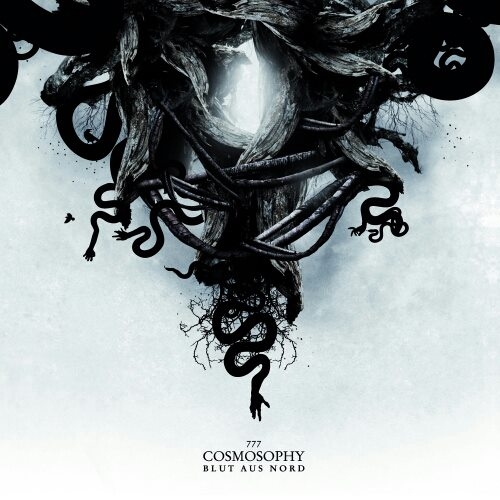
I didn’t go back in time and pick up their classics, but I did eagerly await their next album with zero assumptions about where it might go. This seemed like a band that could do anything they set their mind to, and judging by Kristian Wåhlin’s cover art, it would be something fairly distinct from 777.
Blut Aus Nord – Paien, from Memoria Vetusta III – Saturnian Poetry
What I found was an album that kept a lot of basic elements intact, but, sure enough, sounded nothing like 777‘s cyberpunk journey through a hellspawn-ridden hive mind. Saturnian Poetry feels like much more traditional black metal on the surface, though you will be hard pressed to write it off as such. It takes about five seconds to realize that the blurred tremolo will not be content to loop into any stereotypical black metal monotony. The song jerks upward in a frantic fit, and by the 40 second mark we’re already on to a new rotation. Celestial keyboard “aaahhhs” and a barely sane pattern of motion rip your eyes wide open, and the clean, ethereal vocals at 1:20 tower above as an apathetic higher being uninterested in quelling the chaos beneath it. When the blast beats and constant motion do break, it is never long enough to calm the mood. It is an avant-garde, progressive approach to black metal that I can only compare to Krallice, only where they remain raw and brutal to a fault, Blut Aus Nord mellow out the drumming and keep the eye of a graceful keyboard looming ever above you.
You are being watched as you thrash about into empty space as hard as steel. We don’t know what that eye wants, but we sometimes catch a glimpse of its perspective, as at 5:10, as the beat slows to a plod and the sweeping guitar takes in a vast vision far beyond your natural senses.
Blut Aus Nord – Metaphor of the Moon, from Memoria Vetusta III – Saturnian Poetry
Blut Aus Nord is a band you can sense beyond the limitations of your ears. That was something that struck me from the first time I ever listened to Epitomes 1 and 2 on Sect(s). Where so many experimental black metal bands aim to invoke a feeling, Blut Aus Nord paint a sensory world. The motion of the guitar is so pronounced that you feel the notes cascading around you. Metaphor of the Moon opens amidst a tornado, everything spiraling downward in a rush of energy that encircles you. Wherever their songs might be headed, I tend to feel trapped within them in body–some twisted wonderland where keyboard and clean vocal spirits gaze upon me and invisible forces and amalgamations of lead guitar swoop all around, discernible only through some super-sense that informs me of their presence without ever forming a solid image.
But if I had to pick a fault in Saturnian Poetry, it would be the overly traditional percussion. Beats carried the day in the 777 trilogy. The band’s experimentation with unconventional drum tones added the final layer needed to complete the unique quasi-physical world of their music. On Saturnian Poetry, the lack of this element serves as an occasional reminder that I am, after all, only listening to a song. “Metaphor of the Moon” is the track that seems to extend beyond my attention span the most, at least to a point. I can latch on to it at just about any moment if I choose to, but it sometimes fails to hold me long without some effort on my part.
Blut Aus Nord – Clarissima Mundi Lumina, from Memoria Vetusta III – Saturnian Poetry
That being said, these guys are a clear cut above the vast majority of their competition in the black metal scene. It is hard to believe that France, once known for the raw and unadorned acts of Les Légions Noires, could give us three of the most significant post-black bands of our time, but Blut Aus Nord, Peste Noire, and Alcest surely stand as a triumvirate of progression and experimentation in 21st century metal. Saturn Poetry will never top the 777 trilogy in my books, and generic drumming is to blame first and foremost. Yet I’ll not soon forget a closing track like this–the listener sacrificing himself to madness, screaming towards that eye above, catching unintelligible glimpses that only make his violence more desperate. It never ends, never finds resolution, just continues to implode in perpetual waves of self-destruction. I don’t know that the song, or the album as a whole, has any clear passage. There is no apparent journey here or grand enlightenment at the end, though perhaps I ought to find the first two Memoria Vetusta albums before I pass judgment. Either way, Saturnian Poetry is another shattered window into that twisted, imaginative world that only these French masters can conjure. Whether I see in it precisely what the band intended or not, I definitely see something words cannot easily describe.
This is embarrassing. Here it is 2013, and my 2012 collection consists of only 38 albums, the majority of which I’ve listened to twice at best. I never heard the new Neurosis. I never heard the new High On Fire. Hell, forget metal, I didn’t even listen to the new Shins and Godspeed albums. I can’t offer an experienced, informed opinion now the way I could at the end of 2011. But I’ve been posting up some sort of album of the year list somewhere for over a decade now, and I’ll be damned if I let the fact that I didn’t really listen to any albums in 2012 stand in my way.
Or something like that. Here we go.
10. Dawnbringer – Into the Lair of the Sun God (track: IV)
It’s not often I get into a standard heavy metal album, but Dawnbringer did everything right in 2012. The songs rock along with a bit of an Iron Maiden drive to them, the power and black metal tendencies are tastefully incorporated to enhance the drive without altering the vibe, and the vocals know their limit. If it sounds a bit generic, don’t let that fool you. Not too many bands can pull this off without giving into the temptation to be more “epic” or “extreme” than they really are. Dawnbringer pull it off without the flare–without ever going over the top–and their accessibility places Into the Lair of the Sun God among the best of the year.
9. Korpiklaani – Manala
I wouldn’t say Hittavainen was the heart and soul of Korpiklaani, but he was an essential component. The band would be at a total loss without Jonne Järvelä, and their consistent line-up over the years has contributed enormously to their success, but Juho Kauppinen’s accordion aside, the folk instrumentation was almost all a product of Hittavainen. When he left due to health issues after Ukon Wacka in 2011, I feared it was the end of an era. Korpiklaani never missed a beat recovering from the loss in 2012. In addition to picking up the highly qualified Tuomas Rounakari as their new violinist, Jonne Järvelä stepped up to fill in the void by recording the mandolin, flute, and whistle tracks. I think I can hear some nuance differences between his and Hittavainen’s playing style, but it might just as well be in my head; Manala sounds like a Korpiklaani album through and through. I don’t like it as much as Karkelo and Ukon Wacka–it’s a bit heavier, too much so for my taste in folk metal–but in the greater sphere of Korpiklaani’s discography it is certainly composed and performed to par.
8. Ensiferum – Unsung Heroes
Ensiferum took a lot of slack for this album. I think a lot of people wanted to hear the over-the-top bombast that worked so effectively on Victory Songs, but in my opinion that was already growing stale on From Afar. Unsung Heroes is down to earth in a way they haven’t been since the 2001 self-titled debut, and I love it. They’re heading in exactly the direction I’d hoped for, and with the exception of the ugly mistake that is the album’s 17 minute closing track, Power Proof Passion, Unsung Heroes does not sound at all like a band past their prime. If they continue to push in the direction of tracks like Pohjola, they’re in position to trump Victory Songs and follow up Unsung Heroes with their best album to date.
7. Wodensthrone – Curse
I wish I’d taken the time to review this album earlier in the year, because I haven’t listened to it since the summer, and their flavor of epic black metal isn’t the sort of thing you can fully absorb in a quick last-minute listen. This is an album that can move nowhere but up in my charts over the months to follow, but for the time being I am content to place it somewhere in the middle. While busting out black metal that’s just as grim and unforgiving as the 1990s greats, Wodensthrone manage to infuse a tremendous amount of emotion that speaks of something beautiful hidden beneath the chaos. It’s buried a bit deeper than say, Femundsmarka by Waldgeflüster last year, but the feeling is similar.
6. Vattnet Viskar – Vattnet Viskar EP (song: Weakness)
If someone were to ask me what black metal sounded like in 2012, I might hand them this EP. It’s kind of cool getting to say that, because one of their members is a regular at the music forum where I get most of my recommendations. I wouldn’t have guessed back in March that they would be signed to Century Media by the end of the year, but I’m stoked to hear it. The whole notion of post-black metal has taken on a number of different flavors in these formative years, and Vattnet Viskar expand the genre by incorporating a lot of the all-encompassing guitar tones I associate with post-rock acts like Mono and This Will Destroy You. Top-notch stuff that’s really at the forefront of an emergent genre I’ve been anticipating for years.
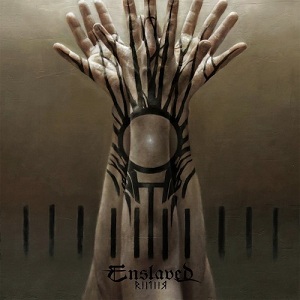
5. Enslaved – RIITIIR
How Enslaved have aged so well is beyond me, but their last three albums have been their best three albums, and 22 years after the formation of this band they remain at the forefront of metal. Their viking-infused progressive black sound of late has done as much to shape the future of the genre as any new-found participant in the current popular trend towards black metal that has been taking shape over the past four years. RIITIIR is another outstanding output by the one classic early 90s black metal band that has managed to weather the ages unscathed.
4. Blut aus Nord – 777: Cosmosophy
The review I wrote of 777: Cosmosophy last month was one of the most thorough I’ve done all year, and there is nothing I care to say about the album that I haven’t said already. It is outstanding in its own right, but it does not feel like an entirely complete finale to their already classic 777 series. The first and third tracks, breathtaking though they may be, don’t seem to sufficiently progress from where the second album in the trilogy, The Desanctification, left off. The second track moreover, Epitome XV, is the weakest link on all three albums. The last two tracks compensate greatly by concluding in proper form, and I certainly think Cosmosophy is excellent. It can only be said to have “shortcomings” in so far as I expected it to be the best album of 2012. Fourth place isn’t too bad.
3. Torche – Harmonicraft (song: Reverse Inverted)
Calling Torche metal at this point is really pushing the limits of the definition. Since their early days writing crushing stoner anthems, they have evolved into a bizarre amalgamation equal parts metal and pop. But it’s not just the uniqueness of the happy, smiley-face hammers Harmonicraft beats you down with that makes it so appealing. Torche have become by all rights the heirs of the 1990s. These guys have more in common with the Smashing Pumpkins than they do with any of their stoner metal contemporaries. This is the sort of thing that 15 years ago we could have just labeled “alternative rock” and gone on enjoying without any need for classifications. While forging an entirely unique, original sound of their own, Torche have managed to capture a song-writing ethos that has been dead for a generation, and Harmonicraft is the cleanest breath of fresh air I’ve inhaled in years.
2. Krallice – Years Past Matter (song: Track 2)
Krallice is my favorite band making music today, and I dare say last year’s Diotoma might be my favorite album by any band ever. Seldom if ever has a band followed up such a masterpiece with something of equal worth, and I was shocked that Krallice had the energy left to release anything at all this year. Years Past Matter is an outstanding post-black metal outing in the vein of Dimensional Bleedthrough. The tracks took longer than usual to grow on me, and usual for Krallice entails dozens of listens, but the payout is always worth the time, and the slow process of appreciation is enjoyable in its own right. Mick Barr and Colin Marston’s dual tremolo is the grand ultimate ear-candy, and so long as they never compromise their commitment to that they will probably remain my favorite band. (Track 3 is my favorite song on Years Past Matter so far, but it was not available on youtube. Track 2 is a worthy substitute.)
1. Panopticon – Kentucky (song: Killing the Giants as They Sleep)
The fact that I didn’t review this album is almost embarrassing, because much like Aesthethica by Liturgy last year, it is an album that absolutely demands a thorough investigation to properly appreciate. I can’t easily tell you why I placed it this high, because frankly I don’t know yet myself. When I first read that a Louisville, Kentucky-based band called Panopticon had released a bluegrass black metal album, all sorts of thoughts ran through my head. Kentucky sounds like none of them. Do ignore the cliche “blackgrass” labels; while Austin Lunn listened to plenty of bluegrass in the process of recording this, he does not actually incorporate the genre as we might think of it. Instead he interweaves traditional Appalachian folk–not bluegrass particularly–as distinct tracks separated from the black metal. What folk does emerge in the bm is more akin to Waylander, and certainly far from “bluegrass”. That’s not a bad thing, just an–I think–important distinction to be made, because otherwise we might be left searching for genre stereotypes which simply aren’t present here. What Kentucky really accomplishes is a merging of a musical themes which perfectly juxtapose a beautiful landscape and a totally destitute human condition. The first half of “Killing the Giants as They Sleep” for instance generates landscape imagery with a degree of effectiveness similar to Femundsmarka by Waldgeflüster. (Have I referenced that album twice now? I think it’s time I paid it another visit.). You take a look around, take a deep breath, and really appreciate the natural beauty that surrounds you. About half way through the dialogue begins, and the explosion around 9:15 serves to draw you fully into the atrocities taking place here, both in the exploitation of workers and the desecration of the environment.
I don’t think Austin Lunn intended to make any sort of political statement here, but in succeeding so comprehensively to depict elements of Appalachia and its outskirts, he effectively did so. At a time when the working class of America is inexplicably becoming staunch supporters of big capital, this album hits a bulls-eye on all of the thoughts that have been forefront on my mind of late. His bleak renditions of union anthems like “Which Side Are You On?”, recently covered with such optimism by the likes of Dropkick Murphys, strike me as a painfully realistic reminder that the entire notion of equality as an American ideal is becoming antiquated.
But that might be seen as secondary. Wherever our ideas may lead us, Kentucky is the sort of album that inclines us to form them. It’s an album that makes me think. Like Aesthethica by Liturgy and Diotima by Krallice last year, it forces me to set aside my mundane daily routines and really engage the human experience. That alone, all other considerations aside, suffices to render it my favorite album of 2012.
Blut aus Nord generated a lot of waves in the metal scene last April when they released Sect(s), the first installment in their 777 trilogy. The album was a gripping ride through a vivid musical nightmare, merging industrial music and a particularly demented take on black metal to paint its demon-ridden post-apocalyptic landscapes. The Desanctification, released in last November, flew much lower under the radar. Lacking all of Sect(s)’s shock value, it was a more contemplative plod which capitalized on the industrial side of their 777 sound and presented the devastation inflicted first-hand on Sect(s) from a less intimate angle. If the listener was the victim on Sect(s), Desanctification offered the role of witness.
Cosmosophy, the final installment in the 777 trilogy, was released this September, and a lot hinged on it. Sect(s) and The Desanctification were drastically different and yet inseparable, the second naturally flowing from the first. How did Blut aus Nord intend to bring it all to an end?
In the very last way anyone could have ever expected: They repeated the exact same thing they did on The Desanctification. It’s a brooding, visually stunning bird’s-eye view of a cyberpunk holocaust, and as such it’s just as outstanding as its predecessor. But where is it going?
If Blut aus Nord released two albums like this every year they might well become my favorite band. I’ve been dying for this kind of material, and The Desanctification and Cosmosophy both fill that niche with a degree of excellence that surpasses all other attempts I have heard. But I guess for me the 777 series was telling a story, vague though it need necessarily be, and Cosmosophy just kind of waves that off. It’s an outstanding album in its own right, but it does not feel appropriate in the context of the trilogy.
Epitome XVII and XVIII are somewhat of an exception,and they’re the tracks I’ll be sampling here. XVII has a definite sense of conclusion about it. It’s not an optimistic one, especially given the lyrics–“How many seasons beyond this sacred life? How many treasons beyond this clever lie?” But the feeling is one of profound revelation, as if the listener in this nearly wordless narrative has finally come to see the grand vision we were all hoping Cosmosophy would offer. The transition that spans from about 4:20 to 6:20 is pensive, serving to reintroduce the darkness that resolution has by no means abated. As this fades and we reach the final track in the trilogy, you can definitely see the story coming to an end:
Epitome XVIII is one of the finest of those bird’s-eye perspectives on the greater 777 landscape, and in its context it offers something of a new, esoteric light on the devastation below. The outro that begins to fade in after the 7 minute mark is the perfect conclusion and perhaps the darkest moment in the entire trilogy, epic in its silence. Of Cosmosophy’s two concluding tracks I have no complaints. It’s the first three that get us there that leave a lot to be desired.
If you care to revisit The Desanctification, it ends on a completely twisted industrial groove that offers all of the madness of Sect(s) without any of the fear–a sense that the subject (the listener) is breaking down into utter insanity, becoming a part of the surrounding chaos. I desperately wanted Cosmosophy to pick up on this note. I wanted to hear a merging of Sect(s)’s black metal and Desanctification’s industrial that, if you’ll humor my manner of description, merged the victim and the witness into one. I expected a juxtaposition of the sweeping landscapes and the frantic madness that could, in the context of the trilogy, depict a sort of out of body experience in the subject/listener. Epitome XIV and XVI instead feel like unused (though equal) tracks from Desanctification, while XV offers three minutes of obnoxiously spoken French which quite frankly fails to invoke anything but annoyance before plunging into an outstanding but compromised semi-operatic sweep that could have found a place on the album but lacks appropriate context as presented.
Epitome XV is the only track I dislike in the trilogy, while XIV and XVI seem out of order. In the meantime, I feel like an essential step between Desanctification’s XIII and Cosmosophy’s XVII is missing. In short, Cosmosophy does not live up to my ridiculously high expectations. If Blut aus Nord were to come out with a surprise Part 4, I certainly would not deem it overkill. But if we view Cosmosophy as just another 2012 metal album there is hardly room to complain. It is only in light of the standard set by Sect(s) and The Desanctification, and in expectation that the conclusion ought to be the 777 trilogy’s finest hour, that it slightly disappoints.



 Through the Shattered Lens