The TSL’s Grindhouse: Pumpkinhead (dir by Stan Winston)


Originally released in 1988, Pumpkinhead has always struck me as being one of those films that more people remember hearing someone else talk about it than have actually sat down and watched.  

I think that’s because it has such a great title.  Pumpkinhead!  That’s not a title that you’re going to forget and it conjures up all sorts of scary images.  If you hear someone mention that title, it stays in your head.  It’s an easy title to remember and it’s also an easy title to turn into a macabre joke.  If, on Halloween night, you and your friends hear a sound in the house, you can always say, “It must be Pumpkinhead!”  Everyone will laugh, regardless of whether they’ve seen the film or not.  It’s kind of like how everyone knows what the Great Pumpkin is, even if they’ve never actually watched the old cartoon.

As for the actual film, it’s a mix of monster horror and hick revenge flick.  It’s one of those movies where a bunch of dumb city kids do something stupid while driving through the country and, as a result, they end up having to deal with a curse and a monster. 

Ed Harley (Lance Henriksen) is a widower who owns a grocery store that is pretty much sitting out in the middle of nowhere.  Seriously, you look at his little store sitting off the side of a country road and you wonder how he makes enough money to feed his family.  Of course, the store’s location isn’t the only problem.  The other problem is that Ed seems to instinctively mistrust the few people who do stop off at the place.  Even if I lived near there, I probably wouldn’t want to shop at that store because I know Ed would glare at me and make me feel like I was doing something wrong.

However, a group of dumbass dirt bikers do stop off at the store.  And then they decide to drive their dirt bikers around the store while another member of the group takes pictures.  Unfortunately, the dirt bikers run over Ed’s son, little Billy.  The dirt bikers flee the scene, heading to their cabin.  Ed meanwhile goes to the local witch and asks her to summon …. PUMPKINHEAD!

After a lengthy ceremony, Pumpkinhead shows up.  Because Pumpkinhead was directed special effects maestro Stan Winston, he’s a very impressive creature.  He looks something like this:

You may notice that Pumpkinhead doesn’t actually have a pumpkin for a head but no matter!  It’s still a good name and when your monster looks like that, he can call himself whatever he wants.

Anyway, Pumpkinhead tracks down and starts to kill the people responsible for the death of Billy.  Unfortunately, it turns out that Ed experiences each murder along with Pumpkinhead and he quickly has a change of heart.  The witch tells him it’s too late.  Pumpkinhead will not stop until everyone’s dead and if Ed tries to interfere, Ed will die as well.

It’s a clever-enough idea, a filmed version of one of those old legends that you occasionally hear about in the country.  It’s a good thing that the monster is really, really scary because his victims are pretty much forgettable.  Some of them feel bad about killing Ed’s son and some of them don’t but it’s hard to keep straight which is which.  They’re just too bland.  As a result, their deaths don’t really generate any sort of emotion, good or bad.  They’re just there to be victims.  The only person your really care about is Ed but that’s mostly because he’s played by Lance Henriksen and Henriksen is one of those actors who can bring almost any character to life, regardless of how thinly-drawn that character may be.  Henriksen has a built-in authenticity.  Since he’s clearly not a product of the Hollywood publicity machine but is instead someone who obviously lived an interesting life before he ever auditioned for his first film, you believe in Henriksen’s performance even when the script betrays him.  You believe that he owns that store, even though the store seems to be in the worst location ever.  When he mourns Billy, you believe it.  When he tries to stop Pumpkinhead, you believe that as well.  What little humanity that there is to be found in the film is almost totally the result of Henriksen’s performance.

So, give it up for Lance Henriksen and give it up for the scariness of Pumpkinhead and also give it up for director Stan Winston, who came up with enough horrific visuals that it almost made up for his apparent lack of interest in the film’s human characters.  Give it up to for a little-known character actress named Florence Schauffer, who is properly creepy as the local witch.  Pumpkinhead is a good film to watch with your friends on Halloween, even if the title monster doesn’t really have a pumpkin for a head.

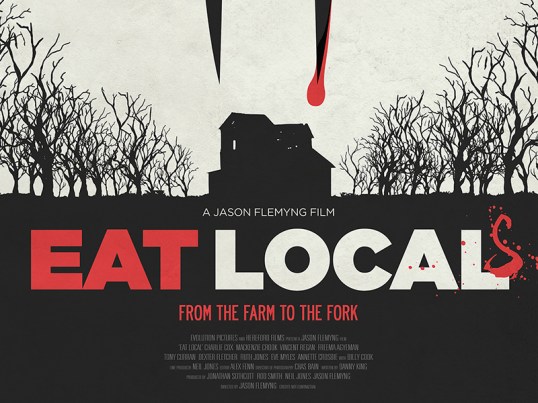
The TSL’s Grindhouse: Eat Locals (dir by Jason Flemyng)


Every fifty years, the top vampires in the UK gather in one location.  They discuss their upcoming plans.  They settle old scores.  They make peace or declare war.  Actually, I’m perhaps giving them a bit too much credit.  Judging from the 2017 film, Eat Locals, they spend most of their time being bitchy and plotting against each other.  Vampires are apparently not the easiest creatures to get along with.

Their latest meeting is taking place at a farmhouse out in the country.  In theory, the farmhouse should be isolated enough for the vampires to meet in peace but it doesn’t turn out that way.  First, Vanessa (Eva Myles) shows up with a human hitchhiker named Sebastian (Billy Cook).  Sebastian may think he’s going to get laid but it turns out that the vampires are more interested in eating a local.  Then, a bunch of British soldiers show up.  It turns out that they’re from the special vampire squad and they’re determined to take out all the top vampires all at once.  Their leader is also apparently interested in collecting vampire blood, which he can then sell to a cosmetics company.  Want to defy aging?  Vampire blood’s the answer!

I watched Eat Locals last Halloween.  My friends and I had previously watched (at my insistence) Vampire Circus and we decided to follow it up with another British vampire film, this one a more recent one.  (Vampire Circus was released in 1972.  Eat Locals, on the other hand, was released 45 years later, in 2017.)  As an unapologetic horror snob, I was a bit skeptical about Eat Locals and, when the film started, I may have groaned a little because it became obvious that this was going to be one of those films where people spent a lot of time sitting around in an unlit room.  But still, I gave it a chance.

And, ultimately, Eat Locals turned out to be better than I was expecting.  The film has its flaws but it was hard not to admire its determination to stay true to its concept, even at the risk of alienating its audience.  Eat Locals pretty much takes place in one location.  This means that, for all of the build-up, the first big battle between the soldiers and the vampires largely takes place off-screen.  That’s the sort of narrative decision that will undoubtedly turn off a lot of viewers but I actually liked the staginess of it all.  At a time when other directors would have cut away and wasted a lot of money on an action scene that wouldn’t have added much to the film’s narrative, director Jason Flemyng (who is better known as an actor) sticks with the vampires.

Unfortunately, the vampires aren’t always as interesting as the film seems to think that they are.  They’re all very arch and very British but most of them don’t have much personality beyond that.  A few of them, however, are memorable as a result of the efforts of the talented cast.  Charlie Cox, Freeman Agyeman, Vincent Regan all make a favorable impression with their fanged roles.  As for the soldiers, they’re all very British as well.  If you’ve ever watched any film about the UK Special Forces, you will immediately recognize every type of character and situation that Eat Locals satirizes.

Eat Locals is an uneven film and the narrative momentum lags during its final few minutes.  In many ways, it feels like a really clever short film that’s been expanded upon.  That said, there’s enough vampiric satire and uniquely British humor to make the film an entertaining watch.

The TSL’s Grindhouse: Son of Sam (dir by Ulli Lommel)


Oh, Ulli Lommel.

Where to even begin?

Born in what is now Poland but what was then Germany, the late Ulli Lommel got his start as a frequent collaborator with the enfant terrible of New Wave German cinema, Rainer Werner Fassbinder.  Lommel acted in several of Fassbinder’s films and Fassbinder produced Lommel’s third film as a director, the acclaimed The Tenderness of Wolves.  In the 70s, Lommel relocated to the United States and, after marrying heiress Suzanna Love, he became a prominent part of the New York City art scene.  He hung out with Andy Warhol.  He made films about punk rock.  He directed three films, Cocaine Cowboys, The Boogeyman, and The Devonsville Terror, that proved that he actually did have some talent when it came to taking on thrillers and horror films.

And then, it all pretty much fell apart.  Reportedly, after he and Love divorced, he lost not only his frequent star but also his main financial backer.  Lommel spent the rest of his lengthy career directing zero-budget horror films that were best-known for featuring stock footage that was lifted from his previous films.  Starting in 2005, he started making direct-to-video movies about real-life serial killers.  In interviews, Lommel insisted that his films were not exploitive but that, instead, his serial killer films were meant to offer up a critique of the hypocrisy of American society.  And while it’s easy to roll your eyes at Lommel’s claim, I have no doubt that he was being, in his own way, perfectly sincere.  His serial killer films are famous for not sticking to the facts but they should be even more famous for their emphasis on alienation and loneliness.  All of Lommel’s serial killer films focus on people living on the fringes of society, ignored by those who would rather pretend that they didn’t exist.  Lommel consistently portrayed serial killers as being a symptom of a much bigger disease.

Unfortunately, Lommel made his films with very little money and on a very tight shooting schedule.  Reportedly, Lommel’s philosophy was to almost always only shoot one take.  If someone screwed up a line or if there was a glaring continuity error or if the camera crew briefly appeared in the background, so be it.  Indeed, because Lommel’s later films were so deliberately chaotic and semi-improvised, it was often difficult to tell if a continuity error was actually a mistake or something that Lommel deliberately planned.

Sadly, this led to Ulli Lommel getting a reputation for being one of the worst directors of all time.  That’s not fair, though.  Whatever one might say about his low budgets or his odd style, one cannot deny that Ulli Lommel had a unique vision and that he stuck with it.  That’s more than you can see for most bad directors.  If nothing else, you’ll never mistake a Ulli Lommel film for being the work of any other director.

Take his 2005 film about the Son of Sam.  The film is 80 minutes of David Berkowitz (played by Yogi Joshi) wandering around New York with a confused look on his face.  Whenever he sees anyone, a voice commands him to kill while another voice chants “Son of Sam …. Son of Sam.”  Meanwhile, there are flashforwards to the recently arrested David Berkowitz, meeting with his public defender and subsequently asking a priest (played by Lommel himself) to exorcise the demons from him.  Then there are flashbacks to Berkowitz at some sort of Satanic coven meeting where the high priestess won’t stop laughing.  (In typical Lommel fashion, the high priestess is clad in her underwear while everyone else in the cult is dressed in black.)  Then, there’s another set of flashbacks to Berkowitz talking to an old woman who may or may not be a part of the cult.  Then a dog shows up and gives Berkowitz a meaningful stare.

It’s a mess with no real plot and making it through the entire 80 minutes is a true endurance test.  The film not only screws up the facts behind the murders (i.e., the real-life Berkowitz shot people sitting in cars, the film’s Berkowitz shoots a drug dealer standing in a doorway) but it also buys into Berkowitz’s self-serving claim of having been manipulated by a Satanic cult, a claim that falls apart under scrutiny and common sense but which was still recently presented as fact by a Netflix miniseries.  We’re told that the film is taking place in the 70s, which is good because, despite the presence of one awkward conversation about going to Studio 54, you’d never know it otherwise.

And yet …. there’s an intensity to Lommel’s vision that I have a hard time totally dismissing.  The movie plays out like a fever dream and the visuals are so chaotic and so random and just so weird that it’s hard not to feel that Lommel probably did manage to capture what it was like inside of David Berkowitz’s messed-up head.

Don’t get me wrong.  Son of Sam is not a good film.  It’s a mess and it’s repetitive nature gets boring fairly quickly.  But it’s also hardly the work of the worst director of all time.  Instead, it’s uniquely Lommel.

Lisa Marie’s Grindhouse Trailers: The First Sunday In October Edition


It’s the holiday season and you know what that means!

Or maybe you don’t.  Sometimes, I forget that not everyone can read my mind.  Anyway, I used to do a weekly post of my favorite grindhouse trailers.  Eventually, it went from being a weekly thing to being an occasional thing, largely due to the fact that there’s only so many trailers available on YouTube.  Now, Lisa Marie’s Favorite Grindhouse and Exploitation Film Trailers is something that I usually only bring out on a holiday.

Like Halloween!

So, with that in mind, here are 6 trailers for the first Sunday of October!  By the way, these trailers might contain some material that some viewers might find objectionable.  To be honest, if you’re reading this site in October, you’re probably used to horrific imagery and there’s nothing here that will really upset you.  But, y’know …. better to pretend to care than to not care at all!

  1. I Dismember Mama (1972)

This is probably one of the best known of the classic grindhouse trailers.  It features very little footage from the film (which, despite the title, is apparently fairly tame) but it does feature interviews with actors playing the people who supposedly watched it.  Interestingly enough, the recent film version of Dear Evan Hansen did the same thing.

https://www.youtube.com/watch?v=J-snCZiiyUg

2. A Night to Dismember (1984)

Oh, Doris!  This trailer for Doris Wishman’s A Night To Dismember goes on for a bit but that’s kind of the key to it’s charm.

3. Blood Cult (1985)

Blood Cult is often cited as being the first direct-to-video film.  And the film definitely has a home movie feel to it …. as does the trailer!

4. Blood Beach (1981)

If Blood Cult is not your thing, how about Blood Beach?  This film has the grainy aesthetic of the best low-budget grindhouse trailers.

5. Blood Feast (1963)

Since we’ve already got a blood theme going here, this seems like an appropriate place for the trailer for the first gore film, Herschell Gordon Lewis’s Blood Feast!  Have you ever had an Egyptian feast?

6. 2,000 Maniacs (1964)

And finally, let’s wrap up today’s edition with another blood-soaked trailer from Herschell Gordon Lewis. 2,000 Maniacs is Lewis’s take on Brigadoon. Not surprisingly, this trailer features almost as much music as the trailer for Dear Evan Hansen.

Lisa Marie’s Grindhouse Trailers will return next week, with more trailer that may or may not be connected to Dear Evan Hansen!

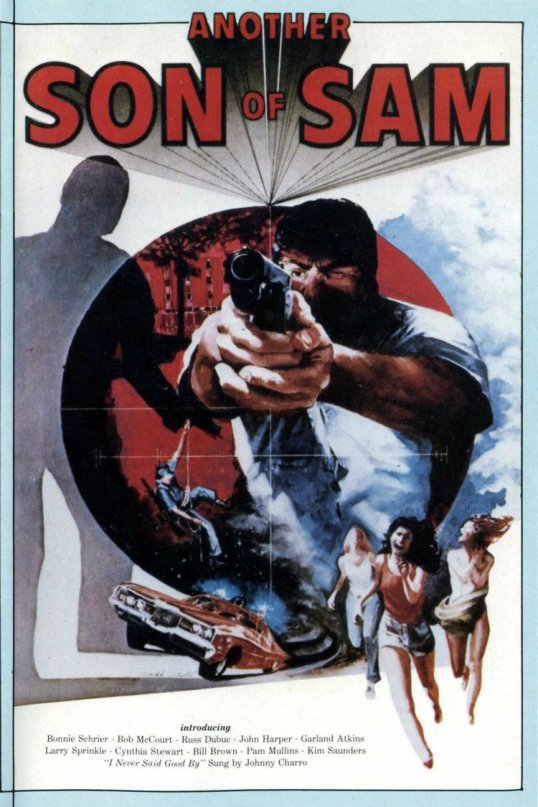
The TSL’s Grindhouse: Another Son of Sam (dir by Dave A. Adams)


Well, his friends call him Another Son of Sam

But his real name is Mister Earl….

Actually, his real name is Harvey.  Let’s make that clear right now.  Despite it’s title, Another Son of Sam has next to nothing to do with the Son of Sam.  Instead, this zero-budget, North Carolina-shot exploitation film is about a mental patient named Harvey who, having been traumatized by his mother, escapes from the hospital and goes on a rampage at a nearby college.  This film was first shot in 1975, under the name Hostages.  However, it couldn’t actually secure a release until 1977, when it was retitled Another Son of Sam.  

Another Son of Sam is difficult to summarize, not because it’s particularly complex but, instead, because close to nothing actually happens.  Even though it’s only 70 minutes long, there’s really only enough plot for about five minutes.  However, because I do like to maintain a certain minimum word count when it comes to my reviews, I guess I better find something to say about this film.

It opens with a lengthy sequence of police Lt. Setzer (Russ Dubuc) enjoying a weekend at the lake.  The lake is never really mentioned again but some of the shots of the boat skimming the water are so nicely done that you can’t help but think that the film should have dropped the whole escaped killer thing and instead just focused on Setzer’s weekend.  After leaving the lake, Lt. Setzer goes to a bar and enjoys a performance from singer Johnny Charro!  Charro, who was and is something of a local celebrity in Charlotte, North Carolina, is credited as playing himself.  He sings an endless song, one that is repeated several time throughout the film.  Whenever anyone turns on a radio, there’s Johnny Charro!

Meanwhile, crazy old Harvey kills an orderly, escapes from a mental hospital, and hides out on a college campus.  Luckily, Lt. Setzer just happens to be investigating an unrelated case at the college!  Once Setzer realizes that there’s a killer on campus, he calls out the SWAT team!  The SWAT team searches for Harvey but, because they all kind of suck at their job, Harvey kills a few of them.

And that’s pretty much the entire film.

Now, there’s a lot of negative things you can say about Another Son of Sam.  None of the characters are memorable.  The acting is risible.  The pace is so slow that 70 minutes feels more like 70 hours.  However, I would like to take a moment to focus on two things that work surprisingly well.

First off, director Dave Adams (who was apparently a stuntman making his directorial debut) purposefully avoids showing us Harvey’s face.  Instead, we see his hands when he’s committing a murder and his eyes when he’s watching a potential victim.  The many shots of Harvey’s eyes, glaring out from the darkness, are actually effectively creepy.  By not showing us his face, Adams allows Harvey to remain an unknowable force of evil.  This is not one of those films where the audience is meant to sympathize or identify with the killer and I appreciated that.

Secondly, the film does this weird thing where the scene will suddenly freeze but we’ll still hear the sounds of people talking or walking down a hallway or listening to Johnny Charro or whatever else they were doing before the scene froze.  Apparently, this is because Adam shot the film using short ends and, as a result, the camera would often run out of film in the middle of a scene.  However, even if it wasn’t deliberate on the part of the director, the freeze frames actually do improve the film.  Along with creating a properly surreal viewing experience, they also remind us of just how unpredictable life can be and how quickly it can end.  One minute, you’re taking a shower or you’re talking about your plans for Spring Break.  The next minute, you’re frozen in place as all of your plans come to a perhaps permanent halt.  The freeze frames may have been the result of incompetence but they still work.

And it’s good that something works in Another Son of Sam because this is an otherwise unfortunate film.  I say that as someone who actually has a weakness for grainy, low-budget, amateur movies.  I liked the lake, the freeze frames, the eyes, and Johnny Charro.  But once the film hit 30 minutes, my mind was wandering.

One interesting note: the film opens with a list of mass murders, starting with Jack the Ripper and ending with David Berkowitz.  It makes the point that most of the killers were never caught and, even if they were, their motivations were never understood.  One of the killers they mention as having never been caught is “Seattle Ted.”  This, of course, was a reference to Ted Bundy, who would be captured two years after the release of Another Son of Sam.

Ladies and gentleman …. JOHNNY CHARRO!

The TSL’s Horror Grindhouse: Sharktopus (dir by Declan O’Brien)


Half Shark….

Half Octopus….

All Man!

No, wait a minute.  That’s not right.  Let’s try that again.

Half Shark….

Half Octopus….

All Killer!

There, that’s it!  That’s our Sharktopus!

Produced by the legendary Roger Corman, Sharktopus originally aired on the SyFy channel in 2010.  It tells the story of S-11, a creature that is half-shark and half-octopus.  How exactly did S-11 come to exist?  Well, blame the government!  The government wanted a new weapon and apparently, it didn’t bother them that the weapon would have no practical use beyond going rogue and killing civilians.  Dr. Nathan Sands (Eric Roberts, the one and only) created the sharktopus with the help of his daughter, Nicole (Sara Malakul Lane).  When S-11 swims off on its own and starts eating human beachgoers, Nicole teams up with mercenary Andy Flynn (Kerem Bursin).  Nicole and Andy think that they’ve been sent to destroy S-11 but it turns out that Nathan has other plans.

Let’s just state the obvious.  This is the greatest film ever made.  Okay, well …. maybe it’s not the greatest.  Some people would probably say that it’s not even that good but I think they’re overthinking things.  What it comes down to is that there really aren’t as many films out there about shark/octopus hybrids as you might think.  When it comes to this very specific genre of horror films, Sharktopus is the best.

This is a film that understands why the audience is watching.  We’re watching because we want to see Sharktopus action!  So, while the film does contain its fair share of scenes of Nicole and Andy searching the ocean, the majority of the film is still made up of Sharktopus attacks.  You don’t really get to know any of the victims, though I did feel bad for the gentleman who shouted, “Oh no!  Not like this!” as he was pulled down to the ocean by S-11’s tentacles, but that’s okay.  It’s all about the Sharktopus, a creature that is so ludicrous that it’s impossible not to like it.

Another thing that’s impossible not to like is the fact that Eric Roberts is in this film.  The last time I checked, Roberts had a total of 641 acting credits listed on the imdb.  He’s appeared in every type of films — from Oscar-nominated prestige films to low-budget faith-based films to Lifetime films to …. well, films like Sharktopus.  But regardless of the film, Roberts always seems to be trying his best or, at the very least, he comes across like he’s genuinely amused by the absurdity of it all.  Roberts has a lot of fun in Sharktopus, playing his mad scientist character with a twinkle in his eye and a barely suppressed evil smile.  Dr. Sands takes genuine pride in his creation and it’s kind of hard not to get caught up in his enthusiasm.

Sharktopus is a fun movie.  It’s a low-budget and deeply silly epic and it you can’t enjoy the sight of shark/octopus hybrid creeping across the beach than I don’t know what to tell you.  In fact, Sharktopus was popular enough with SyFy audiences that it would return for a whole series of films in which it battled hybrid monsters.  Go Sharktopus!

On a final note, keep an eye out for Roger Corman while watching this film.  He plays a man on the beach who watches as a treasure seeker is dragged off to the ocean.  When he realizes that she dropped a valuable coin while being taken away, Corman walks out on the beach and grabs it for himself.  Hopefully, he sold that coin and used the money to go on a nice vacation.  If anyone’s earned it, it’s Roger Corman!


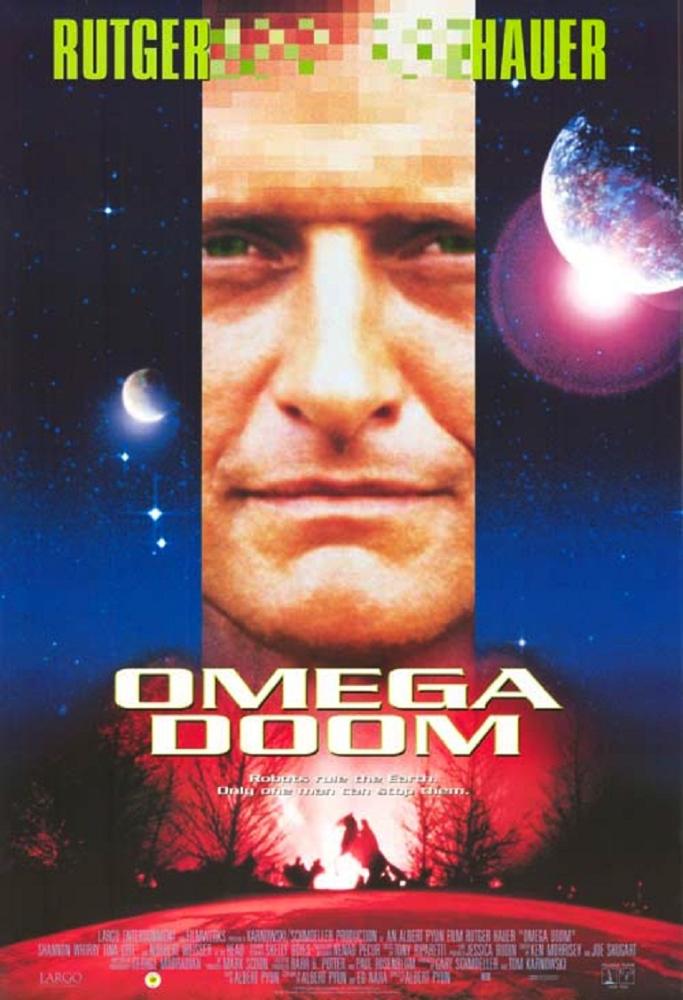
The TSL’s Grindhouse: Omega Doom (dir by Albert Pyun)


Omega Doom!  What’s all that about?

Seriously, don’t ask me.  I just watched this Albert Pyun-directed, 1996 sci-fi epic and I’m stil a bit confused as to what exactly was actually going on in the movie.  This is a movie that opens with a totally blank screen and then, eventually, two red suns appear in the sky.  The film takes place in the future, at a time when humans have nearly wiped themselves out of existence through their endless wars and the planet is now controlled by robots and cyborgs.  Omega Doom (Rutger Hauer) was a cyborg programmed to kill humans until he got shot in the head.  Apparently, taking a bullet to his cranium changed Omega’s programming and now….

Well, that’s the thing, isn’t it?  It’s kind of hard to say what exactly it is that Omega does now.  We do know that he spends a lot of time walking around because there’s a lot of scenes of him doing just that.  Eventually, he stumbles upon the ruins of a town that is now controlled by two warring bands of robots.  Before you can say Yojimbo or even A Fistful of Dollars, Omega is playing both sides against each other and …. well, I don’t know what the preferred outcome here is.  What is Omega Doom’s motivation?  He’s not making any money out of it because robots don’t need money and it’s not like there’s anything left to buy.  And he doesn’t seem to be interested in ruling the town himself because it’s kind of a dead end of a town.  I mean, there’s dead bodies and robotic parts all over the place.  It’s suggested that he might be looking for a secret stash of weapons that can be used to either kill or protect the remaining humans but, at the same time, we don’t ever really see any remaining humans and there’s no reason why Omega would care enough about them to get caught up in a war between robots on their behalf.

So, don’t ask me what’s going on.  I guess it really doesn’t matter because it’s not like you watch a film like this for the plot.  You watch it for the action!  Unfortunately, there’s not a whole lot of action to be found.  There’s a lot of scenes of robots talking about various exciting things that they could, in theory, be doing but no one ever seems to actually get around to doing any of that stuff.  Instead, all of the robots stay in their separate sections of the town and wait for everyone else to make the first movie.  Eventually, Omega makes a few moves but, even then, they’re not particularly exiting moves.  Omega carries a gigantic sword on his back and how I anticipated seeing what he was going to finally do with that sword.  Well, it turns out that Omega didn’t do very much with it at all.

Actually, the main reason you’re going to want to watch Omega Doom is because Rutger Hauer plays the title role and Hauer was always cool, even when he was appearing in a less than memorable film.  In Omega Doom, Hauer does a passable Clint Eastwood impersonation, delivering his lines with just the right amount of weary condescension.  Though you’re never quite sure why Omega is doing anything, Rutger Hauer is always watchable.

And, to be honest, I actually didn’t dislike Omega Doom as much as it may sound like I did.  It’s a slow movie and not much happens but, at the same time, I did like the look of the bombed-out city and, though the dialogue was largely forgettable, there was still the occasional line that suggested that Omega Doom had existential ambition, albeit unrealized ones.  “God took a vacation,” Omega says at one point and, for a split second, you get a hint of what Omega Doom could have been if it had a bigger budget and a better script.  It’s a film that had potential and it’s somewhat fascinating to consider how little of that potential was realized.

Of course, in the end, it all comes down to this: How can you possibly resist Rutger Hauer as a cyborg?

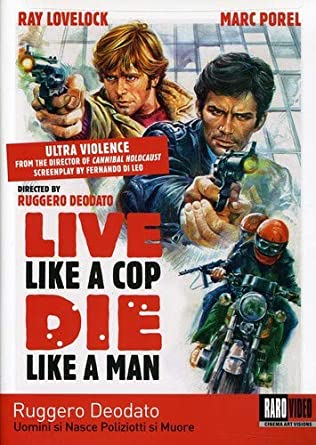
The TSL’s Grindhouse: Live Like A Cop, Die Like A Man (dir by Ruggero Deodato)


The 1976 film, Live Like A Cop Die Like A Man, takes place during the Christmas season.

We know this because the film opens with a man dressed like Santa Claus standing on a street corner in Rome and impotently watching as a woman is dragged behind a motorcycle by two men who were attempting to snatch her purse.  When she doesn’t let go of her purse, one of the men hops off the motorcycle and proceeds to kick her in the face until she stops moving.  Suddenly, two other men — our heroes, as it were — came driving up on a motorcycle of their own.  A chase ensues, through the streets of Rome, during which a blind man’s dog is graphically run over.  The chase which, it must be said, is very well-shot and directed, lasts for over 10 ten minutes and it ends with the two thieves being executed by, once again, our nominal heroes.

A lot of people are executed over the course of Live Like A Cop, Die Like A Man.  That’s because Detectives Fred (Marc Porel) and Tony (Ray Lovelock) have been given a license to kill anyone who breaks the law.  The film is a bit vague on just how exactly the license works and why, apparently, it’s only been given to Fred and Tony.  One major set piece features several dozen cops all waiting outside a house, powerless to get the three criminals within, until Fred and Tony arrive.  Fred and Tony, of course, solve the problem by killing everyone.  Why couldn’t the other cops have done that?  The film doesn’t really make that clear.

Admittedly, Fred and Tony aren’t the first movie cops to get results through unorthodox means.  The French Connection was a popular film in the 70s and it inspired a whole genre of Italian rip-offs, of which Live Like A Cop Die Like A Man is a definite example.  What sets Fred and Tony apart from cops like Popeye Doyle and Dirty Harry is the amount of joy that Fred and Tony seem to get out of killing people.  Early on, they show up at a party and proceed to set all of the cars on fire. They also set two criminals on fire, with Fred doing a happy little dance as the two men go up in flames.  It’s disturbing but there’s also a strange integrity to the film’s shameless embrace of violence.  Live Like A Cop, Die Like A Man doesn’t pretend to be about anything other than satisfying the vigilante fantasies of its audience.

And indeed, it should be considered that Live Like A Cop, Die Like A Man was released during the so-called Years of Lead, when a combination of political terrorism and open crime had made violence an almost daily part of Italian life.  When you’re living day-to-day with the knowledge that you could be blown up at any minute by the Red Brigade, the Ordine Nero, or the Mafia, I imagine that there would be something appealing about watching two young men who are perfectly willing to just shoot anyone who appears to be up to no-good.  It’s easy to imagine that, for audiences in 1976, the random violence of this episodic film mirrored the random violence of everyday life.  Though Live Like A Cop, Die Like A Man was obviously inspired by The French Connection, it perhaps has more in common with the original Death Wish, with the main difference being that Live Like A Cop’s vigilantes are officially sanctioned.

The film also places a good deal of importance on just how close Tony and Fred are supposed to be.  They live together in a ramshackle flat, they apparently spend all of their free time together, and, towards the end of the film, the only thing that keeps the two of them from taking part in a threesome is the sound of someone else being shot.  Unfortunately, Ray Lovelock and Marc Porel did not get along in real life and, as a result, there was never a Live Like A Cop Die Like A Man Part IILive Like A Cop would also be director Ruggero Deodato’s only stab at the polizieschi genre.  He went on, of course, to direct Cannibal Holocaust and The House on the Edge of the Park.  (Interestingly, Tony and Fred’s relationship is mirrored, to sinister effect, by the relationship between the characters played by David Hess and Giovanni Lombardo Radice in House On The Edge of the Park.)  Live Like A Cop, Die Like A Man has gone on to become a bit of a cult film and, as offensive as some will find it to be, it’s also so over-the-top in its violence and its celebration of officially sanctioned bad behavior that it becomes rather fascinating to watch.  It’s so without shame or apology that it’s hard to look away from it, even though you may want to.

The TSL’s Grindhouse: Blue Monkey (dir by William Fruet)


1987 Blue Monkey

Last night, as I sat down to watch the 1987 Canadian film, Blue Monkey, I found myself singing a song in my head:

How does it feel
When you treat me like you do
And you’ve laid your hands upon me
And told me who you are?

I thought I was mistaken
And I thought I heard your words
Tell me, how do I feel?
Tell me now, how do I feel?

Unfortunately, it turned out that the only thing Blue Monkey had in common with the classic New Order song, Blue Monday, was an enigmatic title.  Just as the song never really mentions anything about Monday, Blue Monkey does not feature a single monkey.  One minor character does mention having a dream about a monkey but, otherwise, there are no monkeys in the film.  Speaking as someone who believes that almost any film can be improved the presence of a monkey, I was disappointed.

(Seriously, Nomadland would have been a hundred times better if Frances McDormand had a pet monkey.)

What Blue Monkey does have is a lot of blue.  The characters wear blue shirts and some wear blue uniforms.  Another wears a blue hat.  The film takes place in a hospital where almost all of the walls are painted blue.  Even worse, the majority of the film’s scenes are saturated with blue lighting.  

Here’s just two screenshots:

blue-monkey-1987-movie-image-7Blue-Monkey-1987-movie-William-Fruet-4

Seriously, some scenes were so blue that I was reminded of John Huston’s decision to suffuse Reflections in a Golden Eye with the color gold.  Personally, I think Huston made a mistake when he did that with Reflections but I can still understand the reasoning behind the decision and I can see what Huston was attempting to accomplish.  The blue in Blue Monkey feels like a distraction, as if someone realized, on the day before shooting, that the title didn’t make any damn sense.  “We’ll just make the whole movie blue!”

The problem, of course, is that the film goes so overboard with the blue lighting that it actually becomes difficult to look at the screen for more than a few minutes.  I had to keep looking away, specifically because all of those blue flashing lights were starting to make me nauseous and were on the verge of giving me a migraine.  At times, the image is so saturated in blue that you literally can’t make out what’s happening in the scene.  Of course, once you do figure out what’s happening, you realize that it doesn’t matter.

Blue Monkey takes place in a hospital.  A handyman has been having convulsions after pricking his finger on a plant that came from a mysterious island.  Perhaps that’s because a mutant larvae is now using his body for a host.  The larvae eventually develops into a giant grasshopper — NOT A MONKEY! — who stalks around the hospital and kills a few people.  The Canadian government is threatening to blow up the hospital unless something is done about the blue grasshopper.

It’s a Canadian exploitation film but Michael Ironside isn’t in it so it somehow feels incomplete.  That said, John Vernon plays a greedy hospital administrator and it’s fun to watch him get irritated with everyone.  A very young Sarah Polley has an early role as an annoying child.  There’s actually several children in this film and you’ll want to throw something at the screen whenever they show up, that’s just the type of film this is.  (Some of my fellow movie-watching friends were actually upset that the children survived that film.  I wouldn’t go that far but I still found myself hoping John Vernon would tell them all to shut up and let the adults handle things.)  Susan Anspach plays a doctor, showing that anyone can go from Five Easy Pieces to Canadian exploitation.  The film’s nominal star is Steve Railsback, playing a cop who comes to the hospital to check on his wounded partner and who ends up on grasshopper duty.  Steve Railsback has apparently said that he’s embarrassed to have appeared in this film.  Consider some of the other films that Steve Railsback has appeared in and then reread that sentence.  

In the end, Blue Monkey doesn’t add up too much.  There’s no Michael Ironside.  There’s no monkeys.  There’s just a lot of blue.

The TSL’s Grindhouse: The Amityville Murders (dir by Daniel Farrands)


Ronald DeFeo, Jr. may not be a household name but he’s someone who was indirectly responsible for a lot of cinematic schlock.

Of course, that’s the least of DeFeo’s crimes. When the 69 year-old DeFeo passed away in March, he was serving a life sentence in the state of New York. That’s because, back in 1974, the 23 year-old DeFeo grabbed a rifle and killed his entire family while they slept. When he was brought to trial, DeFeo claimed that he heard Satanic voices that urged him to kill his parents and his siblings. His lawyers tried for an insanity defense, though the prosecution successfully argued that DeFeo was lying about the voices and that he was in full control of his actions on the night that he killed his family. After being convicted and sentenced to life imprisonment, DeFeo sometimes claimed that he had been possessed by the devil and sometimes said that he committed the murders in self-defense and then other times, he said that he did it because he was hoping to inherit his father’s money. Out of all the excuses that he gave for his brutal crimes, DeFeo’s claims of being demon-possessed were the claims that everyone remembered.

Years later, the DeFeo house — which sat in Amityville, New York — was purchased the George and Kathy Lutz. The Lutzes made a small fortune by claiming that the house was haunted and that they had been forced to leave their new home by demonic spirits. (Their claims were apparently supported by paranormal investigators Ed and Lorraine Warren of Conjuring fame.) The Lutzes told their story to Jay Anson, who wrote a book called The Amityville Horror. That book was later turned into a movie and the success of that movie led to a series of sequels and spin-offs. At last count, there’s been at least ten books written about the Amityville case and there have been 30 films that, in one way or another, claim to be connected to the Amityville haunting. Few of those films share much, other than a haunting and the word “Amityville” in the title. There’s not a great deal of continuity to be found in the Amityville films.

One of the latest of the Amityville films, 2018’s The Amityville Murders, deals with the actual murders that supposedly started off the whole cycle of possession and violence. (1982’s Amityville II: The Possession also dealt with the murders, albeit with Ronald DeFeo renamed Sonny Montelli. Two of the stars of that film — Burt Young and Diane Franklin — appear in The Amityville Murders.) John Robinson plays the bearded and withdrawn Ronald DeFeo, Jr. Chelsea Ricketts plays his concerned sister. Paul Ben-Victor plays their abusive father. The film covers the general facts of the DeFeo murders while trying to have it both ways as to whether or not Ronald was in control of his actions. Ronald DeFeo is portrayed as being genuinely unbalanced but, at the same time, potentially demon-possessed as well. The talented John Robinson does a good job of playing Ronald and there’s a few effective shots of his looking unbalanced but, for the most part, there’s nothing here that you haven’t seen in a dozen other Amityville-influenced horror films. As well, since you know from the start that Ronald is going to end up murdering his family, there’s really not any suspense to be found in the film. Instead, the entire movie is just about waiting for Ronald to pick up that rifle and start shooting people, including two children. It’s more than a bit icky, to be honest.

Whenever it comes to an Amityville prequel, the main question is always just how stereotypically the DeFeos are going to be portrayed. It only takes five minutes for DeFeo, Sr. to admonish Ronald with, “Oh! Watch how you talk to your mother!” Every cliché about Italian-American family life is present in The Amityville Murders, from the father hulking around in his undershirt to the mother decorating the house with religious iconography to the superstitious grandmother. Watching the film, I found myself imagining Tony Soprano watching a cheap Amityville film and exclaiming, “Oh! The mouth on this fucking kid over here, like he’s possessed by the devil or something!” The Amityville Murders hints that the DeFeos themselves may have had mafia connections. Indeed, before he decided to blame demonic possession for his crimes, Ronald DeFeo, Jr. claimed that his family had been taken out by hitmen from New York.

This film was directed by Daniel Farrands, who also directed The Haunting of Sharon Tate and The Murder of Nicole Brown Simpson. The Amityville Murders is neither as well put-together as the Sharon Tate film nor as offensive as the Nicole Simpson film. It’s somewhere in between, just another link in the endless chain of Amityville films. I will say that I personally think Farrands is a talented director and I’d like to see what he could do with a budget and a decent script. The Amityville Murders has its share of impressive shots, even if the end result isn’t exactly the last word in Amityville horror.