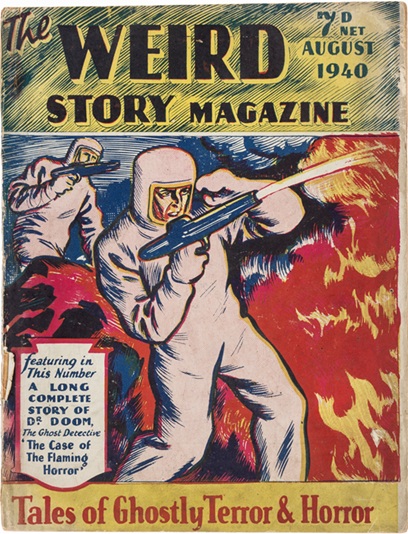
Artist Unknown
This flame-filled cover is from 1940.
Artist Unknown
This flame-filled cover is from 1940.
Who directed the video for Garbageman? I haven’t been able to find the information online, probably because of how old the video is. Do any of you know?
Enjoy!
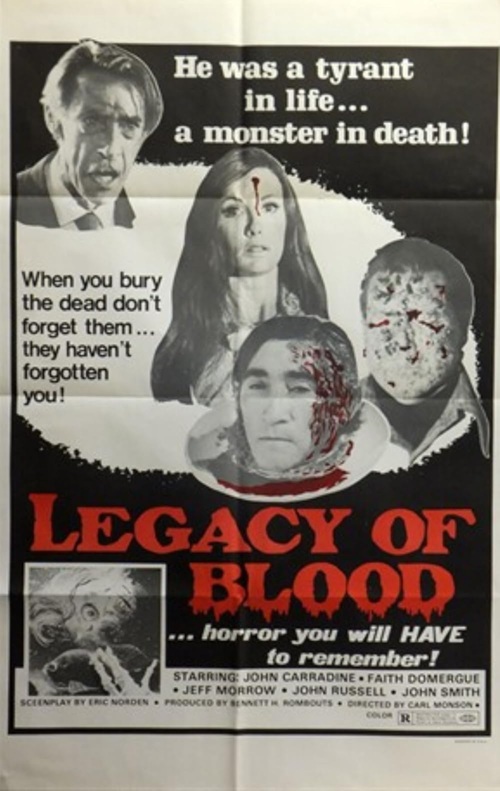
a.k.a. Blood Legacy
In this 1971 film, John Carradine briefly plays Christopher Dean, a wealthy man who hated his family and his servants. He dies before the film actually begins but we do get to see him in flashbacks and we also hear his voice at the reading of his will. Dean leaves a fortune to his children and his servants, but he does so only on the condition that they spend a week at Dean’s estate. If anyone dies or leaves the estate, they will lose their inheritance and the money will be split amongst those who stayed and/or survived. You can see where this is leading, right?
This is actually a promising premise and it’s easy to imagine how it could have inspired an American version of Mario Bava’s Bay of Blood, where one person is killed by another just for that killer to then be killed by someone else until eventually, there’s no one left. Unfortunately, while the characters are all unpleasant and greedy, none of them are as memorable as anyone in Bava’s classic shocker. They’re all generic jerks and, as such, it’s hard to have much of a reaction when they start dying. The film does feature several familiar B-movie stars. Jeff Morrow and Faith Domergue (both of whom were in This Island Earth) appear as brother and sister. Richard Davalos (who played James Dean’s brother in East of Eden) has an eccentric role. Western character actor Rodolfo Acosta plays the sheriff who eventually takes an axe to the forehead. B-movie veteran Buck Kartalian plays Igor, the butler. (His name is actually Igor!) Some of the members of the cast were good actors but few of them are particularly good in this film. I did appreciate the weird energy of Buck Kartalian. John Carradine doesn’t do much but he does deliver his lines with the proper amount of contempt.
The film does have a few vaguely interesting kills. Bees are used as a weapon at one point. A head is found in a refrigerator and Richard Davlos says, “This is just like a horror movie.” Wow, Richard, thanks for sharing! There’s a big twist ending but it really not that impressive of a twist.
Probably the most interesting thing about Blood Legacy is that it’s essentially a remake of Andy Milligan’s The Ghastly Ones. (Director Carl Monson had a habit of ripping off other films. In 1973, he remade Roger Corman’s Little Shop of Horrors. Monson called his remake Please Don’t Eat My Mother. The film starred Buck Kartalian.) Blood Legacy was originally released under the title Legacy of Blood but Milligan was so annoyed at being ripped-off that he later made his own remake of The Ghastly Ones and decided to give it the same title as Carl Monson’s rip-off. Monson changed his film’s title and distributed it under the names Will To Die and Blood Legacy so that it wouldn’t be confused with Andy Milligan’s Legacy of Blood. It makes sense. Why would anyone want their Andy Milligan rip-off to be confused with an actual Andy Milligan film?

The next episode of Hammer House of Horror is The House That Bled To Death but I’ve decided not to share it for this Halloween because it features the death of a kitty and I’m kind of tired of pets dying in horror films. It’s an effective and scary episode, though. It’s on YouTube so if you want to watch it, feel free.
Moving right along, tonight’s episode is Charlie Boy. Graham (Leigh Lawson) and his wife Sarah (Angela Bruce) inherit an statue that they don’t realize also doubles as a really big voodoo doll. After stabbing the statue a bit too many times, Graham comes to realize that he’s accidentally condemned almost everyone he knows to death, including both him and his wife. Thanks to the fast-paced director of Robert Young and the committed performances of the cast, this is an entertainingly macabre episode. It originally aired on October 18th, 1980.
In 1975’s Mary, Mary, Bloody Mary, Cristina Ferrare plays Mary, an American painter who lives and works in Mexico.
Mary seems to be living her ideal life. She paints. She travels. Her work is popular. She has glamorous and wealthy friends. She has her independence. Even when she starts a relationship with a young American diplomat named Ben (David Young), he seems like a genuinely nice guy who respects her need to have a space of her own.
However, Mary has a secret.
Mary is a vampire. She doesn’t have fangs, she doesn’t sleep in a coffin, and she can go out in the daylight. But she has an obsessive need to drink blood. Whenever she can get away from Ben, she’ll pull out a knife and slit the nearest throat. On the beach, a pushy, middle-aged man falls victim to her. Back in the city, she kills her former lover (Helena Rojo), who is not happy that Mary is now dating a man. Mary does her best to hide her murderous inclinations from Ben, even as she finds herself tempted to taste his blood.
However, someone else has recently arrived in Mexico and he appears to be looking for Mary. The Man (John Carradine) dresses in black and wears a mask over his face. The Man also carries a blade and, like Mary, he drinks the blood of his victims. When Mary reads a newspaper story about a murder that she didn’t commit, she realizes that she’s not the only vampire in Mexico. At the film progresses, we learn that Mary and the Man share a very close connection and Mary is forced to confront whether or not she can be both in love and a vampire.
One thing that I appreciated about Mary, Mary Bloody Mary is that it didn’t leave much ambiguity as to whether or not Mary was actually a vampire. At first, it seemed like the movie was going to play the “Is-she-or-isn’t-she” game and maybe suggest that Mary was just mentally disturbed, But instead, the film makes it clear that Mary is dependent upon drinking the blood of others. It’s suggested that vampirism is something that was passed down to her, much like how I inherited my red hair from my father’s side of the family. But, in the end, there’s no doubt that Mary actually is a vampire. Cristina Ferrare occasionally seems miscast as a ruthless killer but, ultimately, she brings the right amount of sophistication to the role and John Carradine is, as always, a nice addition to the cast.
Unfortunately, the majority of Mary, Mary, Bloody Mary is very slowly paced. I can appreciate a film that takes it time but the first 45 minutes of Mary, Mary, Bloody Mary really does sometimes feel like an endurance test. Once The Man shows up, the film’s pace starts to pick up and Mary is very quickly forced to confront the truth of her cursed existence. At times, I got the feeling that the director was trying too hard to convince me that there was more to Mary, Mary, Bloody Mary than there actually was. The film is littered with scenes that suggest the story was meant to be a statement on the human condition but …. nah. Ultimately, it’s just a film about a woman who drinks blood.
 When I was growing up and watching Doctor Who on PBS, I had a friend whose mother forbid him from watching the show because she thought that it promoted Satanism.
Her opinion was almost totally based on the cover of the novelization of one of the Third Doctor’s most popular adventures.

She took one look at that cover and decided that both the book and the show were promoting Satan. I warned him that would happen when he first bought the book but, back in the day, it was nearly impossible to resist the temptation of the shelf of Doctor Who novels at Walden Books. It was almost as if the books had been put there by you know who.

If my friend’s mother had read the book or even watched the serial when it eventually aired on PBS, she would have discovered that The Daemons did not feature the Devil. Instead, it features Azal (Stephen Thorne), an evil horned alien who had spent centuries experimenting on humans and who had inspired many ancient myths and religions. If my friend’s mother had watched the show, she would have seen that, rather than celebrate Satan, the show instead suggested that there was no Satan and that all of mankind’s Gods were actually visiting aliens. She would have also seen that while The Master (played by Roger Delgado) disguised himself as a vicar, it fell to a local white witch to warn everyone in a quaint British village that the local archeological dig was a mistake. Because of the Master’s religious disguise, everyone followed him when they should have been listening to the pagan…
In hindsight, it’s probably a good thing my friend’s mother never watched the show.

The Daemons has a reputation for being one of the best of the Third Doctor’s adventures and I’m inclined to agree. The Doctor (Jon Pertwee) and his latest companion, Jo Grant (Katy Manning), try to stop the dig and instead find themselves trapped by a heat shield that has suddenly sprung up over the village. One of the defining images of this episode was a helicopter busting into flame when it hit the invisible barrier. With the Brigadier and the majority of UNIT outside of the village, The Doctor, Jo, Sgt. Benton (John Levene), and Captain Yates (Richard Franklin) try to stop the plans of The Master and Azal. Unfortunately, the villagers themselves have fallen under the sway of evil and are planning a special maypole sacrifice.

So many different actors have played The Master (and the character has become so overused) that it is easy to forget just how good Roger Delgado, the first Master, was in the role. Delgado played the Master as being incredibly evil but he also played him as having a sense of humor and style about his evil, which is something that subsequent Masters have often failed to do. Delgado’s Master appeared in every serial of the eighth series and he proved to be more than a worthy opponent for Pertwee’s Doctor. Off-screen, Pertwee and Delgado were close friends and Pertwee later said that Delgado’s death in a traffic accident was one of the factors in Petwee’s decision to step away from the show. The Daemons featured Delgado at his best as the Master did his worst and tried to claim the powers of someone who humans considered to be Satan.

The Daemons is also remembered for one of the best lines in the history of Doctor Who. When confronted by Azal’s gargoyle servant, the Brigadier calls over a UNIT solider and orders, “Chap with wings there, five rounds rapid.” I can only imagine how tired Nicholas Courtney got of having that line repeated to him over the years but his delivery of it is perfect. The Brigadier was such a uniquely English character, imbued with the unflappable attitude of a country that had survived the collapse of an Empire, the Blitz, and the Suez Crisis. Nicholas Courtney took a line that sounds like something Graham Chapman would have said on Monty Python and instead made it into an iconic piece of dialogue that reminded those of us American watching on PBS that, in Doctor Who, the entire universe was British.
Though it led to the show being forever banned in my friend’s house, The Daemons is a Doctor Who classic.

 On the planet of Arous, Taura (Sandy Brooke) leads a group of dwarf miners in rebellion against the international empire. The empire sends Captain Bantor (Ross Hagen), Krago (Michael D. Sonye), and the Inquisitor (Aldo Ray) to capture Taura and put down the revolution. When Bantor attempts to attack Taura, he sticks his hand in a volcanic acid plume and screams as it dissolves. Taura is arrested. Judge John Carradine sentences her to a term on Vehemence, a spaceship that serves as an intergalactic women’s prison.
Star Slammer is a Women In Prison film that happens to be set in space. Taura makes an enemy of the sadistic warden (Marya Grant) and her henchwoman, Muffin (Dawn Wildsmith). Taura also befriend Mike (Susan Stokey) and the two of them plot to overthrow the guards and make their escape. When the now crazed Bantor boards the ship, Taura sees her chance. Meanwhile, the prisoners have to deal not only with pervy guards but mutant rats.
Legend has it that Fred Olen Ray had rented Roger Corman’s New World Pictures studio for four days so that he could shoot some extra scenes for his film Biohazard. Ray finished his Biohazard work in one day and then spent the other three days filming promotional footage for the film that would become Star Slammer. He used props that were left over from Galaxy of Terror and was able to get Aldo Ray to come in for a day so that the footage would feature “a name.” Producer Jack H. Harris looked at the footage and put up the money to shoot the rest of the film on the condition that Ray change the title from Prison Ship to Star Slammer.
Amazingly, the resulting film itself is not that bad. Ray used the outer space setting as a way to both indulge in and poke fun at the common tropes of the Women In Prison genre and Sandy Brooke and Susan Stokey both turn in committed performances. Ross Hagen laughs like a maniac and demands vengeance for his missing hand while trying to get his remaining hand on a mind control device. The prisoners are kept in check by promises of prizes and free trips in return for good behavior. A thoroughly deformed guard is promoted as a sex symbol and there’s a sharp wit to many of the scenes. Star Slammer is much more clever and fun than anyone would have any right to expect it to be.

I’ve always loved the interview with the chief of police in the original Night of the Living Dead. I love the delivery of that classic line. “….they’re all messed up.” Yes, they are. The chief doesn’t seem to be particularly perturbed by the fact that the dead are coming back to life. Instead, his attitude is very straight-forward. To quote Tommy Lee Jones in Rolling Thunder, “Let’s go clean ’em up.”
When we first see this interview, it’s easy to laugh at the sight of the chief’s posse and everyone’s odd confidence that the dead will somehow just go away. (Death, after all, is the one thing that is guaranteed to happen to everyone eventually.) Once you know how the story’s going to end, though, this scene becomes much more ominous.
How dumb can one movie be without becoming unwatchable?
1985’s Evils of the Night is here to answer that question!
Three space alien vampires (John Carradine, Julie Newmar, and Tina Louise) have led an expedition to Earth. They’ve taken over a hospital and they’re stealing the blood of their patients so that it can be sent back to their dying planet. They especially want young blood, which is why they specifically came to a college town. Unfortunately, their intelligence was faulty and they arrived during the summer, when the campus was closed. (I guess this is one of those rare colleges that don’t offer a summer term.) There’s actually a very lengthy scene in which Carradine explains the faulty intelligence to Newmar and Louise and then Newmar complains about how the alien intelligence service just isn’t that good. What makes this scene so special is that Carradine delivers his lines with a straight face and Newmar actually seems to be sincerely annoyed. Aliens — they’re just like us!
Just because college is out of session, that doesn’t mean that there aren’t any young people hanging out down at the lake. There’s actually quite a few, though all of them look to be a little bit too old for high school or college or whatever they’re supposed to be attending. Several of them are played by veterans of the adult film industry, including Amber Lynn and Jerry Butler. Everyone wants to get laid down at the lake, which is probably the most realistic thing about Evils of the Night. However, John Carradine needs their blood so he has Julie Newmar hire two slovenly mechanics, Kurt (Neville Brand) and Fred (Aldo Ray), and sends them out to kidnap any young people that they find. Kurt and Fred are very good at their job. Newman pays them and mocks them for caring so much about coins. Little do the mechanics realize that the aliens are planning on shooting them with their space laser as soon as they leave the planet.
Evils of the Night is a good example of a bad movie that is oddly watchable just because the viewer finds themselves curious as to just how stupid things can get. The answer here is very stupid and very nonsensical It never seems to occur to anyone just go to a different lake or maybe just do their skinny dipping in a pool somewhere. The plot has a “make it up as you along” feel to it and that, at the very least, keeps things vaguely interesting. The actors playing the “teen” victims are enthusiastic without being particularly good while most of the veterans in the cast are all obviously just there for the paycheck.
That said, John Carradine. Wow. What a career. A trained Shakespearean actor who made his stage debut in 1925 and went on to appear in a countless number of movie, Carradine was a favorite of both John Ford and Fred Olen Ray. Carradine appeared in hundreds of a theatrical films. In fact, his final film was released seven years after Carradine’s death. Carradine was one of the great actors, with that deep voice and that commanding stare. But he was also one of those actors who was apparently willing to appear in just about anything and that’s one reason why he’s still such a beloved icon. Playing an outer space vampire-turned-doctor was definitely not the strangest role that Carradine ever played. Carradine handles his scenes like a pro!
Evils of the Night is dumb but I dare you to look away.

This 1979 true crime drama opens in Los Angeles in 1963.
Rookie Detective Karl Hettinger (John Savage) has just joined the Felony Squad and met his new partner, Ian Campbell (Ted Danson, making his film debut). Ian is a tall, somewhat eccentric detective, the type who practices playing the bagpipes in the basement and who takes Hettinger under his wing.
Meanwhile, Jimmy Smith (Franklyn Seales) has just been released from prison. The nervous and easily-led Jimmy almost immediately runs into Gregory Powell (James Woods), a small-time hood with delusions of grandeur. Powell is the type who talks a big game but who really isn’t even that good of a thief. Smith and Powell form an uneasy criminal partnership. They are easily annoyed with each other but they also share an instant bond. Though the film doesn’t actually come out and say what most viewers will be thinking, there’s a lot of subtext to a brief scene where Powell appears to caress Smith’s shoulder.
One night, Hettinger and Campbell are kidnapped by Smith and Powell. Smith and Powell drive them out to an onion field. Because he’s misinterpreted the Federal Kidnapping Act and incorrectly believes that he and Smith are already eligible for the death penalty because they kidnapped two police officers, Powell shoots and kills Campbell. (The close-up image of Campbell falling dead is a disturbing one, not the least because he’s played by the instantly likable Ted Danson.) Hettinger runs and manages to escape. He saves his life but he’s now haunted by the feeling that he abandoned his partner.
The rest of the film deals with the years that follow that one terrible moment in the onion field. Treated as a pariah by his fellow cops, Hettinger sinks into alcoholism and eventually becomes a compulsive shoplifter. Smith and Powell, meanwhile, use a variety of tricks to continually escape the death penalty and to keep their case moving through the California justice system. Powell, for instance, defends himself and then later complains that he had incompetent counsel. Smith, meanwhile, is defended by the infamous Irving Karanek, a legendary California attorney who specialized in filing nuisances motions. (Later Karanek found a measure of fame as Charles Manson’s attorney. Eventually, he had a nervous breakdown in 1989, lived in his car, and was briefly suspended by practicing law.) While Smith and especially Powell quickly adjust to being imprisoned, Hettinger spends the next decade trapped in a mental prison of guilty and bitterness.
Based on a non-fiction book by Joseph Wambaugh, The Onion Field is a compelling look at a true crime case that continue to resonate today. The film can be a bit heavy-handed in its comparisons between the two partnerships that define the story. Both Hettinger and Smith are young and neurotic men who find themselves working with a more confident mentor. The difference is that Hettinger’s mentor is the cool, composed, and compassionate Ian Campbell while Smith’s sad fate is to be forever linked to the erratic Gregory Powell. While the film may have the flat look of something that was made for television, it’s elevated by the performances of its lead actors. James Woods give an especially strong performance as the cocky Powell, a loser in the streets who becomes a winner behind bars. Over the course of the film, he goes from being a joke to being the prisoner that others come to for legal advice. John Savage, meanwhile, poignantly captures Hettinger’s descent as the trauma from that night leaves him as shell of the man that he once was.
The film’s supporting cast is full of familiar faces. Christopher Lloyd and William Sanderson show up as prisoners. Ronny Cox plays the detective in charge of the onion field investigation. David Huffman plays a district attorney who is pushed to his breaking point by the obstructive tactics of Smith’s attorney. Priscilla Pointer play Ian Campbell’s haunted mother. All of them do their part to bring this sad story to life.
The Onion Field is a chillingly effective true crime drama and a look at a murder that was inspired by one man’s inability to understand federal law.
 Through the Shattered Lens