Horror Film Review: Troll (dir by John Carl Buechler)


The 1986 film, Troll, opens with Harry Potter moving into a San Francisco townhouse.

Okay, it’s not that Harry Potter.  Troll was produced long before the first Harry Potter book was even published so it’s fair to assume that it’s just a coincidence that this film — about trolls, magic, and faeries — just happens to feature not just one but two characters named Harry Potter.  Harry Potter, Sr. (Michael Moriarty) is a typical, dorky father figure.  Indeed, he’s such a conventional figure that it’s a bit hard to understand why the always neurotic Michael Moriarty was cast in the role.  Harry’s son is named Harry Potter, Jr. (Noah Hathaway).  Harry, Jr. is a teenager who is shocked by how bratty his little sister, Wendy (Jenny Beck), becomes after the family moves into their new apartment.

Why is Wendy acting like such a brat?  It’s because Wendy has been kidnapped by Torok the Troll (Phil Fondacaro), a grotesque creature who not only abducts Wendy but also steals her appearance so that he can safely move around the world of the humans.  Torok, himself, was once a powerful wizard but, centuries ago, he and an army of faeries tried to destroy all the humans in the world.  Their plan didn’t work and, as punishment, Torok was turned into a troll.

But now, somehow, Torok is free and he’s taking over the apartment building.  One by one, he tracks down each tenant and casts a spell which turns them into a mythological creature, like a gnome or a wood nymph.  All of the apartments turns into lushly overgrown forests.  Among those tenants that get transformed are Sonny Bono and a young Julia Louis-Dreyfus.  I have a feeling that, when Sonny later ran for Congress, he did not include his appearance in Troll in any of his campaign literature.  As for Louis-Dreyfus, she was reportedly angered once when a talk show host (I think it was Jay Leno) showed footage from this film while interviewing her.  It’s not so much that Julia Louis-Dreyfus isn’t a convincing wood nymph as much as it’s the fact that she’s Julie Louis-Dreyfus and it’s just difficult to imagine her appearing in such a stupid role.  This, of course, was her first film and everyone has to start somewhere.

Anyway, realizing that he has to rescue his little sister, Harry Potter, Jr. gets some help from the local witch, Eunice St. Clair (Joan Lockhart).  Eunice gives Harry a magic spear to take with him in his quest.  It’s not really that much of quest, however.  Troll is a low-budget film that was produced by Albert Band so this is not the film to watch if you’re expecting some sort of elaborate fantasy epic.

One positive thing that I will say for Troll is that some of the troll makeup is effective.  The plot maks absolutely zero sense but Director John Carl Buechler specialized in creating memorable monsters on a budget and he manages to do that with Troll.  And, despite all of the people getting turned into monsters, Troll is a largely good-natured film.  It’s not a deliberately cruel or even gory film.  It’s a dumb little horror/fantasy film that features Sonny Bono turning into a plant and Julie Louis-Dreyfus turning into a wood nymph.  It’s dumb but it’s mild and generally inoffensive.

Finally, I should also note that it is in no way connected to Troll 2.  Troll 2, after all, is about goblins.

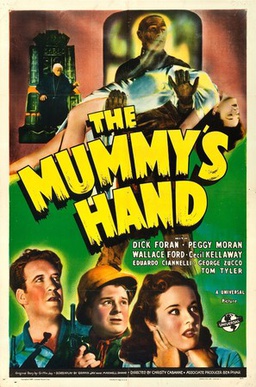
Horror Film Review: The Mummy’s Hand (dir by Christy Cabanne)


In 1940, having brought back The Invisible Man and Frankenstein’s Monster, Universal Pictures decided that it was also a good time to bring back The Mummy!

The Mummy’s Hand takes place in what we’re told is Egypt, though it’s obvious just a Universal backlot.  Two archeologists — Steve Banning (Dick Foran) and Babe Jenson (Wallace Ford) — are penniless and stuck in Egypt.  Babe wants to find a way to return to Brooklyn and his ex-girlfriend.  Steve is a bit more serious about archeology, though it must be said that he’s no Indiana Jones when it comes to discovering relics and taking them to museums.  If Indiana is the type who will risk his life to search a hidden cave in the Amazon Rain Forest, Steve is far more likely to just wander around an Egyptian market until he comes across someone selling an ancient vase.

Which is exactly what happens!  Steve finds someone selling a vase and, after he learns where it came from, he buys the vase.  He takes the vase to Prof. Andoheb (George Zucco), not knowing that Andoheb is an Egyptian high priest who has been sworn to protect the tomb of Princess Ananka.  When Andoheb realizes that the vase could lead to the discovery of the tomb, he lies and claims that it’s a forgery.  He then “accidentally” breaks it in order to keep Steve from showing the vase to anyone else.  Steve, however, is not deterred and a chance meeting with an American magician named Tim Sullivan (Cecil Kellaway) leads to Sullivan agreeing to finance Steve’s expedition to discover where the vase came from.  Sullivan’s daughter, Marta (Peggy Moran), worries that Steve and Babe are just trying to steal her father’s money so she insists on coming on the expedition with Steve.  Also following the expedition is Andoheb, who is himself starting to fall for Marta and who is hoping that he can use a secret serum hidden in the tomb to make both himself and Marta immortal.

Of course, the tomb itself is protected by Kharis (Tom Tyler, under a ton of bandages), a mummy who is immortal due to the serum and who has sworn to protect the tomb from any outsiders.  Kharis moves slowly but efficiently.  He’s a ruthless and silent killer, one whose eyes appears to just be two black holes, the better to reflect his own lack of a soul.

The main problem with The Mummy’s Hand is that it takes forever for the Mummy to actually show up.  This is only a 67-minute film and the Mummy mayhem doesn’t really start until around the 50 minute mark.  As a result, the viewer spends a lot of time watching Steve and Babe wander around Egypt and essentially act like stereotypical American tourists.  Even when the expedition finally gets started, the audience still has to sit through endless scenes of Marta accusing Steve of being some sort of con artist.  This is a movie that will truly leave you saying, “When is the mummy going to show up!?”

That said, The Mummy itself is a frightening creature, especially with his empty eyes.  Mummy’s are naturally frightening, especially when they’re walking towards you and dragging their decaying bandages  behind them.  The Mummy is effective, I just wish he had been featured in more of the movie.

Previous Universal Horror Reviews:

  1. Dracula (1931)
  2. Dracula (Spanish Language Version) (1931)
  3. Frankenstein (1931)
  4. Island of Lost Souls (1932)
  5. The Mummy (1932)
  6. The Invisible Man (1933)
  7. The Bride of Frankenstein (1935)
  8. Dracula’s Daughter (1936)
  9. Son of Frankenstein (1939)
  10. Black Friday (1940)
  11. The Invisible Man Returns (1940)
  12. The Wolf Man (1941)
  13. Ghost of Frankenstein (1942)
  14. Invisible Agent (1942)
  15. Frankenstein Meets The Wolf Man (1943)
  16. Son of Dracula (1943)
  17. House of Frankenstein (1944)
  18. The Invisible Man’s Revenge (1944)
  19. House of Dracula (1945) 
  20. Creature From The Black Lagoon (1954)

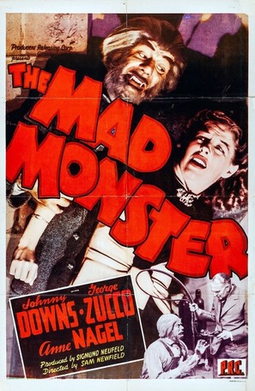
Horror On The Lens: The Mad Monster (dir by Sam Newfield)


In the 1942 film, The Mad Monster, the great George Zucco plays Dr. Cameron.  Dr. Cameron is a mad scientist who has a few issues with his colleagues and who makes the decision to deal with those issues by transforming his simple-minded handyman (Glenn Strange, who played Frankenstein’s Monster in a number of Universal films) into a wolfman.

The Mad Monster is one of the many horror films that were produced by Producers Releasing Corporation, which was one of the most poverty-stricken of the poverty row production companies.  To me, the interesting thing about the film is that Cameron initially wants to use his werewolf formula to help in the war effort.  He wants to help the United States win the war by turning soldiers into wolfmen.  It’s only after his plans are dismissed as being ludicrous that he starts using his wolfman to get revenge.  Unfortunately, the wolfman itself turns more savage and bloodthirsty with each act of revenge so I guess it’s a good thing that it wasn’t deployed on the battlefield because who knows what type of state the soldiers would have been in when they finally came home.

Here is 1942’s The Mad Monster!

Music Video of the Day: Nemesis by Shriekback (1985, directed by Tony van den Ende)


Just try to get that chorus out of your head after listening to NemesisEverybody happy as the dead come home!

Director Tony can den Ende has also done music videos for The Proclaimers, Meat Loaf, Melissa Etheridge, Joe Cocker, Thomas Dolby, Manic Street Preachers, and Guns N’ Roses.

Enjoy!

Horror on TV: The Hitchhiker 5.1 “The Martyr” (dir by Phillip Noyce)


Tonight’s episode of The Hitchhiker is a stylish homage to noir, starring Meg Foster as a femme fatale who is not quite as blind as she pretends to be.  This episode was directed by Phillip Noyce, who was also responsible for a film about an actual blind person, Blind Fury.  Interestingly enough, that film also featured Meg Foster, though in a very different role than the one that she plays here.

This episode originally aired on April 22nd, 1989.

The TSL Horror Grindhouse: Dr. Black, Mr. Hyde (dir by William Crain)


1976’s Dr. Black, My Hyde tells the story of Dr. Henry Pride (Bernie Casey).

Dr. Pride is a respected doctor, the head of a free clinic in the Watts district of Los Angeles.  He has a big house.  He has a fancy car.  With Dr. Billie Worth (Rosalind Cash), he is researching a serum that will help people with cirrhosis to regenerate the tissue of their liver.  Of course, Dr. Pride wasn’t always rich.  In his own words, he and his mother grew up in the guest house of a brothel.  But now that he is rich and successful, some people claim that he’s lost touch with his community.  As a prostitute named Linda (Marie O’Henry) tells him, “You talk white, you think white, you probably drive a white car.”

In a scene that is designed to bring to mind the horrors of the Tuskegee syphilis experiments, Dr. Pride considers the ethics of injecting his serum into his patients without warning them that there might be consequences.  Billie warns him that what he’s thinking about doing would be not only unethical but illegal.  Dr. Pride questions whether ethics matter when dealing with something that could potentially save lives in the future.  After Dr. Pride injects an elderly black woman with the serum, she turns into a white-skinned monster who attempts to strangle a nurse before promptly dying.  Despite this, Dr. Pride continues to develop the serum and eventually, he tries it on himself.

Under the effects of the serum, Dr. Pride becomes a white-skinned madman.  (Bernie Casey wears a white makeup whenever he plays this film’s version of Mr. Hyde.)  Under the influence of the serum, Pride rampages through Watts, killing prostitutes and pimps before transforming back into the Dr. Pride.  The police are investigating the murders but they’re searching for a white man.  Meanwhile, Dr. Pride continues to obsess on trying to work out the kinks of her serum.  He wants Linda to be his latest test subject.

Dr. Black, Mr. Hyde is a blaxploitation take on Dr. Jekyll and Mr. Hyde and, as with many blaxploitation films, the subtext is frequently more interesting than what actually happens on screen.  Dr. Pride, after continually being accused of acting white, takes his serum and soon literally becomes white and sets out to kill the prostitutes and the pimps who remind him of his life before he became a doctor.  And while it’s easy to see this as an example of the serum turning a good man into an evil monster (the classic Jekyll and Hyde formula), it’s also true that, even before his transformation, Dr. Pride views his patients as being potential test subjects.  For all of his talk about helping people, Dr. Pride maintains his distance from the members of his own community.  Is the serum turning Dr. Pride into a monster or is it just revealing who Dr. Pride truly wishes to be?  Given the film was directed by William Crain, who also did Blacula and who, unlike a lot of Blaxploitation directors, actually was black, it’s easy to believe that the subtext was intentional.

Of course, subtext aside, Dr. Black, Mr. Hyde is a cheap-looking and haphazardly edited film.  Much of the acting is amateurish but Bernie Casey gives a strong performance as both the repressed black doctor and his violent, white alter ego.  Cheapness aside, Dr. Black, Mr. Hyde is a frequently intriguing film.

The McPherson Tape (1989, directed by Dean Alioto)


A found footage film, The McPherson Tape (which is also known as UFO Abduction) opens with a title crawl that tells the viewer that what they are about to see is both and also the most compelling evidence to date that aliens are visiting Earth.

On October 8th, the Van Heese family gathers to celebrate the fifth birthday of Michelle.  Michael, the youngest of the Van Heese brothers, is home from college and he’s brought his new video camera with him, which he uses to film the party.  At first, his brothers give him a hard time about both his new beard and his camera but soon, everyone has bigger things to worry about.  When the power suddenly goes out, Michael and his brothers go outside to investigate.  While doing so, they stumble across what appears to be a spaceship and three humanoid aliens standing outside of it.  The brothers run back to the house and, eventually, the aliens follow.

The McPherson Tape was one of the first found footage films and it stays true to the rules of the genre to an extent that more recent examples have not.  That means that the 66-minute film plays out in real time.  There’s no background music.  The sound quality is poor.  The footage is grainy and sometimes out of focus.  This is one found footage film that actually looks like found footage, with the only thing giving the game away being the rubber alien masks worn by the actors playing the invaders.  Just as in real life, it’s not always exciting.  There are moments of dead space where both the audience and the McPhersons are waiting to see what happens next.  But because the film feels authentic and it features a cast of unknowns who do a good job of acting scared and confused, it’s much more effective than some of the slicker examples of the genre that have come out in recent years.

Director  Dean Alioto later remade The McPherson Tape with a bigger budget professional actors.  In 1998, the remake aired on the UPN under the title Alien Abduction: Incident In Lake County and supposedly caused a panic when some viewers though it was an actual documentary.  For my money, though, the original is still the best.

Retro Television Reviews: Five Desperate Women (dir by Ted Post)


Welcome to Retro Television Reviews, a feature where we review some of our favorite and least favorite shows of the past!  On Sundays, I will be reviewing the made-for-television movies that used to be a primetime mainstay.  Today’s film is 1971’s Five Desperate Women!  It  can be viewed on YouTube!

Five women, who all went to college together, reunite for the first time in five years.  They’re planning on spending a weekend at a cabin on a private island.  Lucy (Anjanette Comer) is the alcoholic who talks too much.  Dorian (Joan Hackett) is the pill popper who lies about having a handsome husband and two beautiful children.  Joy (Denise Nicholas) is the former activist turned trashy model.  Gloria (Stefanie Powers) is bitchy and self-centered.  And Mary Grace (Julie Sommars) is the one with the mentally ill mother who refuses to speak to her.  Upon reuniting on the dock, the five women all immediately gather in a circle sing an old sorority song.  It’s going to be one of those weekends!

The private island is lovely and the women believe that they have it to themselves, with the exception of the two men who are also on the island.  Wylie (Robert Conrad) is the caretaker and he seems to be a trustworthy gentleman and exactly the type of guy who you would want to be stranded on an island with.  And then there’s Meeker (Bradford Dillman), who drove the boat to the island and who is the type of overbearing jerk who has to be specifically told not to bother the women.  While the women stay in the main house, the men stay in the nearby caretaker’s cottage.

From the start, it proves to be a stressful weekend.  All of the women have secrets and long-buried resentments that come out at the slightest provocation.  Not helping the fact is that there’s a murderer on the island, one that goes from killing a dog to strangling Dorian while the rest of the women are at the beach.  The woman, figuring that the murderer has to be either Meeker or Wylie, lock themselves into their house for the night but it turns out that it’s going to take more than a locked door to defeat a killer.

Five Desperate Women has an intriguing premise but it also has an extremely short running time.  With only 70 minutes to tell its story and 7 major characters to deal with, the film doesn’t leave much room for character development and, as a result, each woman is only given one personality trait and each actress ends up portraying that trait as broadly as possible.  As a result, it doesn’t take long for the movie to go from being Five Desperate Women to Five Annoying Women.  As for Robert Conrad and Bradford Dillman, the two of them give effective performances but anyone with a hint of genre savvy will be able to guess who the killer is going to turn out to be.  There is one unintentionally funny moment where the desperate women attempt to fight off the killer by throwing rocks at him and none of the rocks come close to reaching their target but otherwise, Five Desperate Women is not particularly memorable.

Horror Scenes That I Love: Peter Cushing in Horror of Dracula


Peter Cushing was a horror mainstay who played both heroes and villains, often appearing opposite Christopher Lee.  By most accounts, Cushing was a kind and old-fashioned British gentleman, one who was beloved by both his colleagues and his fans.  Christopher Lee described him as being his best friend and reportedly, never fully recovered from his sadness over Cushing’s death in 1994.

(Cushing’s long screen collaboration actually first started in 1948’s Hamlet, in which Cushing played Osric and Christopher Lee had an uncredited role as a spear carrier.)

Though Hammer Films often cast Cushing as the mad Baron Van Frankenstein, I preferred his work as the stern but kindly Dr. Van Helsing.  This scene from 1958’s Horror of Dracula, in which Van Helsing drives a stake through Lucy and ends her eternal suffering, features Cushing at his best.  In this scene, we see both Van Helsing’s determination and also some hints of the kindness that Cushing brought to the role.