
by Rafael DeSoto
This cover is from 1936 and wastes no time getting to the point.
by Rafael DeSoto
This cover is from 1936 and wastes no time getting to the point.
The music video for Quiet Riot’s The Wild and The Young takes place in a future that’s controlled by the military and the Parents Resource Music Center (PRMC), the Tipper Gore-led organization that campaigned for albums and CDs to come with warning labels. Because the PRMC was largely made up with the wives of U.S. Senators, there was actually a Senate hearing on obscene lyrics in 1985, which led to a bunch of Senators being made to look foolish by everyone from Dee Snider to Frank Zappa.
Director Jeff Stein has directed several TV shows, along with doing videos for The Who, Weezer, Tom Petty and the Heartbreakers, George Clinton, Cinderella, Warrant, and Wilson Phillips.
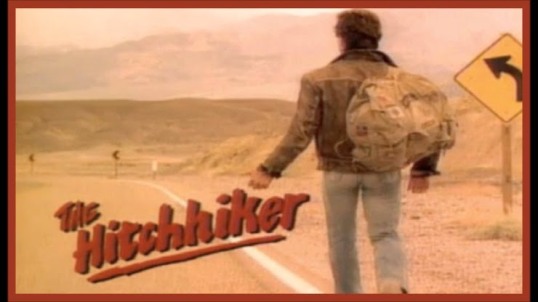
On tonight’s episode of The Hitchhiker, Patti D’Arbanville is perfectly cast Wendy, a performance artist who uses her disturbing nightmares for inspiration and who finds herself losing her grasp on reality.
The episode originally aired on August 5th, 1989.
If you can figure out what’s going on in 1979’s The Psychotronic Man, you’re definitely doing better than most people who have sat through this film.
Filmed on location in Chicago (at a time when the original Mayor Richard Daley was supposedly encouraging filmmaker to shoot anywhere but Chicago because he didn’t want anyone to film anything that could make his city look bad), The Psychotronic Man tells the story of an alcoholic barber named Rocky (Peter Spelson). One day, after work, Rocky decides to drive the long way home, which apparently means driving through every inch of rural Illinois. Seriously, you really do have to wonder just where exactly Rocky lives. Rocky decides to pull over so that he can get some sleep. Suddenly, his car is floating in the air. Was Rocky just having a dream or were aliens trying to abduct him? Rocky’s concerned and so is his wife and so is his mistress.
Rocky goes to a doctor but the doctor has nothing useful to tell him, beyond prescribing his some aspirin for his headaches. Rocky tries to investigate on his own but this just leads to him getting a shotgun pulled on him by a suspicious farmer. This is when Rocky discovers that he can kill people with his mind.
How has Rocky developed the power to kill people with his mind? Your guess is as good as mine, though the film does feature an professor at the University of Chicago who suggests that Rocky’s power is one that we all have, buried deep in our subconscious. Perhaps Rocky’s meeting with the aliens caused this powers to be unlocked. I mean, it’s as good an explanation as any, though you have to wonder why aliens would suddenly want to give an unappealing barber the ability to kill people with his mind. That seems pretty irresponsible on the part of the aliens.
Well, no matter! Rocky’s in a lot of trouble now and he’s got not only the police but also a government agent after him. (The government would like to learn how Rocky developed his “psychotronic powers.”) This leads to several scenes of Rocky and the police walking around Chicago, looking for each other. I would say that probably about 75% of this film is just filler. The plot gets repetitive in record time, as does the bell-dominated soundtrack. Every few minutes, a bell rings as if we need to be reminded that Rocky is one step closer to meeting his psychotronic destiny.
Personally, I enjoyed seeing the location footage of Chicago and the surrounding countryside. It was obvious that the film was shot without bothering to get permits so the majority of the people in the background were probably just people trying to either shop or get to work. That said, The Psychotronic Man plays out a torturously slow pace and Rocky is not at all an appealing main character. Even before he turns into a psycho mind killer, he’s a drunk who slips from a flask while driving and who is cheating on his wife. As far as I’m concerned, Rocky deserved whatever he got!
Finally, this film has lived on due to the fact that it introduced the word Psychotronic to the world. Michael J. Weldon later borrowed the term for The Psychotronic Encyclopedia of Film, The Psychotronic Video Guide, and Psychotronic Video magazine. Psychotronic is usually a term used to describe low-budget B-movies, the majority of which are better than The Psychotronic Man.
 Dr. Bikini Jones (Christine Nguyen) is a world-famous adventurer and archeologist who is willing to brave any danger and sleep with any security guard or spy in her hunt for treasure. She has just recovered a golden idol that contains a code that will lead to the Temple of Eros and a tiara that, when worn, makes the wearer the Empress of Moronica.
Evilla Cruella (Heather Vandeven) may have born in Hoboken but her family came from Mornica and she is determined to be Queen of the Morons. She sends her lover Drago (Frankie Cullen) and her other lover, Carol (Rebecca Love), to steal the idol. Working with CIA agent Mark X (Tony Marino), Bikini must keep Cruella from being the first to find the Temple of Eros. It won’t be easy because the Temple itself is guarded by a hungry dinosaur!
Cruella’s Castle started life as an 82-minute softcore film called Bikni Jones and The Temple of Eros. When the film moved to streaming, it was edited to remove all of the explicit sex and most of the nudity and renamed Cruella’s Castle. (Without the sex and boobs, Cruella’s Castle is only 40 minutes long.) I imagine many would say that the editing took the main reason why anyone would want to watch this movie in the first place but, even in edited form, Cruella’s Castle has got enough double entendrees and intentionally dumb jokes to be entertaining. The dinosaur is surprisingly effective, considering that the budget for this movie was undoubtedly not high and Christine Nguyen has so much energy and enthusiasm as Bikini Jones that it’s hard not to mourn that she hasn’t had any more adventures. This is a typical Fred Olen Ray joint, dumb but inoffensive and even a little fun if you’re in the right mood.
Welcome to Retro Television Reviews, a feature where we review some of our favorite and least favorite shows of the past! On Sundays, I will be reviewing the made-for-television movies that used to be a primetime mainstay. Today’s film is 1971’s The Failing of Raymond! It can be viewed on YouTube!

Poor Raymond!
Played by a young Dean Stockwell, Raymond is patient at a mental hospital who blames everything that has gone wrong on his life on one failed test. During his senior year of high school, he got a 61 on an English test and, as a result, he not only only failed the class but he also wasn’t allowed to graduate. The test was administered by a substitute teacher named Mary Bloomquist (Jane Wyman), one who did not know that Raymond had a reputation for being a bit eccentric. When Raymond tried to ask her whether or not the final two questions were for extra credit, Mary refused to call on him because she was more preoccupied with her failed affair with another teacher (Dana Andrews). Raymond didn’t answer the final two questions, even though he believed that he had the correct answers. Now, locked away in a hospital, Raymond comes across an article announcing that beloved teacher Mary Bloomquist will soon be retiring and moving to England.
Seeking revenge, Raymond escapes from the hospital. While police Sgt. Manzek (Murray Hamilton) search for Raymond, Raymond returns to his old school. When he finds Mary in her classroom, Mary mistakes Raymond for a mover responding to a classified ad asking for help in getting all of her things packed up. Raymond may be a homicidal but he also craves direction and praise so he helps Mary with her packing. As he packs, Mary talks about her decision to retire and it turns out that she’s not quite the monster that Raymond imagined her to be. Mary is retiring because she feels that she has never made a difference as a teacher.
That said, Raymond is still determined to get his revenge. He wants Mary to give him the test a second time and to give him a passing grade. And if she doesn’t, he’s prepared to kill her. Unfortunately, despite claiming to have spent years studying the material, Raymond still thinks that Robert Browning wrote the Rhyme of the Ancient Mariner.…
As the old saying goes, you never know how much your actions might effect someone else’s life. Mary is a dedicated and well-meaning teacher who cares about her students but her decision to fail Raymond, made on a day when she was distracted by her own personal problems, is something that Raymond has never forgotten or forgiven. Mary can barely remember it happening but Raymond has based his entire life around that moment and, as the film progresses, it becomes clear that he’s incapable of understanding that the entire world doesn’t revolve around what happened to him during his senior year. On the one hand, Mary definitely should have answered Raymond’s question about whether or not the final two questions were multiple choice. On the other hand, Raymond has clearly been using the incident as an excuse to justify every mistake that he’s made sense. Ironically, Raymond’s quest for revenge gives Mary the chance to finally be the teacher that she truly wants to be.
It’s an intriguing premise. Unfortunately, like so many made-for-TV movies from the early 70s, The Failing of Raymond is occasionally a bit too stagey for its own good. Despite only being 73 minutes long, it never really develops any sort of narrative momentum. That said, Dean Stockwell gives a performance that makes clear why Alfred Hitchcock was planning on casting him as Norman Bates if Anthony Perkins somehow fell through. As played by Stockwell, Raymond is unfailingly polite and so obviously wounded that it’s impossible not to feel sympathy for him, even when he’s threatening to kill his former teacher. Jane Wyman, as well, gives a sympathetic performance as Mary, who, despite that one bad day with Raymond, really is the type of teacher we all wish we could have had.
This film was directed by Boris Sagal, who did several made-for-TV movies and also directed Charlton Heston in The Omega Man. His daughter, Katey Sagal, makes her film debut in a small role as one of Raymond’s fellow patients.
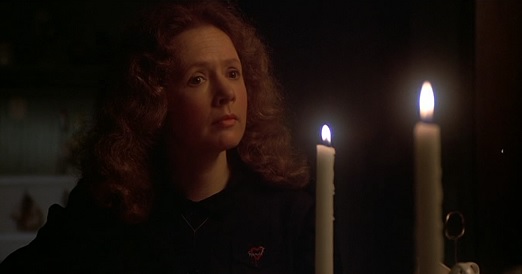
So far, this month, I’ve been doing these horror scenes that I love in alphabetical order based on who was featured in the scene. Originally, today was going to be devoted to Boris Karloff but, last night, I read the news that the great Piper Laurie had passed away at the age of 91.
Have no doubt that Boris Karloff will be honored tomorrow but, for today, I would be remiss if I didn’t pay tribute to Piper Laurie. Piper Laurie often said that, when she read the script for 1976’s Carrie, she at first didn’t understand the story’s tone until she realized that Margaret White was meant to be as comedic as she was frightening. Piper Laure’s performance as Carrie’s mother resulted in an Oscar nomination and it also revived Laurie’s career. (Laurie had semi-retired from Hollywood following her previously Oscar-nominated work in The Hustler.)
In the scene below, Margaret makes one last attempt to keep Carrie from going to the prom. Her line, “They’re all going to laugh at you” comes back to haunt Carrie in a very big way.
One final bit of Piper Laurie horror trivia: In 1959, when Alfred Hitchcock was casting Psycho, Piper Laurie was his second choice, behind Janet Leigh, for the role of Marion Crane.
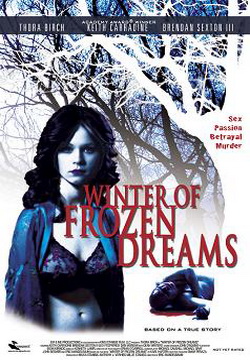
The 2009 film, Winter of Frozen Dreams, opens with a young woman named Barbara Hoffman (Thora Birch) in a Wisconsin courtroom in 1980. She is on trial, having been accused of committing two murders. The jury reads their verdict and the film flashes back three years to show us how how Barbara ended up in that courtroom.
It’s a bit of an odd way to open the film, one that robs the story of any suspense. The story of Barbara Hoffman is a true one but, unlike other true crime stories, it’s not a commonly known one. I had not heard of Barbara Hoffman until I watched this film and, after the film ended, I immediately went to Google to make sure that the film was actually telling the truth when it claimed to be based on a true story. Barbara Hoffman and her trial apparently were a big deal in 1980. (Her trial was the the first murder trial to ever be televised.) But it is now so obscure that it doesn’t even have a Wikipedia entry.
As seen in the film, Barbara Hoffman was a genius. She had a 145 IQ and was the valedictorian of her high school class. She went to college to study chemistry and was doing quite well academically. However, when she got a job answering the phones in a massage parlor, she realized that she could make a lot more money as a sex worker than as a chemist. She dropped out of college before starting her final semester and went to work for a pimp named Ken Curtis (Dean Winters).
Barbara was engaged to two different men. One was Harry Berge (Dan Moran), who has a taste for bondage and being ritually humiliated. At first, his co-workers thought he was kidding when he started introducing the much younger Barbara as being his fiancée but Harry actually signed over all of his property to her and allowed Barbara to take out a life insurance policy on him.
It was Barbara’s other fiancé, a mild-mannered video clerk named Jerry Davies (Brendan Sexton III), who Barbara called on Christmas to tell him that she had discovered Harry’s dead and battered body in her bathroom. Convinced that Harry had been murdered by Ken, Jerry helped Barbara to hide the body in the Wisconsin snow. Of course, even while Jerry was helping Barbara cover up Harry’s death, Barbara was taking out a considerable life insurance policy on him.
After Jerry has an attack of conscience and leads the police to the body, it falls to the pipe-smoking Detective Lulling (Keith Carradine) and his partner (Leo Fitzpatrick) to figure out who was responsible for Harry’s murder. Lulling’s instinct is to suspect Barbara but everyone else seems to think that either Ken or Jerry is the more obvious suspect. After all, Barbara’s a genius. Why would she kill someone?
It’s an interesting story, though Winter of Frozen Dreams is never quite as compelling as one might wish. Some of that is because, despite her genius IQ, Barbara herself never becomes that interesting of a character and Thora Birch never seems to be that invested in her performance. She delivers her lines in a rather flat manner, never really showing the charisma necessary to be convincing as a real-life femme fatale. That said, you do feel sorry for the two men, especially Brendon Sexton III. And Keith Carradine and Leo Fitzpatrick make for an amusing detective team. I almost wish the two of them had starred in their own series, where they traveled the Pacific Northwest and solved small town murders.
Of course, the biggest problem with this movie is that it opens with the verdict so we already know what’s going to happen. We know who is going to die and we know what’s going to happen to Barbara as a result. There’s zero suspense as to how things are going to work out. It’s an error on the part of the filmmakers and an unfortunate one.
4 Shots From 4 Films is just what it says it is, 4 shots from 4 of our favorite films. As opposed to the reviews and recaps that we usually post, 4 Shots From 4 Films lets the visuals do the talking.
This month, we’re using 4 Shots from 4 Films to honor some of our favorite horror filmmakers! Today, we honor the one and only Joe Dante!
4 Shots From 4 Joe Dante Films

Piranha (1978, dir by Joe Dante, DP: Jamie Anderson)

The Howling (1981, dir by Joe Dante, DP: John Hora)
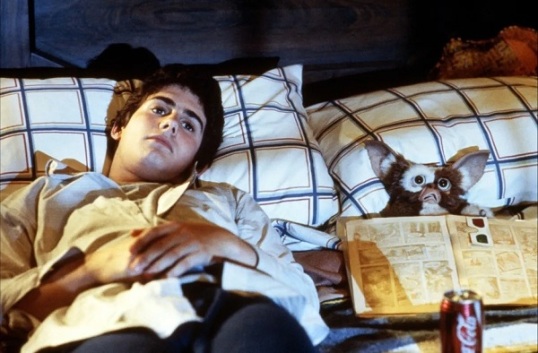
Gremlins (1984, dir by Joe Dante, DP: John Hora)

Burying The Ex (2014, dir by Joe Dante, DP: Jonathan Hall)

One day, I was exploring my town with my camera. I found an alley sitting behind a row of store and I took pictures as the day passed. Today, I look at these pictures and I think about the things that I did not consider while taking them. What is behind the closed doors? How does the difference of an hour change the way a place looks and feels?


Previous Moments:
 Through the Shattered Lens