Grindhouse Classics : “The Hollywood Strangler Meets The Skid Row Slasher”


l_79300_4d2680e6

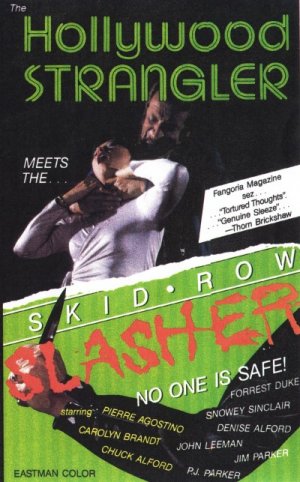
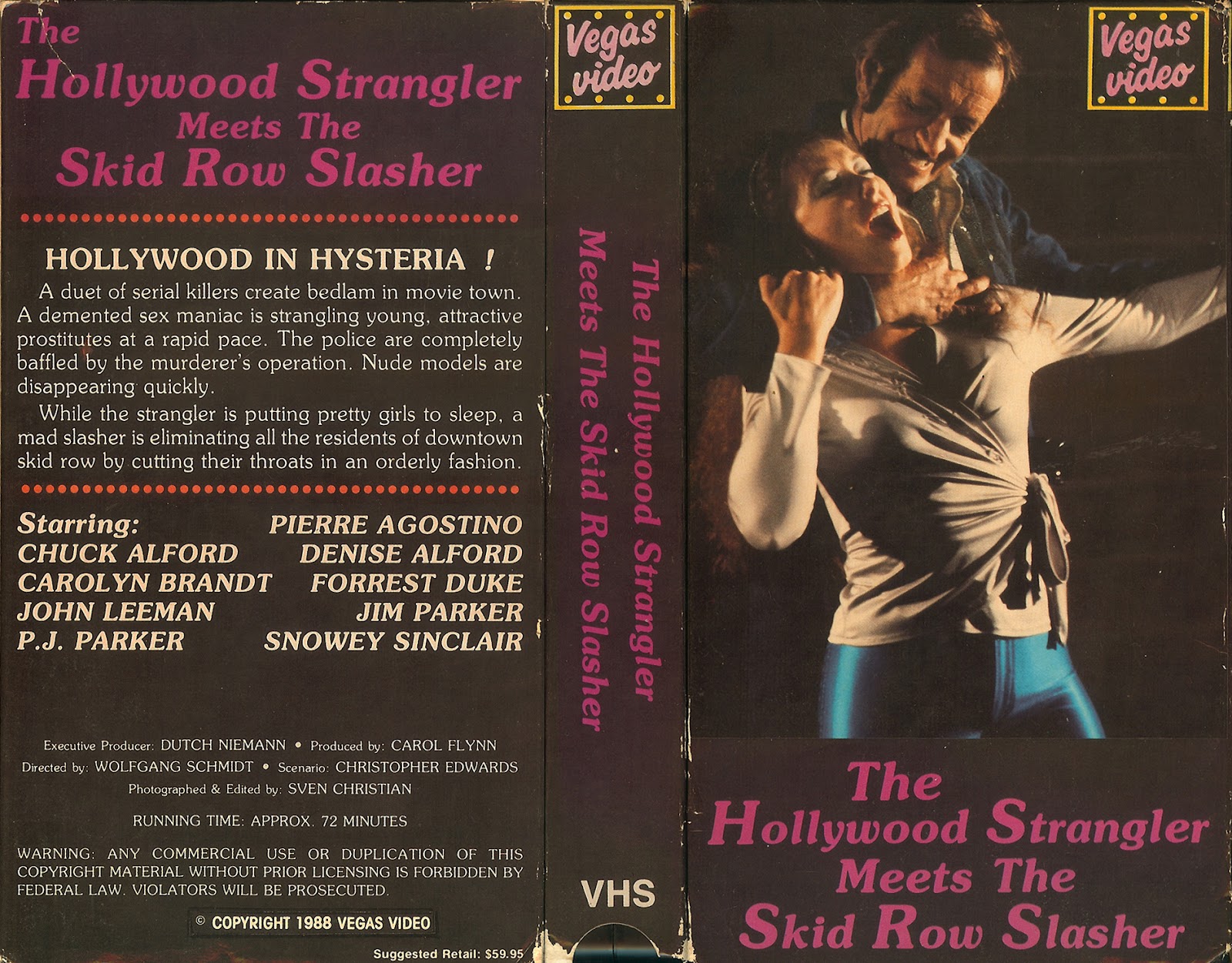
Sometimes, it’s almost impossible to know where to begin. Watching cult auteur Ray Dennis Steckler’s less-than-no-budget/dual-slasher mash-up The Hollywood Strangler Meets The Skid Row Slasher feels like a step back in time to the late 50s/early 60s, when ultra-cheap productions like The Creeping Terror and The Beast Of Yucca Flats were shot not only without sound, but with what sound was dubbed in later in post-production coming primarily in the form of voice-over narration, since the producers were too stingy and/or lazy to match up dialogue with actors’ moving mouths and only wanted to have to hire one person to tell their “story” anyway.

There’s just one wrinkle — Steckler (under his often-used “Wolfgang Schmidt” pseudonym) made this thing in 1979, hoping for a quick cash-in on the success of John Carpenter’s Halloween and the fly-by-night slasher genre that was then burgeoning in its wake! Honestly, by this point even Doris Wishman wasn’t cooking up her home-baked celluloid casseroles in a manner this frugal.

hwood vhs

Still, you’ve gotta give RDS at least some credit here — his dialogue-free, ultra-minimalist approach results in a style that can only be described as uber-naturalist, simply because when you spend this little on a production (the film’s total budget is reputed to be somewhere in the range of $1,000 — yes, you read that right) it literally can’t come out any other way. Honestly, his more “well-known” 1960s efforts such as The Thrill KillersThe Adventures Of Rat Pfink And Boo BooThe Lemon Grove Kids Meet The Monsters and, of course, The Incredibly Strange Creatures Who Stopped Living And Became Mixed-Up Zombies feel like big-money blockbusters in comparison with this effort, which is more akin in terms of its production “values” and “standards” to one of those old 8mm (although this was shot on 16) “educational” films they used to show you in school (if you’re old enough to have been around for them) on subjects ranging from photosynthesis to slaughterhouse operations and everything in between.

Purely as a side note,  I have to say that I have no idea what teachers do when they’re feeling lazy these days — I guess give a power-point presentation or something, but I do know what Ray Dennis Steckler does when he’s feeling like mailing it in — he makes a movie like this one.

Hollywood Strangler Meets Skidrow Slasher 271 - 273

This was made at the apex of our guy Ray’s so-called “dark period” — when he got divorced from actress Carolyn Brandt (although she continued to star in his features, including this one), split LA broken-hearted, set up shop in Vegas, and generally spent his time seething with bitterness toward the Hollywood system that had rejected his admittedly unique — if not good by any standard definition of the word — brand of film-making. Returning to the streets of Hollywood Boulevard for the first time in many years for this one, there is, in fact, a palpable sense of rage that oozes from the frames of The Hollywood Strangler Meets The Skid Row Slasher, and if you do a little game in your head while you’re watching it whereby you replace the young, female victims of the strangler and the derelict, destitute victims of the slasher in your mind with the various exploitation producers and distributors that ripped Steckler off over the years, the flick becomes a lot more interesting.

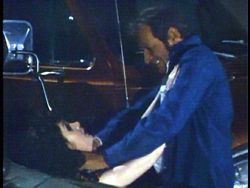
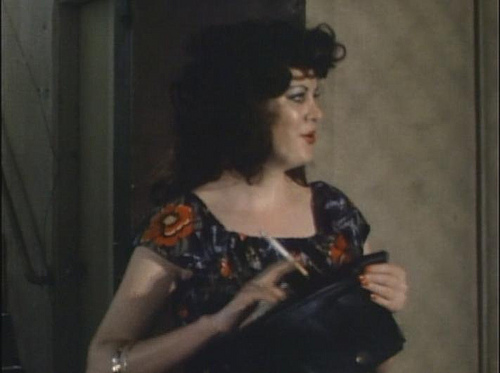
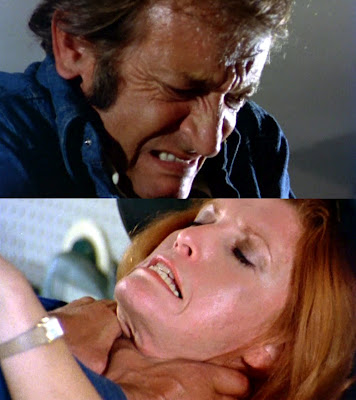
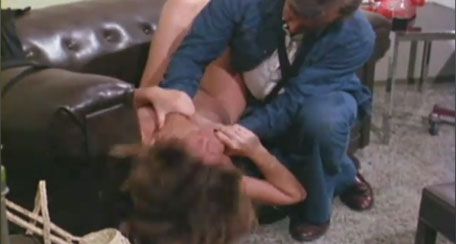
Truth be told, though, that’s about the only way you can draw any sort of “entertainment” from this 71-minute snooze-fest because Ray doesn’t really do anything on his part to keep you involved in the proceedings — it falls entirely on your shoulders as a viewer to invent a reason to keep watching. The “plot” alone’s certainly not gonna do it — our psycho narrator, one “Johnathan Click” (Pierre Agostino) poses as a nudie photographer in order to lure women whose phone numbers he’s obtained via the various hooker newspapers littering the boulevard over to his pad, where he dutifully proceeds to strangle them after they’ve disencumbered themselves of most or all of their clothing, while just a few block over an unnamed used bookstore clerk played by the aforementioned ex-Mrs. Steckler gets so sick of the bums and winos coming into her shop drunk off their asses that she starts slitting their throats (sometimes, curiously enough, with a knife that’s already got blood on it before she even sticks ’em ). As they both go about their business slicing,dicing, and choking their way through tinseltown, their paths are bound to cross — especially once Click rumbles his fellow traveler’s identity — but when they do, will they become uneasy allies in their mutual quest to, as they see it, clean up the streets, or will they have to duke it out to the death, figuring the town’s not big enough for the both of them?

the-hollywood-strangler-meets-the-skid-row-slasher

Don’t worry — by the time their confrontation finally does take place, you won’t give a shit about the outcome. Hell, if you’re a normal human being, you won’t even be awake anymore. Even as a morbid curiosity piece centered around the less-than-burning question of “how can Ray Dennis Steckler  make a movie with absolutely no money?,” this one runs out of gas pretty fast, and once the end credits (such as they are) roll, it feels more like a relief than anything else.

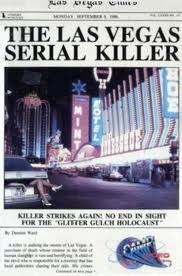
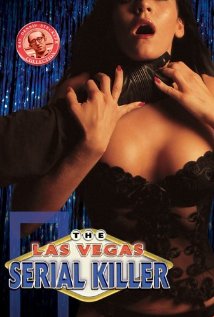
Perhaps the weirdest of all weird things in relation to this production, though, is that Steckler somehow, for some reason, must have felt that it worked (or at the very leaast turned a profit), because seven years later — long after what very few people who would have cared stopped doing so — he decided to make a sequel, this time featuring only “Mr. Click,” called The Las Vegas Serial Killer. I think he spent even less on that one since he didn’t have to  leave town to make it, and most of Hollywood Strangler‘s micro-micro-micro budget was, I’m guessing,  probably consumed by the director’s own travel and lodging expenses, given that the on-screen product looks like it didn’t cost  so much as one thin dime.

All that being said, Steckler performs something of an entirely accidental occult ritual here, by managing to warp our perceptions of the passing of time itself. At barely over an hour, this feels more like seven. You’ll swear that you can sit through the entire Godfather trilogy plus Lawrence Of Arabia  in the time it takes to watch The Hollywood Strangler Meets The Skid Row Slasher. At some point along the way, this passes the point of being merely dull and obtains the power to warp the laws of the universe merely through the force of its lethargy. This is a movie that works hard to be as boring as it is, goddamnit, and as a result it manages to completely take over our minds even if it can’t sustain our attention.

Don’t ask me how that works. I have no idea. Nor does Steckler. This kind of thing just comes naturally to a master of the craft such as himself.

Untitled-2

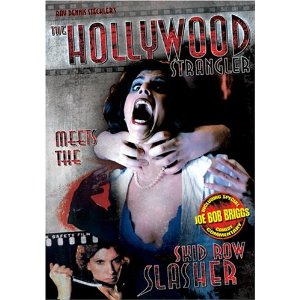
Fortunately, if you spring for either the purchase or rental of The Hollywood Strangler Meets The Skid Row Slasher on DVD, Media Blasters (under the auspices of their “Guilty Pleasure” sublabel) has done some things to make sure this can, indeed, sustain your interest. The widescreen transfers looks, well, as good as it can, the mono sound is bearable enough (not that it really matters that much), there are on-camera interviews with Brandt and Steckler, and we get two commentary tracks — one from Steckler which is pretty good, and one from the inimitable and legendary Joe Bob Briggs, which is, as you would expect, packed full of awesome from start to finish. A better overall package than this movie deserves, to be sure, but you’ll be grateful for it nevertheless.

51KK023JF3L__SL500_AA300_

All of which leads this review to one of those schizo conclusions that only seem possible with bottom-of-the-barrel exploitation cinema — the film sucks, but the DVD is great. At this point in his career, Steckler’s admitted one over-riding goal was to spend as little on his productions as possible, and here it really shows. He also prided himself on his intense hatred for actors and refused to hire any real ones, but that doesn’t matter much in this instance, since even the most talented performers in the world couldn’t save this thing. This is still, however,  a film worth sitting through, if not actively or actually watching — and not just as an endurance test (even though those can be fun sometimes). I know a statement like that positively demands an explanation, so try this — pop this disc into your player and keep one eye on your watch. Hell, keep both eyes on your watch since it’ll be more interesting than the movie. I guarantee you, at some point, the hands will stop moving, and they won’t start up again until “The End” comes up on the screen. That, my friends, is some real movie magic.

Guilty Pleasure No. 2: Save The Last Dance (dir by Thomas Carter)


When Arleigh posted his pick for the first guilty pleasure review here on the Shattered Lens, it made me think about just what exactly constitutes a guilty pleasure.

I’ve always been very much of the belief that you should never feel guilty about feeling  pleasure.  Of course, speaking as someone who was raised Catholic, I can tell you that’s a lot easier said than done.  However, I’ve always been the type who can find something to love in just about any film (with the exception of Avatar).  I’ve never felt any sort of guilt about the fact that I can both love a film like Citizen Kane and a film like Confessions of a Go-Go Girl.  If anything, I take a lot of pride in the fact that I can see the value of a film like Confessions of a Go-Go Girl.  

What, I wondered, could I possibly write about?

And that’s when I remembered Save The Last Dance.

Released in 2001 and produced by MTV films, Save the Last Dance tells the story of Sara (played by Julia Stiles), a high school dance student who fails her audition for Juilliard on the same day that her mother is killed in a car accident.  The guilt-stricken Sara gives up on ballet, moves in with her estranged father, and transfers to an urban high school in Chicago.

Sara is literally the only white girl in the entire school but still manages to befriend Chenille (Kerry Washington), who takes her to a club where she meets Chenille’s brother, Derek (Sean Patrick Thomas).  Despite the disapproval of apparently everyone else in Chicago, Sara and Derek start dating.  Derek encourages Sara to try out for Juilliard again but, as the date of Sara’s audition approaches, Derek finds himself pressured to take part in a drive-by shooting.

When Save The Last Dance first came out, I was a 15 year-old ballet student whose life pretty much was all about dancing..  I went to the movie with some friends from dance class and I have to admit that we were pretty catty in the way that only dancers can be.  Our lives, after all, revolved around dance and we weren’t about to cut Julia Stiles any slack just because she spent four months taking ballet lessons before making Save The Last Dance.  While the rest of the audience was content to enjoy Save The Last Dance for what it was, we fixated on how awkward Julia looked during her second audition for Juilliard.  We commented on how nervous her eyes looked whenever she was dancing and how she really didn’t have a dancer’s body.

As one of my friends put it, “There’s no way she would have gotten into Juilliard,” as if Save The Last Dance was meant to be a documentary about ballet as opposed to a teen romance film.

But you know what?

Though I never admitted it to my dance friends, I enjoyed Save The Last Dance  when I first saw it and I still enjoy it today.  Yes, it is obvious that Julia Stiles was not a trained ballet dancer and yes, the film’s look at race relations is more than a little bit idealized but so what?  Sean Patrick Thomas is hot,  the club scenes are fun (and Julia Stiles is more believable as a club dancer than as a ballerina), and director Thomas Carter is appropriately shameless when it comes to manipulating our emotions.  When I watch  this film now, instead of being critical of the film’s unrealistic portrayal of the dancer’s life, I instead see it as a dramatization of every girl’s ideal fantasy.  Like the best fantasies, Save The Last Dance tells us that — if you just believe — you can have it all: hip friends to protect you, a hot guy to love you, and a second chance to go to Juilliard.

Or as Derek says to Sara, “You can do it. Sara, you were born to do it.”

(Incidentally, if not for a memorable supporting character in Save The Last Dance, a New Jersey girl named Nicole Polizzi would never have been nicknamed Snookie.  So there’s that, as well.)

And so, with this post, allow me to officially announce to the world: I love Save The Last Dance and I am not ashamed!

To quote the tagline from Save The Last Dance’s theatrical poster, “The only person you need to be is yourself.”

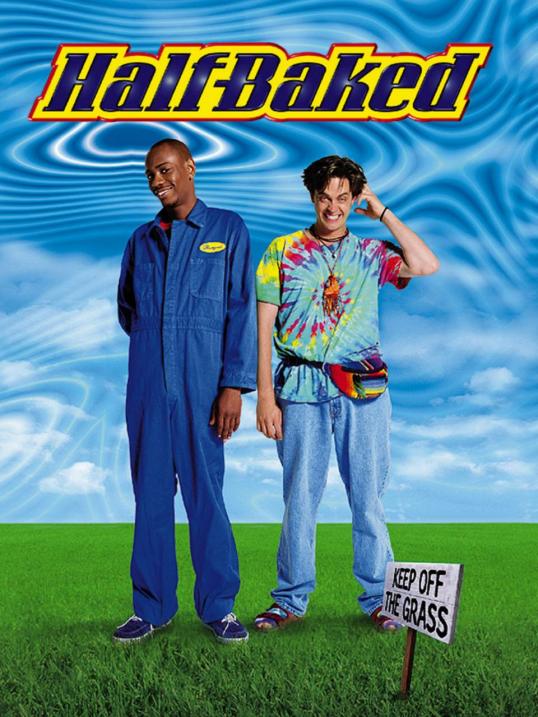
Guilty Pleasure No. 1: Half Baked


Half Baked

“Abba Zabba….You’re my only friend” — Thurgood

With the first month of January 2013 almost coming to an end I thought it was high time to introduce a new feature to the site. This one shall be called “Guilty Pleasure” and it will encompass all sorts of entertainment examples that I and those who on the site who wish to participate that they consider a personal guilty pleasure. It could be any film, music, book or games that one considers a personal favorite despite not being highly accepted by critics and the general population, at large.

The first entry to “Guilty Pleasure” is a stoner comedy that I always end up stopping whatever activity I’m doing at the moment to watch. I have it on DVD, will watch it on cable whenever it’s on and if a Blu-Ray version ever gets released I probably would buy it just to have it. This guilty pleasure film is 1998’s Half Baked starring Dave Chappelle and…well let’s just say all one needs to know is that it stars Dave Chappelle. It’s a mary jane flick that’s reached the levels of the Cheech and Chong flicks of the 70’s and 80’s.

My brother and I have seen this film so many times that we could quote scenes from it almost perfectly. I may not be quite the pothead that the characters in this film end up being, but anyone who has seen Half Baked knows at least one or two who fit the different type of stoners we find in it.

In the immortal words of Sampson Simpson: “YES! Cuban B!”