Sierra Stranger starts with a familiar western situation. Jess Collins (Howard Duff), a penniless but honorable drifter, comes across two men tying another man to the back of a horse. The two men claim that Sonny Grover (Ed Kemmer) is an outlaw and a claim jumper and not to be trusted. Sonny says that he’s innocent and the two men are actually the claim jumpers. Jess does what many a western hero has done. He sides with the underdog and saves Sonny. To thank him, Sonny gives Jess a part of his claim.
Jess rides into the nearby town to claim his new property. He meets and befriends Sonny’s half-brother, Bert (Dick Foran). He also meets and falls in love with Bert’s fiancée, Meg (Gloria McGeehee). However, soon after arriving, Jess discovers that he made a mistake and he saved the wrong man. Sonny really is the dangerous outlaw that everyone says he is. After Sonny robs a stagecoach and murders the driver, Jess risks his new friendship with Bert by trying to bring Sonny to justice.
Howard Duff appeared in his share of B-westerns in the 50s. He was always a solid hero, even if he didn’t really have the screen presence of some of the other stars of the genre. He’s pretty good in Sierra Stranger and the fact that, for once, the town is right while the drifter is wrong is an interesting twist on an otherwise standard story. This is the rare western where the hero makes a pretty big mistake and then has to spend the rest of the movie trying to make up for it. If you’re not a western fan, this is not the type of B-movie that’s going to change your mind. But, for those who do like the genre, it’s an interesting twist on what we’ve been led to naturally expect.
The 1984 film, Bolero, tells the story of Ayre “Mac” MacGillvary (Bo Derek) and her best friend, Catalina (Anna Obregon). They’re young, they’re rich, they’ve just graduated from college, and, despite the fact that they both appears to be in their early 40s, they’re determined to lose their virginities to the most perfect lovers that they can find.
Because the film is taking place in the 1920, Mac and Catalina first travel to the Middle East in hope of finding a Rudolph Valentino-style sheik. Accompanying them is Mac’s chauffeur and protector, Cotton (a clearly embarrassed George Kennedy). Though Mac does manage to find a sheik (played by Greg Benson), her efforts to lose her virginity to him prove to be a failure. Though the Sheik is willing, he indulges a bit too much with his hookah and ends up passing out right before the consummating the act.
Well, if a sheik can’t do it, how about a bullfighter? Mac and Catalina leave the Middle East for Spain and it’s there that Mac catches the eyes of Angel (Andrea Occhipinti), a celebrated bullfighter. Mac decides that Angel will be the one to take her virginity but it turns out that, once again, nothing as is easy as it should be. It turns out that Angel already has a lover and he’s been with her since she was a teenager. And a 14 year-old Gypsy named Paloma (played by Olivia d’Abo) has already decided that she is going to be Angel’s next lover, which is incredibly icky even before the film makes it even ickier,
While Mac is trying to seduce Angel, Catalina is trying to seduce a Scottish attorney named Robert Stewart (Ian Cochrane). “What do you wear under your skirt?” Catalina asks. “It’s a kilt!” Stewart yells because he’s Scottish. Anyway, Catalina eventually does get an answer to her question so yay Catalina!
As for Mac, she does eventually manage to win Angel’s attention but then …. OUCH! Angel gets gored by a bull and yes, he gets wounded exactly where you think that he gets wounded. Suddenly, Angel can no longer get it up but fear not. “We’re going to make that thing work,” Mac says, before she then takes up bullfighting herself. It all eventually leads to a scene that makes heavy use of dry ice and a neon light that misspells the word ecstasy.
Bolero is one of those sex-obsessed films that tries so hard to be erotic that it actually goes in the opposite direction and becomes so firmly anti-erotic that one gets the feeling it could be used as a torture device in a George Orwell novel. “The Anti-Sex League sentences you to watch Bolero!” A huge part of the problem is that, even though everyone in the film is certainly attractive, there’s still next to no chemistry between Bo Derek and any of her potential lovers. The film was directed by Bo’s then-husband, John Derek and, somewhat perversely, John continually films her in the least flattering ways possible. John also tries to introduce some humor into the film — at one point, it turns into a silent film, complete with title cards — but it all falls flat. Finally, the gored bullfighter is played by a very handsome Italian actor named Andrea Occhipinti who I immediately recognized as being the same actor who played the killer in Lucio Fulci’s The New York Ripper. Though it was a bit unfair to Occhipinti (whose likable blandness was exactly what made him such a subversive choice to play the killer in Fulci’s film), I was worried every moment that Mac was left alone with him. (Occhipinti is now one of Italy’s most respected film producers.)
Produced by Cannon Films, Bolero was apparently a huge flop when it was released. Bolero was considered to be so bad that it led to MGM announcing that they would no longer help to distribute any other Cannon Films. I can’t really blame MGM. Even when viewed decades later, Bolero is a dull romp that’s fit only for the Anti-Sex League.
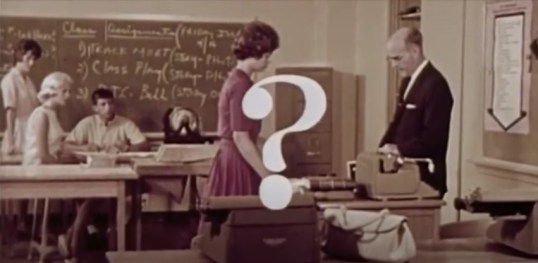
The year is 1963 and Nancy is the editor of the high school newspaper. She’s upset that so many students are settling their disagreements through fighting. She wants to run a story about the fights and she wants to publish the pictures of the two students who were involved in the latest brawl. When her faculty advisor points out that a high school newspaper is supposed to be positive and that publishing the pictures of the combatants would be an invasion of their privacy, Nancy argues that she has a responsibility as a journalist….
NANCY, IT’S A HIGH SCHOOL NEWSPAPER! YOU’RE NOT A JOURNALIST!
Anyway …. what would you do?
This film is from 1963 and it seems to be a bit biased in Nancy’s favor. Of course, Nancy should publicly shame any student caught fighting! Myself, I have to disagree. I’m reminded of the old but very true saying: “No one likes a snitch.” Add to that, judging from the opening shots of this film, the entire school witnessed the fight so it’s not like Nancy is going to be telling her readership something that they didn’t already witness firsthand. Seriously, what is Nancy’s problem?
I’m against censorship but I’m also against being a snitch. Honestly, I think Nancy has gone a little power mad.
However, if you want to consider for this issue for yourself, here, from 1963, is Censorship: A Question of Judgment:
Arizona rancher Wick Campbell (Richard Boone) is angered when he discovers that one of his servants, Maria (Donna Martell), would rather marry Howie Stewart (Skip Homeier) than be with Wick. Wick has had a long rivalry with Howie and his older brothers, John (Randolph Scott) and Adam (Lester Matthews). Determined to get rid of the Stewarts and to have Maria for himself, Wick hires notorious gunfighter Frank Scavo (Leo Gordon) to take over the town and defeat the Stewarts, one way or another.
Ten Wanted Men (the title refers to Scavo’s gang) is an above average Randolph Scott western. Scott was one of the best of the western heroes because he always seemed so authentic whenever he rode a horse, shot a gun, or even just put on a cowboy hat. Scott was also an underrated actor and, as he got older, he became Hollywood’s go-to choice whenever they needed a strong, silent lead for a western. That’s the role that he plays in Ten Wanted Men, as the patriarch of the Stewart family. He’s instinctively fair but he will do whatever has to be done to protect his brothers.
Wick Campbell is John Stewart’s opposite, an oily rancher who hires other men to bully his enemies and who abuses his servant in a way that the Stewarts never would consider. Though Richard Boone became best known for playing the hero on Have Gun–Will Travel, Wick is the type of cowardly villain who everyone will be happy to see get exactly what he deserves. As played by Leo Gordon, Frank Scavo is a brutish outlaw and, unlike Wick, he doesn’t pretend to be anything else.
Ten Wanted Men is a good western. The plot may not be surprising but the gunfights are exciting and Randolph Scott is as ideal a hero as always. Fans of the genre will enjoy it.
In this “modern-day” western, Ken Maynard stars as Ken Baxter. While out camping in the wilderness with his trusty horse Tarzan and his two comic relief sidekicks, Pancho (Julian Rivero) and Panhandle (Ralph Peters), Ken comes across the gravely injured Professor Wahl (Michael Vallon). Wahl is an archeologist who has been left to die. Wahl is too weak to reveal who attacked him and, when Ken gets Wahl back to civilization, he discovers that Wahl’s colleagues, Dr. Flotow (William Castello) and Baron Starkoff (Sven Hugo Bard), aren’t willing to help Wahl unless he shares the location of a helium mine.
Flotow and the Baron are working for “a foreign power” and want to smuggle the helium back to Europe so that their country can use it to fuel their dirigibles. Ken and his sidekicks have to stop the bad guys from getting control of the ranch that sits near the mine. Going undercover, Ken allows himself to be hired by Joe Larkin (Charles King), who is trying to steal the property away from Letty Morgan (Fay McKenzie). Romance and gunfight follows. Ken’s horse, Tarzan, saves the day more than once.
The plot of Death Rides the Range is intriguing and, for a 55-minute programmer, complex. Unfortunately, the execution doesn’t allow the story to fulfill its potential. By the time Maynard starred in this film, the once-major cowboy star had alienated most of the major studios and he had a reputation being difficult. He was reduced to working for poverty row studios, like Colony Pictures. Maynard is a convincing hero and his horse, Tarzan, was one of the most talented of the animal actors working at that time but Death Rides The Range still feels rushed.
Death Rides The Range is mostly interesting as an example of the type of anti-German films that were being made before the U.S. officially entered World War II. The film keeps it ambiguous who Flotow and Starkoff are working for but any viewer who had been following the news out of Europe would automatically know they were working for the Germans. Even when he was making movies for Poverty Row, Ken Maynard was still fighting the good fight.
In 2010, after making audiences laugh with films like Anchorman, Talladega Nights, and Step Brothers, director Adam McKay released The Other Guys. A spoof of buddy cop films, The Other Guys featured Mark Wahlberg and Will Ferrell as two lovably incompetent but well-intentioned cops who took down a corrupt investor played by Steve Coogan. It was a funny movie and, along with Anchorman and Talladega Nights, it revealed that McKay was one of the few directors who understood how to best capture Ferrell’s style of comedy. And yet, the film ended on a bit of an odd note as the end credits were accompanied with statistics on how much money Wall Street executives were getting paid while the average American struggled to keep up with their bills. It suggested that McKay meant for Coogan’s somewhat cartoonish villain to be taken seriously.
McKay followed up The Other Guys with Anchorman 2, which had some funny moments but which was also overlong, spent a good deal of time railing against corporate sponsorship of the news, and took a jarringly serious approach to a subplot in which Will Ferrell’s Ron Burgundy was rendered blind. In retrospect, it’s easy to see how The Other Guys and Anchorman 2 both lay the foundation for what would become McKay’s signature style. The end credits for The Other Guys revealed that McKay felt he could change the world through comedy and, at the time, there was actually something charmingly naïve about his belief that he could use the end credits to turn the audience into activists. Anchorman 2‘s excessive length and its strained attempts at being meaningful (particularly when compared to the pure fun of the first film) revealed a somewhat less charming side to McKay’s activist vision.
This all led to 2015’s The Big Short, a film in which McKay mixed broad comedy with strained drama and attempted to tell the story of the 2007 financial crisis. It was a mess of a film, featuring Ryan Gosling introducing famous people to explain complex financial concepts. It was also a film that occasionally attempted to be a serious tear-jerker, featuring poor old Steve Carell as an investor who still hadn’t gotten over the suicide of his brother. At the time, The Big Short was acclaimed by some and hated by others. Interestingly enough, some of the most liberal film critics out there dismissed the film as being smug and preachy. There were other critics who thought the film was brilliant. The Academy appreciated the film, nominating it for Best Picture and giving McKay an Oscar for his screenplay. McKay, for his part, encouraged everyone watching the Oscars to vote for Bernie Sanders.
In retrospect, of course, The Big Short wasn’t very good. A lot of the film’s so-called revolutionary style was lifted from a British film called 24-Hour People (which, make of it what you will, starred The Other Guys‘s Steve Coogan) and the film’s mocking use of celebrities was nothing that hadn’t already been done before. Worst of all were McKay’s attempts at drama. I’ll always remember the random scene in which Steve Carell is seen crying to Marisa Tomei about his dead brother. “He said he was feeling sad and I tried to give him money!” Carell says. The McKay of old would have understood that this was the point where the scene needed Tomei to deadpan, “That’s probably why he killed himself.” However, The Big Short was directed by the new, serious McKay.
Why was The Big Short such a success with the Oscars? In a pattern that would repeat itself, it was a film that preached to an appreciative audience of the already-converted. No one decided to vote for Bernie Sanders as a result of watching The Big Short. However, those who were already planning on voting for him left the film even more determined to do so. As well, by taking place in 2007 and 2008, The Big Short allowed viewers to blame the sluggish economy on the former president as opposed to the one who was currently sitting in the White House.
In 2018, McKay returned with Vice, in which he brought his new signature style to the life of Dick Cheney. Vice received even worse reviews than The Big Short as it attempted to get audiences to care about someone who hadn’t exactly been relevant for the last ten years. Again, though, Vice was appreciated by a vocal group of critics and it was the second McKay film to receive a best picture nomination. 2018, of course, was a notably weak film as far as Oscar contenders were concerned. Also, undoubtedly, there were many people who felt that nominating Vice would “own the cons.” Of course, if those people (or McKay, for that matter) understood how deeply unpopular Cheney was with most right-wingers, they might have thought twice. If anything, Vice’s portrayal of Cheney being a heartless insider who sacrificed American lives for his own personal and financial gain could have been written by Donald Trump. As well, quite a few audiences members walked out of the theater thinking that Cheney had a point when he said that whatever he did, he did it to keep Americans safe. One need only compare Oliver Stone’s Nixon biopic to Adam McKay’s Cheney biopic to see the difference between a filmmaker who makes movies about politics and an activist who allows his politics to make his movies.
Vice featured a mid-credits scene in which a focus group, having watched the film, got into a fight over whether or not Cheney was a hero. During the fight, two girls were seen looking at their phone and talking about how they can’t wait to see the new Fast and Furious film. That scene pretty summed up McKay’s view of the American public. He may want to save you but that doesn’t mean that he thinks much of you.
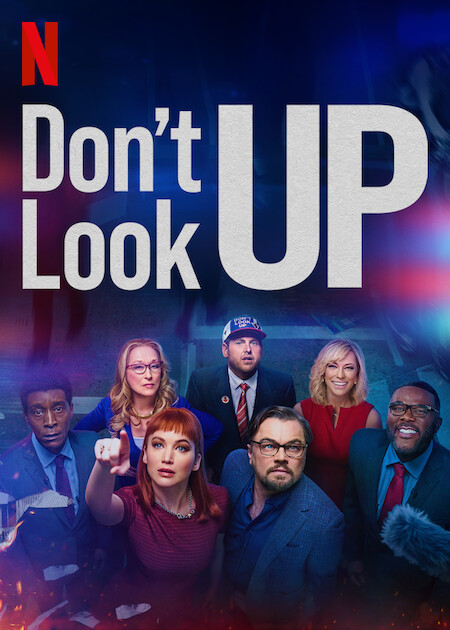
That attitude leads us directly to McKay’s latest film, Don’t Look Up. I fully understand that you may be wondering whether it was truly necessary to devote 1,000 words to Adam McKay’s pre-Don’t Look Up career to review his latest film. I would argue that it was because it’s impossible to really understand Don’t Look Up unless you understand how Adam McKay has gone from directing broad but enjoyably silly comedies to being one of the most self-important filmmakers working today. Don’t Look Up is not a film that could have been made without the undeserved accolades that were given to The Big Short and Vice. Don’t Look Up is the ultimate Adam McKay film, a towering testament to McKay’s misplaced belief that the best way to convert audiences is to hit them over the head with a sledgehammer. The flaws are obvious but they’re the same flaws that many chose to overlook in The Big Short and Vice. Don’t Look Up is not very good but, as with his previous two Oscar-nominated films, that probably won’t matter when the Academy Award nominations are announced on February 8th.
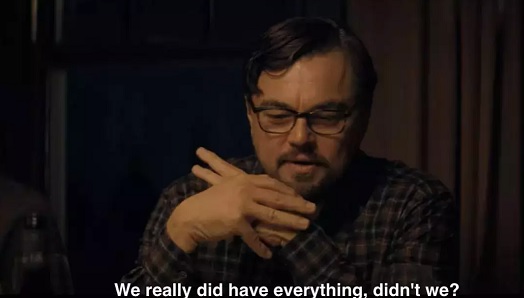
The time is the near future. Kate Dibiansky (Jennifer Lawrence) and Dr. Randall Mindy (Leonardo DiCaprio) are two low-level astronomers who discover that a comet is heading straight towards the Earth. “WE’RE ALL GOING TO DIE!” as Kate puts it. “I’M SO SCARED!” as Dr. Minty puts it. They go to the White House but the President (Meryl Streep) is more concerned with her approval ratings and her son, the chief of staff (Jonah Hill), is a weirdo who keeps talking about how hot his mother is. Kate and Randall go on a morning show but the hosts. Brie (Cate Blanchett) and Jack (Tyler Perry), are only interested in repeating positive news. (We all know how much news stations go out of their way to avoid panicking people.) When Kate has a breakdown, she becomes a meme. Randall, on the other hand, briefly becomes a celebrity and has an affair Brie. While a strange tech billionaire (Mark Rylance) plots to harvest the comet for its minerals, Kate gets a job at a grocery store and has a weird romance with a religious skater named Yule (Timothee Chalamet). As it slowly becomes impossible to ignore the sight of the comet approaching Earth, the President orders her supporters to “DON’T LOOK UP!” Some insist on looking up. Some look down. Fights break out as people argue online. Ariana Grande sings a song to encourage people to look up. Meanwhile, those who always knew what was happening prepare for the world to end because you can do anything in a montage.
Don’t Look Up was envisioned as a commentary on America’s response to the climate crisis. It was originally meant to be released during the 2020 presidential election, hence Meryl Streep playing a president who was obviously meant to be a combination of Donald and Ivanka Trump. When DiCaprio shouts that “this administration” doesn’t care about protecting the Earth from the comet, it’s obvious which administration he was actually supposed to be referring to. However, because of the pandemic, Don’t Look Up wasn’t released until 2021 and, as such, its portrayal of the White House being occupied by an amoral former television star doesn’t carry quite the same bite that it would have in 2020. Because of the delay in the film’s release, many have reinterpreted Don’t Look Up as being a commentary on the COVID pandemic.
Well, regardless, of how you interpret the film, it doesn’t work. It takes all of the flaws of The Big Short and Vice and it multiplies them several hundred times. It’s a big, messy, and rather smug film. The editing is self-consciously flashy, the 138-minute running time feels excessive, and McKay’s attempts to generate dramatic tension reveal that he hasn’t learned much since that scene with Carell and Tomei in The Big Short. It’s been a while since Leonardo DiCaprio has been this bad (and this shrill) in a film while Meryl Streep acts up a storm without really making much of an impression beyond, “Hey, there’s Meryl overacting.” On the plus side, I did like the scenes between Jennifer Lawrence and Timothee Chalamet but there aren’t many of them and one gets the idea that the only reason why Yule was included in the script was so Chalamet could join the cast.
Politically, this is a film that preaches to the converted. Now, if you’re one of the converted, that may not matter to you. You can watch the film and say, “That’s exactly the way it is!” You can even say, as many have, the it’s impossible to change the minds of climate deniers so why should anyone even waste their time trying to come up with a persuasive film. That’s a legitimate argument but it goes against the stated aims of the filmmakers. Both McKay and screenwriter David Sirota have said that the goal of the film is to try to convert climate agnostics. McKay recently gave an interview in which he said that his hope was that Joe Manchin would watch the film because he or a family member liked someone in the cast and that Manchin would later wake up, sweating in fear. However, the film is so heavy-handed and so contemptuous of just about everyone on the planet (even those who look up) that it’s hard to imagine it changing anyone’s mind. The possibility of Manchin or any other politician turning against coal power after watching Don’t Look Up is probably about as likely as an atheist converting to Christianity after watching God’s Not Dead. If anything Don’t Look Up is the secular version of the type of films that people watch in church basements.
“I’M SO SCARED!” multiple characters are heard to shout in scenes that are obviously meant to pay homage to Network‘s cry of “I’M AS MAD AS HELL AND I’M NOT GOING TO TAKE IT ANYMORE!” Indeed, the film owes an obvious debt to both Network and Dr. Strangelove but McKay doesn’t seem to have learned the most important lessons that those films have to offer. Dr. Strangelove may have featured a bunch of dumb people in Washington and it may have been full of characters with silly names but, as a director, Stanley Kubrick wisely took a straight-forward approach to his material. Kubrick directed in an almost semi-documentary manner, giving the film a realistic feel regardless of how crazy things got onscreen. The fact that the film played out in such a matter-of-fact, non-flashy style is why it was so effective. If the action had stopped so Peter Sellers could deliver a 9-minute speech about the evils of nuclear war, it’s doubtful the film would be remembered today. (Famously, Kubrick removed a custard pie fight from the finale because he realized it would take away from the film’s realism. One doubts that McKay would have been capable of such restraint.)
As for Network, Paddy Chayefsky and Sidney Lumet both understood why it was important that Howard Beale be the made prophet of the airwaves but they also understood that there could only be one Howard Beale. Only one man could rant and rave and be killed for low ratings. If every character had been Howard Beale, Network would have been unwatchable. With Don’t Look Up, McKay fills the movie with Howard Beales and it gets tedious. The constant screams of “I’M SO SCARED!” become a sort of panic porn as opposed to being the calls for action that McKay seems to mean for them to be.
And yet, despite not being a very good movie, I have a feeling that Don’t Look Up will be nominated for Best Picture and it will be nominated for the same reason as The Big Short and Vice. Politically, it has the right message for a very select audience. It’s a film that will resonate with people who have a very specific way of viewing existence. It may be a film that preaches to the converted but the converted love it. It’s a film that appeals to those who are convinced that the world is going to end at any moment. It’s a film for everyone who is pissed off that some people were more concerned about the next Fast and Furious film than they were with watching the latest political melodrama.
All of that said, perhaps the most interesting thing about Adam McKay’s politically-charged films is how ineffective they are. The Big Short won an Oscar for McKay’s screenplay but Bernie Sanders twice lost the Democartic presidential nomination to candidates who were backed by Wall Street. Indeed, much like Oliver Stone’s Wall Street, The Big Short today seems to be more likely to inspire someone to play the stock market than to rally against it. As for Vice, Dick Cheney’s daughter is currently the media’s favorite Republican and Cheney himself was recently given a hero’s welcome when he returned to D.C. Watching Don’t Look Up, you have to wonder how many people sympathized with the “I’M SO SCARED” crowd and how many people instead watched the rich and powerful boarding a spaceship and thought to themselves, “That’s who I want to be.”
Personally, I refuse to give up hope for Anchorman 3….
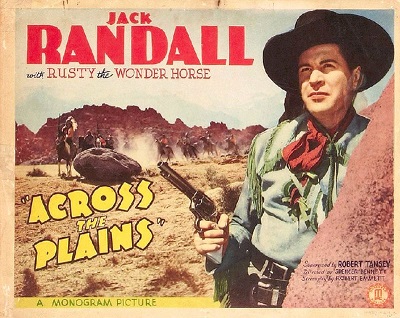
In the old west, a group of outlaws attack a wagon train, killing a husband and wife but sparing their two children. One child is taken by the outlaws, who tell him that they have saved him from an Indian attack. He grows up to be The Kansas Kid (Dennis Moore), a wagon master who still works for Gordon (Bob Card), the outlaw who raised him. The other child is adopted by a Native tribe and grows up to be known as Cherokee (Jack Randall). Cherokee has been hired to protect a gold shipment that Kansas and Gordon are determined to steal. How long until the brothers come into conflict?
Across The Plains is a pretty good programmer. Dennis Moore and Jack Randall are convincing as two men on opposite sides of the law who don’t realize that they’re brothers and director Spencer Gordon Bennett captures the scenery of the old west. This is a western where the frontier really feels and looks like an untouched frontier! The gunfights are effectively choreographed and directed and the family aspect is a good spin on a simple story. For fans of westerns, Across The Plains is an enjoyable example of the genre.
Dennis Moore and Jack Randall were both B-western mainstays. Moore occasionally played a hero but was usually cast as a villain. Across The Plans gives him a chance to play a more complex role than usual and he takes full advantage of the opportunity. The Kansas Kid may be an outlaw but he’s not so much bad as just misguided. Jack Randall was one of the many stage names used by actor Addison Randall. He started out as a singing cowboy before playing more traditional heroes, like in this film. In Across The Plans, Randall was as tough and convincing a western hero as he always was. Tragically, he died six years after making this film when he fell off a horse while filming a Universal serial called The Royal Mounted Ride Again. He was only 39 years old.
Has Aaron Sorkin ever met anyone who doesn’t sound like Aaron Sorkin?
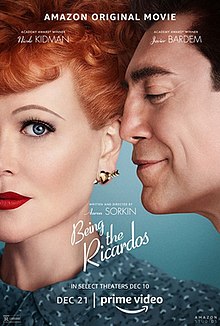
That was the question that I found myself considering as I watched Sorkin’s latest film, Being the RIcardos. The film may present itself as being a film about Lucille Ball (Nicole Kidman) and Desi Arnaz (Javier Bardem) but neither Lucy nor Desi ever come across as being actual human beings or even celebrities trying to be human. Instead, they both come across as Sorkin stock characters. Lucy is the socially maladjusted genius who demands a lot from the people working for her and who struggles with apologizing. Desi is irresponsible but a hard worker, a man who makes a lot of mistakes but who should never be underestimated. They speak in quips and they instinctively understand what the people in their audience want to see. Who can keep up with Lucy and Desi? Certainly not the suits from the network! Trial of the Chicago 7 had Tom Hayden and Abbie Hoffman taking on the military industrical complex. Being the Ricardos has Lucy and Desi taking on both the entertainment industry and the McCarthy era.
The film claims to tell the story of the week that Lucy and Desi’s show, I Love Lucy, was nearly destroyed. The week started with columnist Walter Winchell revealing that, when she was in her 20s, Lucy was briefly registered as a member of the Communist Party. (Lucy explains that she did it as a favor for her grandfather, who “cared about the working man.”) The day after learning that her subversive past has been exposed, Lucy and Desi tell the show’s writing staff that Lucy is pregnant and they expect the writers to write her pregnancy into the show regardless of what the uptight studio execs declare. Meanwhile, Lucy has to deal with rumors of Desi’s infidelity while Desi struggles with being overshadowed by his wife. Lucy’s co-star, Vivian Vance (Nina Arianda), resents having to play a frumpy character while her other co-star, William Frawley (J.K. Simmons), spends most of the movie drunk off his ass. If anything Frawley and Vance come across as being more interesting than either Lucy or Desi but, just as in real life, this is the Lucy show. Frawley makes a few drunken comments about a seven year-old communist. Vance sits in her dressing room and fumes. In real life, when she learned Lucy was pregnant, she reportedly yelled, “I’d tell you to go fuck yourself but apparently Desi already did that!” That line isn’t in the film, which is a shame.
The film skips around in time. There’s an odd framing device, taking place in what I presume is meant to be the 80s and featuring the surviving members of the production staff are being interviewed for a documentary. Why Sorkin decided to use this documentary device is odd. It seems like he could have just used real archival footage if he wanted to go for a documentary approach as opposed to staging a fake documentary where older actors playing real people still sound like relentlessly quippy supporting characters in a Sorkin film. We also get the occasional flashback to the early days of Lucy and Desi’s relationship, none of which are particularly interesting. One of the people being interviewed for the documentary tells us that, before she met Desi, Lucy was being groomed to become a serious dramatic actress. “She could have starred in All About Eve and blown the doors off!” we’re told and that’s great but is that the opinion on the fictionalized person being interviewed for the documentary or is that something that Aaron Sorkin came up with to try to create some dramatic tension? I mean, saying that Lucy would have been the equal of Bette Davis is quite a statement but the film doesn’t show us any scenes of Lucy being a particularly skilled dramatic actress so it just comes across as being kind of overly dramatic thing to say.
We do get several scenes of Lucy explaining why jokes are funny. Nicole Kidman gets a very serious look on her face while Sorkin shows us what’s happening inside her mind. Lucy pictures herself, in black-and-white, stepping on grapes in Italy. Dramatic music swells as we snap back to Lucy declaring what the scene needs to truly be funny. (“I lose an earring,” she says, as if she’s just figured out how to resolve Gatsby’s obsession with Daisy.) It’s the sort of thing that makes you wonder if Aaron Sorkin has ever actually told a joke that he didn’t spend a few hours thinking about ahead of time. The film’s portrayal of what went on behind-the-scenes of I Love Lucy is so portentous and overdramatic that it really only makes sense if you accept the idea of creating television being some sort of religious ritual, with showrunners and producers taking the place of God. God needed 6 days to create the world but Lucy only needs 5 to create classic television comedy. Take that, God!
Aaron Sorkin is a writer who desperately needs a cynical collaborator. With The Social Network and Moneyball, Sorkin was fortunate to be paired with David Fincher and Bennett Miller, two directors with notably dark views of humanity and who served to temper Sorkin’s sanguine excesses. When Sorkin directs his own material, the audience ends up with scenes like Joseph Gordon-Levitt standing in protest at the end of The Trial of the Chicago 7 or Desi Arnaz calling J. Edgar Hoover from the set of I Love Lucy in Being The Ricardos. These are deeply silly scenes that did not happen in real life and which, even more importantly, should never have gotten past a first draft. Sorkin’s need to end everything with a “big hero” moment is his most glaring flaw as both a writer and a director.
For the record, Lucille Ball did register as a communist when she was younger. And, indeed, it is true that she did it as a favor for her grandfather. It was briefly a news story but Lucy was quickly cleared. Before shooting that week’s episode, Desi told the audience that “The only thing red about Lucy is her hair and even that is not legitimate.” That was a good line and no, Desi didn’t need the help of J. Edgar Hoover to sell it.
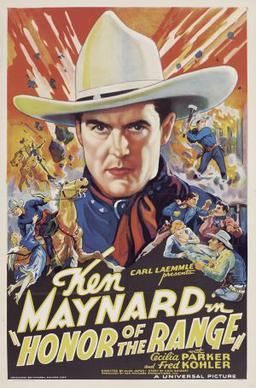
In an old west town, Sheriff Ken Bellamy (Ken Maynard) is an honest and upright lawman who thinks that he is trusted and respected by all. His brother, Clem (also played by Ken Maynard), is a storeowner who is less respected and very jealous of his brother. When Ken is asked to store some money in a safe, Clem decides to help the local outlaw, Rawhide (Fred Kohler), steal the money. Clem gives Rawhide the combination but Rawhide then betrays Clem and takes him hostage. Meanwhile, the townspeople think that Ken must has stolen the money so they toss him in jail and appoint a man named Boots (Frank Hageny) as the new sheriff. Now, Ken has to not only figure out how to escape from jail and the townspeople but also how to defeat Rawhide’s gang.
Ken Maynard and his white horse Tarzan were two of the biggest western stars of the pre-code era. Most of them were routine programmers but Honor of the Range stands out because it allows Maynard to step out of his usual heroic role by having him also play Clem. Maynard could be a stiff actor when he was playing a traditional hero but here he seems to be enjoying playing the untrustworthy Clem. Maynard actually produced Honor of the Range himself and it’s much more serious than the typical Ken Maynard western. The town’s betrayal of the sheriff is played straight, as is Clem’s resentment of his brother. With higher production values than usual and Maynard looking credible whenever he was holding a gun or riding his horse, Honor of the Range is one of the better westerns to be distributed by Universal during the pre-code era.
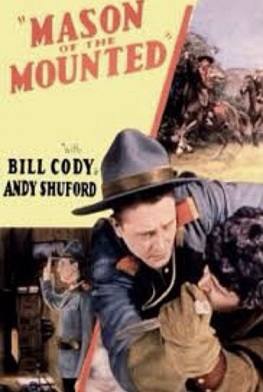
Bill Mason (Bill Cody) is a member of the Canadian Mounted Police who is sent over the border to track down a murderous horse thief. Going undercover, Mason discovers that a nearby frontier town is being terrorized by rustlers. The townspeople have named Calhoun (LeRoy Mason) as the head of the local posse but Mason soon discovers that Calhoun is actually the horse thief!
Mason of the Mounted is only 57 minutes long but it’s a very slow-moving 57 minutes. It’s also a pre-Code film but, other than a grisly shot of a dead body at the start of the film, there’s nothing about Mason of the Mounted that you wouldn’t expect to find in a western made under the production code. Much of the film centers around Mason befriending an American teenager named Andy Talbot (played by Andy Shuford). This was actually one of 8 films that Bill Cody and Andy Shuford made together. Cody was a genuine cowboy who performed in wild west shows before and after his film career. Shuford was a child actor whose career was primarily in Westerns. During World War II, he enlisted in the U.S. Army Air Corps, flew many missions out of England, and eventually reached the rank of colonel. He never returned to making films.
As for Mason of the Mounted, Bill Cody has some authentic cowboy grit and is credible when he’s on a horse or shooting a gun but the plot moves too slowly and most of the cast is stiff and awkward. I did like the idea of the main rustler disguising himself as the only person capable of stopping the rustlers. That was an interesting idea and I wish the movie had done more with it. This is a film that’s mostly for fans of the genre and even the most undemanding western fan will probably have a hard time making their way through the whole thing.
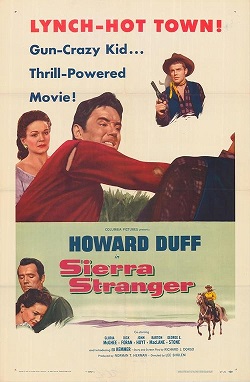 Sierra Stranger starts with a familiar western situation. Jess Collins (Howard Duff), a penniless but honorable drifter, comes across two men tying another man to the back of a horse. The two men claim that Sonny Grover (Ed Kemmer) is an outlaw and a claim jumper and not to be trusted. Sonny says that he’s innocent and the two men are actually the claim jumpers. Jess does what many a western hero has done. He sides with the underdog and saves Sonny. To thank him, Sonny gives Jess a part of his claim.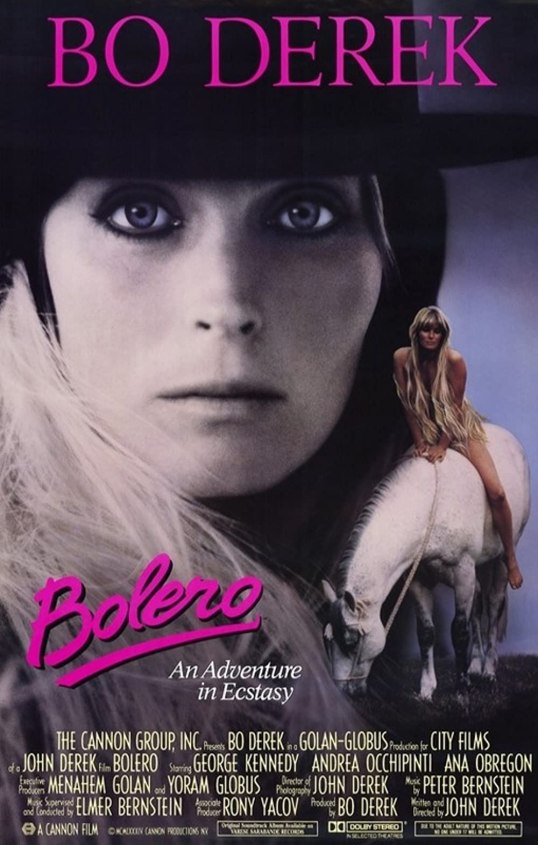


 Through the Shattered Lens