Film Review: Swan Song (dir by Todd Stephens)


Once upon a time, Pat Pitsenbarger (Udo Kier) was one of the most important citizens of Sandusky, Ohio.  He was the town’s leading hairdresser.  He was the man who the wealthy trusted with their appearance.  When he wasn’t cutting hair, he performed drag as Ms. Pat and when he wasn’t cutting or performing, he built a nice home with his partner.  He often remembers the two of them working in the garden.

All of that is in the past, though.  Pat’s partner died years ago and Pat was reminded of his place in the community when some of his wealthiest clients didn’t even bother to come to the funeral.  Pat lost his business.  He lost his home.  He’s spent the past decade or so living in a nursing home.  Pat may be the best-groomed and best-spoken resident of the nursing home but he’s still definitely a man who is waiting for death.

One day, a lawyer shows up at the home and informs Pat that one of his most faithful clients, Rita Parker Sloan (played by Linda Evans), has died.  Rita had one last request.  She wanted Pat to do her hair and makeup for the funeral.  At first, Pat is hesitant.  His memories of Rita are not particularly pleasant.  But finally, he decides to do it.  He escapes from the nursing home and starts to walk to the funeral home.  To do Rita’s makeup, he’s going to need supplies, some of which haven’t even been existed since the 80s.  Unfortunately, he has no money and, as he soon discovers, his old home no longer exists either.  The world has changed.

As quickly becomes clear, there’s more to Pat’s journey than just wanting a final chance to do Rita’s hair.  As he walks through the town, he tries to reconnect with his past, just to discover that much of his past has been torn down.  His old beauty shop is under different management.  His old house has been torn down.  Few people seem to remember or recognize him.  One of the few people who does remember Pat is his former protégé, Dee Dee (Jennifer Coolidge), who now basically hates his guts.  Meanwhile, Rita waits in the funeral home, her hair and makeup a mess.

Released last year, Swan Song is an imperfect but ultimately touching movie.  The shadow of death hangs over almost every scene.  It’s not just that Pat is doing one last favor for the deceased Rita.  Nor is it just that Pat is haunted by memories of his dead partner.  (The scene where Pat visits his grave is one of the most effective in the movie, thanks to Kier’s heartfelt performance.)  It’s the fact that Pat himself knows that he’s getting older and he only has a certain amount of time left.  His walk across Sandusky is not just about traveling to the funeral home.  It’s also his final chance to see the world, remember the past, and experience how things have changed (or not changed as the case may be).  The journey is about Pat coming to terms with his anger, his sadness, and his past.  It’s also about Pat’s desire to go out the same way that he’s always lived, on his own terms.

As I said, it’s not a perfect film.  There are a few scenes that threaten to get a bit mawkish.  But even the most overwritten scenes are saved by the brilliant lead performance of Udo Kier, who gives a wonderfully complex performance as Pat.  Since the 70s, Kier has been a mainstay in European exploitation cinema.  He stared in Flesh For Frankenstein and Blood For Dracula.  He had key supporting roles in two Dario Argento films.  He appeared in art films, horror films, dramas, comedies, and thrillers.  He’s appeared in blockbusters and small indie films.  At times, it can seem like Kier is one of those actors who basically accepts anything that’s offered to him, regardless of whether the material is worthy of his talents or not.  Kier has appeared in good films and bad and, perhaps because he’s been such a ubiquitous cinematic presence, he’s often been unfairly taken for granted as an actor.  In Swan Song, Udo Kier gives one of his best performances as the sometimes brutally snarky but ultimately kind-hearted Pat Pitsenbarger.  If for no other reason, watch this movie to appreciate the often underrated talent of Udo Kier.  A lesser actor would have turned Pat into a cliché.  Udo Kier transforms Pat into a complex and rather heart-breaking character.

Swan Song is currently streaming on Hulu.
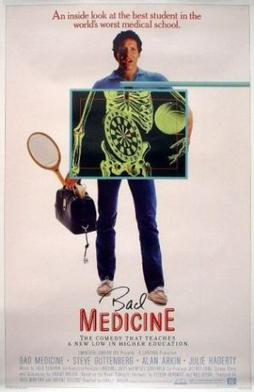
Bad Medicine (1985, directed by Harvey Miller)


Jeff Marx (Steve Guttenberg) is a smart but lazy pre-med student whose grades are so bad that he can’t get accepted to any of the good medical schools.  His father (Bill Macy), who is also a doctor and who wants Jeff to one day take over the family practice, arranges for Jeff to attend medical school in a fictional Central American country.  The head of the school, Dr. Ramon Madera (Alan Arkin), is also the country’s dictator.  Dr. Madera is happy to make money off of desperate Americans but he still enforces strict rules of behavior at the school.  He also makes it clear that none of the medical students are to treat the poor villagers who live near the school.

When Jeff arrives at his new school, he discovers that his classmates are, like him, all screw-ups.  They’re also played by a cast of actors who, like Guttenberg, epitomize the 80s ensemble comedy craze.  Curtis Armstrong, of Revenge of the Nerds and Risky Business, plays Jeff’s best friend.  Fast Times At Ridgemont High‘s Robert Romanus is the Italian medical student who is loved by all the ladies.  Airplane!‘s Julie Haggerty is the idealistic medical student who wants to take care of the local villagers.  Even Gilbert Gottfried is in this movie!  He plays Dr. Madera’s main assistant and hatchet man.

Bad Medicine was released in between the first and the second Police Academy films and it basically tells the same sort of story that made those two films unlikely hits.  Guttenberg and his fellow students start out as a screw-ups but, by the end of the movie, they’ve proven themselves as doctors.  Perhaps because it was based on a novel that was written by an actual doctor, Bad Medicine is a little more sincere than Police Academy.  In Police Academy, the scenes of the recruits doing police work were the biggest jokes of all and, even after he helped to save the city, you still never bought the idea that Steve Guttenberg would have stuck around after graduation so that he could wear a uniform and walk a beat everyday.  Though Bad Medicine is full of the usual Police Academy-style hijinks, it doesn’t treat the work that the doctors are doing as a joke.  Though regrettable stereotypes abound (this is a film that features Gilbert Gottfriend playing a character named Tony Sandoval, after all), Bad Medicine treats the villagers with respect.  Guttenberg gives a relaxed and likable performance, without making Jeff into as much of a wiseass of Police Academy‘s Cary Mahoney.  Julie Haggerty brings her usual spacey charm to her role.  Not surprisingly, it’s Alan Arkin who steals the film, though you do have to wonder how Dr. Madera has time to run both a country and a medical school while also falling in love with Julie Haggerty.  Give the man some credit for knowing how to multitask.

It ends, much like Police Academy, with the med students giving a chance to prove themselves in a crisis situation.  Unlike Police Academy, Bad Medicine was not a hit at the box office, though it did make a small profit.  As a result, there was never a Bad Medicine 2, which is unfortunate because we could always use more good doctors.

I Watched Angels In The Outfield (1951, dir. by Clarence Brown)


Major League Baseball could use some angels right about now.

When this year started, I was so excited for the start of Spring Training at the end of this month.  Finally, I thought, football will be over, baseball will be starting, and maybe my Rangers will finally have another winning season!  Instead, for the last 80 days, we’ve had a lockout while the owners and the players negotiate the terms under which the season can begin.  The start of Spring Training has been delayed.  Opening Day could be delayed.  All I want to do is to enjoy some baseball but who knows when that’s going to happen.

At least I can still watch baseball movies.  The original Angels in the Outfield is about the general manger of the Pittsburgh Pirates, Guffy McGovern (Paul Douglas).  The Pirates are having a terrible season.  They’re last in the league.  Guffy starts fights with the umpires and shocks the media with his unprintable language but he just can’t put together a winning season.  Things are so bad that an orphan named Bridget (Donna Corcoran) stops praying for a new family and instead prays for the Pirates  Then, one night, Guffy hears the voice of an angel who tells him that if he stops cursing and stops fighting, the Pirates will get some heavenly help.

Guffy cuts back on his cursing and learns to control his temper and the Pirates start winning.  Is it because of the angels or is it because Guffy has become a better manager?  He falls in love with reporter Jennifer Paige (Janet Leigh) and they make plans to adopt Bridget but then the voice tells Guffy that, when it comes to the Pennant, he’s going to have to win that one on his own.  Can Guffy lead his team to victory without the help of the angels?

For many baseball fans, Angels in the Outfield is all about wish fulfilment.   That’s especially true if you’re a fan of a team that lost two World Series in a row and who hasn’t had a winning season in a while.  There’s been a lot of times when I’ve watched the Rangers and wished for some heavenly intervention!  Maybe if our coaches would stop cursing or yelling, the Rangers would actually finish somewhere other than in last place.  It’s worth a shot, guys!

Angels in the Outfield is a sweet movie.  I especially liked the scenes where Guffy used Shakespearean language to argue with the umpires so that he could avoid having to curse at them.  Angels in the Outfield captures the excitement of watching your team win.  I actually got jealous of the fans in the movie because it’s been a long time since I’ve seen anyone get that excited over baseball.  When Angels in the Outfield calls baseball “America’s pastime,” you believe it.  I also liked that the angels themselves were never seen.  Instead, all that is seen are the fantastic catches and the home runs that come about as a result of their help.

I’d love some angels to come down right now and talk to the players and the owners for all of us.  Get it worked out, people.  Don’t take away our opening day!

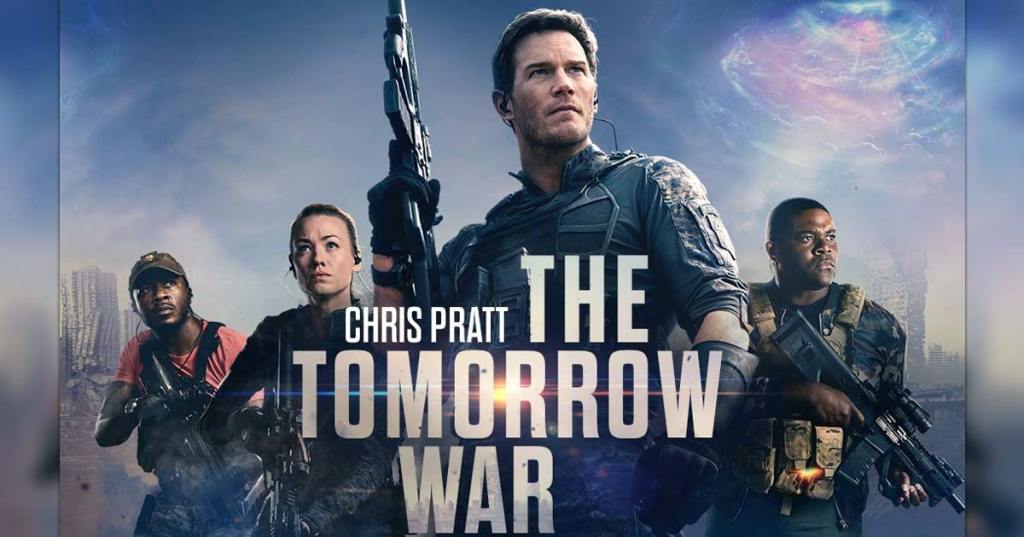
The Tomorrow War, Review by Case Wright


I loved this movie and really loved live tweeting it with Lisa Bowman. There are some critics (killjoys) who want to pick on the movie because it doesn’t “make sense.” No one said this was being made for the Science Channel; so, just cool it and enjoy! Do I think that time travel is a bunch of nonsense? Yes, but so what?! I don’t believe in “Letters of Transit,” Facehuggers, or the Force.

I can relate to the hero A LOT; he’s a Veteran with Daddy issues who is trying to get a career going in STEM and he has a young daughter. The film opens with us learning he is teaching high school science and can’t get a private sector job. He feels like he’s meant for more, but can’t get there. He and his wife are hosting a Christmas party and watching soccer. Dan, I know that times are tough, but why bring soccer into it? I don’t think that people watch soccer on purpose. How could they? Why make your life harder? Our future-selves appear and ask for help in fighting aliens who are turning us into snacks. We agree to help and mobilize a global draft.

This is where most critics get worked up. Why help fight a battle that is already lost? I’ll tell you! The movie makes more sense than people think. Why send Dan Forester (Chris Pratt) and millions of other people from our time to fight aliens from the future? They needed cannon fodder while they protected researchers who created a toxin to kill the male and female aliens. Without that toxin, Dan would not have been able to defeat the alien queen. Take that! The whole plan is to get the toxin finished and have Dan go back and kill all the aliens with it. Without it, she would’ve eaten him. Yes, we needed the cannon fodder. If Dan succeeds, wouldn’t that bring all the draftees back to life? Yeah, maybe? Einstein didn’t really didn’t have to deal with too many aliens and wormholes. I would put that in the column of …. relax.

Back to the movie, Dan gets drafted and his wife wants him to get his estranged father to help him remove his draft tracking device. Dan’s father abandoned him and his mother; so, Dan gets angry at his father and decides to honor his draft commitment and fight aliens. He goes to the future with no training, fights aliens, and retrieves the toxin. Way to go, Dan.

These monsters are gross and good adversaries. They’re fast, they shoot spikes, the eat you, they have natural armor, and can coordinate attacks. We are doomed. After he gets the toxin, he meets his grown daughter Muri who is the head of the resistance. We learn Dan fell into a depression because he couldn’t live a bigger life and he abandons his family just like his father did. This is why Muri drafted Dan: She wanted him to be his best self and to be the special person that he needed to be after his military life was over. She gives her father a chance to be a hero again. When Muri finishes the toxin, he goes back to save the future or the past …it’s kinda confusing.

I have given quite a bit of the film away, but it’s still amazing. I appreciate the critique that Charlie (Sam Richardson) brought too much humor to the film. I actually liked it, but I could’ve lived without it as well. Instead of the endless jokes, I would’ve liked more development of Dorian (Edwin Hodge). His lines popped more and brought more seriousness to the film. Were Charlie’s jokes funny? Yes, but while the jokes went on, I thought- I really wish I could hear more from Dorian interacting with Dan.

The direction was very well done. I love a well choreographed action movie without a lot of cutaways. This delivered. I was surprised to learn that Chris McKay’s filmography was heavily in animation. I hope he gets more opportunities for live action. The final battle scene was a lot of fun. I liked that the female characters had depth, kicked ass, and had real arcs. Because of that, my daughters love watching the movie with me. I can only write that we haven’t seen the movie six times.

Documentary Review: Downfall: The Case Against Boening (dir by Rory Kennedy)


On October 29th, 2018, Lion Air Flight 610 crashed into the Java sea, killing all 187 passengers and crew.  It was the first accident to involve the Boeing 737 Max series of aircraft and it was also one of the first major air disasters after a period of relative safety in the sky.

A few months later, on March 10th, 2019, Ethiopian Airlines Flight 302 crashed juts six minute after taking off.  All 157 passengers and crew were killed.  Like the Lion Air flight, the plane was a Boeing 737 Max.

At the time, Boeing insinuated that pilot error was to blame for both crashes but several investigations revealed that Boeing, which previously had a reputation for being one of the most safety-conscious companies around, cut corners when it came to the 737 Max series.  In order to cut costs, not all safety protocols were followed.  As a result, many concluded that the 737 Max jets should never have been approved for service to begin with.  After a lengthy congressional hearing, Boeing CEO Dennis Mullenburg stepped down as a result of the scandal.  Despite the fact that over 300 people had been killed in the two crashes and the fact that he left the company in shambles, Mullenburg left Boeing with a 62 million dollar severance.

That’s the story that’s told in the new Netflix documentary Downfall: The Case Against Boeing.  It’s the type of thing that will and should leave you outraged.  Due to the company’s negligence, over 300 people are dead and their families and friends have been left behind to mourn their loss.  Boeing, at first, blamed the pilots, with the implication being that Indonesian and Ethiopian pilots just weren’t as good as their western counterparts.  When the inevitable investigation was launched into just what exactly was going on over at Boeing, the company was less than forthcoming.  There’s a lot to be angry about and the majority of the people who watch the documentary will be angry.

That said, the actual documentary itself is typical of a lot of the docs that turn up on the streaming services.  It deals with an important subject but it does so in a rather superficial manner.  It brings up the relevant issues but it doesn’t actually bother to dig too deeply into them.  “Wow, this is really messed up, right?” the documentary seems to be saying and yes, it is messed up.  But, at the same time, Downfall doesn’t really explore how it came to be so messed up or what can be done to make it less messed up.  Instead, there’s a lot of archival news reports and enough footage of U.S. Rep. Peter DeFazio grilling the Boeing executives that the documentary could pass for a campaign commercial if not for the fact that DeFazio is retiring at the end of his current term.  Aesthetically, the documentary feels more like an extended episode of Dateline or 60 Minutes than an actual examination as to just what exactly was going on at Boeing.  As far as documentaries directed by Kennedys are concerned, Rory Kennedy’s public service docs are certainly preferable to the anti-vax nonsense pushed out by RFK, Jr.  (Rory, it should be noted, is pro-vaccination and has publicly condemned her brother’s anti-vax activities.)  But still, it’s hard not to wish that Downfall had dug just a little deeper.

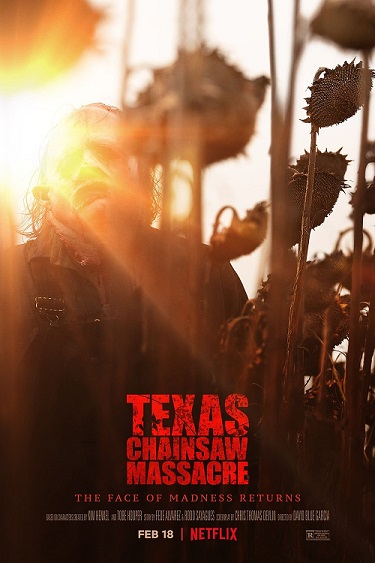
Film Review: Texas Chainsaw Massacre (dir by David Blue Garcia)


Leatherface is back but don’t worry!  He’s mostly just killing hipsters.

The newest version of Texas Chainsaw Massacre is a direct sequel to the classic 1975 film.  50 years after the murders the shocked the world, Leatherface is still missing.  True crime shows still do specials about the massacre at Harlow, Texas and the mysterious murderer who were a mask made out of human skin.  The only survivor of that massacre, Sally Hardestry (Olwen Fouéré, taking over the role from the late Marilyn Burns), went from being a half-crazed hippie to being a Texas Ranger.  She spent decades searching for Leatherface but she never found him.

I can only assume this means that Sally was terrible at her job because this film reveals that Leatherface is still living in the small rural town of Harlow, Texas.  Harlow has been largely abandoned since the original massacre.  But Mrs. Mc (Alice Krige) still owns the orphanage where Leatherface apparently grew up and Leatherface still lives with her, which is weird since Leatherface had a very tight-knit family in the first film and all of the subsequent sequels.  (As opposed to what David Gordon Green did with his Halloween reboot, the new Texas Chainsaw Massacre does not go out if its way to specifically deny the canonicity of the other Chainsaw films.  I, for one, appreciated that.  Regardless to what the critics may say, there’s always been a rather appalling smugness to the way that Green’s Halloween franchise casually wiped out everything that came after Carpenter’s original film.)  Unfortunately, the bank has foreclosed on most of Harlow and the town has been bought by a bunch of Austin hipsters, who are planning on turning the town into a Marfa-style artist’s colony.  I guess the idea is that artists will be attracted to the town by its cannibalistic history, just as some are attracted to Marfa’s frequent UFO spottings.  Of course, the Marfa Lights have never killed anyone but who knows?  Austin’s weird.

When the main hipster and the sheriff order Mrs. Mc to leave the orphanage, she has a heart attack.  Leatherface accompanies her in the ambulance because, apparently, no one finds it odd that there’s a silent, hulking man wandering around in the same location where a silent, hulking man previously killed a lot of people.  About halfway to the hospital, Mrs. Mc dies and Leatherface decides that it’s time to retrieve his tools and go hipster hunting.

The new Texas Chainsaw Massacre isn’t terrible as much as its just generic.  Everything about it feels like it’s been lifted from other recent horror revivals.  The film opens with some stabs at modern relevance, with scary rednecks glaring at the Yankee invaders and Dante (Jacob Latimore) declaring the Harlow represents the “joys of late stage capitalism.”  Lila (Elsie Fisher, who previously starred in Eighth Grade and who gives a good performance here, despite getting stuck with a poorly written character) is a survivor of a school shooting and she gets upset when she sees that the local mechanic owns an AR-15.  The film then turns, very briefly, into a social satire when the smug hipsters are revealed to be just as greedy and superficial as the people that they’re looking down on.  However, once Leatherface grabs his chainsaw, it turns into just another slasher film.  Sally does eventually show up and calls Leatherface a “motherfucker” while pointing a rifle at him but that moment feels a bit too derivative of the recent Halloween films.  Perhaps if Marilyn Burns were still alive and had returned to play the role, Sally vs. Leatherface would have been the iconic horror moment that it was obviously meant to be but, with a new actress who doesn’t even have a Texas accent, it just feels a bit forced.  The problem with this slasher film being generic is that it’s called Texas Chainsaw Massacre.  That’s quite a legacy to live up to and, for a lot of horror fans, generic simply won’t cut it.

Indeed, as I watched this latest version, I couldn’t help but think about what made the original version a classic.  The original version used its low budget to its advantage.  It had a rough, raw feel to it, one that made you feel as if you were watching real people as opposed to local actors.  It also had very little gore, leaving it to the audience to imagine what horror truly went on inside of Leatherface’s kitchen.  (Needless to say, the imagination can always come up with something far more disturbing than anything that could actually be captured on film.)  This new version takes the opposite approach.  If the original worked because it haunted you after the final frame, the new version is all on the surface. There’s a lack of authenticity to this new version of Texas Chainsaw Massacre.  The first film was made by Texans and it was filmed in Texas.  You could look at any scene in the original and feel the heat and the humidity.  This new version was filmed in Bulgaria.  Texas may be in the title but it’s nowhere in the film.

(Indeed, one of the main reasons why the original film was a success was because it was identified as taking place in Texas, a state that scared a lot of people when the film was originally released and a state that, admittedly, probably still scare scares a lot of people, even though we’re all pretty nice down here.  People would laugh off a Vermont Chainsaw Massacre.)

There’s also no family dynamic in this new version.  There’s no sign of Leatherface’s brothers or their ancient grandpa.  Once Mrs. Mc dies, it’s pretty much just Leatherface and no one, not even Sally, comments on the fact that Leatherface didn’t work alone in the first film.  Without his family around, Leatherface just becomes another silent serial killer.  There were times, in the sequel, where he seemed like he had more in common with Rob Zombie’s version of Michael Myers than with the overwhelmed but hard-working Leatherface of the original film.

That said, on the positive side, I did appreciate the remake’s final scene.  It was a bit predictable but it still managed to be enjoyably chaotic.  What’s more annoying?  Leatherface or a self-driving car?

Film Review: My Best Friend Anne Frank (dir by Ben Sombogaart)


The year is 1944 and 16 year-old Hannah Goslar (Josephine Arendsen) and her younger sister, Gabi, are among the many Jews being held at the Bergen-Belsen concentration camp.  Death is all around.  At night, when Hannah is sent to empty out the buckets of waste that have been filled up in her barracks, she sees another prisoner being casually shot by the guards.  Whenever things get to be too much for her, Hannah closes her eyes and asks herself, “What would Anne do?”

As terrible as things are where Hannah is being held, it’s rumored that things are even worse behind the wall that runs through the center of the camp.  The less “privileged” prisoners are kept there.  The wall is thin enough that Hannah can talk to the people on the other side, even if she can’t see them.  Hannah asks them if her best friend, Anne, is among them.  “She has beautiful hair,” Hannah says.  The voice on the other side of the wall explains that no one in the other half of the camp has hair.  Everyone on the other side of the wall is being starved and worked to death.

Occasionally, Hannah remembers what life was like before she and her family were arrested by the Nazis.  Two years earlier, she was a student in Amsterdam and her best friend was Anne Frank (Aiko Beemsterboer).  Hannah was shy but Anne definitely wasn’t.  Hannah was often naïve and fearful but Anne was always intellectually curious and up to try almost anything.  Occasionally, they fought as friends sometimes do.  But Hannah always considered Anne to be her best friend.

The Amsterdam scenes do a good job of contrasting Hannah and Anne acting like ordinary teenagers with the evil that’s always lurking in the background.  Haughty soldiers in German military uniforms stroll the streets of Amsterdam, moving with the arrogance of men who know that no one can defy them.  Because Hannah and Anne wear gold stars on their clothing, they have to sneak into the movies and, when they do, they find themselves watching a propaganda newsreel about how much better life is in the Netherlands now that the Germans are in charge.  Hannah often sees her father having hushed conversations with other nervous-looking adults.

Of course, those of us watching at home know what is going to happen.  We know who Anne Frank was.  Or, I should say, I hope we know who Anne Frank was.  I tend to assume that everyone knows about the horror of the Holocaust and that everyone knows about the anti-Semitism that fueled the rise of Adolf Hitler and the Third Reich.  Unfortunately, over the past year or so, my faith has been shaken.  Anti-Semitism has never gone away but, in recent years, it seems as if it’s become socially acceptable within certain parts of mainstream society and that really should scare the Hell out of anyone who has any knowledge of history.  I have seen reportedly intelligent people either playing down the horrors of the Holocaust or trying to act as if the Holocaust was not about the Third Reich’s obsession with wiping out a race of people.  Whoopi Goldberg may have been the most famous person to have recently gotten the facts of the Holocaust wrong but she’s hardly the only one.

To me, that’s why a film like My Best Friend Anne Frank is important because it reminds us of not only what happened at camps like Bergen-Belsen but also what happened beforehand.  The camps and the ideology that fueled them didn’t just spring up out of nowhere.  Instead, they were built while the rest of the world tried to deny what was happening right before their eyes.  The concentration camp scenes in this film are harrowing but even more disturbing are the Amsterdam scenes where people casually walk by signs that declare that no Jews allowed and almost everyone merely averts their eyes.  When Anne and Hannah walk through Amsterdam, they are insulted not just by the Nazis but also by the Dutch citizens who don’t wear gold stars, many of who seem to take an attitude of, “At least it’s not me being othered.”

My Best Friend Anne Frank is currently on Netflix.  Josephine Arendsen and Aiko Beemsterboer both give good and heart-breaking performances as Hannah and Anne.  The film is not just a story of survival under the worst of circumstances but it’s also a tribute to the power of friendship.  Though Anne did not survive the camps, Hannah was liberated after 14 months at Bergen-Belsen and now lives in Jerusalem.  She is now 93 years old.

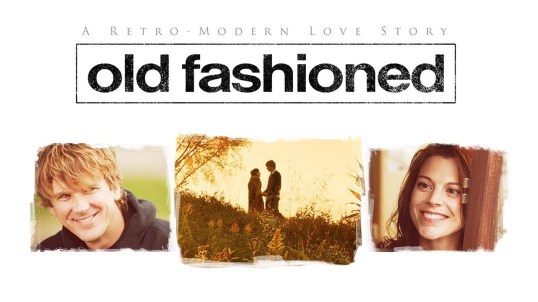
I Watched Old Fashioned (2014, dir. by Rik Swartzwelder)


Clay (Rik Swartzwelder) is a former frat boy who has spent the last nine years trying to find love the old fashioned way.  He won’t accept a kiss on the lips.  He says that all dating does is make people act in superficial and dishonest ways.  He says that he cannot even be alone with a woman unless she is wife.  (Clay’s not married.)  Because he’s so old fashioned, it makes sense that Clay would open an antique store in a small town.  (Of course, he’s named the store Old Fashioned.)  When a single, free-spirited woman named Amber (Elizabeth Roberts) runs out of gas in the town and then impulsively rents the apartment above the shop, Clay is forced to reconsider his rigid rules about dating.

At first, I didn’t know what to make of Old Fashioned.  I can be old fashioned about some things myself but Clay took it to extremes and I wasn’t sure why anyone would want to waste their time trying to get his attention.  Yes, people can be superficial when they’re dating and they act differently once they’re in a committed relationship but what’s the other option?  Arranged marriages?  Only getting to know people through church socials and holiday picnics?  Clay didn’t have the answers for that.  Instead, he just said that he would get married when he met the “right woman” and that he would instinctively know who she was.  Nice plan, Clay. Too bad the real world is a little more complicated than that.

Luckily, it turned out that the movie agreed with me, with Amber challenging Clay’s beliefs and regularly calling him out for his holier-than-thou attitude.  Clay wasn’t presented as being wrong for choosing to be old fashioned but instead for being so extreme about it.  Some good things came about as a result of Clay’s beliefs, like the scene where Clay keeps his best friend from cheating on his fiancée.  But, by being so judgmental and unwilling to compromise, Clay was also intentionally shutting himself off from the world.  He was using his beliefs as an excuse to build walls and keep anyone from getting too close to him.  The movie takes its time in explaining Clay’s backstory and the events that led to him becoming so old fashioned and it turns out that Clay used to be bad even by the standards of the typical frat boy.  Trying to make up for the past, Clay has swung from one extreme to another but he’s never learned how to forgive himself or others for their mistakes.  I still had a hard time believing that Amber would have ever put up with him in the first place but it’s good that she did because Clay really needed someone to help him snap out of it.

Old Fashioned is less about how people should date and more about the importance of being willing to forgive and to accept that no one can ever be perfect.  That’s a pretty worthwhile message, especially in today’s day and age.  Forgiveness should never become old fashioned.

A Blast From The Past: Big Man On Campus (dir by Sid Davis)


The 1963 educational short film, Big Man on Campus, tells the story of Jerry, a 13 year-old with the attitude of a 16 year-old.

Jerry thought he was the coolest kid at his middle school.  He thought throwing a milk carton was no big deal.  He thought not studying for his classes wasn’t the worst thing in the world.  He thought all of his classmates would like him if he rode his bicycle into traffic.  He thought starting fights was no biggie.  He thought everyone wanted to listen to another chorus of Grease Lightning.  He thought Sandy was just a summer fling and that having the Ramones play at the local high school wouldn’t be a big deal.  Jerry thought a lot of things.

Jerry was wrong.

Fortunately, the Vice Principal was there to set Jerry straight.  That’s right, the vice principal.  Jerry may thing he’s a big man on campus but he’s not even important enough to rate a meeting with the principal.  Instead, he has to make due with the guy who teaches Chemistry.  It takes a while for the vice principal to step out of his office but when he does, it’s obvious that the vice principal, with his navy haricut and his eyeglasses, isn’t going to stand for any nonconformity.  Most afternoons, the vice principal would be busy tracking down and tearing up flyers for the Fair Play for Cuba Committee.  Instead, on this day in November of 1963, the vice principal is having to discipline Jerry.  Not only has Jerry caused a disruption at the school but he’s also allowed for the proliferation of pro-Castro propaganda.  Can Jerry be saved or is he destined to become a pinball wizard with his own holiday camp?

You probably already know the answer.  This educational film comes to us from Sid Davis, whose films were best known for their use of an extremely judgmental and rather dramatic narrator.  The Sid Davis narrators were the ones who wouldn’t only explain what had happened but who would also offer up questions like, “You never thought one little action could ruin your life and the lives of so many others, did you?”  That narrator is heard in Big Man on Campus but we also hear the voice of Jerry, trying to convince himself that his actions were no big deal and that everyone is totally overreacting.

Of course, deep down, Jerry knows that he’s no good.  He knows that his mother is setting him up for a life of crime by arguing that “boys will be boys.”  He knows that he’s destined to end up at juvenile hall and, after that, a life of unemployment.  He knows all of this but he needs the help of a seriously annoyed adult to help him truly understand it.  He needs the hard-earned, war-scarred, and apparently nearsighted wisdom of the vice principal.

Can Jerry be saved or is he destined to end up working a prop comic in Wichita Falls?  Watch and find out!

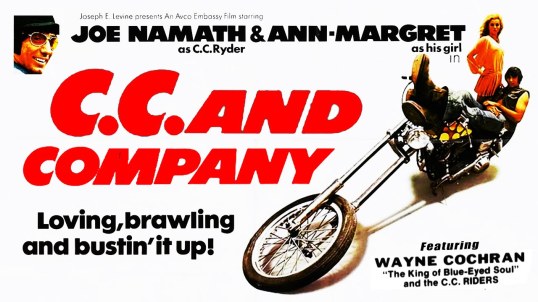
The TSL’s Grindhouse: C.C. and Company (dir by Seymour Robbie)


As our long-time readers know, I’ve seen my share of bad movies but it’s been a while since I’ve seen one as bad as 1970’s C.C. and Company.

C.C. and Company is about a drifter named C.C. Ryder (played by Joe Namath, who was a pro football quarterback at the time).  Ryder rides through the desert on his dorky motorcycle.  He doesn’t have a job.  He doesn’t have much money.  He does have a lot of hair and he also has a lot of teeth.  We know that because it’s rare that there’s ever moment when C.C. isn’t smiling.  C.C. is perhaps the most cheerful amateur criminal that I’ve ever seen.  Even when C.C. really shouldn’t be smiling, he’s smiling.  There are moments when people try to kill C.C. and he responds with a smile.  This could be a sign of C.C.’s devil-may-care-attitude but I think it has more to do with Joe Namath being a really bad actor.

C.C. is apparently a member of a motorcycle gang.  I say apparently because no one in the gang seems to like him and they’re constantly beating up on him.  The leader of the gang is Moon (William Smith) and among the members of the gang is an intimidating figure named Crow (Sid Haig).  Smith and Haig were both professional actors and genuine tough guys.  They not only knew how to act on camera but they also knew how to throw a punch without faking it.  Having them act opposite Namath doesn’t really accomplish much beyond emphasizing just how terrible an actor Namath was.  Even though Moon is a Mansonesque creep, you still find yourself rooting for him whenever he and C.C. get into a fight because Smith creates an actual character whereas Namath…. well, he doesn’t.  I sat through this entire film and never once did I find myself wondering what C.C.’s initials stood for.  That’s how uninterested I was in C.C.’s life.

Anyway, C.C. meets the wealthy and chic Ann McCalley (Ann-Margaret) after Ann’s limo breaks down in the middle of the desert.  C.C. not only fixes the limo but he also saves Ann from Crow and Lizard (Greg Mullaney).  It’s love at first sight but, unfortunately, Ann has places to go so she drives off and C.C. returns to the biker camp and watches as Moon sends his girlfriend, Pom Pom (Jennifer Billingsley), out to make money on the highway.  As I watched all of this, I found myself wondering how everyone else in the gang got stuck with names like Moon, Lizard, Crow, Rabbit, Pom Pom, and Zit-Zit (my favorite) but somehow C.C. was able to keep his innocent initials.  The movie never explained the ritual behind receiving motorcycle gang names and I think that was a missed opportunity.

Eventually, C.C. trades in his dorky motorcycle for a Kawasaki, largely because Kawasaki apparently paid the film’s producers a lot of money.  C.C. enters a race and wins.  Ann sees him win and falls even more in love with him.  C.C. gets into a fight with the gang and then he and Ann head to …. well, it looked a lot like Reno but honestly, who knows for sure?  Eventually, Moon and the gang track C.C. and Ann down and it all leads to one last fight.  We never do find out if the “company” of the title referred to Ann and her rich friends or Moon and the gang.  Not even C.C. seems to know for sure.

So, there’s a lot of reasons why C.C. and Company doesn’t really work but mostly it all comes down to the lead non-performance of Joe Namath as C.C.  There’s nothing tough or intimidating or rebellious about Namath.  C.C. is the biker you can bring home to meet your parents.  William Smith and Sid Haig are a lot more fun but they’re playing totally disreputable characters.  Namath and Ann-Margaret have zero romantic chemistry and the entire film has the look of a cheap made-for-TV movie.  Between C.C. and Company and Altamont, 1970 was not a good year to be a biker groupie.

That said, there is one good scene in C.C. and Company, where C.C. and Ann go out dancing.  While Joe Namath awkwardly shakes his shoulders while flashing that ever-present grin, Ann-Margaret dances as if the fate of the world depended upon her.  One year after the release of this movie, she would prove herself as dramatic actress and receive her first Oscar nomination for Carnal Knowledge.