Horror on the Lens: Trilogy of Terror (dir by Dan Curtis)


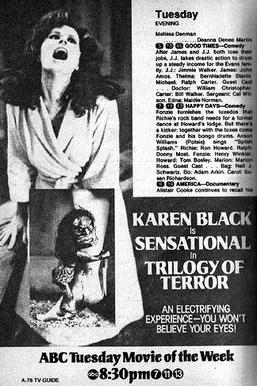
For today’s horror on the Lens we have a made-for-TV movie that was produced and directed by Dan Curtis.

Trilogy of Terror, which aired in 1975, is an anthology film, featuring three segments that were each based on a short story from Richard Matheson.  What makes this particular film special is that each segment features Karen Black playing a radically different character from the previous segment.  The film really is a showcase for this underrated actress, though Black herself later said that the film ruined her career because it typecast her as a horror actress.

The third segment is the one that gets all the attention.  That’s the one with the killer doll.  I like all of the segments, though.  The first one is often considered to be the weakest but anyone who has ever been through a similar situation will appreciate it as tale of revenge.  The second segment has a playful vibe that I liked.  And yes, the third segment is genuinely frightening.

From 1975, here is Trilogy of Terror:

October Positivity: Pardoned By Grace (dir by Kevan Otto)


Wait, what’s this?

A sincere and heartfelt faith-based film that works largely due to a sensitive and likable performance from Joey Lawrence?

Well, stranger things have happened.

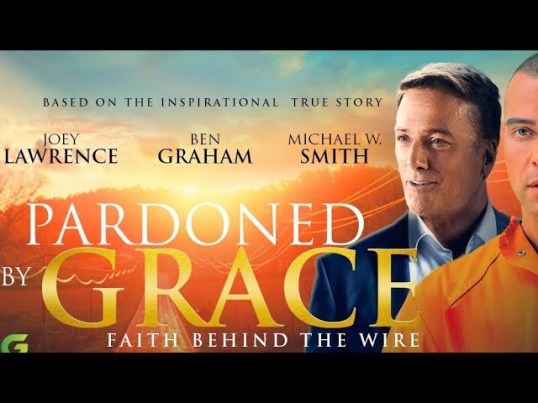
2022’s Pardoned By Grace tells the story of Scott Highberger (portrayed by Joey Lawrence).  Scott is a screw-up.  From the first time we see him until roughly until about an hour into this film, Scott is always doing something wrong.  He starts out the film as a small town drug addict and dealer and, throughout the course of Pardoned By Grace, he is consistently tempted to retuning to that lifestyle.  He’s someone who has spent his entire life being told that he’s never going to amount to anything and that he’s destined to be a failure so it kind of makes sense that he wouldn’t be worried too much about following the laws of conventional society.

The film follows Scott as he goes in and out of prison.  The warden, the guards, and even the other prisoners all know that Scott is capable of being more than just a convict but Scott himself cannot find the faith to keep from getting into trouble.  Whenever he’s released, he messes up and he’s sent back to jail.  At one point, he even gets a good job and he starts making a lot of money and that’s all it takes for him to start using cocaine again.

Finally, after having alienated every member of his family and committed one too many crimes, Scott finds himself in a church, where he listens to a sermon from Pastor Dave (Michael W. Smith).  Dave instinctively hires Scott to handle odd jobs at the church.  While Scott cleans up the place and stacks chair and tries to live an honest life, Dave makes plans for his prison ministry.  Scott is excited when he’s invited to take part in the ministry but then he learns that he won’t be allowed to enter any prisons to preach because he still has a years-old warrant out for his arrest.  Scott heads to Florida, where he turns himself into the police, even though he knows that, as a repeat offender, he is looking at a potential life sentence as a result.

Pardoned by Grace works surprisingly well.  Joey Lawrence is not exactly the first person who comes to mind when you think of an actor with tremendous dramatic range but he is still likable and earnest as Scott, a man who is determined to atone for his past mistakes and to take responsibility for his actions, even if it means losing his freedom.  If anything, Lawrence’s limited range actually makes him a good pick for Scott, who is initially portrayed as being someone who does whatever he feels has to be done in the moment with very little consideration given to what his actions could mean in the future.  As well, one doesn’t have to be religious to appreciate the film’s portrait of a justice system that is so obsessed with punishment that it’s forgotten that one of the purposes of prison is rehabilitation.  Scott is not someone who wants to be a criminal but it’s not prison that helps him to move on from his old ways.  Instead, it’s the faith of someone who is willing to give him a second chance.

Pardoned by Grace was surprisingly good.

Ghost Box (2015, directed by Mike O’Mahony)


A man is living every writer’s dream.  He has quit his day job and is now working on his book that he thinks will prove the existence of the paranormal.  However, while doing research, the man summons an actual ghost that appears to be determined to make his life a living Hell.

Ghostbox, which I watched on Pluto earlier today, was obviously made for a very low-budget and it’s cast is full of unknowns.  The story unfolds slowly and those looking for sudden shocks and expensive horror effects will want to look elsewhere.  Ghostbox attempts to be more of a mood piece than a typical scream-out-loud horror movie.  When taken on its own terms, though, Ghostbox isn’t bad.  It does a good job of setting the mood and the film’s plot actually does pay off at the end.  It’s a simple ghost story that is barely over an hour long.  Though it takes some getting used to, I liked the DIY feel of the film and even the slow pace felt appropriate for the story that the movie was telling.  Your mileage may vary.

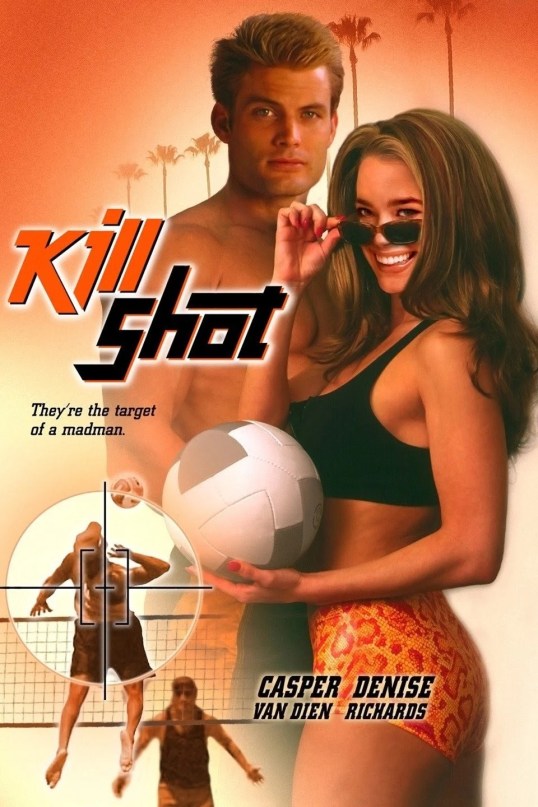
So, I Watched Kill Shot (1995, Dir. by Nelson McCormick)


A group of college students all live in a California apartment complex that’s owned by Jake Mondello (Gianni Russo), who also owns a restaurant and sponsors a beach volleyball team.  From the description that I read of the movie’s plot, I thought there would be a lot more beach volleyball and, from the title, I thought there would be a lot more thrills.  Turns out I was wrong on both counts.

It’s pretty obvious that this was a pilot for a tv show that was inspired by Melrose Place.  A lot of characters are introduced and they’re all shallow but pretty.  Just like with Melrose Place, everyone has a drama and everyone has someone that they like but who they can’t tell about their feelings.  Casper Van Dein is the most recognizable person in the cast.  He plays a rich boy who likes to play volleyball and who falls for a poor girl.  Other characters include Jacqueline Collen as a former volleyball star who is going back to college and who is being stalked by her ex (Jack Scalia), Catherine Lazo as the med student who loses her scholarship, and Ria Pavia as an abrasive science student who falls in love with her new roommate (Mushond Lee), even though he’s gay.  Ernie Reyes, Jr. plays Koji, who is a computer nerd who says stuff like, “I just got a new CD-rom game.”  He’s so good with computers that the police turn to him to help track phone calls and match finger prints.  Denise Richards appears for two seconds and smiles at Casper.  Gianni Russo is the worst actor in the movie but everyone loves Jake because Russo also wrote the script.

This was largely plotless and pointless.  Casper was nice to look at but I didn’t care about any of the characters.  There is a big beach volleyball game at the end but it only lasts for a few minutes and it was impossible to tell who was winning.  One important character is taken out by a kill shot but no one notices.  Watching the movie made me hate both the beach and volleyball.


A Blast From The Past: Final Curtain (dir by Edward D. Wood, Jr.)


1957’s Final Curtain is a short, 22-minute film in which a mysterious man (Duke Moore) wanders around a creepy and seemingly abandoned theater.  While Dudley Manlove (who played Eros the Alien in Plan Nine From Outer Space) provides narration, the man sees many strange things in the theater.  What is real and what is merely a hallucination?  Watch to find out!

Final Curtain was envisioned, by director Edward D. Wood, as being the pilot for a horror anthology series.  Though none of the networks were interested in buying Wood’s proposed series, Wood considered Final Curtain to be his finest film and it certainly is a bit more atmospheric than the typical Wood film.  The role of the mysterious man was written for Bela Lugosi but, after Lugosi passed away, Duke Moore was cast in the role instead.

From 1957, here is Final Curtain.

Horror on the Lens: The Norliss Tapes (dir by Dan Curtis)


The Norliss Tapes (1973, dir by Dan Curtis)

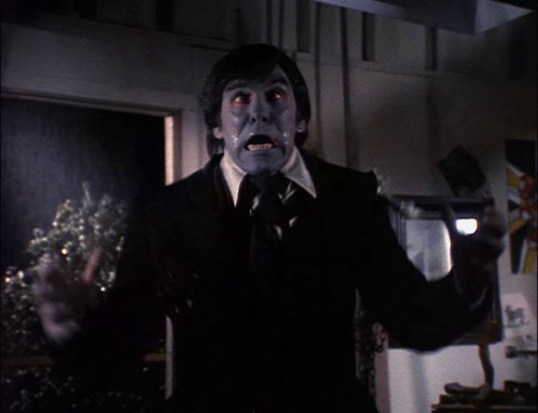
Today’s Horror on the Lens is The Norliss Tapes, a 1973 made-for-TV movie that was also a pilot for a television series that, unfortunately, was never put into production.

Reporter David Norliss (Roy Thinnes) has disappeared.  His friend and publisher, Stanford Evans (Don Porter), listens to the tapes that Norliss recorded before vanishing. (Stanford Evans, it must be said, is a great name for an editor.)  Each tape details yet another paranormal investigation.  (Presumably, had the series been picked up, each tape would have been a different episode.)  The first tape tells how Norliss investigated the mysterious death of an artist who apparently returned from the grave.

For a made-for-TV movie, The Norliss Tapes is pretty good.  It’s full of atmosphere and features a genuinely menaching yellow-eyed zombie monster. The film was directed by Dan Curtis, who was responsible for several made-for-TV horror films and who also created the deathless TV show, Dark Shadows. Curtis also directed a few feature films. Burnt Offerings, for instance, will be forever beloved for its scene of annoying little Lee Montgomery getting crushed by a chimney. If you ever get a chance to listen to the director’s commentary that Dan Curtis recorded for the Burnt Offerings DVD release, you must do so. Curtis comes across as the crankiest man on the planet and it’s actually kind of fascinating to listen to. His irritation when Karen Black keeps asking him if he knows the name of the actor who played the ghostly chauffeur is truly an amazing thing to here. (For the record, the actor’s name was Anthony James, he also had important supporting roles in two best picture winners — In The Heat of the Night and Unforgiven — and yes, he was one of the best things about Burnt Offerings. Karen Black knew what she was talking about.)

But back to The Norliss Tapes!

Admittedly, this is not the first Halloween in which I’ve shared The Norliss Tapes with our readers. Back in both 2015 and 2021, The Norliss Tapes was one of our “horrors on the lens.” Unfortunately, there’s only so many good quality, public domain horror films available on YouTube so, occasionally, a movie is going to show up more than once over the years. But, as long as it’s good film, who cares?

Enjoy The Norliss Tapes!

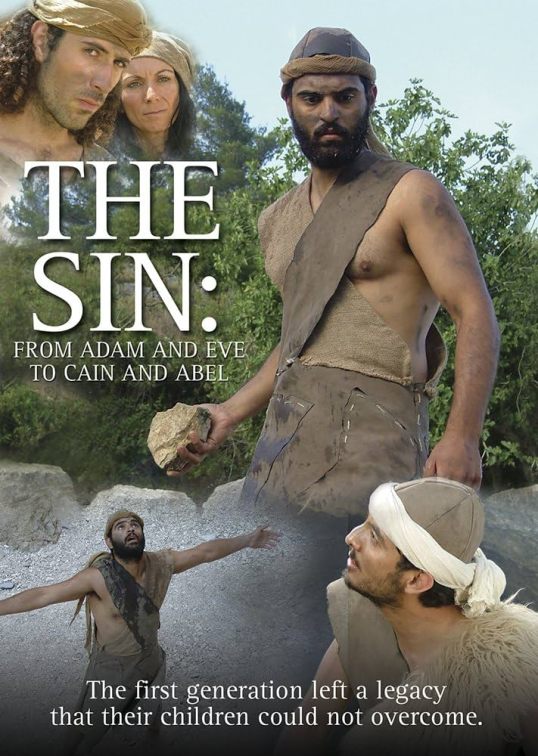
October Positivity: The Sin: From Adam and Eve to Cain and Abel (dir by Robert Savo)


2017’s The Sin tells a familiar story.

Shortly after creating the world and the first people, God allows Adam (Ayman Nahas) and Eve (Khawlah Hag-Debsy) to live in the Garden of Eden.  He only gives them one major rule to follow.  They can eat from any tree except for the Tree of Knowledge.  They’ve got all the food that they could possibly want, as long as they don’t break that one very simple rule.  Eve promptly breaks that rule, taking the advice of a serpent and eating an apple.  She then convinces Adam to do the same.  When God asks Adam whether or not he ate from the tree, he lies.  Then he tries to put all the blame on Eve.  God responds by kicking them out of the Garden and cursing them to suffer on Earth.

Adam and Eve wander the Earth, arguing nonstop about who is to blame.  Finally, they stop arguing long enough for Eve to get pregnant.  In the film, they are depicted as having two sons, Cain (Shredi Jabarin) and Abel (Nahed Bashir).  Abel is the gentle sheep herder.  Cain is the farmer who sees everything as a competition.  When God prefers Abel’s offering of a lamb to Cain’s offering of some nuts and berries, Cain murders his brother and then lies about it.

And, needless to say, everything’s been going downhill ever since.

This is a short film, barely clocking in at 50 minutes.  It tells the story faithfully enough, though it leaves out Seth and Adam and Eve’s other children.  (Perhaps that’s to avoid discussing the possibility that Cain and Seth ended up marrying their own sisters.  I mean, they had to populate the Earth somehow)  The main problem with the film is the acting.  The actors playing Adam and Eve both come across as being rather goofy and the scenes of them arguing about who is to blame feel more like petulant nagging than an actual discussion about who is to blame for bringing sin into the world.  As for Cain and Abel, Abel is kind of wimpy while Cain comes across as being the worst dumbass teenager ever.  The scene were Cain start to shout “competition” over and over again made me smile a bit too much, considering that I knew this was going to lead to the first murder.

On the plus side, the film refrains from putting all the blame on Eve.  While Eve may have been the first to bite into the forbidden fruit, Adam made his choice and then he not only lied about it but tried to put all the blame on Eve.  If anything, this film suggests that Adam was punished less for what he did and more because he refused to accept responsibility for his actions.  By that same token, Cain’s murder was bad but his refusal to take responsibility for his actions showed that he was beyond redemption.

As a final note, let me just say that it’s always amazing to me the odd and obscure things that you can find on Tubi if you just spend a few minutes scrolling through your list of recommendations.
Black Cadillac (2003, directed by John Murlowski)


On a snowy night, Scott (Shane Johnson), CJ (Josh Hammond), and Robbie (Jason Dohring) cross into Wisconsin so that they can have a good time at a notorious roadhouse.  After CJ starts a fight that gets them kicked out, the three of them start to drive back to Minnesota.  They stop to pick up a deputy sheriff, Charlie (Randy Quaid), whose squad car has broken down.  Charlie assures the young men that he’s off-duty and asks them a lot of questions about what they’ve been doing during the night.  When a mysterious 1957 black Cadillac pulls up and challenges the Scott to a drag race, Charlie tells Scott to “go for it!”

It turns out that the Cadillac is interested in more than just a race.  It tries to force Scott into crashing his car and, even after Scott seems to escape from the car, it keeps showing up wherever the friends are driving.  Why is the other driver after them and how is Charlie involved?

Not a bad film.  The black Cadillac and its driver are great villains that seems to be able to transport anywhere.  No matter what the three young men do, they can’t escape from or even slow down the Cadillac’s pursuit.  The three friends are all likable, even if the movie does get bogged down with all of their secrets.  Randy Quaid shows  why, before he apparently lost his mind and started talking about star whackers, he was one of the busiest character actors around.  Black Cadillac is a good mix of horror and car chases.

Horror on the Lens: Manos: The Hands of Fate (dir by Harold P. Warren)


torgo

I should start things off with a confession.  This is actually not the first time that I’ve shared Manos: The Hands of Fate here on the Shattered Lens.  I previously shared it during the 2013, 2015, 2020, ad 2022 Horrorthons and, each time, I even used the exact same picture of Torgo.

However, Manos proved to be such a popular choice that I simply had to post it again. Manos has a reputation for being one of the worst films ever made.  And, honestly, who am I to disagree?  (Though disagree, I do.)  However, it’s also a film that simply has to be seen.

(As well, I love regional horror and there are a few films as regional as Manos, a film that was filmed in my home state of Texas and directed by a fertilizer salesman.)

By the way, everyone who watches Manos ends up making fun of Torgo, who was played by John Reynolds.  What they may not know is that Reynolds committed suicide shortly after filming on Manos wrapped.  So, as tempting at it may be to ridicule poor Mr. Reynolds’s performance, save your barbs for Torgo and leave John Reynolds alone.

And be sure to enjoy Manos: The Hands of Fate!

October Positivity: Before It Happened (dir by Andrew Jacob Brown)


It’s going to be a bit of a mini-October Positivity review tonight.  I spent today helping my neighbors move then crying because my neighbors had moved, and then trying to talk my new neighbors into not getting rid of their new house’s hot tub.  I’m tired, so I’m going to try to keep things relatively short tonight.

In 2023’s Before It Happened, Eli Jenkins (played by the film’s director, Andrew Jacob Brown) is such a hard-boiled cop and detective that, when he realizes that the Mayor of his town has been kidnapping children and holding them prisoner in his home, he literally forces his way into the house and puts that perverted public official in his place.  Now, you would think that the Mayor of reasonably-sized town being arrested for kidnapping a child would be big news and Detective Jenkins would be on all of the Fox or Newsmax shows.  Instead, Jenkins gets yelled at for not following procedure.

Uhhmm, guys — your mayor was abducting children and holding them prisoner in his home!  His wife was helping him!  Why does no one in this movie seem to think this is as strange as I do?  I mean, seriously, I know that we’re no longer shocked when a public official is arrested but this still seems like a pretty big deal.

Anyway, Jenkins is given a new assignment.  He needs to find his ex-partner, Bobby (Jason Haines), and bring him to meet with his brother, the chief of police (Brian Eberly) who happens to be dying.  Jenkins tracks down Bobby but it turns out that Bobby, who was once a good and ambitious cop, is now totally irresponsible and in debt because he sold some valuable basketball cards to a comic book store.  Jenkins has to get the cards back before he can even think of taking Bobby to see his brother.  Since the original owner of the cards is holding Jenkins’s current partner (Christopher Shane Lowry) as a hostage, it is literally a matter of life-and-death.  Bobby and Jenkins work together to try to make things right and, along the way, they confront their own demons.  This leads to an increasingly complicated series of events.   Meanwhile, almost everyone that Jenkins talks to tells him that the Biblical prophecies are coming true and that the world will soon end….

There were some good things about this film.  I did smile a bit at just how complicated Eli’s relatively simple assignment became.  He just couldn’t catch a break and no one was willing to help out until Eli did something for them first.  That part of the film had a lot of potential.  But, like so many faith-based film, Before It Happened suffers from amateurish acting and a script that often seems to be trying too hard to imitate the big budget blockbusters that inspired the film.  Sometimes, you just have to be willing to admit that you don’t have the budget or the experience necessary to make a Hollywood-style crime drama.  Before It Happened‘s story had potential but the execution failed to realize it.