“Shaft” #1 Brings Blaxploitation Bad-Ass To The Printed Page


4252960-01a

Right off the bat, I should probably apologize for the misleading headline here — Dynamite Entertainment’s Shaft #1 (the first of a six-part series) isn’t “bringing blaxploitation bad-ass to the printed page” so much as it’s bringing it back to the printed page, given that “the black private dick that’s a sex machine to all the chicks” actually started out life not on the silver screen, but in a series of pulp novels by the legendary Ernest Tidyman. And it’s probably down to the fact that Tidyman’s widow owns the copyright to the character of John Shaft that we even have this new spin-off comic at all, seeing as how negotiating a licensing rights deal with her is probably a lot easier than dealing with, say, MGM. Even so — am I the only one who’s surprised that this comic even exists?

I mean, when I think of licensed properties making the leap to the four-color world, I think Star WarsStar TrekBattlestar Galactica. Heck, this week Boom! Studios even released the first issue of a new Escape From New York ongoing monthly, and that didn’t exactly come out of left field in my estimation, but this? A comic based on a cult blaxploitation hero who “peaked” about 40 years ago in terms of his popularity? I gotta say, I didn’t see that one coming at all.
4253652-01b

Still, I’m glad it’s here, and in the hands of writer David F.Walker and artist Bilquis Evely, Tidyman can rest easy in his grave — they seem to know what they’re doing every bit as much as Gordon Parks and Richard Roundtree did when they translated the urban adventures of “the cat who won’t cop out when there’s danger all about” onto celluloid. Is this a good comic? Damn right.

Walker (who’s also penning a six-part Shaft prose story available by scanning QR codes included in the printed versions of each of the comics) has opted to go the “prequel” route here, taking us back to 1968 when a newly-returned-from -Vietnam John Shaft is trying to make a go of it an as Brooklyn-based amateur boxer. We learn a lot about our main character’s backstory here — certainly more than we ever did in the film — and I have to say that all the revelations we’re served ring very true indeed to the Shaft we’ve always known, while somehow being at least modestly surprising at the same time. The fact that Walker is able to convey all this info with a sparse and breezy prose style is an added plus, and while the main through-line of the plot is a pretty simple one — Shaft is ordered to throw a fight, what’s he gonna do about it? — that doesn’t mean the impact of our guy John’s decision, predictable as it may be, has any less of an impact on readers. He’s headed for big trouble, and I’m looking forward to it already.  This first issue is pure table-setting, to be sure, but where’s the harm in that? Set the table nicely enough and I’ll want to stick around for the meal.
4253651-01c

The art from Evely, whose prior work I confess to being unfamiliar with, can also be fairly categorized as “not flashy, but certainly effective.” It’s pretty simple and straightforward, but displays a kind of professionalism and eye for craft that were more common in the comics of 1971 — the year that Shaft hit theaters — than they are today. It suits the subject and time period quite well and invests the  reader in the proceedings rather than alienating you with so much of the unskilled “flashier” art we find in, say, the average DC “New 52” comic. The panels in this book  look good without sacrificing realism and plausibility along the way, and  are more concerned with drawing you in than bowling you over. All in all, a job very well done.
4253650-01d

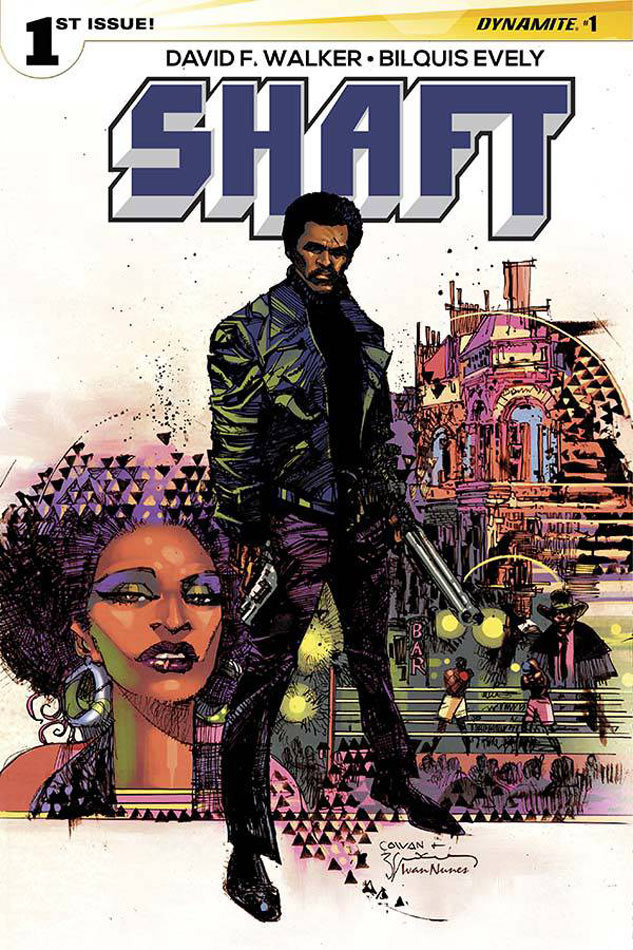
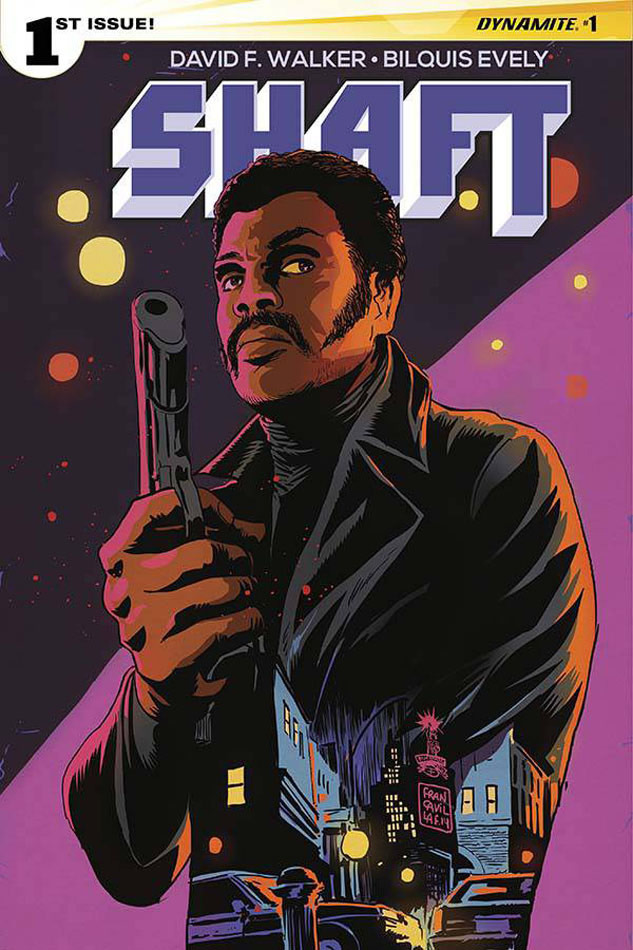
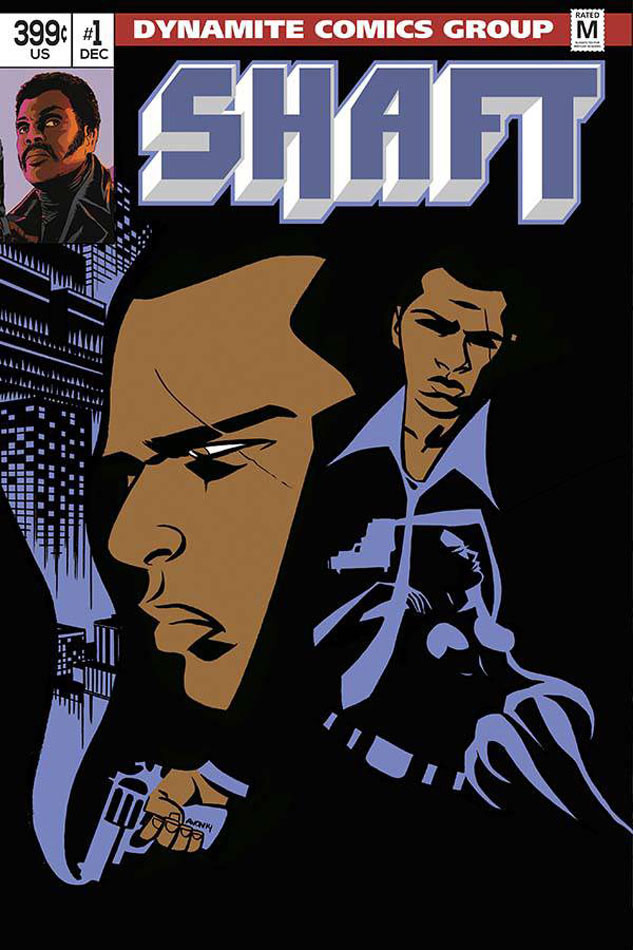
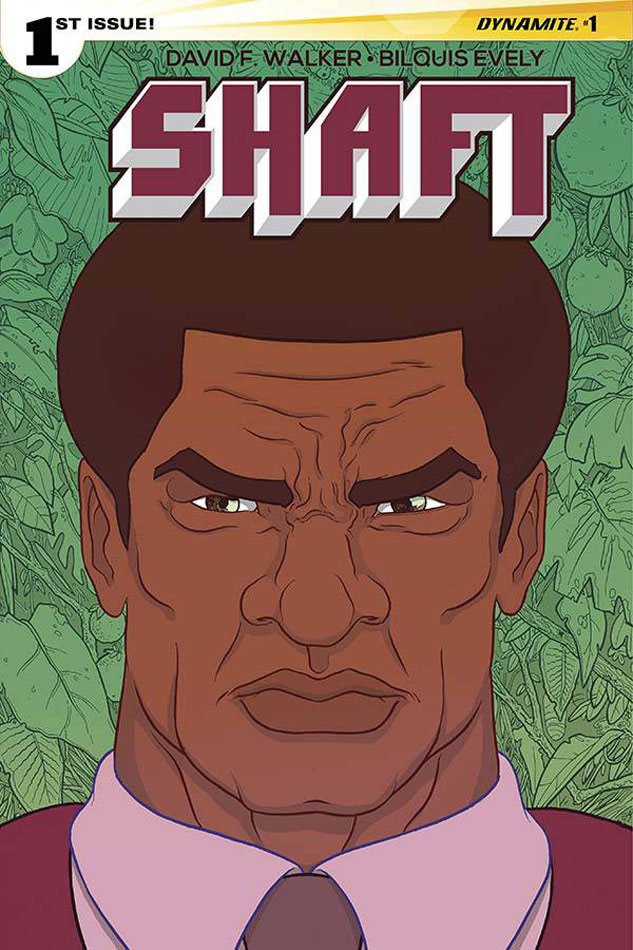
As with pretty much all Dynamite first issues, Shaft #1 has hit the stands with about a bajillion different variant covers. I’ve included my four favorites with this review (by Denys Cowan and Bill Sienkiewicz, Francesco Francavilla, Michael Avon Oeming, and Ulises Farinas, respectively), and while they all portray a more Richard Roundtree-looking Shaft than Evely does in his interior pages (well, except for the one by Farinas, since that’s not Shaft at all, but the bad guy of the story), you really can’t argue with the awesome-ness of any of them. I opted for the Francavilla cover since I always opt for Francavilla covers, but I was sorely tempted by the main Cowan/Sienkiewicz one, as well. Any way you go, though, you can’t lose — either with what’s on the outside of the book or what’s in it. This is the John Shaft we’ve always known, but shown in a whole new light that I think almost all fans will appreciate.
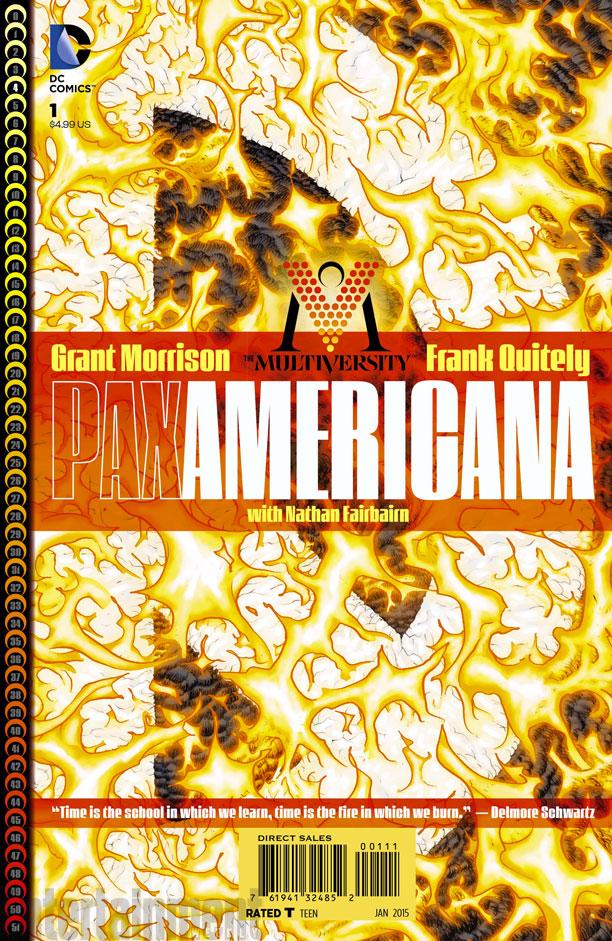
 

“The Multiversity : Pax Americana” #1 Is The Comic Of The Year — No Question


MULTIVERSITY-Cv4-05

Understand — it’s not like me to make grandiose pronouncements like “such-and-such is the movie of the year,” “such-and-such is the comic of the year,” etc. It’s pretty damn hard to pinpoint something as being the best offering in any given medium when one person, obviously, can’t see or read everything that’s out there — and it’s probably doubly stupid to engage in such hyperbole before the year is even over.

And yet — that’s exactly what I’m doing right here, and with full confidence. That’s because the latest issue of Grant Morrison’s The Multiversity has no chance of being topped, barring a miracle of some sort. It’s just. That. Fucking. Good.

1-1

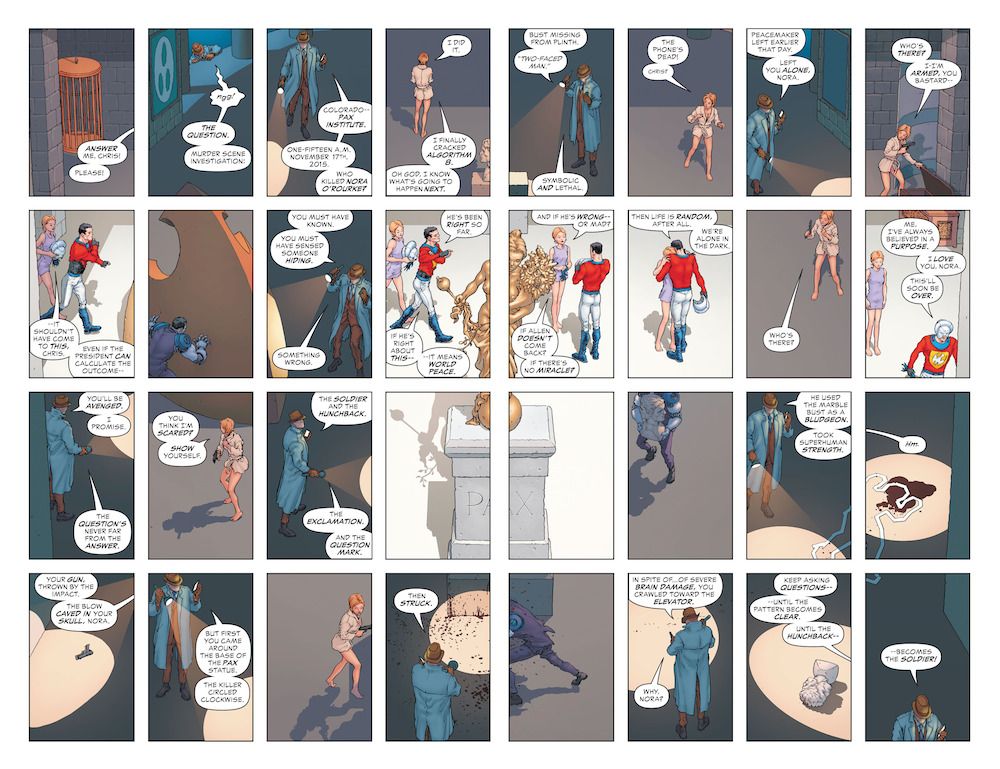
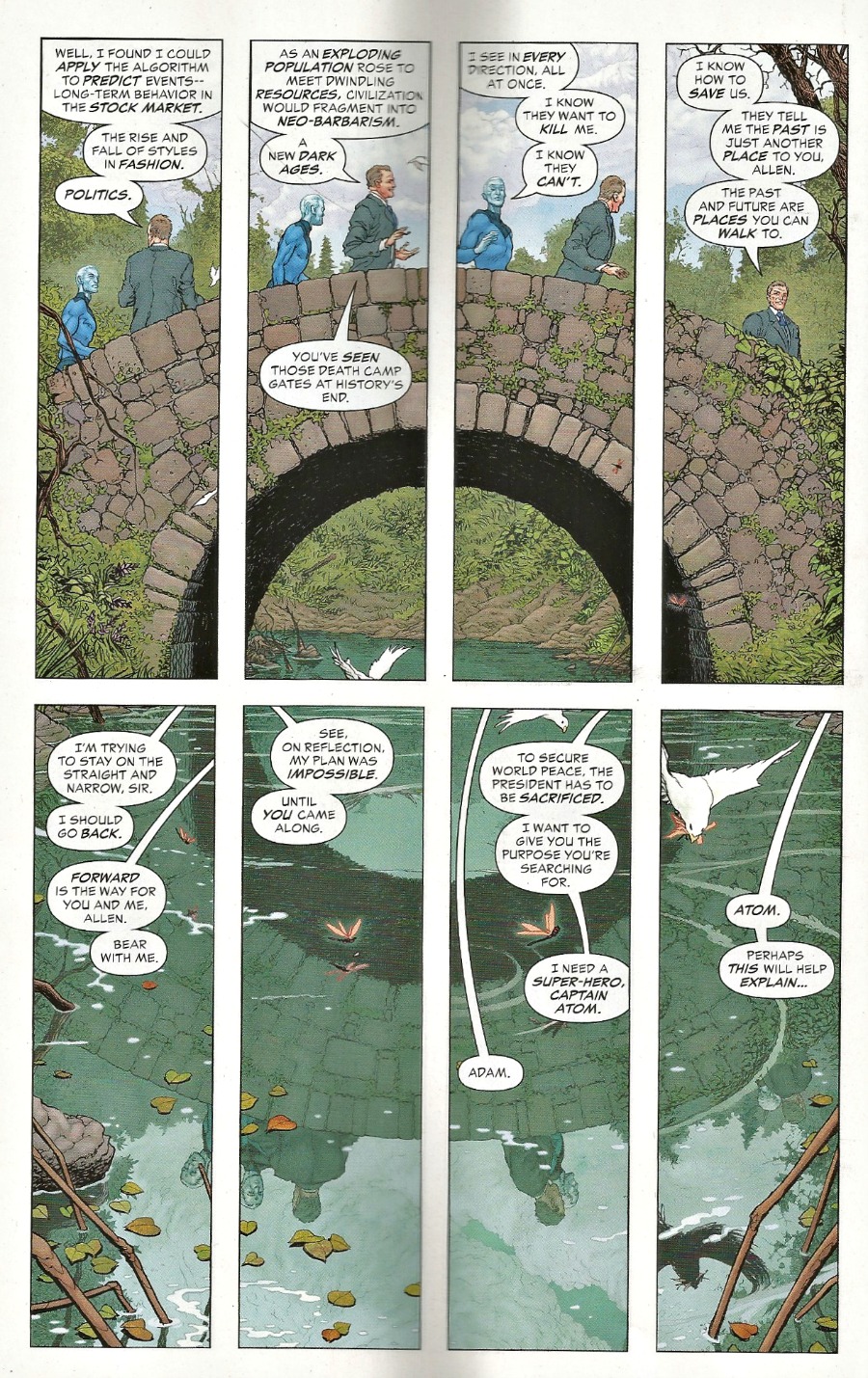
For those not familiar with the basic premise of what’s going on with The Multiversity, it’s an eight-issue mini-series from DC written by Morrison and illustrated by a bevy of the industry’s top talents — in this case,  his frequent collaborator Frank Quitely, who absolutely outdoes himself here. Yeah, okay, all his stuff’s awesome to behold, but his work  on Pax Americana leaves even his much-celebrated turns on Flex MentalloBatman And Robin, and All-Star Superman so far behind in the dust it’s not even funny. Just look at that spectacular page reproduced above and you’ll know that not only is Quitely rendering images here with amazing detail and care, he’s also pushing the boundaries of the comics page in terms of how narrative structure flows visually. I haven’t seen an artist on a “Big Two” project tell a story this hermetically sealed, with its own unique and perfectly logical, yet also expressive and evocative,  language since Dave Gibbons created the singular look and feel of the Watchmen “universe” nearly 30 years ago.

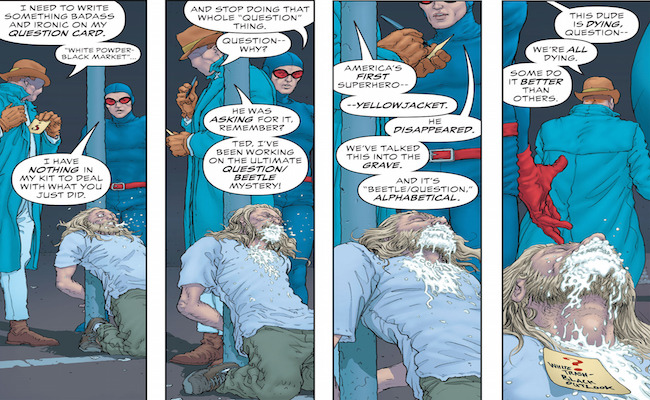
And hey, it’s no coincidence that we bring up Watchmen here since Pax Americana has been referred to, more than once, as “Morrison’s Watchmen,” and for good reason.  Each self-contained issue of The Multiveristy takes place on one of DC’s “parallel Earths,” with a slowly-unfolding, meta-fictional, ” comic within a comic” premise (nothing new for our guy Grant there, he’s been busting the fourth wall ever since his days on Animal Man) binding them all together in ways not fully understood yet given that we’re only halfway through the series, and this time out we’re on Earth-4, the Earth populated by the Charlton comics “Action Heroes” that DC acquired in the early ’80s and that Alan Moore famously first intended to utilize as his principal characters in he and Gibbons’ seminal work.  Morrison famously hates Watchmen, and takes every available opportunity to say so, and so the “intrigue factor” here is pretty high in terms of comics fans wanting to see how he’d handle essentially the same characters.

MCPAX-SMP-2

I say “essentially the same” because, of course, Moore and Gibbons weren’t allowed to use the Charlton characters in the end, and so quick stand-ins were devised — The Question became Rorschach, Blue Beetle became Nite Owl, Nightshade became Silk Spectre, Peter Cannon, Thunderbolt became Ozymandias, Peacemaker became The Comedian, and Captain Atom became Dr. Manhattan. DC had “other plans” (most of which amounted to a hill of beans) for the “real” characters at the time, but in the “New 52” universe they’ve all been shelved indefinitely and so Morrison is free to use the original versions here — with the exception of Peter Cannon, whose copyright has reverted back to his creator, Pete Morisi.

The Watchmen similarities don’t end with the principal characters the story is based around, though — Pax Americana also employs a tight, dense story structure that plays around freely with timelines and often employs mirror images of the same scene told from multiple perspectives, such as in the astonishing two-page spread above. Rest assured, it all makes perfect sense, but odds are you won’t catch it all on the first reading unless you’re, I dunno, Stephen Hawking or something.

1447_multiversity_pax_americana_1_splash

And that’s part of the joy of a book like this, isn’t it? Make no mistake — if you’re not willing to invest a few hours, at least, of your time (not to mention $4.99 of your hard-earned money) into what Morrison and Quitely (along with colorist supreme Nathan Fairbairn, who imbues the world of Earth-4 with a distinctive palette all its own) have created here, you’re short-changing yourself, because this is a story that reveals more and more about itself with each successive re-read. As you continue to peruse its contents you’ll be able to glean which instances are integral to a full understanding of the complex proceedings and which are just clever structural gimmicks employed by the author to impress you, but it wouldn’t be a good mystery story — and Pax Americana is, in fact, a great mystery story, centered around the most consequential murder any society can endure, that of its leader — without a few red herrings being thrown into the mix. Heck, Morrison even takes a fun, albeit admittedly cheap, shot at his arch-enemy, Mark Millar, by deftly deconstructing the most pivotal sequence of Wanted and essentially copying it note-for-note while turning it on its ear at the same time, and has a bit of fun at the expense of the scene with Sally and Laurie Jupiet/Juspeczyk in Watchmen #2, as well. Gratuitous? Sure, but it works.

The other ballsy move Morrison makes here is in asking the same fundamental question with his story that Moore and Gibbons did with Watchmen in terms of when is it right to sacrifice the few for the (supposed) good of the many, who “gets” to make that call, and how do they arrive at their decision? Granted, it’s a weighty theme that can’t be grappled with as comprehensively in one 40-page comic as it can in 12 separate 30-page comics, but I give him credit for essentially finding a way to tell multiple (hmmmm — a multiversity?) of stories here at once, given that there’s more going on in this one issue than most comics with a standard “A to Z” linear narrative manage to pack into a year’s worth of their pages, and by utilizing the same characters (again, essentially) that Watchmen used to deal with the same (again, essentially) themes and concepts, Morrison and Quitely aren’t so much aping Moore and Gibbons as they are answering them.

None of which is to say that Pax Americana is going to make people forget about Watchmen any time soon. Or even that it’s “as good” as Watchmen. Again, it’s much shorter, for one thing — but it’s certainly as intricate, arguably even moreso, certainly as demanding, and in the end, certainly as revelatory, at least for those with the patience to give it the detailed attention it both deserves and rewards (as an added plus, you needn’t even be invested in the other Multiversity comics to get on board with this one, it reads just fine on its own).

The comic of the year? Yeah, I can say that pretty easily — even though there’s a bunch of other stuff I haven’t read, and the year’s not over yet.

Palace Intrigue Is The Order Of The Day In “Empire Of The Dead : Act Two” #3


4212100-03

Remember that famous scene in The Godfather where Michael Corleone is having his henchmen settle all The Family’s old scores while he attends his infant son’s baptism? George Romero clearly does, because Empire Of The Dead Act Two #3 (or George Romero’s Empire Of The Dead Act Two #3 to be technically correct about things) is all about Mayor Chandrake — who’s front and center in Alexander Lozano’s stunning cover, as shown above — eliminating all threats to his leadership of both New York City and the secret vampire cabal for whose benefit the entire town is run. He’s ruthless, determined and, unlike Michael Corleone, not afraid to get his own hands dirty in the process.

The bloodbath is precipitated, as you might guess, by a visit from the cops — not Chandrake’s own loyal “security” personnel, but actual, rank-and-file NYPD detectives. Apparently, he doesn’t own them all yet, and one newcomer to the story, a certain Buckie Perez, seems to be the post-zombie apocalypse’s answer to Jim Gordon in that he can’t be bought, bullied, or otherwise strong-armed into toeing the mayor’s line. Between a true “good cop” snooping around, the seeming political ascendancy of his nephew, Billy, and the pesky presence of an “unauthorized” victim of vampirism still resting semi-comfortably in the hospital, then,  there are a lot of loose ends to tie up.

The problem is — one of the above-mentioned targets survives their attempted assassination, and there’s still that missing dirigible from a New Jersey warehouse to be accounted for.

Outside Chandrake’s desperate and homicidal machinations, though — which do lead to some interesting, if overly-expository in terms of how they’re handled, revelations (for instance, there are actually a lot fewer vampires than we’d previously been steered into assuming) — some other notable plot developments  do take place here, particularly in The Arena, where the void left by the loss of super-fighter Zanzibar ends up being filled by  — zombies who have actually learned to team up and work together? Trainer/wrangler Paul Barnum sees this, reluctantly, as a positive — but only for the time being, since he knows what it means if the same behavior patterns begin to emerge on the streets.

As for the cliffhanger, it’s a doozy — mistakenly believing that all his problems are solved, Chandrake pays a visit to his latest muse, Dr. Penny Jones, in her newly-equipped-to-the-hilt lab, and let’s just say that she might finally be getting close enough to the fire to be irrevocably burned.

All in all, then, a reasonably solid issue story-wise with one addition to the creative team worth mentioning in the form of the arrival of inker Rick Magyar, who seems to stay fairly true to Dalibor Talajic’s pencil line in that not a whole lot of stylistic difference can be discerned between this and the previous two installments, which Talajic inked himself, apart from an overall “darker” look owing to Magyar leaning a bit more heavily on his brush, so to speak, which suits both the material itself, as well as the mood it creates, quite nicely. A solid effort from all concerned, then,  that has me very much looking forward to next month.

“The Kitchen” #1 : If You Can’t Stand The Heat — Well, You Know


4212079-01

So it appears that one of the sites I’ve done a fair amount of writing for, geekyuniverse.com, has shuttered its digital doors.Furthermore, it looks as if they sold their domain name off to something called “Swagger Magazine,” whatever that is, and did all of  this without informing any of us contributors that it was happening. Am I pissed? I guess I wasn’t at first, but now I sort of am, simply because all that content I posted on there, much of which was pretty good (even if I do only say so myself), is now lost forever, and because, going by sheer numbers alone, my stuff was far and away the most popular material on the site. Seriously, most of the posts on there were lucky to generate a half-dozen “likes” and one or two faceboook and twitter “shares,” while my articles routinely got a couple hundred of each. Does that mean I think my stuff was “better” than the work of the site’s other contributors? I dunno. I guess that’s all a matter of taste. I’d invite you to compare all of our work and decide for yourself, but — it’s all gone. And somebody made a little bit of money — probably not much, but something — selling off a site that was built by the work of folks who submitted work to it for free. Pretty goddamn sleazy, really.

Anyway, I’ve tried to get an explanation as to why it all went away without explanation, but the (now former) owners of the site haven’t responded to either my tweets or my emails, so I guess all I can do it call ’em out on their bullshit here and let them know that I’m not impressed. Don’t spend that two or three hundred bucks you made in one place.

Still, what the hell does any of this have to do with Through The Shattered Lens? Well, it means — for better or worse — that I’ll have a little bit more time to contribute to this site for the next couple of months, until my super-big-project-that-I-can’t-talk-about-yet eats up all my time for a little while, and that I’ll have more time for this site again once said super-big-project-that-I-can’t-talk-about-yet is finished. It also means that my quick-fire comic book reviews — as opposed to the lengthy, detailed, serialized pieces I do for the more “academic” comic website sequart.org — are in need of a new home with the demise of GU, so you’re getting ’em here.

I figure, hey, why not? Nobody else here “talks comics” very regularly, and I know a certain number of readers (and writers) here are fans of the medium, so, for the time being at an rate, I’ll “park” my comic book review work here unless and until Arleigh or Lisa Marie or somebody tells me to take it somewhere else. Which they won’t because they’re good people who like to indulge me — right?

4212404-01-variant

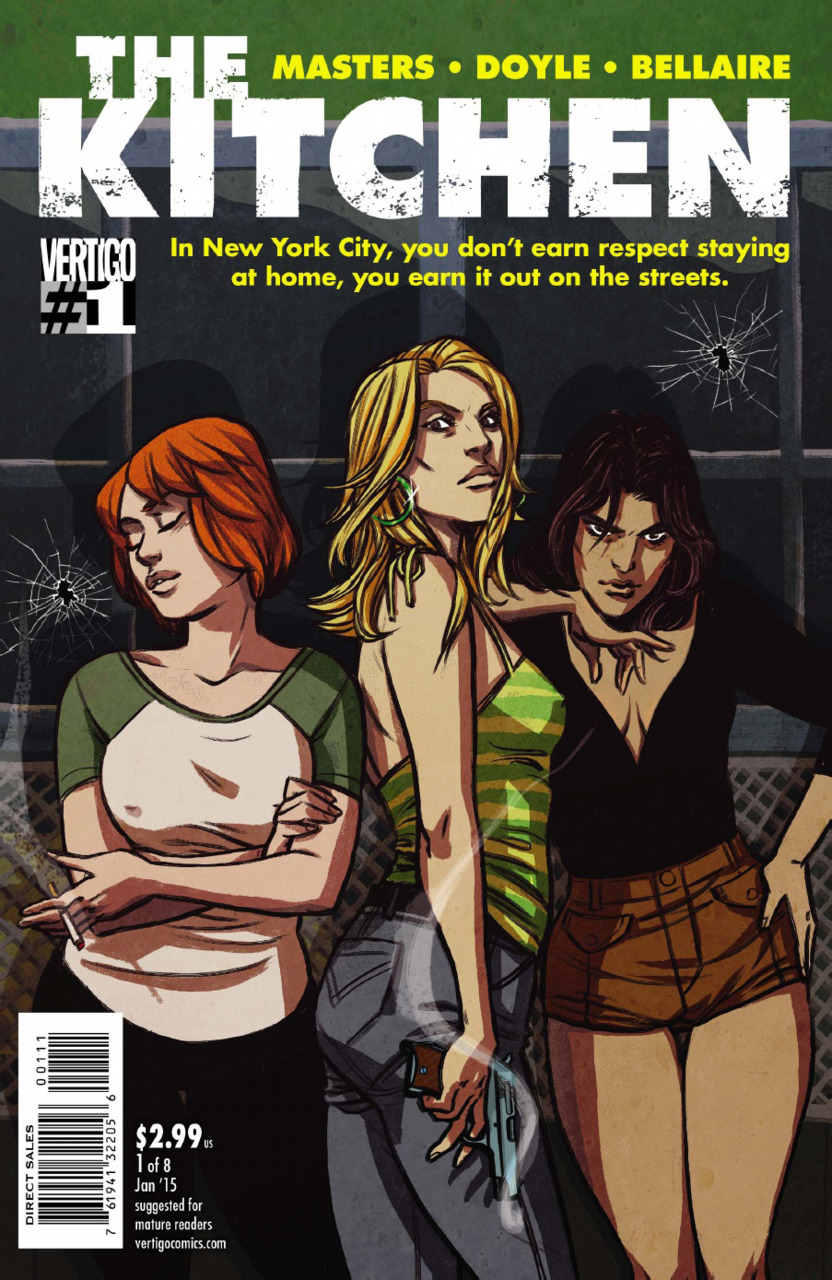
With all that preamble shit out of the way, then, let’s talk about The Kitchen #1, shall we? It’s a new eight-part creator-owned mini-series from DC’s venerable “mature readers” imprint, Vertigo, and it stands out for not only being a book centered on non-spandex-clad female characters, but for boasting a nearly-all-female creative team — except for, ya know, the writer.

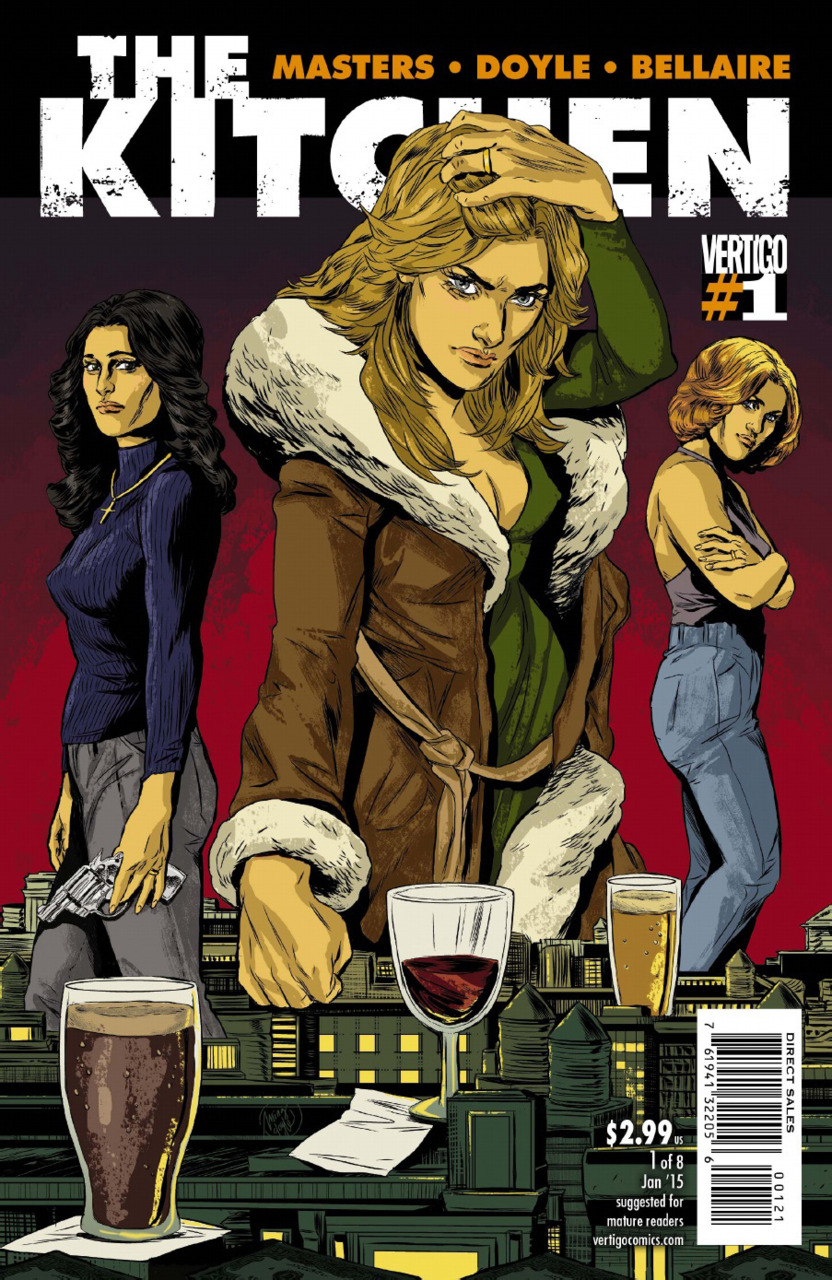
Described in Vertigo’s press materials as a “talented newcomer,” author/co-creator Ollie Masters provides the only whiff of testosterone here, with the project’s artist/co-creator being the talented Ming Doyle, fresh off her run on the critically-lauded Image series Mara (which was written by apparent serial-sexual-harasser Brian Wood), the colorist being the highly-sought-after Jordie Bellaire, and covers coming our way courtesy of current “hot property” artist Becky Cloonan (except for the variant for this first issue, pictured above, which is from Doyle’s own mind and hand).

With a crew like that in place, then, you can be sure that the finished product is gonna look good — and it does. Doyle evokes the 1970s Hell’s Kitchen settings perfectly, and her characters look like real human beings of the sort you’d see at the time. Everything from the home furnishings to the cars to the street scenes to the facial expressions are all wonderfully authentic and yet also smoothly expressionistic, with everyone looking like a real, actual individual rather than a curvy superheroine who just happens to be wearing street clothes. The seventies were a wonderfully “run down” time in New York — long before Times Square and other “red light districts” got gobbled up by Disney — and the titular Kitchen was especially run down, even by then-contemporary standards. You feel every bit of that oozing, semi-intoxicating unwholesome-ness in Doyle’s art and Bellaire”s suitably drab, realistic colors.

So, then, what of the story? I’m unfamiliar with Masters’ other work — assuming he has any to his credit — but he acquits himself very nicely here. The premise goes that local loan shark/”protection” racket strongman Jimmy Brennan, a semi-connected guy in the Irish mob, has been sent away, along with two of his crew, for beating the shit out of some snitch right in plain sight of the cops, and in his absence, his brother, Jack, is letting things slide to the point that Jimmy’s wife, Kath, and her friends, Angie and Raven (who are married to the two other guys that got shipped upstate along with their boss), are finding the weekly takes from local businesses that the rely on to maintain their “lifestyles” are getting lighter and lighter all the time. Not content to let this state of affairs continue, and unable to rely om Jack to straighten it out, they decide to take matters into their own hands. Problem is, their primary target, a pizza shop owner, turns out to be a lot more than just another dime-a-dozen welcher, and “sending a message” by going after him on their first night out may prove to be a fatal mistake —

First issues can be a little bit of a tricky business because you’ve gotta introduce most, if not all, of your principal cast, give them each a semi-distinct personality, and establish the basic “through-line” of your plot, all while leaving things on nice little cliffhanger that will have your readers coming back for more. Masters manages to do all that and furthermore, he does so without ever making it feel like he’s going into overly-heavy “info-dump” mode. All in all, it’s a job very well done.

Combine great art and color (and covers) with a reasonably good, involving story, stick it between two covers, and keep the price — thankfully! — at $2.99, and you have to say that The Kitchen is definitely following a recipe for success.

Stand Back For A George Romero Info-Dump In “Empire Of The Dead : Act Two” #2


4143654-02

If you’ll recall, the second issue is when the wheels fell off a bit in act one of George Romero’s Empire Of The Dead Marvel Comics series, and it really took about another whole issue after that for the story to find its footing again.  I’m pleased to say the pattern doesn’t repeat itself here in the second story arc, but truth be told this book does have some rather hefty problems, and we’ll get to those in just a minute.

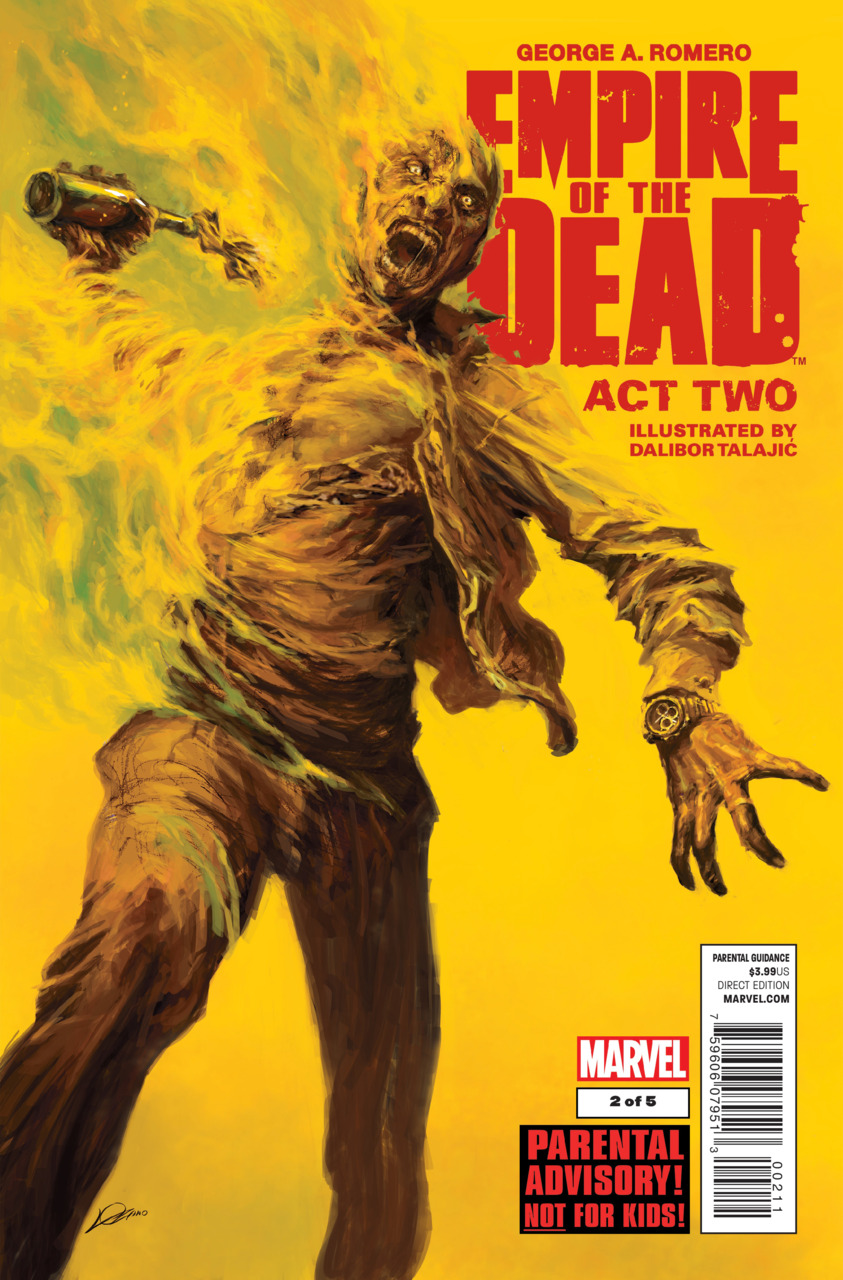
First, though, I gotta say my hat is off to Alexander Lozano for that kick-ass cover shown above. Sure, the painting of a zombie wearing what appears to be a pretty expensive watch and hurling a molotov cocktail — with the fire not doing jack shit to him, by the look of it — has nothing to do with the interior contents whatsoever, but it sure is cool-looking. Maybe my favorite cover yet, which is just as well since it’s the only one, with this issue being the first in the series to go out without any variants.I was kinda hoping that Francesco Francavilla, who did the variant last month, would stick around for a bit, but I’m not surprised that Marvel has finally scaled back to just one cover for this title, since — let’s face it — sales aren’t all that great, and it would be pretty unusual for them to keep doing two covers month in and month out on any book, much less one like this where most folks seem to be waiting for the trades rather than picking it up in singles, anyway.

What can I say, though? I’m fully aware that it’s not the economical way to go, but when I know there’s a Romero fix to be had, I need it quick, and by and large this series has been one that reads pretty well in individual installments, so I’ll keep going like I have been with it — even though, as I said before, this particular issue does have some problems.

So, hey,  let’s talk about those, shall we? It’s been hinted for some time that the vampires in the “Romeroverse” operate by a different set of rules (yes, folks, we’ve got “Romero Rules” for vampires) than we’re accustomed to, and with the main focus of the story this time around being on the patient being treated by Dr. Penny Jones who’s been bitten and, in equal portion, a young prostitute named Sarah who’s undergoing “the change” voluntarily, those rules are finally spelled out explicitly. It’s interesting reading and all, don’t get me wrong, but it’s more than a bit clunky, and doesn’t exactly flow with the rest of the proceedings. It’s more like an almost-overly-expository side-step than anything else, and there probably could — and should — have been a way to get all this information across by dint of actions taking place within the main body of the plot itself. This is stuff we need to know, without question, but we don’t need it to be spoon-fed to us this clumsily.

And speaking of clumsy — the aforementioned Dr. Jones and “zombie wrangler” Paul Barnum appear to finally be making some romantic headway this time out, but their not-quite-love scene is almost painfully awkward and clunky to read. Sorry, George, but people just don’t talk that way.

Those quibbles aside, though, there is definitely plenty to like in George Romero’s Empire Of The Dead : Act Two  #2, including the further rapid “humanization” of SWAT-officer-turned-zombie Xavier, a more complete layout of the plan to sell out Billy Chandrake and still bring down his uncle’s reign as mayor at the same time (and yeah, this part admittedly gets pretty heavily expository as well, but at least it reads better), and the emergence of a new champion in the “slaughterbowl” ring at the expense of a character who’s been with us since the beginning. All in all, then, some fairly interesting and significant plot developments do take place here, but be prepared for some complete breaks in the action that send us down info-dump avenue along the way.

On the art front, Dalibor Talajic seems to be growing into the job and I like his work here a lot better than I did last month, but damn — I still miss Alex Maleev. Talajic’s style is just fine for the conversational, “wordy” scenes, but when it comes to the bloodier zombie carnage we all love, he’s still got a ways to go to even come close to the heights his distinguished predecessor achieved. Here’s hoping he gets there at some point.

As for the ending this time around, well — that confused me, I admit. Last issue got us all good and primed for the aerial blimp assault on New York from the forces formerly aligned with southern rebel-rouser Dixie Peach, and this time they go into action — but apparently they’ve decided to stage a trial raid on Secaucus, New Jersey first. Don’t ask me what that’s all about. Hopefully next issue will reveal the method behind this particular bout of madness, because right now it just plain doesn’t make any sense. This is a series that has rewarded its reader’s patience on a few occasions before, though, so I’m optimistic that trend will continue.

George Romero Picks Up Where He Left Off With “Empire Of The Dead : Act Two” #1 — But What About Everyone Else?


4087873-01

I’ll admit that it brands as being in a tiny minority, but George A. Romero’s Empire Of The Dead  is my favorite ongoing zombie story right now. I’ve long since given up hope for The Walking Dead as both a TV series — blasphemy to some around these parts, I know — and a monthly comic,  with Kirkman and his cohorts long having since lost the plot, in my view, in both of that franchise’s iterations, but good ol’ George, after stumbling out of the gate a bit in Act One of this, his latest (and first printed-page) undead epic, really seems to be in the midst of getting a damn solid little tale going here, and I couldn’t be happier about it. Well, actually, I suppose I could 

For one thing, the second five-issue arc of what’s slated to be a 25-parter (bearing the official copyright title this time of George Romero’s Empire Of The Dead Act Two #1) starts off with some notable changes on the creative front. Gone is artist extraordinaire Alex Maleev, who towards the end of the first series was blowing some deadlines (not that his art wasn’t worth the wait, it most certainly was), and in is Dalibor Talajic, fresh from drawing two rather unremarkable Dexter min-series for Marvel (not that it was his fault — his illustrations were fine, but Jeff Lindsay really mailed it in on the script front, particularly in the atrocious second series,  Dexter Down Under, which is a bit of a shock given that he, ya know, created the character and everything), and who, like his predecessor, is tackling both the penciling and inking duties on the book. Talajic’s art is fine as far as these things go — and his style seems to have taken a healthy leap forward from that aforementioned Dexter work — but the change is still a jarring one, and overall the look of the series has changed from grim and gritty “naturalistic” horror to more standard-issue Marvel Comics “house style” renderings, so that’s kind of a drag. I knew the switch was coming, and it’s a little less violent than I’d feared, but — I dunno. No offense to Talajic, but I think that if bringing on a new artist was inevitable, a guy like Declan Shalvey, for instance, would have been a better fit.

Maleev’s off the cover assignment, too, but if the work of new cover artist Alexander Lozano is any indication, we’re in good hands on that front. Yeah, admittedly, the scene depicted on the cover shown above doesn’t actually happen in the book, but so what? It’s still got a classic “old-school horror comic” vibe to it and wouldn’t feel at all out of place adorning the front of an old Warren mag like Creepy  or Eerie. I liked it a lot, and I think most other readers will, as well.

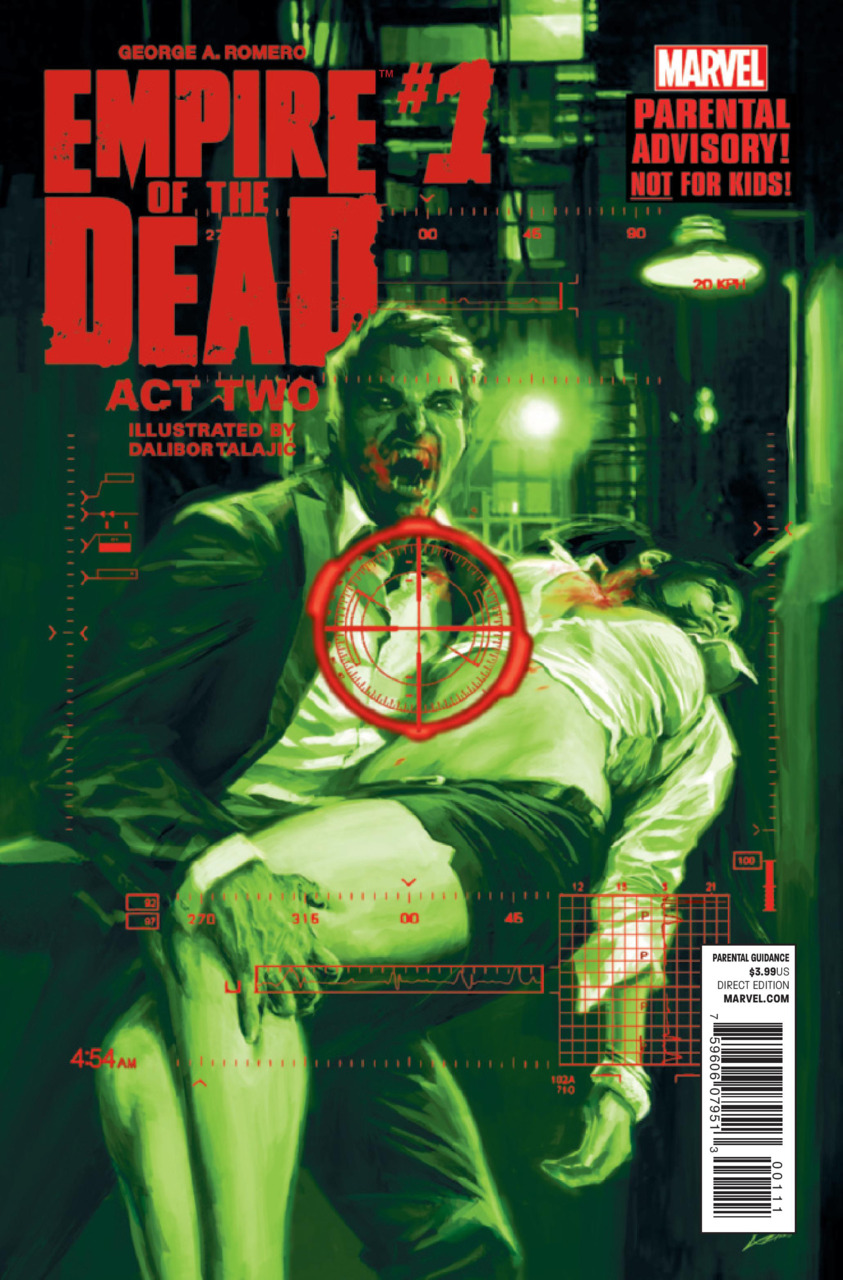
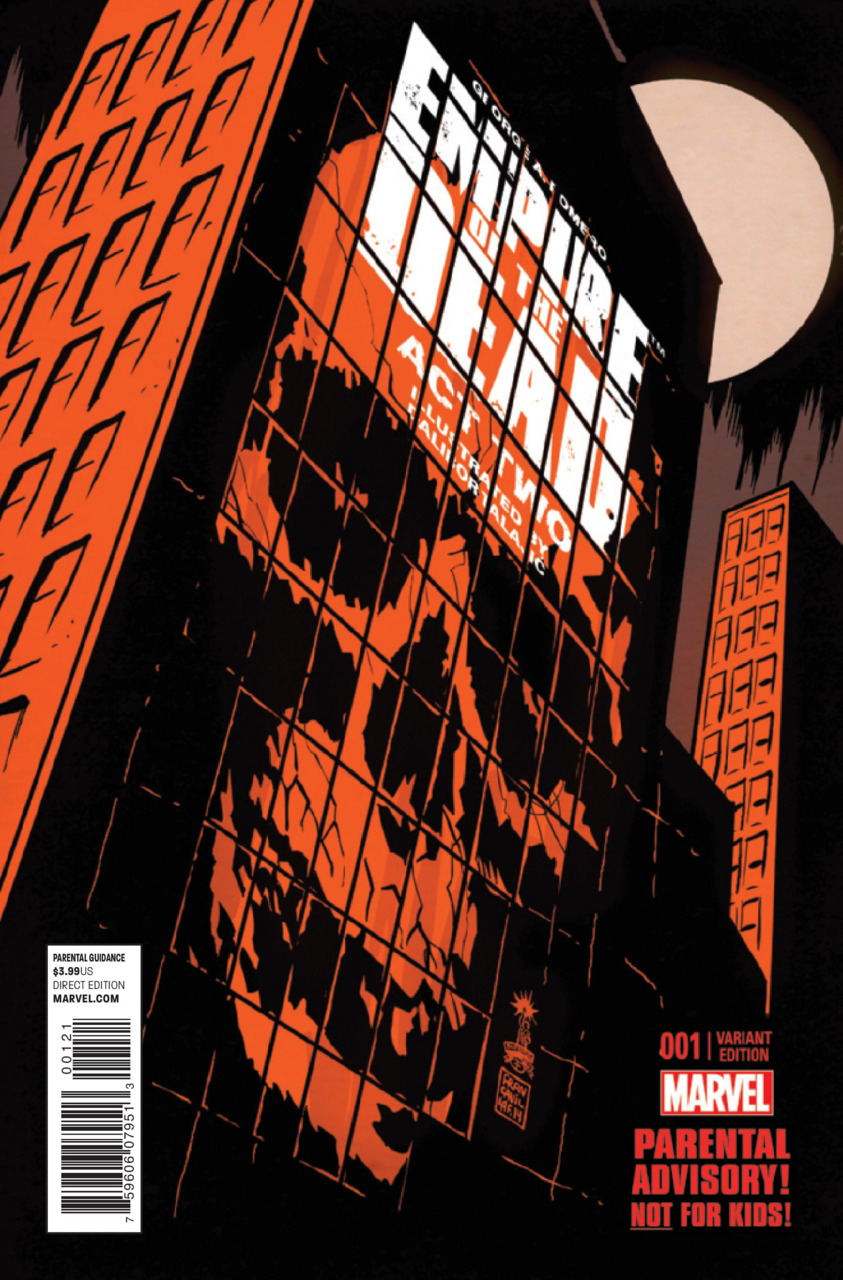
There’s also been a change of artists for the variant covers, but again, this is no problem in my estimation. Yes, Arthur Suydam’s “NYC” cover series was a blast, but when you’ve got Francesco Francavilla stepping up to the plate in his absence, well — who’s complaining? This guy has been one of my favorite cover artists for years now (have you seen the incredible work he’s been doing on Dynamite’s new Twilight Zone comic?), and my only gripe about his alternate cover for this issue (as shown below) is that my LCS didn’t get a single copy of it, otherwise you can bet that I would’ve snapped it up pronto.

4088277-01-variant

On the story front, I’m pleased to report that Romero is continuing the steady roll he’s been on since the fourth issue of Act One which is when, for my money, things really started kicking into another gear. As with most first issues (although whether or not this can actually be considered a “first” issue is debatable, I suppose), we’re in “pure set-up” mode here, but the payoffs to the various storylines that are running look like they’re going to be big, provided the father of the entire modern zombie revival doesn’t drop the ball. Semi-intelligent “walker” (whoops, wrong comic) Xavier seems to be making a quantum leap forward in becoming “civilized” under the tutelage of Dr. Penny Jones, and has formed a real emotional bond with her wayward young friend (whose name, in case you’d forgotten — as I admit I had — is Jo), and shares a secret with her that most likely will shake the entire series to its core. Dr. Jones, for her part, seems to be torn between responding to the romantic advances of the vampiric Mayor Chandrake and his head “zombie wrangler,” Paul Barnum, but rest assured there’s more to that situation than meets the eye — Barnum hints that he’s keeping a pretty big secret himself, and the Mayor, while not one to lose any sort of contest (and he drops some ominous threats to that very effect), may be forced to devote more of his attentions elsewhere, as the campaign to unseat him currently being waged by his nephew, Billy, seems to be gaining some traction. But is Billy really driving this train — or is he being set up for a spectacular “crash and burn” come-uppance?

And speaking of being set up — what of southern rebel-rouser Dixie Peach and her newly militarized entourage? A major development occurs in this issue that may end up marking her as  expendable to her own cause. I admit that the timelines attached to some of these various plot-threads do seem a bit garbled, and probably could’ve benefited from an eidotr who was paying somewhat closer attention ( the Xavier subplot seems to have advanced by several days, if not weeks, as has the mayoral race, while the subplot involving Dixie Peach and her no-longer-quite-allies seems to be picking up more or less right where it was left hanging in Act One), but if that all sounds intriguing to you — and trust me when I say it is — then put your reservations about the change behind this book’s drawing board aside, and queue up for the rest of Act Two, because it appears it could be quite a memorable ride.


Agent of Time Variance Authority (TVA): when Exiles met What-If


Idea:
It sprang from my desire to see more of the Marvel Multiverse and make the Time Variance Authority an organization worthy of respect.  The hero will travel across various realities to eliminate threats and preserve the space-time continuum and multiverse.

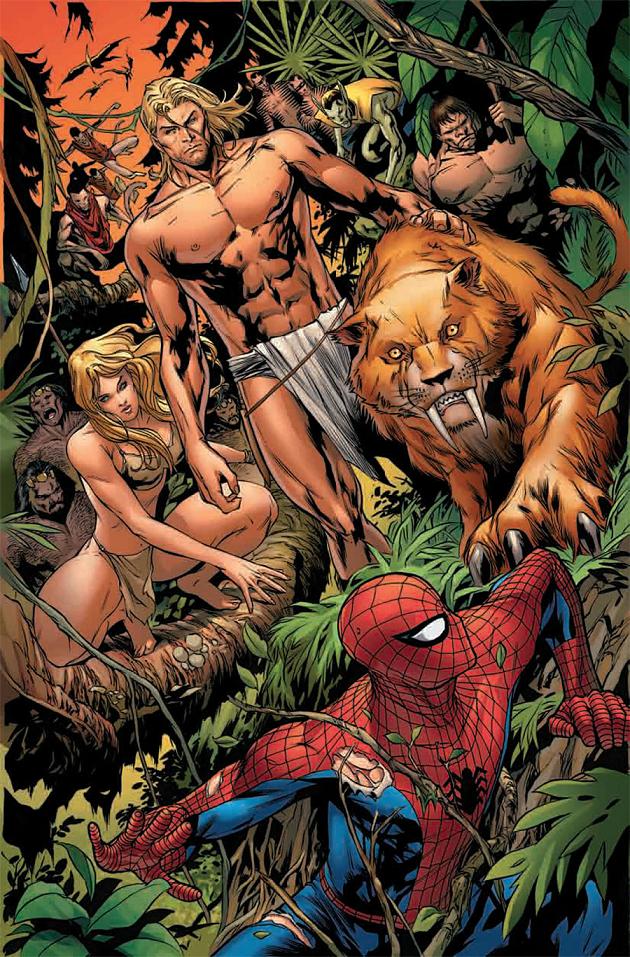
K’aang is a variant of Iron Lad (the teenage Kang the Conqueror) who is a greater fanboy than Iron Lad. He was able to become a distinct being from his future self, much like Kang separated himself from Immortus in Avengers Forever. He became a specialist employed by the Time Variance Authority and renowned for ending Cosmic Man’s inter-dimensional piracy.  He utilizes the spoils from his mission instead of his armors.

youngavengers5

Kang vs Iron Land (by Jim Cheung)

Paraphernalia:
Air Mariners are technologically advanced track cleats that grants flight through replication of Prince Namor’s flight mechanism.

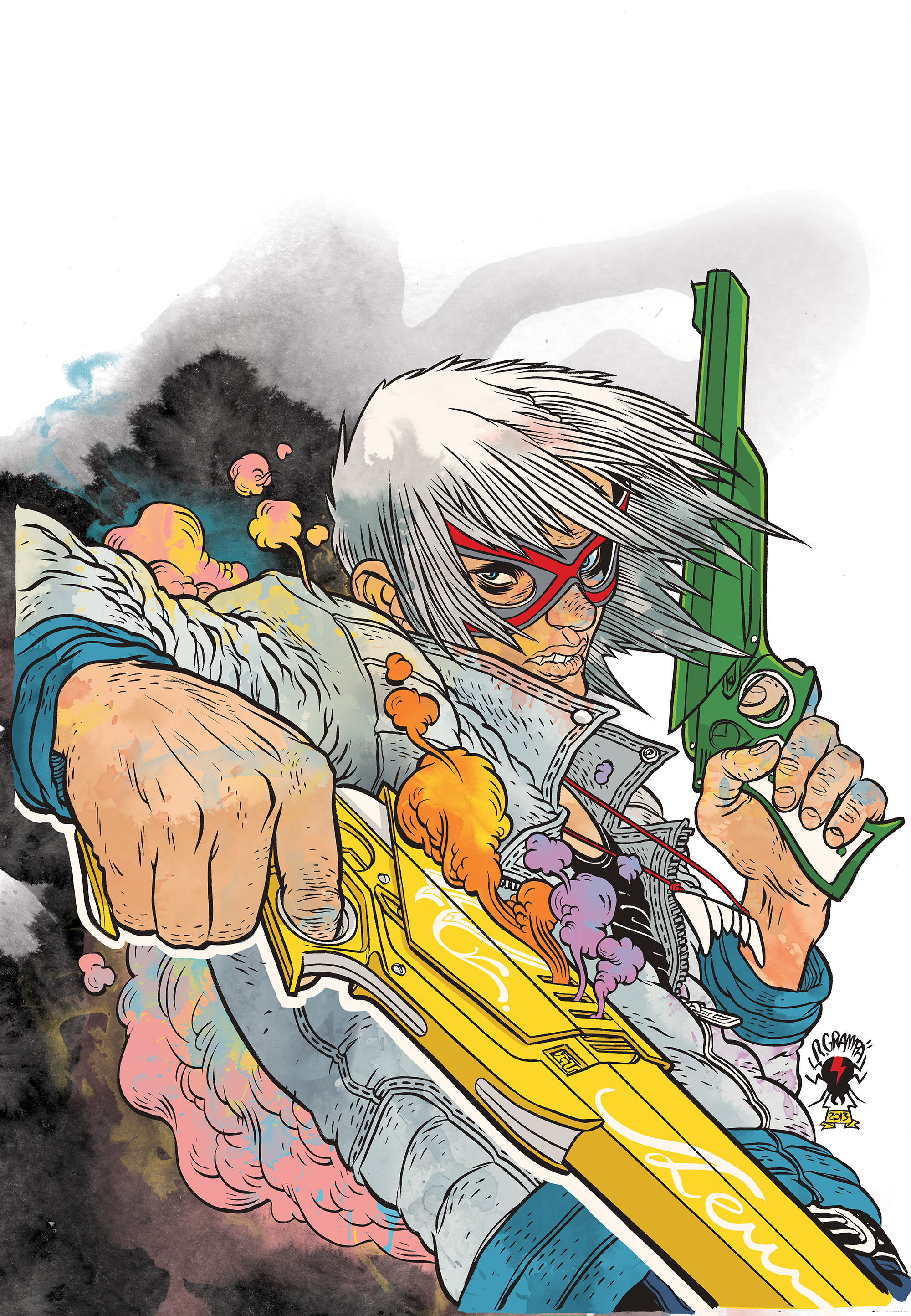
An Auric Blaster is a variable directed-energy firearm based on a Fantastic Foundation gun controller. It is equipped a Kurtzberg battery and a Skrull Flux Matrix.  (It resembles the golden blaster depicted by R. Grampa on the Killjoys cover).
Special Attribute:
It is fueled by the user’s belief and emotions.
Genetic and gravity locks prevent others from using the weapon.
Variable Emissions:
An Absolute Nullifier is a repulsor emission that neutralizes the posthuman targets.
A Dean Cutter is a potent laser with the same frequency as a Majesdanian photonic discharge.
A Hammond Flare is an incendiary plasma created by a modified Pyronano aerosol.
An Oberon Spray is an ionized stream of “pixie dust” (a hallucinogenic agent created from Wakandan toad venom).
Psyche Pulse is a psionic energy burst that causes great damage to organic and inorganic objects.
A Pym Pellet is a smart bullet derived Unstable Molecules saturated with Pym Particles. Its target lock feature possesses Z-axis manipulation to phase through any obstacle (civilian or barrier) to reach the target or increase its density to diamond hardness to penetrate armor.

11436746215_7d2c202bab_o

The Caliburn is a dagger fashioned from Zabu’s tooth and coated in Anti-Metal. It disintegrates metallic molecular bonds on contact.

A Doop Inventory is an ionic storage device that contains items within a simulated Doop Land (pocket dimension used by Doop to store things).

A Horizon Slugger is a refined Reverbium baseball bat with an embedded Schultz Vibro unit. It absorbs kinetic impact and oscillates at a frequency that generates concentrated blasts of air.

An Oubliette Sigil is a ring-like data transmitter that implants custom traits into the wearer.
Skills:
Psychometric mastery of any weapons he touches
Adept in multiple human and alien martial arts.
Fluent in numerous Earth and alien dialects.

The Thunderer is Zabu’s tooth fashioned into a dagger and molecularly bonded with Uru. It generates and tactilely discharges tetrawatt voltage.

Wall Crawlers are a custom pair of sneakers with Vibranium soles that enable the user to scale any flat surface.

Zabu Cloak is thethe chemically treated pelt of Ka-Zar’s animal companion. It is bulletproof.

prv338_pg5

(Zabu the sabertooth by Greg Land)

“Empire Of The Dead” #5 : George Romero’s Grand Chessboard Finally Comes Into Focus


3898437-05

If it seems like it’s been awhile since we looked at a new issue of Empire Of The Dead around these parts, that’s because it has — the fifth and final segment of the first arc in George Romero’s printed-page zombie epic (officially titled in the copyright indicia as George Romero’s Empire Of The Dead Act One #5) is a good few weeks late in maintaining its purportedly monthly schedule, but now that it’s finally here, let’s not waste any more time, shall we?

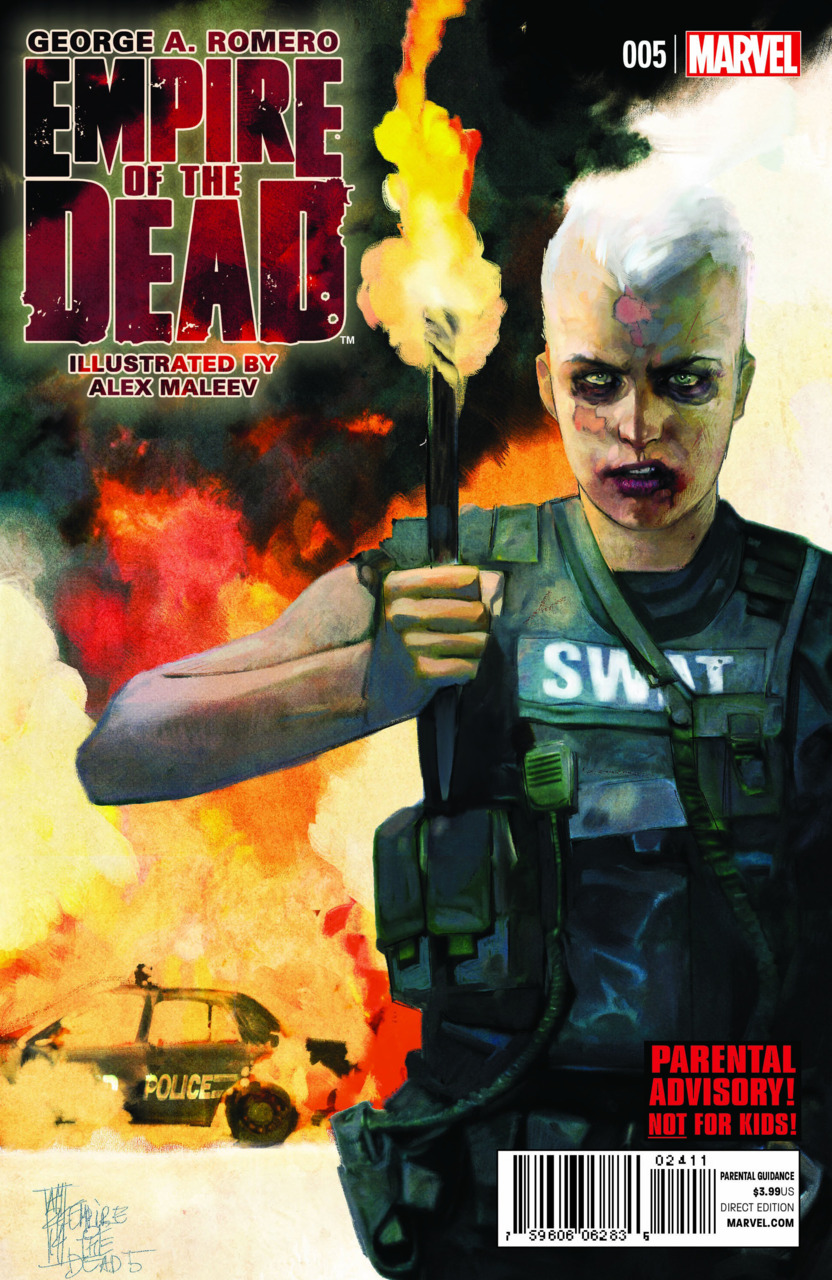
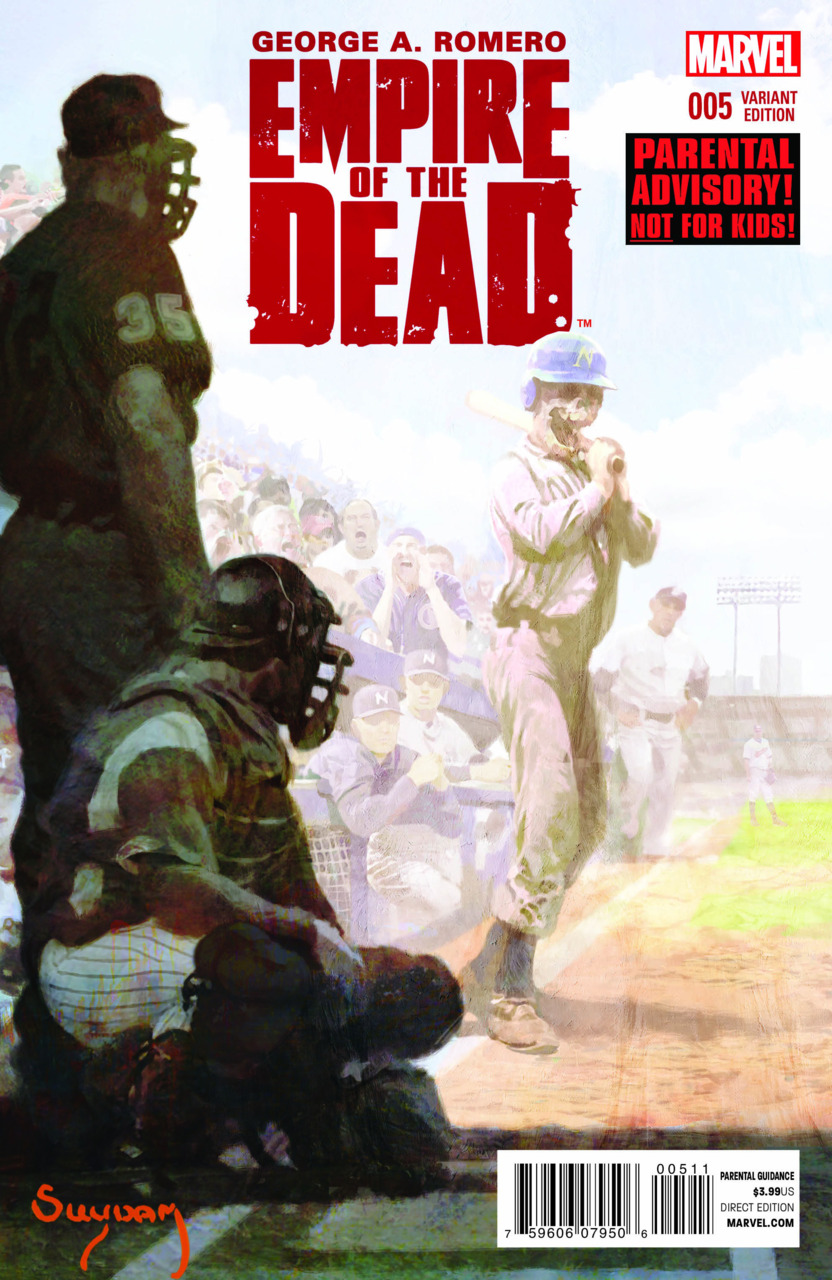
I’ve remarked previously about how this first arc seems more and more like pure set-up the longer it goes on, and I’ve wondered aloud about just how the father of the modern zombie genre was going to bring all the disparate subplots he was working on together in time for at least something resembling a decent climax by the time this issue was over, but I also stated that I still had an innate trust in our guy George’s storytelling ability and reiterated each time I felt like things were headed at least slightly off the rails that I was still reasonably certain that he’d find some sensible way connect all his metaphorical dots before the sand ran out in his equally metaphorical hourglass. As it happens, it seems my faith was not misplaced, because Empire #5 does exactly what you want all good “season-ending” stories to do : brings the overall picture into much clearer view while simultaneously whetting your appetite for the next new episode — and the TV “season” analogy probably isn’t a bad one here given that Romero and artist Alex Maleev (how ’bout that awesome cover he’s cooked up for this one, huh? Arthur Suydam’s “NYC variant,” as they’re known,  is reproduced a couple of paragraphs below) will be returning for their second five-issue “act” in September, right around the same time most television series begin their new episodic runs.

But damn — I don’t really wanna wait that long, ya know? Romero opens the action here in issue number five by delivering Xavier and her makeshift army of “smart” zombies right into the hands of Dr. Penny Jones and “trainer” Paul Barnum, and leaves us with one of his trademark ethical quandaries : will the marginally-more-intelligent undead horde be better off as lab rats, or fodder for coliseum death matches? Either outcome seems grim, and Romero seems to be taking the editorial stance we’ve grown accustomed to from him over the years : the real “monsters” here are the humans, and the zombies can’t win either way unless and until we butt out and leave them the fuck alone.

Palace intrigue is the other major order of the day here, and without giving too much away I’ll just say that the vampiric Mayor Chandrake’s sloppy-ass nephew, Billy, finally screws the pooch here and sees his recklessness get him cut off from the “family business.” Not to worry, though : unbeknownst to all, including Billy himself, this blood-drinking version of Fredo Corelone has friends in high places, who are distinctly unhappy with how his uncle is running the show and think it might be time for some new leadership in New York.

And speaking of friends in high places, it turns out that Southern hell-raiser Dixie Peach and her motley crew of social deviants and hell-raisers might just have some, as well — and they’ve got guns. Lots and lots of guns. And tanks. And bazookas. And grenades. And everything else an ambitious young sociopath might require for a fun night on the town. They’ve also got one thing Dixie herself doesn’t seem to possess — an agenda, and how she fits into that (as well as for how long) remains something of an open question as their siege gets underway on this issue’s climactic final page.

3898756-05-variant

If it seems like I’m pretty stoked at this point for act two, you’re absolutely right. My only real “beefs”  with this issue — and they’re comparatively small ones — are that Maleev’s art does, in fact, look a little bit rushed in some spots, and Romero’s dialogue veers into ever-clunkier territory as things progress. Don’t get me wrong : on the whole the visuals are still quite striking and perfectly suited to the story, but especially for a book that a good 3 or 4 weeks late, I’d expect more consistently-good-looking panels, and Maleev looks like he was cranking it out in order to meet his deadline (not that he made it) in several places here. The dialogue thing is both more excusable and less : obviously Romero had to get a lot done in a short amount of time here, so overly-expository “info-dumps” are to be expected, but if he’d paced himself a bit better earlier on (remember what a complete waste of time, story-wise, the second issue, in particular, was?) he might not find himself as hard up against the wall as he does here.

Overall, though, I can’t claim that these two factors, important as they are, detracted too much from my overall enjoyment of this issue. Nine out of ten of Maleev’s images still look amazing, and events in the story aren’t just moving at this point, they’re flat-out steamrolling. I would expect that Marvel will be issuing a trade paperback collection of this initial run sometime fairly soon in the weeks ahead, and this will probably prove to be an even stronger and more cohesive read in that format, so if you haven’t been following this series in its monthly (-ish) installments, that will give you a good opportunity to get caught up before the next series gets rolling.

Bring on September already!


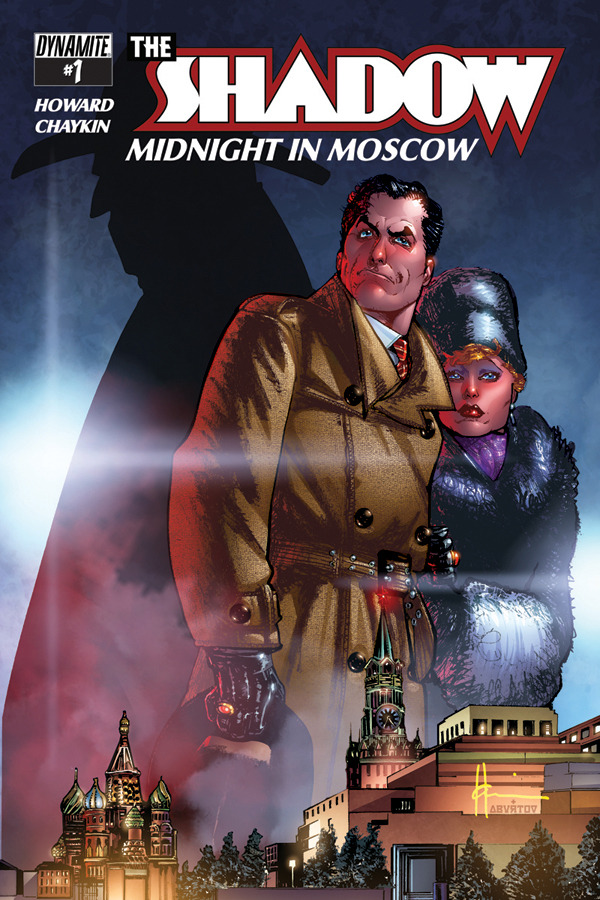
Chaykin’s Back! Need I Say More? “The Shadow : Midnight In Moscow” #1


3833259-01

Believe it or not, friends,  for a guy who has something of a reputation for being a curmudgeon, sometimes I’m so goddamn happy that I don’t have a care in the world. Seriously. Life can be just perfect, regardless of whatever else is going on. Let me tell you why today was just such an occasion.

I went to the comic shop — it’s new comic Wednesday, so nothing unusual about that — and there it was : the first issue of Howard Chaykin’s The Shadow : Midnight In Moscow from Dynamite Entertainment, the long-promised six-part series that sees one of the masters of the medium return to the character that he single-handedly re-defined nearly 30 years ago in the pages of the instantly-legendary The Shadow : Blood & Judgment, And ya know what? It feels like he never left.

Probably because, in a very real sense, he never did. And I’m not just referring here to the numerous variant covers that he’s provided for other Shadow books since Dynamite acquired the character’s license, I mean that Chaykin has cast a long — errmmm — shadow over the classic pulp icon ever since his one and only outing as his writer/artist, and even though there have been some terrific Shadow stories told by other creators since — Andy Helfer and Kyle Baker’s 1908s series for DC remains a wickedly subversive read and really stands out as an under-appreciated gem to this day, and Garth Ennis had a nice run writing the erstwhile Mr. Lamont Cranston’s exploits in recent years for Dynamite — the fact remains that the the only reason the property endures to this day at all is because of Chaykin’s four senses-shattering issues all those years ago. The rest, including the Russell Mulcahy film? All aftershocks from the main event, dear reader.

Chaykin himself’s done plenty of first-rate work since, mind you — his recently-concluded and criminally-overlooked Buck Rogers mini-series for Hermes Press is a great “jumping-on point” for those of you who may not be too terribly familiar with his work — and he even enjoyed a fairly successful TV writing career for several years (most notably on the original The Flash series for CBS) before returning to comics, but I always hoped, no matter how far afield he traveled (figuratively speaking, of course) that one day he’d come back. And now he has. And like I said, life’s pretty much goddamned perfect.

28642Moscow01_page1-xlg

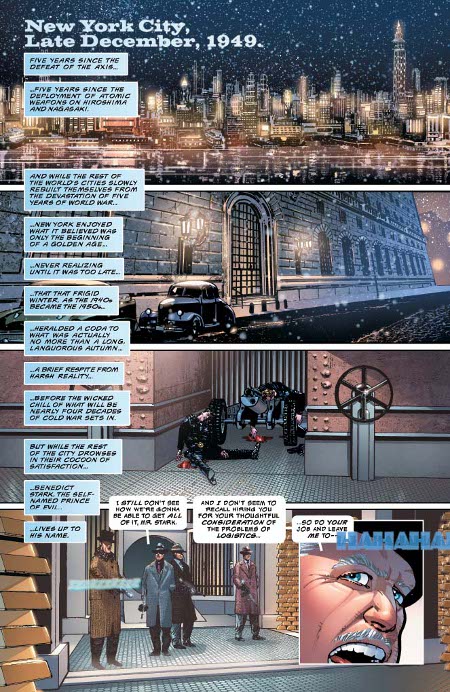
Not that the book is, mind you, but so what? It’s plenty awesome as first issues go, and even though Chaykin’s pencil and ink work isn’t as tight as it once was, and his writing is somewhat wordy by today’s increasingly-devalued standards, it’s still the best thing on the racks this week by far, and would be just about any week. Like any opening salvo, the main thing Chaykin’s gotta do here is set up mood and atmosphere, and he does that with just as deft a hand as ever, despite this series’ shift back into the past.

I suppose a few brief historical notes are in order here, though, before I leave anyone in the dust : Blood & Judgment, you see,  brought The Shadow into the (then-) present day for the first time in decades, and while that made long-time fans nervous, there was no need to worry — Chaykin, fresh off a highly-touted run on his groundbreaking, creator-owned independent work American Flagg! was more than ripe for the challenge of updating a character that had, essentially, never been updated, and he captured the dark charm, mystique, and righteous vengeance at Lamont Crantson’s core immediately. His series was laced with violence, a smattering of sex, and plenty of sardonic “gallows humor,” and by the time it was over, everybody was happy. I’ve honestly never met anyone who’s read that book that doesn’t love it.

So when it was announced that Midnight In Moscow would be taking us back in time — and not to the 1920s/30s, the era where most Shadow stories are set, but to 1950 (to be specific, the story actually begins on New Year’s Eve 1949) —  a lot of people were, once again, perplexed. Not your humble reviewer, though : I figured Chaykin was doing what he’s always done best — exploring uncharted territory. We’ve never seen a Shadow adventure set in this time period (at least not in comics), so here, I figured, would be a chance to find out what he was up during some of those “missing” years. So far, Chaykin’s typically daring move seems to be paying off, as the future that we know is coming hangs over the proceedings here like, in the words of the late, great Stuart Adamson, “a blanket on a cage.” The “Big War” is over. The Cold War is looming. And in Chaykin’s view, that might be an even scarier proposition. So why is The Shadow choosing now as the time to —- oh, never mind, I won’t spoil it. Just wait for the last page.

28640Moscow01_page4-xlg

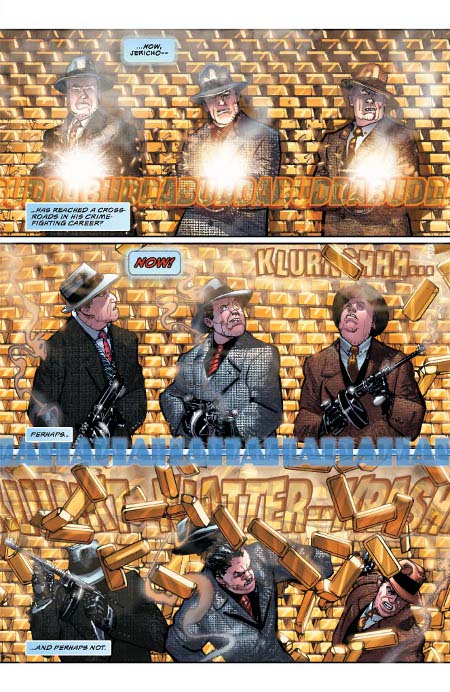
I’ll tell you what, though, friends —  before you get to that last page, it’s gotta be said that every page of this book oozes foreboding. While the main details of the plot are still sketchy — in brief they seem to revolve around a scheme to “atomically shrink” gold to make it easier to rip off and transport — you can bet we’re only just scratching the surface of what’s sure to be a complex plot here. Don’t ask me what the soon-to-be-blackmailed scientist in London has to do with anything. Or why The Shadow himself appears to generally be laying low these days. Or what the hell Moscow even has to do with anything. But I trust that we’re not just in good hands here — we’re in the best hands.

And that extends beyond Chaykin himself. His colorist of choice in recent years is Jesus Aburto, who did an absolutely sensational job on Buck Rogers and appears ready and eager to top himself here, and his regular stalwart letterer, Ken Bruzenak, is back on the case, as well, which means that all those awesomely-stylized “HAHAHAHAHAHA”s haven’t lost any of their visual “oomph.” To those who ask what the hell difference a letterer makes, just take a look at the pages reproduced above and below.  As a matter of fact, they also serve as pretty solid evidence that the entire creative team here is firing on all cylinders.

28641Moscow01_page5-xlg


So yeah — the gang’s all here, from the Shadow and his best gal, Margo Lane (along with their team of crack undercover sleuths) on the page, to the stellar array of talent assembled to make those pages, and you probably couldn’t ask for a better take on the character from even his creator, the legendary Walter Gibson. This is a fucking event, people, courtey of a guy who belongs on the “Mount Rushmore of ’80s Comics Creators” right alongside Moore and Miller, and for folks who are most familiar with Chaykin for his recent (and superb) work as artist on Image’s Matt Fraction-penned Satellite Sam, it provides a chance to see why all of us old-timers have been raving about his writing, as well as his drawing, for so long now. For those pretty much unfamiliar with comics in general — probably the reason I posted this review up here rather than on one of the more comic-centric sites I write for — it’s a terrific excuse to to pop into your LCS and pick up a contemporary book from one of the most respected creators around, who’s back to doing what he does best. Seriously, right after Watchmen  and The Dark Knight Returns, Chaykin’s Shadow is it as far as revered mainstream comics from that decade we’re all still talking about  goes, and he immediately steps back into the character and his world with breathless ease here. Get in on the ground floor of this one while you can — there were only three copies left when I hit the shop just a couple of hours after it opened today, so you’ve been warmed — it promises to be one terrific ride.

“Empire Of The Dead” #4 : George Romero Continues Playing The Long Game


3775351-04

There’s no doubt about it at this point — the entirety of the first five-issue arc in George Romero’s Empire Of The Dead is pure set-up. Consider : with one more installment  to go in the opening “act” (the official numbering here being George A. Romero’s Empire Of The Dead Act One #4) we’re finally getting our first sustained glimpse at a character called Dixie Peach, somebody who, from all I’ve read about this series, is slated to play a pivotal role in the proceedings. Who exactly she is and what her motivations are remain a mystery — she and her crew have just come up to New York from Georgia and seem to be intent on causing mayhem as, I guess, a sort of “payback” for the Civil War, and get off to a pretty good start by killing a border crossing guard and shooting out a security camera — but nevertheless, four chapters into his story Romero finally seems to have all his chess pieces in place.

Not that we see all of them this time around, mind you. Mayor Chandrake’s nephew, Billy, is notable for his absence  (in fact the Mayor himself only makes the briefest of appearances here, when he attempts his “vampire seduction” act on Dr. Penny Jones before being cock-blocked — or maybe that should be neck– blocked — by Paul Barnum, who’s finally given something semi-meaningful to do in this issue), as is Zombie super-fighter Zanzibar, but there’s only so much you can cram into 20 pages, I guess.

Former SWAT cop-turned-zombie Xavier has the biggest part to play here in number four, as she befriends a homeless young girl and seems to adapt quickly to her new role as the child’s protector, further continuing Romero’s theme of “humanizing” the undead. That could prove to be an interesting relationship down the road. And the vampire power structure is laid out in more detail as we learn just how thoroughly their “curse” has penetrated every level of the city’s administration and political infrastructure. Plus, we get to learn what happens to vampires when they — get this — die (and yes, they do die under the rules Romero is establishing/expanding upon).

3775531-04-variant

With the second-to-last issue of the opening series being this heavy on the (sometimes clumsily-scripted, it has to be said) exposition, then, it’s fair to say that act one of Empire has laid its cards on the table : don’t expect a self-contained narrative here that can be read on its own apart from its forthcoming sequels. Romero’s following the “long game” strategy so fashionable at Marvel of late, probably best exemplified by Dan Slott’s Superior Spider-Man, which has essentially turned out to be a 31-issue mini-series setting the stage for Peter Parker’s return next week in the (yawn) new Amazing Spider-Man #1.

Not that I expect our guy George to take it quite that far, mind you — by the time we get through all five planned “acts” of Empire Of The Dead, I do believe —or at least hope — that we’ll have a fully-functional, start-to-finish, epic zombie story. But he’s building things very slowly, methodically, and carefully. If this were the work of somebody knew to the genre, I’d probably be a little more cautious about how little narrative progress had been made by this point, but you know how it goes with Romero : sooner or later every one of his plot threads ties together and we end up with a story that says more about “us” (humans) than it does about “them” (zombies).

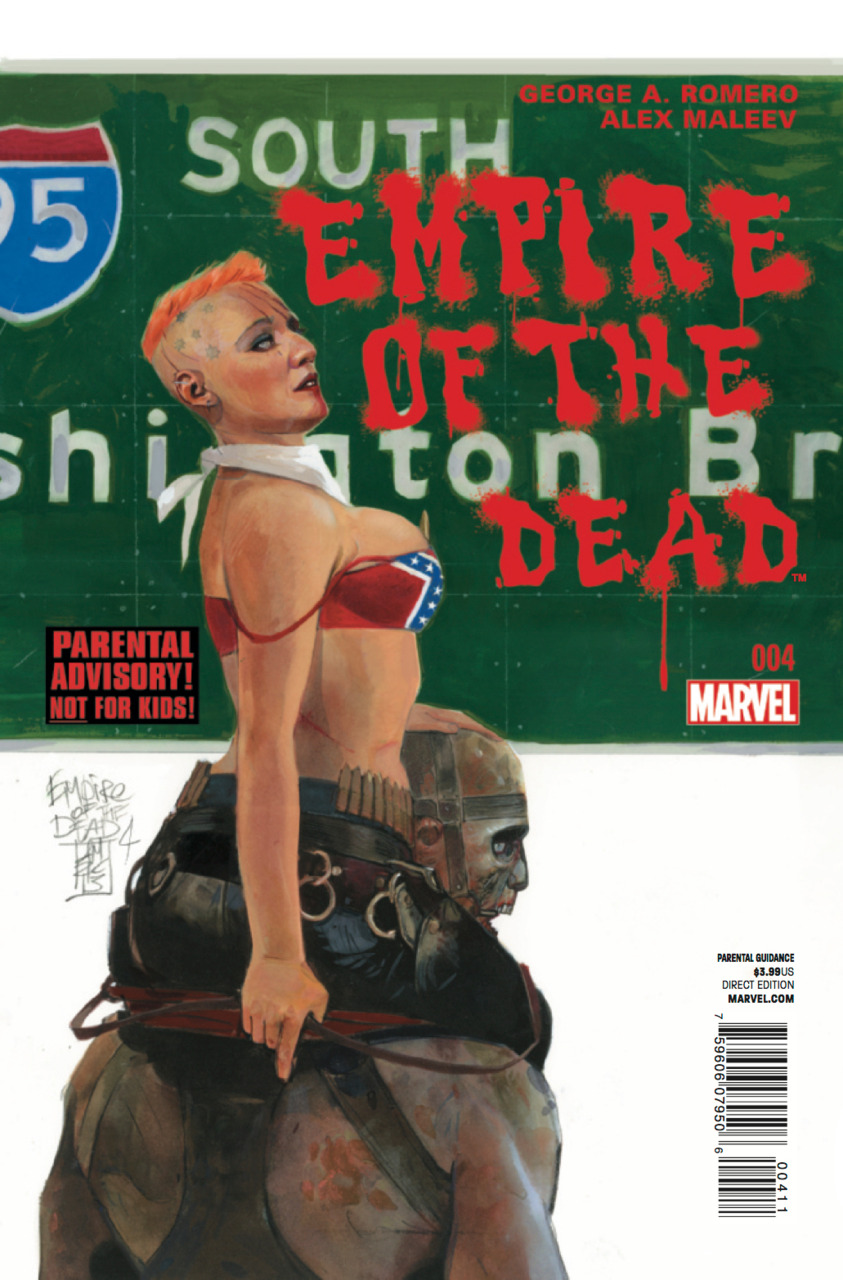
Alex Maleev’s art is enough to keep me coming back for more, as well (his main cover, and Arthur Suydam’s variant, being reproduced above, respectively,  for your edification). He’s just plain hitting it out of the park here, and seems to be gaining more confidence, and a better handle on the grim world he’s depicting, with each issue. I dare say he may even be surpassing the lofty standard he set for himself on  his legendary Daredevil run here. 21 more issues of images as flat-out awesome as those he’s giving us isn’t something I’m going to complain about in the least, and I’m sincerely hoping that the breaks between acts one and two will be a very short one indeed.