
by Lou Marchetti
by Lou Marchetti

by Lou Marchetti

by Lou Marchetti

by Lou Marchetti
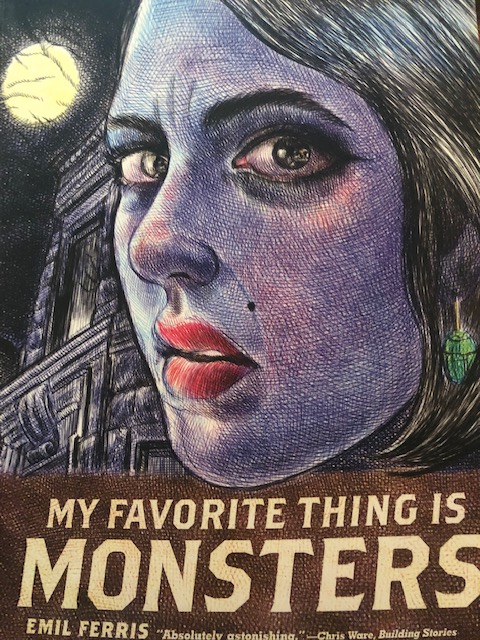
Happy Horrorthon! Have you ever read something so dark you felt unclean? My Favorite Thing is Monsters gave me that feeling. The reason I felt unclean is because the situations appeared to be based upon real events in Chicago in 1968 and earlier in Europe. Apparently, everyone in Uptown Chicago in the 1960s and in Germany from the 1920s-1940s was just a terrible person who preyed upon the weak, put their own needs first, and made foolish decisions.
Am I being harsh? No….No, I’m not. When a person can question you, “Didn’t the child being sold into prostitution plot sicken you?” and you have to respond, “Which time?” you wonder why this was written at all? Was Emil Ferris’ having an iced tea one summer and thought, “Hmmmm the world seems like it’s missing something….I got it! … the world is missing a murder mystery that revolves around terrible people who actually deserve to be dead.” By the last few pages, I was rooting for Chicago to be hit be a meteor- it’s the only way to be sure. I know … I know… but Case, so many people liked this book… how dare you buck the literary zeitgeist?! I write… tough! This book is beautifully illustrated, but straight up gross and a pain to read.
The central focus of the story is solving the murder of Anka who has a mysterious and dark past … and when I write Dark Past… I mean the absolutely worst life ever. Anka is the ONLY Holocaust survivor who is not sympathetic! Why?! Because in order to escape the Holocaust, she made a deal with a Nazi pederast to take 6 young children from the camp and force them into child prostitution and be raped by Anka’s Nazi pederast benefactor and other Nazis for the rest of their lives. Yes, that happened! This book was recommended by a parent whose daughter was friends with my daughter and she “loved it, it’s my favorite book”… ok, I’m never speaking with her again!
The plot begins with Anka’s body found in her apartment, shot in the chest, and with no forced entry. Karen Reyes, the ten-year-old main character, does not believe the police’s determination that it was a suicide. Therefore, Karen dons a trench coat and detective hat and gets on the case. By gets on the case, I mean Karen goes on a meandering journey of self-discovery and repeatedly ignores the two most obvious suspects: Anka’s jealous husband and her brother who is a part-time tattoo artist, murderer, who bedded Anka who was married (I should note: the brother bedded Anka while she was alive because this book would go there if it could and probably will in the sequel), and quasi-philosopher.
The book does have a redeeming feature: the art is beautiful, which is maybe a symbolic statement about the world itself; the world is beautiful, but the monsters (people) are the ones who make it ugly.
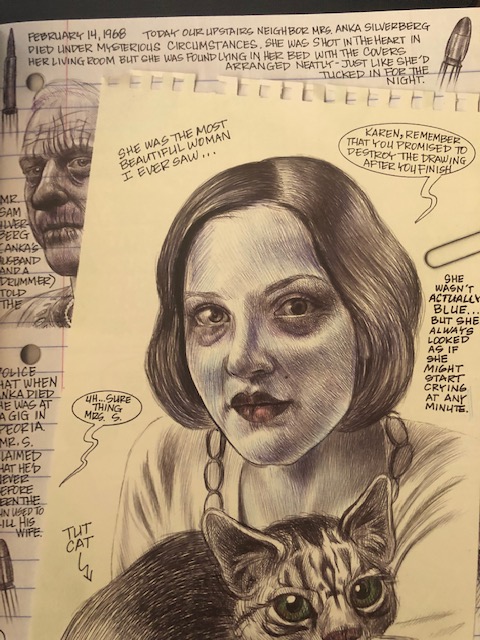
Karen sees the entire world through art and monsters and draws herself as a short werewolf in the story. She finds out more information about Anka – She was born in Germany shortly after WWI. Her mother sold her into child prostitution twice and Anka garnered a pederast benefactor Schultz who is described above.
Germany is described much like Chicago, an evil place filled with predators, who seek to dominate and murder for their lusts. My big complaint is that this behavior is never really judged harshly by the author; it’s matter of fact and without contempt.
Back in Chicago, her brother Deez would use his tattoos as a form of ownership over his female conquests. The most relevant conquest was Anka, who was extremely mentally ill by the time she moved to Chicago, but that didn’t stop Deez. He also liked to tattoo her back after he would take advantage of her sexually. It was beyond disturbing. Later, in the story, their mother gets cancer and needs medical care. Deez gets drafted, but doesn’t go. You’d think he would accept the draft because it would give his family greater stability, nope; instead, Deez continues down the road of hedonism and violence. Then, I truly despise him.
The characters who are decent human beings are subjected to constant degradation, humiliation, and physical violence. The best thing about this book was that it ended. You don’t even find out who killed Anka for sure at the end of the book because apparently there is a hunger for a sequel for this. Maybe we should keep track of the fans of the people who enjoyed this book- light monitoring only. Who am I kidding?! ROUND THE CLOCK SURVEILLANCE!

by Lou Marchetti
Published by EC Comics, Tales From The Crypt is one of the most fondly-remembered horror comics books of the 1950s. The series actually began under the title International Comics and went through several other title changes before becoming Tales From The Crypt. A horror anthology series that was hosted by The Crypt Keeper, The Vault Keeper, and the Old Witch, Tales From The Crypt ran from 1950 to 1955 and was so popular with young readers that a psychologist named Fredric Wertham claimed that reading the comic book could lead to juvenile delinquency and other deviant behavior. The resulting moral panic led to a Congressional investigation and the adaptation of the Comic Book Code. It also led to the cancellation of all of EC’s horror titles, including Tales From The Crypt.
In the decades since, issues of Tales From The Crypt have been highly sought after by collectors and the comic book even inspired a television show on HBO. Below is a selection of the covers of Tales From The Crypt, the series that corrupted America’s youth.


It’s always interesting to see what used to be controversial.

by George Ziel

by Lou Marchetti

Artist Unknown
 Through the Shattered Lens