Thousand Years of Dreams Day 25: Stones of Heaven


Day 25’s dream-memory is called “Stones of Heaven” and it’s a tale that when looked into should remind people of their own lives.

This remembered dream-memory of Kaim’s explores the meaning of strength and weakness in humanity. In one end, we have people who dedicate so much of their lives to achieving perfection and discipline that they soon begin to shed the very humanity which gave them the strength to begin their journey in the first place. On the other side of the equation we have those who have failed in their own attempts to achieve something great yet from this failure (or failures) they’re able to gain a sort of wisdom which just reinforces their very humanity in the face of adversity and hardship.

Stones of Heaven

The waterfall lies deep in the forest, more than a day’s travel from the nearest village.

It is said to be a holy place.

In search of the divine amid the towering peaks, pilgrims stand beneath the plunging falls in their final ascetic practise.

The water of the falls is freezing cold.

All it takes is a momentary lapse of concentration, and the person is hammered down by the rushing water.

The pilgrims call this waterfall the Stones of Heaven.

Heaven is testing their mental and physical strength, they say, by hurling an endless stream of “stones” down upon them in the form of the powerful waterfall.

“And the stones have a mysterious power,” a former pilgrim says to Kaim with a pained smile. He himself failed in this final austerity, he adds.

“Different Stones of Heaven fall on each person. It’s as if they can see into your heart.”

“What do you mean?” Kaim asks.

“The burdens you bore and the dreams you dreamed in the secular world appear to you one after another.”

In his own case, he says, what came to him first were the voices of women.

“The water plunging down into the basin of the falls began to sound like women’s voices. Sweet voices whispering in my ear, voices sobbing, voices moaning in a lover’s embrace… an incredible variety. And for better or worse I knew every single one of them. Some I was thrilled to hear again, while others I hated remembering.”

“Meaning, you’ve gotten yourself into a lot of trouble involving women?”

“I have indeed. Not to boast or anything, but that was one battlefield I knew better than anybody. I survived, but I made a lot of women cry, and there were a lot of them I loved. My whole purpose in undertaking the austerities was to put that life behind me, but the Stones of Heaven know what they’re doing. In the final, final test, they go after your greatest weakness. If you waver the slightest bit, you’ve had it. The water slams you down, and your austerities are over.”

The man feeds a stick of kindling into the campfire.

“And I’m not the only one,” he continues.

“One fellow heard the voice of the mother he hadn’t seen since he was a little boy; another heard the voice of his dead child.”

“Is it always voices?”

“I wish it were. If you hold up through the voices, the waterfall’s mist starts changing into the shapes of people. You might see somebody who you hated so much in the secular world that you wanted to kill him, or it might be some loan shark you had to go into hiding to get away from.

One little flinch and you’re done for.”

This particular austerity can be performed only once. There are no second chances.

Someone who has persevered for a whole day and night but who fails in the end has no choice but to return to the secular world in defeat, as this man did.

“Not that it was easy for me to get on my feet again once I was back there, either.”

The man chuckles and calls out to a young pilgrim. Or, more precisely, to a young man who was a pilgrim until a few moments ago, but who has just now dragged himself up to the lip of the basin in utter dejection.

“Hey, young fellow, the campfire’s over here. I’ve got liquor to warm up your insides, and some fresh-grilled meat. Get a little of that in your stomach and you’ll have the strength to make it down to the village.”

The man now makes his living as master of the teahouse by the waterfall. Of course, pilgrims undergoing austerities carry no money with them, but the man is not expecting to become rich doing this work.

For bodies chilled by long hours of pounding under the waterfall, he provides a warming fire, food and drink, and sometimes even money to tide them over when they first go down to the village. Payment can be made at any time. The men can bring him the money after they have started to take in earnings again from the jobs they find in the secular world.

He sets no date for repayment. He takes no IOUs. He says he is fine with that.

“Aren’t there some who don’t pay at all?” Kaim asks.

“Of course there are,” the man says matter-of-factly. “But I think my running this teahouse has another kind of discipline for myself.”

“Another kind of discipline?”

“That’s right. The Stones of Heaven will accept only the strongest pilgrims, the ones unperturbed by anything. The role I want to play is to accept the ones who were broken by the Stones of Heaven – the weak human beings. I want to go on accepting the weakest of the weak. The kind who not only succumb to the Stones of Heaven but who even fail to pay for their food and drink afterwards!”

“That is your kind of discipline?”

“Exactly. It makes for a hard living, that’s for sure. I thought I was prepared to deal with cheats and weaklings, but there are a lot more of those than I ever bargained for,” he declares with a hearty laugh.

But then he quickly turns serious and says, “To tell you the truth, I think of this less as a form of discipline than as a way to get even.”

“Get even? With whom?”

“With those gods or whatever they are that keep hurling down their Stones of Heaven.

Human beings are weak – shockingly so, in the eyes of a God. But, I think, and this is not just because of what happened to me, that being weak is the best thing about human beings. Weakness can make us cunning, but it can also make us kind. Weakness can torment us, but it can just as easily be our salvation.

Don’t you see? If the gods are hurling down their Stones of Heaven just to make people aware of their own weakness – just to make us savor our own powerlessness – then I’d just as soon drop my trousers and moon them. I’ll slap my bare butt and say to them,

‘I’m not like you! I’m not going to punish human beings for being weak! I accept them for what they are, weakness and all!'”

The man feeds a new piece of kindling to the fire and says with a shy shrug, “I guess I got carried away.”

Kaim smiles and shakes his head as if to say, “Not at all.”

“Tell me, though,” the man goes on. “I see you’re a traveller, but you don’t seem to be a pilgrim.”

“You’re right, I’m not,” Kaim says. “I was trying to cross over the pass and took the wrong road.”

“Well then, as long as you’re here, why not give the Stones of Heaven a try? It’ll be something to talk about.”

“No, thanks,” Kaim says, smiling.

“Whats the matter? Afraid they’re going to show you whatever it is that shakes you up?” The man smiles and nods. “Can’t say I blame you, though.”

The man is mistaken about Kaim. He is not the least bit afraid of such a thing.

What scares him is the opposite prospect. That of not being shaken up. Of encountering in himself a person unmoved by anything at all.

“Anyway, it would be suicide to jump into the waterfall without preperation.”

“How’s that?”

“It’s freezing cold, for one thing. There’s even colder water bubbling up from a spring in the basin. Even the most well-conditioned person has to be careful and take time to accustom himself to the low temperature. If you go in all at once, it can stop your heart.”

The man jerks his chin in the direction of the falls as if to say, “Look at them.”

Two new pilgrims are preparing themselves for the challenge of the Stones of Heaven.

The men appear to be brothers. The older one kneels at the edge of the basin, splashing himself and massaging the cold water into his skin from foot- to heart-level. The younger brother is too impatient for that. He wants to jump right under the falls. The elder brother cautions him and takes all the time he needs to accustom himself to the water’s coldness.

He exudes the quiet power of one who has withstood the most rigorous training.

“Aha,” the teahouse owner says to Kaim, smiling. “we’re in for a rare privilege. I think we are about to see the first successful attempt in a long while.”

“You can tell?” Kaim asks.

“You can if you’ve spent as much time here as I have. The winners and losers are decided before the men ever step under the falls.”

Having completed his meticulous preparations, the elder brother enters the basin. Even then, the steps he takes are slow and cautious.

The younger brother follows him in, kicking up a spray with every step.

“The younger one is hopeless,” says the man with a sigh, adding another stick of kindling to the fire.

“I’d better get the liquor ready now,” he mutters to himself.

The brothers stand side by side beneath the pounding waterfall. The Stones of Heaven rain down upon them.

As the man predicted, the elder brother, utterly calm, stands up to the onslaught of images sent by the Stones of Heaven.

Also as the man predicted, the younger brother yields to the Stones of Heaven and is beaten down into the basin of the waterfall.

But then something happens that goes far beyond what the man predicted.

Writhing in agony, the younger brother bobs helplessly in the basin, unable to rise himself.

He is drowning.

He tears at his own chest. His heart is failing. He was not fully prepared to enter the icy water.

“Help me, brother, please!”

But the elder brother doesn’t move. He remains under the waterfall in total concentration.

“Hey, what are you doing there? Hurry and help him!” the man yells, but the elder brother’s expression remains unchanged. He never flinches.

“He’s drowning! You can’t just leave him like that. He’ll die!”

The elder brother never moves.

He grits his teeth, keeps his eyes clamped shut, and shows no sign of moving out from under the waterfall, as if to declare, “This is it! This is the final test of the Stones of Heaven!”

The man screams at him, “You idiot!” and dives into the rolling basin in a rash effort to help the younger brother.

For the moment his untrained body hits the frigid water, the shock of it seizes his heart.

Still, he reaches out toward the drowning brother, who is sinking beneath the surface. A great shudder goes through him and with an enormous groan he takes hold of the young man’s wrist and pulls his limp body toward him.

He tries to return to the shore, but his strength gives out and he falls back into the water.

Next it is Kaim’s turn to dive into the basin beneath the falls. He takes hold of the two unconscious men and drags them toward the shore.

The tones of Heaven pour down on Kaim, and he is assaulted by one vision after another –

battlefields,

scenes from his wanderings,

shooting stars,

the climbing and sinking sun,

raging winds,

and countless deaths of those he has come to know on the road of his all-too-long life.

It will do you no good, he silently declares to the gods hurling the Stones of Heaven at him.

My heart remains unmoved. I have lived through a reality far crueler than any phantom you can show me.

Whether or not his life is a sign of his strength, he does not know. He will not boast of it, nor will he tell the tale to others.

He has, however, lived it; that much is certain. He has lived it through the years.

Kaim climbs onto the shore and lays the limp bodies of the teahouse master and the younger brother beside the fire.

As he warms himself, he thinks, The Gods who hurl the Stones of Heaven are inferior Gods.

If they could truly see into everything, they would never have been foolish enough to show Kaim scenes from his past. For what would disturb him most of all would be the unwelcome sight of moments from his own limitless future.

And if they were to ask him the simple question, “For what purpose were you born?” his knees would buckle in an instant.

The first to regain consciousness is the young pilgrim.

The teahouse master’s condition is critical. Kaim’s attempts to warm him and massage his clenched heart have little effect.

“Pull yourself together now! Look, we’ve got a fire here – the fire you built! Let it warm you!”

Kaim shouts into his ear until the man finally manages to force his eyes open a crack and move his purple lips.

“Is… is he… all right?”

“Sure, he’s fine, don’t worry.”

“Oh, good… good…”

“Pull yourself together, man!”

“Tell me, though… is strength the same as coldness?”

“Never mind! Stop talking!”

“Because if it’s true… if strength is coldness, I don’t want any part of it…”

The man gives Kaim a faint smile and closes his eyes.

He will never open them again.

Human beings are weak and fragile.

All it takes for a person to die is for a fist-sized organ to stop beating.

Human kindness, on the other hand, may derive from everyone’s profound awareness of the fragility of life.

Facing the teahouse master’s lifeless corpse, the younger brother hangs his head and cries. This weak man, defeated by the Stones of Heaven, sheds heartfelt tears for the man who saved his life.

His strong elder brother, meanwhile, is still being pounded by the waterfall, unfazed by the Stones of Heaven.

Surely his strength will be recognized by the gods, and he will bring his ascetic training to perfect completion.

Still, Kaim finds the tear-stained face of the younger brother beautiful in a way the stronger elder brother’s can never be, and he wishes that he himself could be moved like the younger man.

There was an unmatched nobility in the last smile of the teahouse master who gave up his life to save that of a complete stranger. Kaim wishes that he, too, could experience such feelings.

And what of my own face?

Living through a thousand years of life is not strength.

Yet, burdened with a life he cannot lose, will Kaim ever be able to change weakness into kindness?

This he cannot tell.

He can only live, unknowing.

He can only walk on.

He can only continue his journey.

Kaim looks at his reflection in the basin of the waterfall.

On the water’s heaving surface, he sees the trembling face of a lonely wanderer.
Thousand Years of Dreams Day 24: The Village Closest to Heaven


“The Village Closest to Heaven” is the Day 24 entry of this 33-day marathon of Shigematsu Kiyoshi’s short stories which make up the Kaim collection, He Who Journeys Eternity.

It’s a tale remembered by an immortal warrior who cannot die no matter if it’s natural causes or through war. He has experienced death in all its forms and yet he always remains the only one untouched by Death and remain to wander the world as the eternal warrior. It’s during one such stop in a village that he sees a people who doesn’t see death as something to fight against but something they’ve accepted as part of their natural order of things.

It’s this acceptance that has made each and every person in this village to live their lives to the fullest each and every day for no one knows if tomorrow their time will come for them to go to “heaven”. It’s a way of living that many nowadays would consider as crazy. Too much do people think that they can fight death and their focus and life has been consumed at doing just that they fail to live a full life. It’s only in the end when their struggle to fight off the inevitable has failed do they finally realized how much of their life they’ve wasted.

There’s a moral to this tale and that’s to live life to the fullest. Enjoy life and do it with those you love and care about. Worrying about things we never really have control over is a waste of the finite time we have.

The Village Closest to Heaven

In this village ringed by jagged mountains, the women give birth to many children.

Five or six is not uncommon. Just the other day, the wife of the village headman gave birth to her tenth child.

“And why do you think that is?” the young fellow asks the traveller, looking down at the snow-blanketed village.

Kaim cocks his head in search of an answer.

Meanwhile, the young man takes something like a piece of crystal candy from a small leather pouch. He pops it into his mouth and says with a laugh, “Because they die right away.”

“The children?”

“Uh-huh. Hardly anybody grows up to be an adult. Most kids die after five or six short summers. Look at the village headman’s wife; she’s lost seven kids already.”

Whether from a genetic problem or a disease endemic to the area, the people of this village have always lived short lives, he says, from way, way back.

“Now that you mention it,” says Kaim, “I haven’t seen any old people here.”

“See what I mean? A few decades ago, I’m told, one person lived to be fifty, but people say that’s the oldest anyone ever got in the whole history of this village.

This is why we give birth to lots of kids – give birth to a lot and lose a lot.

If just one of them lives into adulthood, though, the family line is saved and the village history continues. You see my point?”

The young man is sixteen, as is his wife.

Their first child is due to be born any day now – literally today or tomorrow.

The young man crunches down on the candy in his mouth. “Let’s get going,” he says, and around his wrists he winds the ropes he uses to pull the sled. He hasn’t loaded the sled yet, but dragging it up the steep, snow-covered road is hard work. This, he says, is why the pay is so good.

Only a few days earlier, he lost his good friend and fellow worker, who had been three years his senior. When Kaim happened along, the young man asked him if he would help by pushing the sled from behind until they cleared the pass. Kaim agreed, and they became an instant team.

Kaim circles around to the back of the sled and asks,

“You don’t have any animals to pull the sled?”

“Afraid not,” says the young man. “I know it’s strange, but our horses and cattle and donkeys all die young. You can spend a lot of money at the town market buying an animal, and it’ll keel over before it’s done a lick of work. Finally, the best way is for us humans to plow the fields and pull the sleds ourselves.”

The arms with which the young man himself is pulling the sled are massive, and he forges through the road’s snowy cover with powerful steps.

His fellow worker was stronger still, he says. “He taught me how to pull the sled, how to set rabbit traps, how to build a fire… all the skills I need to live, with all the love he would give to a kid brother. Before I knew it, he was gone.”

People here always die suddenly, he says. “They can be perfectly healthy one minute and drop dead the next. No time for suffering. Just like that. No time to call a doctor. Even if a doctor comes, there’s nothing he can do.”

“Did your friend die that way?”

“Uh-huh. He was shoveling the snow that piled up overnight, clearing the road, when he dropped dead. By the time we ran over to help him, he was gone. That’s how it always is. Always. That’s how they die. Grown-ups, kids… everyone.”

“And you, too, then…”

“I guess so. Nobody knows when the moment is coming. It might be decades from now, or it could be tomorrow…”

After this cool pronouncement, the young man turns to look at Kaim and, pointing to his own chests, says with a smile, “Or maybe even now.”

The smile is genuine, without a hint of despair or bitterness toward the cruelty of his fate.

“Aren’t you afraid to die?” Kaim starts to ask him but stops himself. It’s a stupid question, he decides, and one that he is not qualified to ask.

Where could a man burdened with eternal life find appropriate words to speak to a man burdened with the threat of sudden death?

Kaim and the young man keep dragging the sled up the steep mountain path. Their destination is the lake beyond the pass. The young man’s job calls for him to cut ice from the surface of the frozen lake and transport it back to the village.

“We in the village call the like the ‘Spring of Life’.

If you trace the source of the water that bubbles out of the ground here and there in the village, you will always wind up at the Spring of Life.”

Kaim nods silently.

“The ice from the Spring of Life takes forever to melt. That’s why, look, you can even do this…”

Again the young man takes a piece of the crystal candy – or, rather, ice – from his leather pouch and puts it in his mouth.

“It gives you energy. It’s indispensable when doing hard work or for pregnant women or infants. Just put a piece in your mouth and it gives you instant strength.”

The young man offers a piece to Kaim, who nods again in silence.

“We’re really not supposed to give any to outsiders, but you’re special ’cause I’m putting you to work. If I give it to you, though, I want you to help me load the ice on the sled. I can handle it by myself on the way back.”

Kaim silently accepts the ice from the young man, who assures him, “It tastes good, too,” and watches him, smiling. Kaim averts his gaze somewhat and puts the piece in his mouth.

The ice should be nothing but frozen water, but it has a mild sweetness.

Just as Kaim expected.

He spits it out when the young man is not looking.

Poison. I know that taste, thinks Kaim.

The village people are used to this taste, so they think nothing of it. Without a doubt, though, there is poison in the ice.

The long flow of time smoothes over the wounds inflicted by history. The permanently snow-capped peaks make people forget the existence of the wide world on the other side.

The young man calls this lake the Spring of Life, but those who lived far beyond the mountains, at the source of the river that feeds the lake, used to know it as the Pit of Death.

Long, long ago – several hundred years ago – the entire area around the river’s source was polluted with the poisonous metallic outflow from a mine.

The river was filled with dead fish floating belly-up, and the poisonous gas that rose like a mist from the ground killed both the earthbound animals and the birds in the sky.

The forests withered, and the lively town that had grown up with the development of the mine became a deserted ruin.

Nature took many years to recover, but the forests eventually turned green again, which attracted small animals and eventually the larger animals that hunted them.

People, however, never came back, and there was no one left to hand down the story of the tragedy that occurred at the river’s source deep in the mountains.

The only one who knows everything that happened is Kaim, the man who has lived a thousand years.

The young man stands by the frozen lake and takes a nice, satisfying stretch.

“You know,” he says to the traveller, “I sometimes think this village might be the closest one to Heaven in the whole world. Perhaps it’s because we are too close to Heaven that we’re all summoned by the gods early on. Don’t you think that might be true?”

Kaim says nothing in response to this.

Over many years, this lake has accumulated the metallic poison that flowed into it from upstream. And over many years the poison that infiltrated the soil has mingled with the ground water, bubbling up in the spring water with which the villagers slake their thirst.

No one knows the exact chemical makeup of the poison, but at least it does not cause the villagers to suffer until, at the last moment of their lives, the accumulated poison suddenly takes its toll. This may be its one fortunate aspect. On the other hand, this might simply make the misfortune it brings all the more conspicuous.

“Still,” the young man says as he saws off a piece of ice by the shore,

“I do hope that the children my wife and I have will be able to live longer lives – say, if we have five, at least one of them will live long enough to grow up and have kids. That way, for me, it would be like finding some meaning in having been born into this world. It was the same for my father and mother, and my grandparents. They all had lots of kids and mourned the loss of lots of kids but managed to raise one or two to adulthood before they died. That’s what gives our life meaning.”

He wipes the sweat from his brow and puts another piece of ice candy in his mouth.

If I were to tell him everything I know, thinks Kaim, if I were to tell him everything that had been buried in the darkness of history, and if he were to tell the other villagers, the tragedy might not have to be repeated.

The young man says, “When a baby is born here, they ring the village bell. Also when someone dies. The same for both; birth and death are like two sides of the same coin. So there’s no sadness when someone dies. Everybody sees them off with a smile and a wish; ‘You go ahead of us to Heaven and save a good spot there for us.’ Do you understand that sentiment?”

“I do,” says Kaim. “I do.”

“That’s how we’ve always done it; welcoming lots of new lives to the village and sending lots of lives off to Heaven. I’ve never been much of a student, so I don’t know exactly how to put this, but I kind of think maybe ‘the village closest to Heaven’ is a place where life and death are right next door to each other.”

The young man gives Kaim an embarrassed smile at the sound of his own words.

“Maybe it’s because I’m about to have a kid of my own that I’m starting to think about these complicated things.”

“No, that’s fine, I see exactly what you mean,” Kaim says.

The moment the words leave his mouth,

a bell sounds from the foot of the hill –

several long, slow rings.

“That’s it!” exclaims the young man. “My child has been born!”

He dips his head and says again, as if savoring the sound of his own words, “My child!”

While the bell is rung likewise for births and deaths, the young man says, the sound in each case is subtly different. When a young villager learns to tell the two apart, he or she is considered to be an adult.

“I hope this one lives a long time…” the young man says, choking with the flood of emotions that show on his face, but then he goes on as if to negate his own hopes for the future;

“Either way, whether it lives a long time or not, my child has now been born into this world. That’s all that matters. I’m so happy, so happy…”

Eyes full of tears, he turns a beatific smile on Kaim.

And then-

Still smiling, he collapses where he stands.

Kaim lays the young man’s corpse on the sled and returns to the village.

As the young man said, the villagers accept his death with the same smiles they had for the birth of his baby.

Death is not a time for sorrow. It simply marks whether one has been called to Heaven earlier or later.

The young man’s wife takes an ice candy from the leather pouch he has left behind and places it gently into the baby’s mouth.

“I want you to grow up to be strong and healthy,” she says.

“Daddy is saving a wonderful place for you up in Heaven. But go there slowly, slowly… and until you go to Heaven, I want you to grow up here in the village till you’re nice and big.”

Her words have the gentle tone of a lullaby.

Kaim says nothing. If he is to stand unflinchingly for what is right, his silence may be a crime. But, burdened with eternal life, Kaim knows how suspect the “right” can be. Throughout history, people have fought and wounded and killed each other in the name of what they declared to be “right”. By comparison, the look on the dead young man’s face is tranquility itself.

The “village closest to Heaven” is filled with happiness indeed.

The baby starts to cry, its loud wailing like a celebration of the beginning of it’s own life, however short that life is likely to be.

Kaim leaves the village with a smile on his face.

The village bell begins to peal, reverberating with utter clarity through the distant mountains as if to bestow a blessing on the young man who lived life to the fullest with neither resentment nor regret.

And when this too-long life of mine draws to a close,

Kaim thinks,

I’d like to be sent off with the sounds of bells like this if possible.

Because he knows that day will never come, Kaim walks on, never stopping, never looking back.

His long journey is far from over.

Thousand Years of Dreams Day 23: The Ranking of Lives


Time to begin the third and final leg of this 33-day marathon and to usher this in will be the dream-memory simply titled, “The Ranking of Lives”.

It’s actually quite a coincidence that a dream-memory about a particularly virulent plague Kaim lived through in the past will come up the night before the release of the Steven Soderbergh film about a similar topic in his latest film, Contagion. The title of the memory Kaim remembers is also quite timely in that it brings to the mind my own country’s struggle on the idea of affordable health care for everyone. It’s a topic that has split the country between those who thinks this should be a necessity for everyone and those who think the government shouldn’t get involved in forcing such a plan to everyone whether they want it or not.

I try to remain silent about this topic when it comes up and will continue to do so here. I will say that the idea of ranking people’s lives in importance to the group, nation or state is an idea whose logic I do understand, but also one that is difficult for me to accept as a human being. It brings to mind the nature of the battlefield triage. In time of battle many soldiers and civilians will be wounded. It’s the level of their woulds which determines whether they get immediate treatment or pushed back to allow someone who needs the help more. Battlefield triage is a concept I do think takes the “ranking of lives” in a more humane fashion. Doctors and medics only look at the extent and level of the injuries. The patient’s standing in society both in the military and as a civilian don’t matter as much as whether the patient’s injuries need immediate attention. If their injuries are life-threatening, but can be mended then they go ahead of the line. If their injuries is not life-threatening then they wait.

Now, some will ask about those who are dying and whether they also get immediate help. It’s here that physicians must always make the toughest decisions. Do they take precious time and resources to try and save someone who is beyond saving or do they just help ease the pain and allow them to move on in relative peace? It’s a decision that not anyone can make and, for most of us, it’s something we’re glad we never have to make.

This type of “ranking lives” I can understand and accept, but it is still something that shouldn’t be easy to deal with.

The Ranking of Lives

A terrible epidemic is ravaging the kingdom.

The onset of the disease is sudden. Due to genetic or perhaps hormonal factors. It strikes only males. The victim experiences a high fever, a violent headache, and often a swift death.

The disease does have two hopeful aspects.

First of all, if an individual survives it, he need not fear catching it again: from then on he has immunity.

Secondly, an extremely effective medicine exists. If used preventatively or in the initial stages of the disease, the drug, a tablet made primarily from a plant that grows in the mountains, almost always results in a cure.

Does this mean people can relax, and that there is no need to worry?

Unfortunately not, for an ironic twist of fate is something that life tends to thrust upon people all too often.

The high-altitude plant used to make the medicine that is so effective in prevention and early cure is extremely rare, verging on extinction.

In other words, there is not enough medicine for all the kingdom’s subjects, only for certain people.

“Do you see what I mean?” asks Dok, a quiet man on patrol in the capital’s marketplace with his fellow military policeman, Kaim.

Sending his sharp gaze down one alley after another, Kaim responds “You’re saying they rank people to decide who gets the medicine?”

“Exactly,” says Dok.

“In deciding the rank order, they brand us as either ‘Subjects Indispensable to the Nation’ or ‘Other Subjects’.”

Capital military policemen will receive their medicine relatively early, which demonstrates their ranking as “Subjects Indispensable to the Nation.”

“I guess it makes sense,” Dok goes on, “If all of us were to keel over, order in capital would break down like nothing. We always have to be the picture of health as we patrol the city, right Kaim? ‘For the sake of the homeland,’ as they say.”

“I suppose so . . .”

“First the royal family gets the medicine. Then the royal guards. Third comes politicians, and then the financiers who run the country’s economy, the police and fireman, doctors, and finally us-the capital military police. There’s not enough to give it to just anybody.”

Dok all but spat out those final words, and asks, “What do you think, Kaim? Ordinary subjects are people, too. Is it okay to ‘rank’ them like that?”

In theory, Kaim should be able to reply without hesitation that of course it is not okay.

But, realistically speaking, he says, “There’s no way around it.” He averts his gaze from Dok’s as he hear himself saying these words.

“No way around it huh?” he mutters with obvious distaste.

“Maybe you’re right. Maybe there is no way around it.”

He sounds as if he is trying to convince himself, in fact it does seem to be the only means open to them.

“The folks here in the marketplace know about the disease, obviously.”

“Obviously.” answers Dok.

“If their fears get the better of them, they could riot at any time.”

“Absolutely.”

“We can just manage to keep the peace by patrolling the streets like this.”

“I know what you mean.”

“If we were to succumb to the disease, their lives would put them more at risk. If we can’t dose every subject in the kingdom, all we can do is think about how best to keep the harm or the impact of the disease to an absolute minimum.”

“I couldn’t have said it better myself Kaim. You get a perfect score. Good job!”

His words of praise carry obvious barbs.

Sensing their presence, Kaim falls silent. Underlying Dok’s sharp comments is not only the pain of biting saracasm but the sorrow of helplessness.

Two children, a boy and a younger girl, run past the men, laughing. Dressed in rags, they have probably come from the slum behind the market to gather scraps of vegetables little better than garbage.

Dok points to their receding forms and says,

“I’d like to ask you a question, Kaim.”

“All right . . .”

“Are those kids ‘Subjects Indispensable to the Nation?”

Kaim has no answer for him. Because he knows the right answer all too well, he can only lapse into silence.

Responding to Kaim’s silence with a bitter smile, Dok goes on,

“According to your logic, Kaim, if those kids fall sick and die. “There’s no way around it.’ Or at least capital police like us have a greater right to the medicine than those kids do. Am I right, Kaim? Isn’t that what you’re saying?”

Kaim could hardly declare that he was wrong.

Responding again to Kaim’s silence, Dok asks,

“Now don’t misunderstand me. I’m not attacking you. It’s just that everybody is indispensable to somebody. Even those kids. They may be just a nuisance to the state-poor beggars, but to their parents they are indispensable lives that must be protected at all cost. Am I wrong?”

What a kindhearted fellow, Kaim thinks, maybe too kind – to a degree that could prove fatal for a soldier.

From the direction of the castle comes the sound of the great bell – an emergency assembly signal to the soldiers patrolling the streets.

The medicine seems to have arrived for them.

“Let’s head back,” Dok pipes up, apparently emerging from his gloom,

“Let’s be good boys and take the miraculous medicine that’s going to save our lives and protect the kingdom.”

The sorrow-filled thorns sprouting form his words pierce Kaim through the heart.

It is the following day when Dok tells Kaim of his plan to desert.

“I’m only telling this to you Kaim,” he says when they are patrolling the marketplace again.

“I know the punishment for desertion is harsh. I’m not sure I can make it all the way, and if I’m caught, I know I’ll be court-martialed and executed.”

He has resigned himself to that possibility, he says, which is why he wants to make sure that Kaim knows the purpose of his desertion.

“I’m not betraying the country or the army. I just have to deliver . . . this.”

In his open palm lies the tablet that he was issued the day before.

“You didn’t take it?” Kaim asks, shocked.

“No, I fooled them,” he chuckles, immediately turning serious again and closing his open hand.

“You’re going to deliver this tablet?”

“Uh-huh.”

Dok holds out his hand now, pointing toward the mountains south of the capital.

“At the foot of those mountains is the village where I was born. My wife and son are there. He’s just five years old and he’s been sickly since the day he was born. If he gets the disease. It’s all over for him.”

“So you’re going to give him the medicine?”

“Do you think it’s wrong of me to do that?”

Transfixed by Dok’s stare, Kaim is at a loss for words.

Suddenly the gentle Dok’s eyes betray a murderous gleam.

“I may be a soldier dedicated to protecting the nation, but before that I am the father of a son, and before that I am a human being.

I don’t give a damn about the kingdom’s ranking of lives according to whether or not they are ‘indispensable.’

I want to save the life of one human being who is indispensable to me.”

Dok’s eyes take on added strength. They are bloodshot now, dear proof of his resolve.

“If I leave now, I can be back in the barracks by roll call tomorrow morning. I’ll come home as soon as I give him the medicine, so I’m asking you to do me this one favor: don’t cause any commotion until then.”

“No, of course not, but . . .”

“I’m not sure I can make it, but I am sure my boy will die if I just stay here. He’ll pull through if he has the medicine. If there’s even the slightest possibility of that. I have no choice: I have to take a chance.”

“They’ll kill you if they catch you.”

“I don’t care. I can die with pride, knowing I did it to save the life of the one person most important to me.”

“What if you get sick?”

“All I can do is leave it up to fate.”

Dok smiles.

Human beings can’t do anything about fate, but I want to do everything I can as a human being.”

This is why Dok has revealed his plans to Kaim.

“One more thing, Kaim. If they kill me or if I get sick and die. I hope I can depend on you to visit my village sometime and tell my wife and son what happened.

Make sure they know that I didn’t desert because I got fed up with the army. I did it to save my son’s life, which is something that is more more important to me than army rules and even more important than my own life.”

He will be satisfied as long as that message gets through, he says with a smile. Kaim has no way to reply to this.

Not that Kaim fully accepts everything Dok has said to him. He is convinced not so much by the man’s reasoning as he is overwhelmed by something that transcends reasoning: by the power of life, by the strength and depth of Dok’s desire to save a life precisely because it is something that will eventually be cut off by death.

“I’m going to make a run for it for it while we’re patrolling the marketplace. I’m asking you to look the other way. Tell them I dissappeared when you took your eyes off me for a split second.”

Kaim can do nothing but accept Dok’s plea in silence.

He sees that deep in the hearts of those who love, finite life is a place that cannot be entered by those who have been burdened irrevocably with life everlasting.

The two men reach the far end of the marketplace.

“All right then, sorry to put you through this . . .” Dok says.

He turns toward the exit and is about to plunge into the crowd when it happens.

A child comes bounding out the alleyway.

It is the same shabbily dressed girl from the slums who ran past the men yesterday, laughing. Today she is alone and crying her head off.

She looks around with wild eyes, and when she spots Kiam and Dok in uniform, she comes running to them, shouting. “Help! Help!”

“What’s the matter?” Doks asks.

She takes his hand and leads him into the alleyway as if to prevent the surronding people from hearing what she is about to tell him.

“It’s my brother!” she blurts out. “He’s sick ! He’s got a high fever and he’s shaking all over! We’ve got to do something or he’s going to die!”

Kaim and Dok look at each other.

“How about your parents? Don’t you have a father or mother to take care of him?” Kaim asks.

“What parents?” the girl retorts tearfully.

“They both died a long time ago. There’s just me and my big brother. Oh please help him, please!”

“But I was just . . .” Dok mutters, fidgeting, ready to run. He looks at Kaim with pleading eyes.

Kaim kneels and down and looks the girl straight in the eye. “When did his fever start?” he asks.

“Just a few minutes ago,” she says.

“We were leaving to pick up vegetable scraps, and he fell down . . .”

Only a little time has passed since the disease struck. He could be saved by the medicine.

But of course there is no medicine for slum children.

Judging from the girl’s wasted frame, her brother must also be eating poorly. The disease will almost surely ravage his malnourished body and snatch his life in a matter of hours.

The girl will not come down with the disease of course, but even if it cannot attack her directly, once she has lost the only other member of her family and has no one to take care of her, the tiny thing is bound to trace the same fatal path as her parents and brother sooner or later.

“Please help my brother . . . please!”

She clings to Kiam and Dok, huge tears streaming down her cheeks.

Kaim gives her a slight, silent nod. He rises slowly and reaches for a small leather pouch dangling from his sword hilt.

Before he can lay hold of it, he hears saying to the little girl.

“Don’t worry.”

Dok is holding out his hand to her, smiling gently.

In the palm of his hand is a tablet.

“Give this to your brother.” Dok says. “There’s still time to save to save him.”

The girl gives him a puzzled look and hesitates until he urges her.

“Hurry. Do it now!’

She reaches for it uncertainly and takes it in hand with great care.

“Hurry home, now!”

Dok says witha smile for her. the girl dashes off.

“Thank you! Thank you! Thank you!”

Her shrill, tearful voice rings out as she dissappears into the alleyway.

“I’m glad it worked out like this, Kaim.”

Dok says with a shrug and a pained smile. “So now I won’t be branded a deserter, and I won’t have to give you anything to worry about. No, this is a good thing.”

He sounds as if he is trying to convince himself. He even nods deeply in agreement.

Surely he cannot have done this without regrets, especially if his son at home should take sick and die.

His voice is calm, however, as he says. “I couldn’t help it. When I saw that little girl crying like that . . . I know my son would understand.” He gives himself another deep nod.

“Still, Dok . . .”

“Never mind. Don’t say a thing.” Dok cuts him off and squints towards the alleyway the girl ran down.

“There’s absolutely no rank order to lives. The only thing that matters is to save a life you see with your own two eyes.”

“I know what you mean.” says Kiam

“Just because I saved one slum kid’s life, there’s no guarantee he’ll grow up to be a credit to the nation.

Maybe all I succeeded in doing was prolonging the life of yet another drag on the state. Maybe after I get back to the barracks. I’ll start thinking of other people I should have save instead of him.”

“On the other hand, Kaim.” he says, interrupting himself and turning to look at Kaim as he considers yet another posssibility:

“On the other hand, I look at it this way, too. Maybe it is just a matter of innate human instinct to want to save the life before your eyes.

Maybe we learn those other kinds of ranking later: ‘for the nation,’ or ‘for the people, ‘ or even ‘for my son.’

I may have failed as a soldier or as a father. but I think I did the right thing as a human being.”

Dok stops himself there and starts walking without waiting for Kaim to reply. He might be trying to hide his embarrassment at his own tortured reasoning.

Seeing this, Kiam produces a laugh and calls out to to Dok as casually as if he were suggesting they go to the tavern for drinks.

“Hey Dok!”

“Uh-huh?”

“You forgot this!”

Now Kaim finishes what he interrupted before, reaching for the leather pouch tied to his sword hilt.

From it he takes a small pill.

“What? You mean . . .?”

“I didn’t take it either.”

Incapable of losing his life to a disease. Kaim has no use for the medicine to begin with.

Of course he has no intention of telling Dok about that. Even if he were to try telling him he had lived a thousand years, it is not likely that Dok would take him seriously.

“You have a family, Dok. Lives you’d give anything to protect.

That is a great thing.”

Now Kaim holds out a hand with a tablet in it the way Dok did earlier to the girl.

“I envy you,” he says with a smile.

“Wait, Kaim, wait . . . Hey, I mean you . . .”

“I don’t have a family,” he says, increasing the depth of his smile.

Responding to Kaim’s smile, with it’s mixture of sympathy and warmth. Dok silently accepts the tablet.

“Well now, would you look at that beautiful blue sky!” says Kaim.

“I think I’ll just stand here a while, looking up at it, not thinking about anything at all. This might be a good time for you to run home to your son.”

Kaim does as he says, looking up at the sky.

Before long, he hears the sound of footsteps running across stone pavement.

“Make sure you come back alive Dok,” Kiam mutters.

Kaim strolls along, looking up at the blue sky, until he dissappears into the marketplace crowd.

End

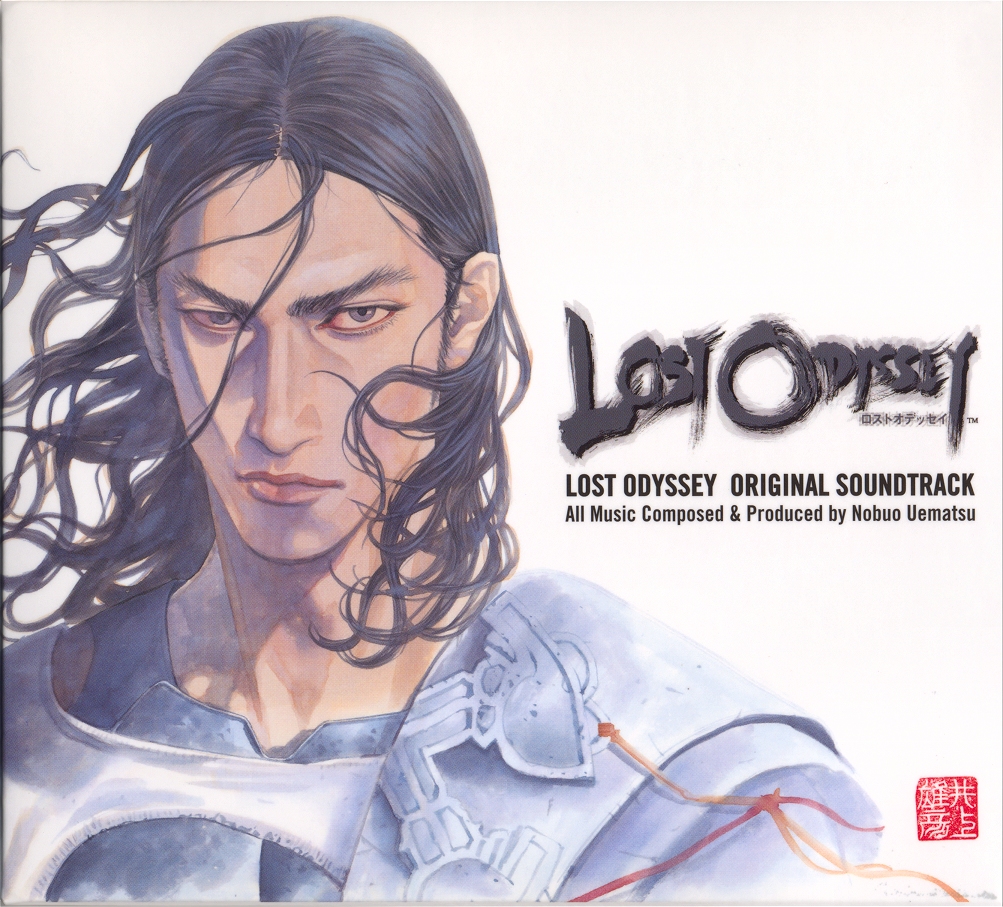
Song of the Day: Small Recollections (by Uematsu Nobuo from Lost Odyssey)


We’re now two-thirds into the 33-day Shigematsu Kiyoshi short story marathon and for the last third I decided to kick it off with my third favorite track from the Lost Odyssey soundtrack. The latest “Song of the Day” is the simple and playful tune “Small Recollections”.

This track gets used a lot in the game’s collected dream-memories. It’s usually used in concert with other music when the dream involves children Kaim has met through his 1000-year and more journey as the eternal warrior. I like this song for it’s simplicity. It’s a solo piece done on a calliope and made to sound like it’s coming from a child’s music box. It’s really quite a great use of this instrument and one I’ve rarely heard used in a soundtrack for a film or game.

It’s hard not to listen to this song and not think of the simpler times when one was a kid and the biggest worry in our mind’s was whether we’d get to eat ice cream, cake or both at a birthday party. “Small Recollections” is definitely something one can hear at a fair or a carnival and always something that would make one smile like a kid again.

Thousand Years of Dreams Day 22: Bright Rain


For Day 22 we get to experience another remembered dream-memory from Kaim, but this time around the innocent sounding title of “Bright Rain” gives way to something much darker.

Like most of Kaim’s dream-memories, this one uses the theme of war to give some insight to the eternal warrior’s personality. It’s through Kaim’s reminiscing that we get to know how he views how certain groups, states and nations find the excuse to wage war on their neighbors. Whether it’s to continue feeding one’s greed or to gain more power, the reasons always ends up with one powerful nation warring against it’s weaker and poorer neighbors.

We see this illustrated in a most tragic way through the innocence of a young boy who believes the bright rain to be something extraordinary and magical. The brutal truth of the matter is that it’s neither of those things, but instead the ever-widening circle of war dragging in more and more parties until the reason for why the war began has been lost to the devastation and death all-around.

There’s a saying that the first casualty of war is the truth. But going by this tale of “Bright Rain” I believe the first casualty of war is innocence.

Bright Rain

“The bright rain is going to start soon.” The boy says, pointing out to sea.

“The bright rain?” Kaim asks him.

“Uh-huh. It happens every night, way out there.” he says with a carefree smile.

“It’s so pretty!”

“Bright rain, huh?”

“Yeah. I want you to watch it with me tonight. It’s really pretty.”

The boy has never once left the island in the ten years since his birth.

The island is small and poor, and the only ways to make a living there are fishing from dugout boats and gathering forest fruits. One monotonous day follows another, the islanders waking at dawn and sleeping beneath the star-filled sky. The boy does not yet realize that this is the greatest happiness of all.

The boy begins speaking to Kaim, who turns to look in his direction.

Hunkered down on the beach in the moonlight, the boy in profile glows like a chocolate sculpture.

“Over there, where the bright rain falls, is a great, big island, right? I know all about it. That island is way bigger than this one and way more stuff goes on there and it’s just full of shiny things and pretty things and food that’s way better than I can even imagine, right? Don’t worry, I know all about it”

Kaim says nothing but gives the boy pained smile.

Beyond the horizon lies a big island, indeed – a vast continent. Kaim was there until four days ago. Then, rocked in the hold of a freighter for three days and nights, he crossed the sea to this island.

“I know about it, but I’ve never seen it.” the boy says, his voice dropping.

He hangs his head, diverting the moonlight from his face. His chocolate skin melts into the darkness.

“Would you like to go there?” Kaim asks.

“Sure I would.” the boy replies without hesitation. “All the kids here want to.”

“Everybody leaves the island, I suppose.”

“Sure they do! Boys and girls both. As soon as they’re old enough to work, they go to the ‘other country.’ Me, too, in another five years… I’ll be ready in three years. Then I’ll take the boat that you came here on and go to the other country and work hard and eat tons of yummy things.”

The boy raises his face again.

Locked on the ocean, his eyes are shining.

They are eyes full of hopes and dreams.

But they know nothing of the ‘other country’. He can never know a thing about it as long as he stays here.

Not one of the young people who crossed the sea, their eyes shining like the boy’s with hopes and dreams, ever came back.

“Of course not.” the boy would say. “The other country is so much more fun, there’s no point in coming back!”

The boy believes in the happiness awaiting him in the other country. about which he knows nothing.

Only when they leave the island do the brown-skinned people here learn that their skin is a different color from that of the people in the other country.

That the language of the island is of no use in the other country.

That the people of the other country look on the islanders with cold eyes.

That the only way for them to meet people with the same brown skin, the same language, and the same birthplace is to head for the island people’s ghetto in town.

The first words the boy was certain to learn in the other country’s language would be the ones the people of the other country used for people like him; illegal alien.

By the time he learned it, he would be tumbling down the hill in the ghetto.

The boy gallops away from the beach and returns a few minutes later with an overflowing armload of fruit. He says they grow where the wind from the ocean meets the wind from the mountains.

“They’re at their best on nights when the moon is full. Go ahead – have a taste.”

He wipes a piece of fruit against his worn-out shirt and hands it to Kaim.

“What do you call this?” Kaim asks.

“You’re going to laugh, they pinned such a fancy name on it: ‘Grain of Happiness’.”

“That’s a nice name.”

Kaim bites into a Grain of Happiness. It is shaped like an apple from the other country. But it is some two sizes smaller and just that much more packed with juicy sweetness.

“This is great.” Kaim says.

“You really like it? I’m glad.” the boy says with smile, but he is soon hanging his head again and sighing.

“I like them a lot too.” the boy says, “but I bet the other country has all kinds of stuff that’s way better than this, right?”

Kaim does not answer him but takes another bite of a Grain of Happiness.

The boy is right: there are lots of foods in the other country far more delicious than these Grains of Happiness.

Or, more precisely, there were.

Now, however, the other country has been transformed into a battlefield.

The war started six months ago.

That was when the boy began seeing the ‘bright rain’ every night.

The prosperity of the “other country” is extreme. The most glittering happiness is available there to anyone with enough money, and money is available there without restriction to anyone with enough power.

Might makes right.

Wealth makes goodness.

Those who are neither mighty nor wealthy obtain right and goodness by finding others who are both weaker and poorer than themselves and ridiculing, despising and persecuting them.

The island people, whose language and skin color are different from those in the other country, are seen as the other country’s shadow.

This is not a shadow, however, that forms because there is light.

The very existence of the shadow is what makes the light all the brighter.

This is the only way that inhabitants of the other country know how to think about things.

Eventually, however, strength reaches a saturation point, wealth that has run its course begins to stagnate, and expansion is the only course left open.

Desires can only be fulfilled through a continual bloating.

In order for the other country to remain strong and for the wealthy to stay wealthy, the leaders of the other country made war on a neighboring country.

“Any minute now.” the boy says, looking out to sea again with a carefree laugh.

“The bright rain is going to fall, way out over the sea.”

The war was supposed to have ended quickly. Everyone in the other country believed that with overwhelming wealth and strength, it would be easy for them to bring the neighboring country to its knees.

To be sure, at first war went according to plan. The occupied areas grew each day, and the entire populace of the other country became drunk with victory.

One after another, however, the surrounding countries took the side of the neighboring country. Which was only natural. For if the neighboring country fell, they themselves might be the other country’s next target.

The other country’s entire diplomatic strategy failed. Which was only natural. For no country on earth will make friends with a country that only knows how to flaunt its wealth and power.

An allied force was organized around the neighboring country. Together, the surrounding countries sought to encircle and seal off the other country.

From that point on, the war entered stalemate. Limited battle zones saw troops advancing and retreating again and again, in the course of which the other country’s wealth and power was consumed little by little. Disgust for war began to spread among the populace, and to obliterate that mood, the military circulated false propaganda:

The military situation is developeng in our favor.

Our army has again crushed the enemy’s troops.

The truth was that the occupied territories were being recaptured one after another, and the allied forces now were crossing the border to strike inside the other country’s territory.

I’n response to foolhardy attack by the enemy, our resolute fighting men launched a counterattack, annihilating their forces.

The day for our victory song is upon us.

Stopping war was out of the question. Admitting defeat was out of the question. The people had believed that wealth and power would enable them to rule everything, but now they knew the terror of having lost both.

The allied forces were joined by a powerful supporter. A mighty empire that wielded authority over the northern part of the continent joined the battle as if to say, “Let us finish job for you,” crushing the other country once and for all.

But the powerful empire was not satisfied just to destroy one upstart nation. It turned its overwhelming military might upon the allied forces. As it had so many times in its history, it seized the opportunity of its clash with the surrounding countries in order to further expand its own power.

Having lost its leaders and turned into a wasteland as far as the eye could see, the other country now became the new battlefield.

Outnumbered, the allied army hired mercenaries from other continents.

Kaim was one of those.

For many days he participated in losing battles in which there was no way to tell which side was fighting for the right.

After seeing his mercenary unit wiped out, Kaim headed for the harbor.

The boy’s island has maintained a position of neutrality in the war. It is simply too small to do otherwise. It lacks the war-making capacity to participate in battle, and it possesses no wealth to attract the attention of the countries engaged in the fighting.

But Kaim knows what will happen.

When the battle lines expand, this island will become valuable as a military foothold. One side or the other will occupy the island and it will do one of two things; it will construct a base, or it will reduce the entire island to ashes, thus preventing the enemy from using it as a military foothold. Nor is this a matter of the distant future. At the latest, it will happen a few weeks from now, and perhaps as soon as two or three days…

Kaim has come to island to convey this message.

To tell the people that as many of them as possible should board tomorrow morning’s regular ferry to the nearby island.

He wants them to start by sending away the children.

He wants never again to witness the spectacle of young lives being crushed like bugs.

“Oh, look! There it goes” the boy cries out happily, pointing toward the horizon.

“The bright rain!”

Far out to sea, a white glow suffuses the night sky. The powerful empire has begun its night bombing.

The boy has no idea what the bright rain really is. He can watch with sparkling eyes and murmur, “It’s so pretty, so pretty…”

To be sure, viewed from afar, the bright rain is genuinely beautiful, like a million shooting stars crossing the sky all at once.

But only when viewed from afar.

A dull thud resounds from the sky.

Another dull thud, and another and another.

“Thunder? Oh, no, if it rains we can’t go out fishing tomorrow.” the boy says with a smile and a shrug.

He’s such a friendly little fellow, thinks Kaim.

The boy had seen him on the shore and spoken to him without hesitation.

“Are you a traveller?” he had asked, and went on speaking to him like an old friend.

Kaim wants children like this to be the first aboard tomorrow’s ferry.

“I’m going home now.” says the boy. “What are you going to do?”

“Oh, I guess I’ll take a nap under a tree.”

“You can sleep in our barn. Why don’t you spend the night there?”

“Thanks,” Kaim says. “But I want to watch the ocean a little longer. Tomorrow, I thought, I’d like you to show me around.”

“I get it. You want to see the head of the village. I know a shortcut through the woods – right over there.” Kaim is hoping to convince the village head to evacuate the island. If they act right away, they can make it. They can save a lot of the islanders.

But…

As the boy stands, sweeping the sand from the seat of his pants, he looks questioningly at the sky.

“Funny.” he says, “It sounds kind of different from thunder.”

The dull thuds keep coming without a break.

Little by little, they draw closer.

Kaim jerks his head up and yells at the boy, “The woods! Run to the woods!”

“Wha…?”

“Hurry!”

His voice is drowned out by the deafening roar of the machine guns.

The bright rain has started.

The island has been made a target far sooner than Kaim had imagined.

“Hurry!” Kaim yells, grabbing the boy’s hand.

The woods are the boy’s only hope.

“Hey, wait a minute!” the boy shouts, shaking free of Kaim’s grip and looking up at the sky.

“It’s the bright rain! It’s falling here now, too! Wow! Oh, wow!”

All but dancing for joy, the boy gallops down the beach – until he is bathed from head to toe in the bright rain.

A single night of bombing is all it takes to reduce the island to ashes.

Never realizing the value of the happiness they possessed, never even knowing that such happiness has been snatched away from them in one night’s passing, the people who filled the island with their lives until evening are gone in the morning, all dead except one: the immortal Kaim.

On the beach at dawn, the only sound is that of the waves.

Again today, no doubt, urban warfare will decimate the city streets, and tonight the bright rain will pour down on the town again.

The boy who called the rain beautiful will never again open his eyes wide with wonder.

Kaim lays the boy’s corpse in a small dugout canoe that survived the flames.

He places a ripe “Grain of Happiness” on the boy’s chest and folds his arm over it, hoping that it will sate his thirst on the long road to heaven.

He sets the dugout in the water and nudges it toward the open sea.

Caught by the receding tide, rocketed by the waves, the boat glides far out from the shore.

Such a friendly little fellow, the boy smiles even in death. Perhaps it is the one gift the gods were able to bestow on him.

The boy is setting out on a journey.

May it never take him to that other country, Kaim begs.

Or any other country, for that matter.

Kaim knows; there is no place forever free of that bright rain.

Because he knows this, he sheds tears for the boy.

The rain falls in his heart: cold, sad, silent rain.

Emptied of bombs, the sky is maddeningly blue, wide and beautiful.

End


Thousand Years of Dreams Day 21: Seth’s Dream Part 2


Day 21 brings us the second part of “Seth’s Dream” and while this particular dream-memory has more to do with unlocking part of the mystery that is the immortal fate of Seth and Kaim it still continues the theme and subject of prisons of solitudes we make for ourselves began with Part 1.

This remembered dream by Seth works best when paired with playing the game. Of all the 33 dreams created for Lost Odyssey these two remain the weakest in terms of emotional impact just for the fact that they’re more game plot related than stand-alones.

Seth’s Dream Part 2

I know you probably hate me now Aneira.

Or perhaps, as the descendant of the noble white-winged clan, you harbour no such vulgar emotion as hatred.

Kind and gentle as you are, perhaps you have forgiven me. Perhaps you have accepted what I did, and now you pity me for being trapped in the prison of solitude again.

But still, good, kind Aneira, I insist on making one last, selfish request:

Please hate me.

Please hate me for eternity.

If I know that you hate me, I can remain connected to you.

If I know that you have not forgiven me, the pain of that will enable me to feel you close to me.

Are you laughing at my convoluted reasoning?

Then let me say it more simply.

I am lonely.

I fear eternal solitude.

That fear has been with me ever since I killed you with my own two hands…

Nine hundred years have passed since we first met.

In the conventional way, I took a husband. Even more conventionally, I gave birth to a son.

Soon after naming the baby “Sed”, my husband died in an epidemic. At his bedside, of course, I cursed the fate that would not let me die.

Had you not been with me, Aneira, I would never have been able to find the strength to raise Sed by myself.

You said to me, “There is no greater joy than for a child to be born and to grow up healthy.”

Fitting words from you, sole survivor of the winged clan!

You also said to me, “You will be all right, Seth. You are no longer alone. Now you have Sed. You will never be alone as long as he is with you.”

I nodded to you in tearful recognition of the truth of your words, and you went on with some embarrassment:

“Leave Sed to me, I will train him to be a full-fledged man of the sea. If anyone should dare to threaten him, I will protect him with my life.”

How kind you were, Aneira!

How truly kind!

Even now I can recall the carefree smile on your face when you were playing with Sed.

He was such a frail little boy, but you steeled your heart to train him sternly, and on those days when he had cried himself to sleep, I often caught you in profile, watching him in sleep, your face sutured with ineffable gentleness.

How glad I am, Aneira, that fate brought us together!

In my long, long, endlessly long life, I can declare without hesitation that you were my finest companion.

So why, Aneira, did events play out the way they did?

To this day, I have no idea why.

Do you know?

Did you know why those things were happening to you?

This is what I would like to know.

All the more so because I can no longer learn the answer. I desperately want to know it

It happened thirty years ago.

I said goodbye to you and Sed, and made my way to the Tower of Mirrors.

For the memory had come back to me: the mission on which I had come to this world; The task I had been sent here to accomplish and the reason I possessed: memories of a thousand years spent in this world.

I was a pirate who prized freedom above all. And what I enjoyed most of all was living widely on open sea. Exactly why I was so drawth to freedom, I myself did not know.

But, that was when I learned: deep in the heart of one who desire freedom lays the pain of freedom denied.

It was you, Aneira, who first taught me the expression “prison of solitude”.

And it was true: I was trapped in a prison of solitude.

Not simply, however, because I was confined in a cave on a desert island. For me, being in this world was itself a prison of solitude.

When I came to realize this, I headed for the Tower of Mirrors in order to return to the world I had come from.

Nourished by my thousand years of memories…memories of having lived in this world…I would return to the world where I belonged.

In the Tower of Mirrors, he was waiting…Gongora, the man with who I was supposed to return to my original world.

I had no way to knowing, however, that this was a trap that Gongora had set for me.

I can never forget how he stood there, spread legged and defiant, before the Tower of Mirrors, laughing that arrogant laugh of his. My stomach turns when I recoil his hateful face, and my flesh creeps when I think of his cunning, fearsome trap.

Gongora had no intention of returning to our former world. Instead, he hatched a fiendish plot to make himself ruler of this world, and anyone who resisted him, he crushed without mercy.

I was one of those who stood in his way.

As soon I learned of his evil design, I flew back to my pirate ship.

Of course, such a monster could not be satisfied with merely waiting for me there.

Knowing him…

I felt a terrible foreboding.

“Sed! Aneira!” I screamed as I leaped into the ship.

In the next second, I was with a gasp that my foreboding had been correct.

Both Sed and you where there, Aneira, on the deck.

Sed lay bleeding.

And you

When you became aware of me and slowly turned in my direction, you had a strange gleam in you eyes.

And there was something in your mouth.

I was Sed’s leg. You had ripped it from his body.

All sound faded.

Sed lay there in a sea of blood, his leg torn off, trying to cry out to me.

I couldn’t hear a thing.

I could read in his sorrow filled eyes, however, his plea: “Don’t blame Aneira! It’s not his fault!”

I’m sure I must have said something.

“What happened?” or perhaps “How did this happen?” or “Calm down, Aneira.” Or “Be strong, Sed.”

But Then again, I may have simply screamed, too rattled to produce coherent words.

In any case, I could not hear my own voice.

You were glaring at me, Aneira. Your eyes shone horribly.

You were no longer the Aneira I knew. You had been possessed by some wholly other being.

Why, Aneira, why?

You spit out Sed’s leg and let it drop onto the deck.

And then you came after me.

Sed’s voice broke the silence when he shouted, “Stop!”

Was he screaming at you, Aneira, or at me to stop?

The whole scene became enveloped in a white light.

When I regained consciousness, I was lying on the deck.

As I slowly opened my eyes and raised myself, I realized that my sword was gone. I had only an empty scabbard at my waist.

I looked around with a shock, and there you were, Aneira, lying on your back.

My sword had been plunged into your chest and stood there like a grave marker.

“Aneira!” I screamed and ran over to you.

I started shaking you, but your eyes were shut tight, and there was no sign they would ever open again.

I shouted at you to wake, to come back to me.

Then I shouted to Sed, “Hurry, Sed! Come here, Aneira is…”

But there was no reply from Sed. Having lost so much blood, he was unconscious.

If only you had been merely unconscious, Aneira!

If only you had been badly wounded but alive!

If only you could have started breathing again!

But my sword had done its job to horrifying perfection. It had pierced your chest exactly where it needed to in order to take your life.

I stared at your corpse uncomprehendingly.

O, Aneira, lone survivor of the proud white-winged clan!

Tell me…please tell me…what happened?

Was I the one who killed you?

I sense someone approaching from behind.

I turned to find Gongora staring at me, expressionless.

“You killed him,” he sad softly, his voice devoid of emotion.

I shook my head, winding.

“No. . .”

My voice was hoarse, trembling. . .

Gongora went on, as if slowly pressing his words into my ears.

“It was you. You killed him.”

“No! I would never do such a thing!”

The trembling of my voice spread to my entire body. To think that I might have killed you,  Aneira, with my own hands…that could never be! This was what I wanted to believe, but the reality before me was shattering such hopes.

Gongora threw back his head in contemptuous laughter, all but proclaiming his victory over me.

“You see now, Seth, what you have done…killed the one you most loved. You are on your way back to the prison of solitude!”

Again he laughed aloud.

And he was still laughing as he left the deck, this man who, knowing I could never die, set a trap for me that was crueller than death itself.

I collapsed where I stood.

Looking up at the sky, I felt the tears pouring down my face…tears of blood.

Again I was plunged into eternal solitude, never to be released from it by death.

Gongora succeeded in locking my heart in darkness again, sealing in my memories with it.

I wept uncontrollably.

I screamed until it all but ripped my throat to shreds.

If my heart…my mind and soul…were something lodged inside my chest, I would have torn it out.

Help me, Aneira! Help me!

Thousand Years of Dreams Day 20: The Story of Old Man Greo


I think the best thing I can say about Day 20’s dream-memory, “The Story of Old Man Greo”, is that it’s the bookend to my favorite and most emotional dream-memory which began this series: “Hanna’s Departure”.

It’s the tale of an old shoemaker. One whose shoes are renowned far afield. It’s a story of Old Man Greo whose fate in not being able to travel himself had given him the focus to make the implements to allow those going on their own journeys to do so in comfort and in a pair of well-crafted, thick-soled shoes. From the onset of the story it seems like it’s just a simple tale of a cobbler, but as one reads or watches the dream to it’s conclusion one can see how “The Story of Old Man Greo” matches and bookend’s Hanna’s own story.

Both stories tell of individuals who don’t let their infirmities dampen their spirit. They might not have been able to travel the world themselves, but in their own ways they have through others. If there were ever two dream-memories to evoke the biggest emotional response it would be these two and that surprising thing is that they both do so without being manipulative. Both Old Man Greo’s and Hanna’s stories retain that earnest virtue which can dampen the eyes of the most cynical in us all.

The Story of Old Man Greo

Old Man Greo was known as the best shoemaker in the country.

His shoes were light as leather and tough as steel. They were also expensive– three times higher than anything else on the market. People who did not know his reputation were so shocked to hear what he charged they would say:

“The old man must be making his shoes for his own amusement!”

Of course, this was not the case. He had become a craftsman’s apprentice at a tender age, and whenever he learned one master’s skills he would move on to more talented shoemakers. Before he knew it, he found himself making shoes for the grandchildren of his earliest customers.

Greo was such a skilled craftsman, he could make any kind of shoe the customer ordered, but he was best at, and most enjoyed making, thick-soled traveling shoes.

All his customers agreed. “Once you’ve traveled in Old Man Greo’s shoes, you can’t wear anybody else’s.”

Some would say. “You know what it’s like to wear his shoes? You don’t get tired the same way. You just want to keep walking– as long and as far as you can. You almost hate to get where you’re going.”

True craftsman that he was though, Old Man Greo rarely talked to his customers, and he could be downright unfriendly. Complimented on his work, he wouldn’t so much as smile. Instead, he would put another piece of tanned leather on his wooden shoe last and start hammering away.

The only time the old fellow would crack even the slightest smile was when a customer visited his workshop to place an order.

Not that he was ever thrilled to get an order. What he most enjoyed was when a customer brought him a pair of shoes that had outlived its usefulness. He would stare lovingly at the worn-down soles and the disintegrating uppers, and he would actually talk to them!

“You’ve done some good traveling, I see…”

His regular customers would never dispose of their old shoes themselves because they knew how much he enjoyed this. Neither would they do anything so foolish as to clean the shoes before handing them over to the old man. He wanted them straight from the road–covered with dirt, oil-stained, and stinking of sweat.

“These fellows are my stand-ins.” he would say, choosing an honored place for them in his storehouse.

“They take my place on the road, you know. They’ve done their job. I hate to throw them away just because they’re no good anymore.”

Proud craftsman though he was, Old Man Greo never wore his own shoes.

He couldn’t have worn them even if he had wanted to.

His legs were gone from the knees down.

A terrible illness had attacked his bones when he was very young, and the legs had been amputated to save his life.

The old man had lived his long life in a wheelchair. He had never once left his native village.

This was what he meant when he said that his shoes did the traveling for him.

“Haven’t seen you for a while.”

Old Man Greo says without looking up from his work as Kaim steps across the threshold. His back is toward the door, but he can tell from the sound of the footsteps when a regular customer has entered his shop.

“You crossed the desert?”

The sound tells him how worn down the shoes are, and where they have been. Old Man Greo is a craftsman of the first order.

“It was a terrible trip.”

Kaim says with a grim smile, setting on a chair in the corner of the shop. When old Greo is in the final stages of shoemaking, almost nothing can make him stop work, as all his regular customers know.

“Were my shoes any good on this one?”

“They were great! I couldn’t have done it with anyone else’s.”

“That’s good.”

The old man doesn’t sound the least bit pleased, which is to be expected.

Greo is especially curt when he is working. If Kaim wants to see the old man smile, he will have to wait a little until he hands Greo his old shoes during a work break.

“Here to order new ones?”

“Uh-huh.”

“Where to this time?”

“Up north, most likely.”

“Ocean? Mountains?”

“Probably walking along the shore.”

“To fight?”

“Probably.”

Old Man Greo signals his understanding with a quick nod. He says nothing for awhile.

The only sound in the workshop comes from Greo’s wooden mallet.

Kaim is moved to hear it. Like old times.

He has ordered any number of shoes here. Even before the old man took over the shop.

Kaim is one of Old Man Greo’s oldest customers. In other words, he is one of the few who have survived repeated journeys.

Swinging his mallet and speaking in short snatches, the old man tells Kaim about the deaths of some of his regular customers. Some fell ill and died on the road. Others lost their lives in accidents. And not a few were killed in battle…

“It’s hard when only the shoes come back.”

Kaim nods in silence.

“One young fellow died a few weeks ago. He was wearing the first pair of shoes I ever made for him. The soles were hardly worn at all.”

“Tell me about him.”

“You know, you hear it all the time. Leaves his home town, wants to live someplace exciting, parents try to stop him but he goes anyway.”

“I’m surprised he could afford shoes from you.”

“The parents bought them. Sad, isn’t it? They give their boy all this love and care, and he’s barely out of childhood when he says he’s going to leave home. They finally give up and decide to let him go. They figure they can at least give him a pair of my shoes as a going-away present. Less than a month later he comes back as a corpse. I don’t know parents nowadays, they spoil their kids rotten. It’s so damned stupid,” Greo snarls.

Kaim knows that the old man’s feelings go deeper than that. Old Man Greo is the kind of craftsman who would rush to make new shoes for the funeral of a sad young man who had breathed his last while his dream was only half-finished. He would pit them on the young man’s feet in the coffin and pray that he would be able to go all the way on this final journey.

Greo falls silent again and wields his mallet.

Kaim notices how bent and shriveled the old man has become.

He has known him a long, long time. Those days will be ending soon enough, Kaim thinks with an ache in his chest.

Old Greo finally reaches a point in his work where he can turn and face his customer.

“It’s good to have you back, Kaim.”

His face is covered with wrinkles. Kaim realizes anew how old he has become.

“Where did you say you were traveling?”

“The desert.”
“Right. I think you told me that before.”

Kaim shakes his head. The old man seems to lose his powers of concentration when he isn’t working, and his memory is shaky sometimes.

Little by little–but unmistakably–old Greo is spending more time drifting in the space between dream and reality. People grow old and die. The truth of this all-too-obvious destiny strikes Kaim with special force whenever he completes a long journey.

“So, you survived this one, too, I see.”

Kaim looks at him with a strained smile.

“Have you forgotten? I can’t die.”

“Oh, I guess I knew that…”

“And I never get old. I look just like I did the first time you met me, don’t I?”

The old man looks momentarily stunned. “Oh, I guess I knew that, too…” he says, nodding uncertainly.

“Sure, you were a kid then. You had just had that sickness and lost your legs and were crying all day long.”

“That’s right… I remember…”

“You used to call me Big Brother Kaim and play with my old shoes. Do you remember?”

“Yes, of course.”

Greo speaks with certainty now. Either the fog has cleared or the distant memory has come back with special clarity because it comes from so long ago.

“The soles were worn down, there were holes here and there, and they had a sour stink of mud and sweat.

To other people, they must have looked like plain old shoes ready for the garbage, but to me they were a treasure.

I remember running my finger through the coat of road dust that covered them and trying to imagine where they had been. I enjoyed them so much! I really enjoyed them!”

Kaim’s shoes were what got old Greo started as a shoemaker.

“It was all thanks to you, Kaim. If I hadn’t met you, I would have spent my life cursing my fate. Instead, I’ve been happy. I’m happy now. Even if I can’t leave this workshop, my sons can travel for me. I’ve had a happy life.”

He pauses. “Well, now, will you listen to me talking up a storm!” Greo says with an embarrassed smile. He extends a thick hand to Kaim.

“All right now, give me my sons,” he says, and Kaim hands him the worn-out old shoes he has brought with him.

The old man strokes them fondly and says with a sigh. “You’ve been through many a battle.”

“I was a mercenary, too, for a time.”

“I know that,” says Greo. “I can smell the blood.

All the shoes that travel with you are like this.”

“Are you angry?”

“Not at all. I’m just glad you came back from this latest trip in one piece.”

“I’ll be leaving again as soon as you make me new ones.”
“Another once of those trips? To war?”

“Uh-huh…”

“And when that journey ends, you’ll leave on another one?”

“Probably…”

“How long can you keep it up?”

Kaim’s only answer is a grim smile. Forever. This is not a word to speak lightly in the presence of someone who has lived what little time he has to the fullest.

“Oh, well, never mind,” the old man says, turning his back on Kaim to continue his work.

“Wait three days. You can leave the morning of the fourth day.”

“That will be fine.”

“When will me meet next after that?”

“Two years, maybe. Three? It could be a little longer.”

“Really? Well, then, this could be the last pair of shoes I ever make for you.”

Kaim believes it will be. The old man is not likely to last three more years. Kaim fervently wishes it were not so, but wishing by itself can do nothing.

Only those who possess eternal life know that this is precisely why the time a person lives is so irreplaceably precious.

“Say, Kaim…”

“What’s that?”

“Mind if I make a second pair of shoes out of the same piece of leather to match your new ones?”

They will be for himself, he explains, to be placed in his coffin for his life’s final journey.

“I’d like that,” answers Kaim. The old man swings his mallet instead of thanking him. The sound is far sadder and lonelier than usual.

“Come to think of it, though, Kaim, be sure to come back to this town even after I’m dead. Offer up your old shoes at my grave.”

“I will.”

“I’d like to say I’ll be going to heaven a step ahead of you and waiting for you there, but in your case it doesn’t work.”

“No, unfortunately.”

“What’s it like, an endless journey? Happy? Unhappy?”

“Probably unhappy.” Kaim replies, but his voice is drowned out in the rising sound of Greo’s mallet until it is lost even to his own ears.

Old man Greo reached the end of his full span of years soon after Kaim’s visit to his shop.

Because Greo had no family, his grave in the cemetery at the edge of town was cared for by his many sons. In accordance with his wishes, his regular customers offered up their old shoes at his grave.

Kaim’s shoes were among them.

The words inscribed on his gravestone were chosen by Greo himself.

He explained his choice to Kaim this way: “I would say the words to each new pair of shoes before I handed them to the customer. I always said them to the customer, too. I never once had the experience, though, of hearing someone say the words to me.

That’s why I want them on my gravestone.

These are the words I want to be seen off with on my journey to heaven.”

Several decades flow by.

Not only Old Man Greo but all the customers who knew him have long since departed the world.

The only one who still comes to pay his respects is Kaim.

He no longer wears shoes that were crafted by the old man. Like the life of man, the life of a pair of shoes cannot be eternal.

Still, Kaim comes to the town at the beginning of every journey, touching his forehead to the ground at the old man’s grave.

The gravestone is covered with moss, but the words engraved on it, strangely enough, are still clearly legible.

“May your journey be a good one!”

These were the words the old man always spoke.

Coming from his mouth they could be brusque, but they were always charged with feeling.
End

Scenes I Love: Children of Men


SPOILERS

For the latest “Scenes I Love” I had to pick one of the most powerful scenes in cinema in the past ten years. I happened to catch this scene once again while channel surfing and came across it just exactly where the scene in the clip begins. I speak of the Miracle Cease Fire scene in Alfonso Cuaron’s 2006 sci-fi dystopian (though the film does offer a glimmer of hope in the end) film, Children of Men.

This scene must be given some basic ground work to be understood why it was so powerful. In Children of Men the world hasn’t had a single birth for almost 18 years. In this mix is the only birth which has become the contention between a resistance group calling themselves the “Fishes” who are opposed to the government’s fascists policies concerning immigrants. So, with this in mind this scene comes across as powerful indeed.

The looks of everyone from the refugees, the armed “Fishes” to the government troops when they heard the baby crying in the arms of Kee as Clive Owen’s character escorted them from the battle-scarred tenement building was the pay-off that the film was building towards from the very first seconds of the film. Both sides intent on destroying each other stopped fighting just to be able to allow something which hasn’t happened in 18 years to find a safe haven from the fighting.

Cuaron’s direction of this scene also made it one of my favorite scenes ever in how he doesn’t try to preach that love and peace conquers everything. Once the baby’s cries were far enough from those who listened to it the fighting resumed in earnest. This scene had both hope and joy balanced with despair and futility all occurring in the same scene. It’s a shame this film wasn’t seen by many when it first came out during the 2006 Christmas season.

Thousand Years of Dreams Day 19: The Tragedy of the Butcher General


“The Tragedy of the Butcher General” is one of the few dream-memories of Kaim’s which comes across as more of a warning fable than anything else. For the 19th day of this 33-day long series, this latest dream brings forth the story of a general so focused on destroying every thread of life in order to prevent any possibility of revenge that he had earned the nom de guerre of “The Butcher”.

In Earth’s past history stretching back as far as the earliest days of the written word there’s been many examples of military leaders who use the tactic of killing everyone on the opposing side whether they were soldiers or civilians. Their reasoning is to leave anyone with the memory of defeat will only foster future hatred which would flame to new war and fighting. Man’s history is written in the blood spilled by such men. While civilized nations now look down upon such ways even now such things still exists.

Wars will always be man’s main and best occupation no matter what peace-loving people may want, but there is a difference between waging war when there’s no other peaceful solution to be found and waging butchery because one side fears to leave even a surrendering enemy to continue the hate. This is where we get genocides of the last hundred years whether it’s the Holocaust of World War II, the Killing Fields of the Khmer Rouge, the Balkan ethnic cleansing of the 1990’s and the tribal mass murder in the grand-scale in Rwanda.

In the end, every Butcher General in history always ends up isolated and finally defeated by the very hate they’ve been trying to destroy. Wars may be something man will forever be shackled with to wage over and over, but in the end every war has to end sometime let allow for healing to begin. Only when the act of healing and peace are given the chance to help repair the damage are we closer to finding a way to end all wars.

The Tragedy of the Butcher General

Everyone knows this general as “The Butcher.”
He is strong in battle, a skilled tactician, he has mastered the techniques of turning the
specifics of topography and timing to his advantage, and he is outstanding, above all,
in the skills of an individual warrior.
Victory on the battlefield, however, does not lead straight to butchery.
Many generals have been nicknamed for their military prowess-
the Victorious, the Indomitable, the Invincible-
but only one is known as the Butcher.
“Do you know why that is, Kaim?”
the general himself asks as he gloats over the vast mountain of corpses
Kaim does not reply. He entered the fray as a mercenary, but his exploits far outclassed
those of the regular troops. For the general to call a man into his presence and speak to
him face-to-face is apparently an honor beyond even most officers’ wildest dreams.
“Not just from winning battles.” the general goes on. “That would be too simple: just kill
the enemy general. Take the big one’s head and the battle’s over. Right?”
Kaim nods in silence. That is how this battle should have ended instead of continuing for
three days. The enemy general proposed a surrender on the first day. He offered his
head in exchange for the lives of his men and villagers. But the Butcher rejected the
offer and continued his all-out attack on an enemy that had lost the will to fight,
annihilating them in the process. The last day was used to burn down the forest into
which the unresisting village had fled.
“The real battle doesn’t end when you raise the victory song on the battlefield.
If even one person survives, the seed of hatred lives on. I’m talking about the desire for
revenge. Nothing good can come from leaving that behind. You must cut the cause
of future troubles at the root.”
This is why the troops under the general’s command killed the young men of the village
after they were through exterminating the enemy troops. They also killed the unarmed
old poeople. They killed mothers fleeing with children in their arms. They killed the
children they stripped from those mothers’ corpses.
“Do you think me cruel, Kaim?”
“I do.” Kaim answered, nodding.
The officers gathered around them went pale, but the Butcher himself smiled
magnanimously and went on.
“You didn’t do any of those things, I gather.”
“My job is to kill soldiers on the battlefield. My contract doesn’t call for anything else.”
“And i’m saying that that is a follish line of thinking.
The soldiers you killed have brothers and children. Do you plan to go on living in
fear of their revenge? That is sheer stupidity. If you wipe out the entire family, you
can live without such worries, you see.”
The general laughs uproariously, and the surrounding officers all smile in response.
Kaim, however, his expression unchanged, starts to walk away.
“Where are you going, Kaim?”
“We are through talking, aren’t we? My contract has ended.”
“Never mind that. Just wait.”
When the general says this, several soldiers stand to block Kaim’s way.
“Listen, Kaim. I’ve had reports of your performance from the front lines.
What do you say to fighting under me from now on? You can exploit your
martial talents to the full.”
“I am not interested.”
“What’s that?”
“I will never draw my sword on an unarmed opponent.”
The Butcher is momentarily taken aback, the shock written clearly on his face.
“You still don’t understand, do you? You should try reading a little history.
You’ll find that hatred only breeds more hatred. This is what inevitably brings
down even the most prosperous nations and powers, which is why I make
absolutely sure to sever it at the root.”
“If you ask me, general, war and butchery are two different things.”
“What are you-“
“The same goes for valor and brutality.”
“You, a lowly mercenary, dare to lecture me…?”
“Let me tell you something about hatred, too, general.
It doesn’t evaporate from cutting off a life.
It remains-in the earth, in the clouds, in the wind.
I have lived my life in that belief, and I intend to go on doing so.”
“You stupid-“
“Butchery is the work of cowards. That is what I believe.”
“Where do you get the nerve…?”
The general glares at Kaim, and his men draw their swords.
At that very moment, from within the scorched forest come the cries of soldiers.
“Here are some! Five of them still left!” “No, six!” “Over there! They went that way!”
Distracted by the shouts, the general commands his men.
“Hurry, capture them! Don’t let even one of them get away!
Hurry! Hurry! You can’t let them escape!”
The men blocking Kaim begin to fidget, and none of them thinks to stop him
as he calmly walks away.
“Do you hear me? You must not let them escape! If even one of them gets away.
I’ll have your heads-all of you!”
The general’s calls are clearly those of a coward.
The Butcher presided over many battles after that.
and he burned countless villages to the ground, butchering all of their inhabitants.
Then, one night, something happened.
The general felt a strange itching sensation on the back of his hand.
It was different from an ordinary insect bite or skin eruption. It was deeper down
and felt like a kind of squirming.
“This is odd…”
He clawed at his skin, but the itch would not subside. It was very strange:
there was no redness or swelling or sign of a rash.
“Maybe i touched a poisonous moth…”
The general had burnt yet another village to the ground that day. Surrounded by
beautiful countryside, the village in times of peace had been extolled as the “Flowering
Hamlet.” In keeping with the name, the villagers poured their energies into cultivating
flowers of their hues, and the ones in full bloom in this particular season had the colour
of the setting sun.
Indeed, the entire village looked as if it had been dyed the color of a beautiful afterglow.
This was the villager that the general burned down with flames far redder than any sunset.
The villagers, who ran in circles begging for their lives, he killed on at a time. Far redder
than the sunset, far redder than the flames was the blood that soaked into the earth.
“But this is how it always is. I didn’t do anything special today.”
Shaking the hand that refused to stop itching, the general took a swallow of liquor.
And in that moment it happened.
Tearing through the thin skin of the back of his hand,
a number of small grain-like things that emerged from within.
No blood flowed.
No pain accompanied them.
Exactly the way plants sprout from the earth.
No, the things that covered over the back of his before his very eyes were,
unmistakably, plant sprouts.
Horrified, the general took a razor to the back of his hand and tried to shave the
things off.
When the blade came in contact with them, however, they gave off sounds like
human moans-sounds exactly like the moans of a human being dying in agony as
his entire body is slashed by swords.
Or like the moans of a person who is being burned alive.
“Shut up, damn you! Shut up, you hellish-“
Holding the razor in one hand to shave the other, he could not cover his ears.
His body was soaked in a greasy sweat by the time he succeeded in shaving
the horrible things from the back of his hand. To salve his own anger, he
shouted for the men who were supposed to be guarding him.
“Where the hell have you been?”
“Sir?”
“You should have come running when you heard unusual voices coming from my tent!
That is your job as my guards!”
The guards gave each other puzzled looks, and the first replied hesitantly to the general,
“Forgive me, Sir, we were standing just outside the entrance,
but we never head any such…”
The general glared at his guards, enraged, but after struggling to keep his welling
anger in check, he shouted. “Never mind, then. Get Out!”
He was too upset to waste time on subordinates.
Almost immediately, the itching attakced the back of his hand again.
But this time it was not limited to his hands:
his flanks, his shoulders, his buttocks, behind his knees,
his whole body started to itch.
Alone again, the general tore off his nightclothes and inspected his entire body
in the moonlight seeping through the roof of the tent.
The things were sprouting from everywhere now, and some even had leaves
beginning to grown on them.
The general raised a soundless scream and began wildly attacking the growths
wherever he could reach them.
Each one he cut from his body released a horrible moan- horrible, horrible,
horrible…
His bed sheets turned green before his eyes, and soon the numberless sprouts
were transforming into numberless human corpses. They covered not only his
bed, but the whole earth, before they melted into the darkness of night and
vanished.
One sleepless night followed another in endless succession.
The horrible things kept sprouting from his skin however he cut them off.
Ointments had no effect. He tried taking every poison-quelling tablet he could get
his hands on, but nothing worked.
He could not speak of this to his subordinates.
If a rumor spread that strange plants were sprouting from the Butcher’s body,
it would embolden his enemies and discourage his allies.
One of his subordinates might even try to take his head at night.
His cowardice had earned him, the name of the Butcher, and that same cowardice
was what turned the general into a lonely, isolated man.
He had no one he could tell about this.
Each night the general would wage his lonely battle-
through perhaps it could not be called a battle precisely. The things merely sprouted
from his body and put up no resistance. When he took the razor to them, they
would simply moan and fall away. What the general was engaged in on his own
was less a battle than lonely butchery.
Several more nights went by.
The sprouting continued with undiminished force. The single fortunate aspect, perhaps,
was that the things only sprouted in places on his body where the genral could reach
with his razor. This could as well have been a curse, however. The general had no
choice but to go on shaving the things precisely because he could reach them.
Precisely because he was able to perform the butchery by himself.
He could not call for help.
His lonely butchery continued.
His sleepless nights continued.
The general’s flesh wasted away.
Why is this happening? the general asked himself.
Why did this have to happen to me?
This is a time of war. I am here on the battlefield. I have to kill
the enemy in order to survive. In order to give myself future peace
of mind, I have to kill them all, both armed and unarmed.
“It is simple common sense,” the general all but spit out the words.
“All I have done is the sensible thing in the most sensible way”
This night again the sprouts emerged from his body.
This night again the general had to shave them off.
Again the countless moans.
Again the countless bodies.
Again he heard the cock crow to announce the end of the night.
Again the general passed the night without the comfort of sleep.
The general’s own body, once superbly conditioned on the battlefield, withered away
before his own eyes. But more than his body, his mind became unstable.
He spent his days sprawled on his bed.
Eyes open or closed, he would see images of his past scenes of butchery.
Now he began to recall the words of a skilled but insolent mercenary.
Hatred doesn’t evaporate from cutting off a life.
It remains-in the earth, in the clouds, in the wind.
The general wanted to see that man again-
to see him and ask him again, “Have i been wrong all these years?”
The man himself, a man of few words, would probably not answer his question.
Still, the general wanted to see him again, that mercenary, that Kaim fellow.
The sun went down. The night gradually deepened.
As always, the itching started and the plants began to sprout.
But the general, grasping the razor in fing:ers that now looked like withered branches,
no longer had the strength to shave them off.
His back began to itch.
This was the first time the things had sprouted someplace beyond his reach-
as if they had been waiting for this opportune moment.
Sprawled on his bed, the general let the razor drop from his hand.
Enough
I don’t care anymore.
The sprouts kept growing, creeping over him,
and before long they had covered him completely.
At that point his back split open and an unusually large sprout emerged.
By dawn the sprout had fully matured, and before the cock crowed,
it produced a single blossom the colour of an evening afterglow.
Many long years have passed
Visting the old battlefield, Kaim finds a flower garden there.
Blooming in profusion are flowers of cleary different shape and color
than the ones along its border.
Beside the garden stands a stone monument inscribed with the garden’s history:
In this place, a great general met his end. He was known as
the Butcher. He died suddenly one night, and from his body
grew many flowering plants. These were Evening Flowers, a
blossom unique to a village the general had burnt to the ground.
An ancient legend tells us that the seeds of the Evening Flower
lodge in the bodies of those who nourish hatred in their breasts,
and the roofs of the plant feed the flowers with the person’s flesh
The garden’s flowers, the color of the setting sun, sway in a gentle breeze.
Kaim stands there for a time, gazing at the countless flowers given birth by hatred,
before walking on in silence.
It is said that in the very center of the garden lies a disintegrating suit of armor,
but no one has ever found it…

End

Song of the Day: A Demon’s Fate (by Within Temptation)


My love for metal continues to grow with each new recommendation and post made by site music writer necromoonyeti. I will admit that outside of thrash I do gravitate towards the more power and symphonic subgenre of metal. This is why for the latest “Song of the Day” to end the day and usher in Sunday I’ve picked my favorite song from Dutch symphonic/gothic metal band Within Temptation’s latest album, The Unforgiving, which also was used by AMV creator Chiikaboom for her AMV, Devil’s Game. This song is “A Demon’s Fate”.

This song just comes at you right from the beginning like a soundtrack to some fantasy or urban gothic film. This is an appropriate response since the album was created as if the band was composing a soundtrack for a film. This album is a concept one and while it doesn’t hit and win big with every track in the end they’re all worth listening to and my ears leaned towards “A Demon’s Fate” the moment I heard it.

The gothic sound of the band in past album’s has been tempered somewhat to make way for an even more symphonic metal sound. In this song, frontwoman Sharon den Adel (she definitely blows up the misconception that women who front metal bands are not hot) just sings her heart out. Sharon definitely has some impressive vocals and lungs with some of the chorus she had to belt out. At times, her vocals almost overpower the power of the music behind her but luckily she never crosses that line.

While Within Temptation doesn’t have fantasy themes of Blind Guardian or the speed and rough edge of thrash bands like Metallica and Slayer, they do seem to be making their stand as symphonic metal’s premiere group and all thanks due to Sharon den Adel.

A Demon’s Fate

Too many times
Seeing the violence
It’s feeding my mind
No one is saving you
How can you find
A heaven in this hell?

Leave it behind
Hearing your silence
It screams our goodbye
Cannot believe it’s an eye for an eye
Love is gone to waste

Angels have faith
I don’t want to be a part of his sin
I don’t want to get lost in his world
And this playing this game

When the shadows remain in the light of day
On the wings of darkness he’ll retaliate
He’ll be falling from grace
Till the end of all his days

From the ashes of hate
It’s a cruel demon’s fate
On the wings of darkness
He’s returned to stay
There will be no escape
Cause he’s fallen far from grace

What have you done?
Is this what you wanted?
What have you become?
His soul’s not forsaken
You’re walking alone
From heaven into hell
Now that you know
Your way in this madness
Your powers are gone
Your chains have been broken
You’ve suffered so long
You will never change.

Angels have faith
I don’t want to be a part of his sin
I don’t want to get lost in his world
I’m not playing this game

When the shadows remain in the light of day
On the wings of darkness
He’ll retaliate
He’ll be falling from grace
Till the end of all his days

From the ashes of hate
It’s a cruel demon’s fate
On the wings of darkness
He’s returned to stay
There will be no escape
Cause he’s fallen far from grace

Angels have faith
I don’t want to be a part of his sin
I don’t want to get lost in his world
I’m not playing this game

When the shadows remain in the light of day
On the wings of darkness
He’ll retaliate
He’ll be falling from grace
Till the end of all his days

From the ashes of hate
It’s a cruel demon’s fate
On the wings of darkness
He’s returned to stay
There will be no escape
Cause he’s fallen far from grace