VGM Entry 05: SID comes to life
(Thanks to Tish at FFShrine for the banner)
1985 was the year that changed video game music forever, and this transpired primarily through the mediums of the Commodore 64 and the Nintendo Entertainment System. At a glance it can seem a lot easier to discuss the latter, what with Koji Kondo’s classics being performed around the world in symphonies today. The former still lacks a formalized history. Where people will readily make the bold and overpresumptuous claim that Super Mario Bros. revolutionized NES music, or even all game music, you don’t really hear the same claim being made about Monty on the Run. This is good, because neither are entirely true. The main difference I suppose is that Super Mario Bros. was undeniably the most popular game of its day, while you may well have never even heard of Monty on the Run. I don’t know if its priority over other Commodore 64 works stems from greater marketing success in 1985 or from a later acknowledgement that it was probably the best among a whole lot of excellent songs.
Let’s focus on the Commodore 64 first. The C64 sound revolution required a lot of programming innovations. The sort of sounds Rob Hubbard, Martin Galway, and the like were able to produce weren’t preset to the click of a button, and they weren’t at all obvious. Hubbard was most certainly the first prolific composer for the system, and a lot of SID programming innovations were his in origin, but to what extent C64 musicians influenced each other at this point in time is hard to say.
Monty on the Run (Gremlin Graphics, 1985) is probably Rob Hubbard’s most famous work, granted it was one of many he composed in 1985, and the improvement here over C64 examples from previous years is certainly staggering. I mean, games like 3D Skramble in 1983 may serve as fine examples of the SID’s naturally appealing tones, but they certainly don’t predict a chip and roll epic. With Rob Hubbard in 1985, and with Monty on the Run as the hallmark, we can really mark the end of serious technological limitations for home gaming sound. Programming sound for the Commodore 64 was a painstaking process no doubt, but its sound capacity was not so limiting as to physically deny quality in anything but the obscure/avantgarde. It took sound programmers a while to catch on, and perhaps, in light of the fact that they were not previously expected to compose great music for home game systems, it took a while for developers and real musicians to partner up. But three years after the release of the Commodore 64 and its legendary SID chip, home gaming music really came into its own.
Despite both making their first major waves in 1985, western and Japanese sound programming probably developed independently at first. Early game composers tended to stay within their regional spheres of influence. The European movement was not exclusive to the SID, but rather to local systems. Rob Hubbard for instance composed for the ZX Spectrum as well as the Commodore 64 early on, scoring such games as Spellbound (Mastertronic, 1985), but he never really branched out to Japanese gaming mediums. The Commodore 64, ZX Spectrum, and Amstrad CPC formed a fairly isolated pocket of platforms. Similarly, Koji Kondo composed exclusively for Nintendo, and Nobuo Uematsu’s non-NES works were all on computers of Japanese origin, such as the PC-8801 and MSX. A few British musicians, notably Tim Follin and Neil Baldwin, would later turn to the Nintendo, but the language barrier proved daunting. Some of Neil Baldwin’s best works were never commercially released due to communication difficulties between British developers and Japanese producers.
The most interesting indicator of what was going on with the Commodore 64 might be “Synth Sample” by Georg Feil. Composed in 1984 or 1985, it was a widely distributed file in the early days of the internet and had no affiliation with any sort of commercial enterprise. No one needed to ‘invent’ game music. It wasn’t discovered; it didn’t come to the first sound programmer as a sort of epiphany. It was the natural result of improvements in sound chips. Once the potential for good music was out there, it would happen with or without support from major game developers. The SID sounded great, it still sounds great, and it was an inspirational instrument in its own right. Hubbard and others might have been lucky enough to be paid a pittance for their works, but I like to think of them as musicians more so than ‘composers’ in the commercial sense.
VGM Entry 04: The dark ages
(Thanks to Tish at FFShrine for the banner
One of the final systems to be categorized as “second generation” was Coleco’s ColecoVision, released in 1982. It also happens to be the only second generation system for which I have found an example of good music.
I don’t believe that any music actually appears in the original arcade version of SubRoc-3D (Sega, 1982), but the following year’s ColecoVision port features a wild avant-garde pause screen tune that I really think captures the best second gen technology had to offer. Certainly the ColecoVision had better audio than the Atari 2600 to begin with, but it’s a little easier to imagine a piece like this on other platforms. Who needs a coherent melody anyway? On more advanced systems like the Nintendo, game audio is plagued by attempts to capture musical styles beyond the system’s means. Nobuo Uematsu for instance may be found guilty on such charges, and the scores for the first three Final Fantasy titles really aren’t all they’re cracked up to be. What you get with SubRoc-3D is a pretty early example of a sound programmer adapting musical style to the needs of the machine.
But the third generation and its partners in crime did not rise up from the dust and ashes in 1985. The mediums through which the first really great video game music would take shape often originated years before developers, and specifically sound programmers, took notice of them. Just as the Atari 2600, a pop culture icon of the early 80s, was actually released in 1977, gaming as it came to be redefined around 1985 often took place on early 1980s systems. The gap between system release and major game development would not really disappear until the fourth generation. If you look for music in the earliest years of the Commodore 64 for instance, the best you’re going to find–or at least the best I could find–are tunes like that of 3D Skramble (Anirog, 1983). Given what Commodore 64 music would soon become without any improvements in technology, it’s reasonable to wonder whether a few solid early 80s works have been forgotten over time.
A lot of the early to mid-80s systems which would resuscitate the video game industry are a bit obscure. Different systems thrived in different markets, and the North American gamer is not likely to have ever heard of say, the PC-8801 or the MSX, despite their significance in Japan. Let’s take a moment to look at some of the names that will be reoccurring throughout this series of articles. I’m not going to pretend I know much about them, but at least some name recognition will help clarify future events.
The one overwhelming exception to the rule of ho-hum early 80s home gaming music is Ultima III: Exodus, composed by Kenneth W. Arnold and released across a large variety of systems (and thus a large variety of audio formats). I will be returning to it later, but I thought it might provide a nice background piece for the moment.
1977 – Apple II
The Apple II was a home computer designed by Steve Wozniak and released in 1977. (Steve Jobs was little more than a shady businessman exploiting his success as far as I’m concerned, though I don’t know whether Wozniak would agree). As with any system of that era, its sound capacity was very limited, but upgrades were developed over the following years. Sweet Microsystems released their first Apple II soundcard, Sound I, in 1981, and at some point in time between then and 1983 this was upgraded into the Mockingboard A, which used the General Instrument AY-3-8910 Programmable Sound Generator (PSG). Game audio as it actually sounded through the Mockingboard is a little hard to come by these days, but the most important music to utilize the Mockingboard, that of the Ultima series, has been faithfully reconstructed.
1981 – PC-8801
NEC Corporation’s PC-8801 was a computer only released in Japan, and judging by the shear quantity of material created for it I have to imagine it became Japan’s most dominant gaming system. As a musical entity the PC-8801 came to life in 1985, when new models began to incorporate the Yamaha YM2203 FM synthesis chip.
1982 – ZX Spectrum
Britian’s Sinclair Research Ltd. released the ZX Spectrum home computer in April 1982. Musically, the ZX Spectrum would always take second stage to the Commodore 64, but it was sufficiently capable for some significant names in sound programming to work their magic on it. Later ZX Spectrum models would employ the General Instrument AY-3-8910 PSG.
1982 – Commodore 64
Commodore International was founded in Toronto and headquartered in Pennsylvania, but their Commodore 64 found the bulk of its success in Europe. Released in August 1982, it would become the quintessential medium for chiptunes. Its SID chip (Sound Interface Device) continues to define the genre today, and the most famous European sound programmers of the 1980s all had a go at it. Through the SID such figures as Rob Hubbard, Tim Follin, Martin Galway, Chris Hülsbeck, Jeroen Tel, and Neil Baldwin would revolutionize game music.
1982 – FM-7
The FM-7, or Fujitsu Micro 7, was a Japanese home computer equipped with the AY-3-8910 for which little original game material has been brought to my attention. Occasional game port projects for the FM-7 may make for some interesting comparisons.
1983 – MSX
The AY-3-8910 was a prolifically distributed chip, and it found its way into the MSX as well. The MSX was an industry standardization project headed by Kazuhiko Nishi, vice-president of Microsoft’s Japanese branch and director of ASCII. The MSX model found a lot of success outside of the United States, and many early computer games were designed for it. This was followed by the MSX2 in 1985, which switched the audio chip to a Yamaha YM2149 PSG. I am not sure that this should be considered an upgrade though. As I understand it the YM2149 was a replica of the AY-3-8910, produced by Yamaha under license from General Instrument. At any rate, games like Vampire Killer (Konami, 1986) and Final Fantasy (Square, 1987, ported in 1989) would feature it.
1983 – Famicom/Nintendo Entertainment System (NES)
The NES requires little introduction, but it is certainly worth reiterating the fact that it was released in 1983. Super Mario Bros. was not actually a launch title (though it would be in the United States), and it would take two years, and arguably the brilliance of Koji Kondo, to really get the Nintendo game music revolution under way. NES hardware included its own audio design.
1984 – Amstrad CPC
Amstrad was yet another British company to employ the AY-3-8910. Amstrad would go on to purchase the rights to the ZX Spectrum in 1986 and develop new models of that system, so the CPC and later versions of the Spectrum would have a lot of technological overlap.
1985 – Sega Master System (SMS)
Sega showed up late on the scene with their Master System, in part because it was a recovery from the relative failure of the SG-1000, released in 1983. The Master System faired only slightly better. It used the Texas Instruments SN76489A–the same PSG chip appearing in the ColecoVision sampled above.
1985 – Amiga
The Amiga was Commodore’s next generation of home computers, with the original Amiga 1000 designed to be a major upgrade over the Commodore 64 (which dated back to 1982). But much like the Atari 2600, the Commodore 64 came into its prime a few years after its release, and consumers weren’t quite ready to upgrade in 1985. It would be the Amiga 500 version, released in 1987, that became the C64’s rightful heir. Like the C64, the Amiga had its own unique sound chip, called Paula.
VGM Entry 03: The crash of ’83
(Thanks to Tish at FFShrine for the banner)
You may have heard that the video game market crashed in 1983. You may have even heard that this was the consequence of E.T. the Extra-Terrestrial (Atari, December 1982) being a commercial disaster. I don’t know that anyone is naive enough to actually believe this latter claim, but E.T. certainly tops most lists of “worst” video games ever made because of it. A more accurate explanation is summed upon Wikipedia: “the main cause was supersaturation of the market with hundreds of mostly low-quality games which resulted in the loss of consumer confidence.” E.T. was definitely one such low-quality game, but it was one of many.
Yes, the market was flooded, games and systems were being cloned right and left, and everyone was looking to maximize profits by minimizing production costs. The mere existence of such titles as Purina PetCare’s Chase the Chuck Wagon (Spectravision, 1983) should raise an alarm, and nothing surpassed the almighty failure of the Atari 2600 port of Pac-Man (Atari, 1982).
Rumor has it Atari released a test version in the early stages of development in order to get the title on the market in time for the holidays, but the game appears to have been released in March. Either way, it was completely unplayable. Atari were so convinced that consumers would purchase it based on the name alone that they produced two million more game cartridges than actual Atari 2600s.
Atari’s deceptive business practices certainly did not win over the hearts and minds of the public, so why didn’t other companies pick up the slack? Well, the truth is they couldn’t. Games like Pac-Man could have been better, but they couldn’t have been much better, because they were constructed with 1977 technology. Atari didn’t deceive the public by blowing off the production of Pac-Man so much as they deceived the public by pretending that the game was even possible on the system. It really wasn’t.
This is the arcade version of Up’n Down (Sega, 1983), to steal an example from Karen Collins. It was pretty standard for its day, and while it has nothing on the likes of Gyruss, it certainly did not contribute to a market collapse. Indeed, if everyone owned a home console with the graphic and audio capacity of 1983 arcade machines instead of the 1977 Atari 2600 there would have likely been no market crash; this is the point which I think a lot of commentaries overlook.
You couldn’t pull off a game like this on the popular home systems of the early 80s. Once ported to the Atari 2600, Up’n Down sounded like something of a sadistic nightmare set to the visual backdrop of a sewage drain. The technical explanation for why the music was so terrible is a bit beyond my grasp, but in plain terms the sound chip was simply not in tune as we commonly think of it. Further complicating the problem, the approximate notes available in any particular octave varied drastically, and the tuning for the North American and European versions were slightly different. Attempting to create good music on the Atari was simply hopeless, and visually, well, you can count for yourself how many pixels developers had to work with.
This wasn’t going to cut it. Nothing in the second generation of video game consoles was. It’s not that home gaming had to keep pace with the arcade, but it still needed to break that threshold of well, being any good. Quality wasn’t a possibility on these older systems, and by 1983 novelty had run its course.
The last interesting point I care to make is that a lot of Atari 2600 games did in fact have continuous music during gameplay. Up’n Down is a prime example. Quite a number of second generation systems–the Atari 2600 (Atari, 1977), Bally Astrocade (Bally Technologies, 1977), Odyssey 2 (Magnavox, 1978), Intellivision (Mattel, 1979)–were theoretically capable of this. If music was guaranteed to sound as bad as Up’n Down, then perhaps no developers bothered to waste their time with it initially, before the arcade made it an expected feature of games. But on the other hand, maybe some developers did, and their games were later lost in the sea of trash that characterized first and second generation game consoles. Was Rally-X in 1980 really the first? I suppose it’s not an important question, but I think the typically unsourced claims to its credit merit scrutiny.
VGM Entry 02: Early arcade music
(Thanks to Tish at FFShrine for the banner)
Few early games had music mainly because they were better off without it. The music of Rally-X was certainly an enhancement to the gameplay, but if it really showcases the best technology of the day then it’s easy to understand why most programmers didn’t bother. New technology came fast though, and Rally-X was hopelessly outdated in a matter of months. Carnival (Sega, 1980) is often credited as the first game to employ any of the new and improved sound chips for continuous music, but this claim amounts to little. All of the arcade developers took advantage of the advancements as quickly as they were able.
That’s why you get games like New Rally-X (Namco, February 1981), released less than a year after the original. Video game music immediately emerged in fully developed form the moment it became an option; it didn’t really take any market research to recognize that this would enhance the product.
From 1981 on, arcade music sounded pretty decent. Certainly a lot of games suffered from bad compositions, but many did try, and the work here becomes a simple matter of listening to everything and picking out the best. Arcade games had a unique advantage in this regard. Being self-contained systems, every new game had the opportunity to employ the newest technology on the market. This was seldom the case with computer games, and never the case on home consoles. A pretty massive disparity in sound quality would continue to distinguish arcade music from all of the competition up through the end of the 1980s, when the arcade began to die out as a viable source of revenue for game producers.
The indisputable king of arcade music was Taito. They backed up their claim to being the first, with Space Invaders in 1978, by maintaining a higher standard of quality than most of the competition. Jungle King (1982) is one of my favorite early examples. Here the music isn’t just a nice added feature; it’s the game’s entire selling point. The player feels compelled to keep moving, driven by a sense of urgency and adventure that would be completely absent otherwise. The sound effects make an effort to acknowledge the music’s dominance, seldom clashing and, with the hero’s footsteps on the rock-dodging stage, even roughly synching up to add another layer of depth to the music.
Jungle King has kind of a funny history. The form you are seeing here never made it far out the door before the estate of Edgar Rice Burroughs won a lawsuit for copyright infringement on Tarzan. Having already tossed out a beta version called Jungle Boy, Taito recouped their losses by replacing the Tarzan character with a creepy explorer in a pith helmet and safari outfit and retitled the game Jungle Hunt. Never really satisfied with this conversion, they went back to the drawing board again after the release, replacing the explorer with a pirate. Pirate Pete became the forth and final installment of the game, featuring new graphics and a new soundtrack but the same old mechanics.
Konami may have been Taito’s driving force, persistently one-upping them. Gyruss (Konami, 1983) is a real audio masterpiece. Rally-X and Space Invaders both had tonal sound effects, and in the latter ‘sound effects’ and ‘music’ were one and the same entity. Gyruss might be seen as a sort of climax to this trend of music-sound effects-gameplay synthesis.
J. S. Bach’s Toccata and Fugue in D minor, BWV 565, might seem like an odd choice at first glance, but it had recently been converted into a rock and roll hit by the U.K. band Sky, so it certainly had some pop culture appeal. The significance here though is how well the game is paced to the music, or vice versa. Enemies appear almost on cue, and every sound effect is perfectly attuned to the background music. Really, to call it ‘background music’ at all does it a disservice. Gyruss has a very distinct song, but though the music and sound effects can be easily separated, in practice they are essentially indistinguishable.
What’s most impressive to me is that I really doubt the synthesis is programmed. It would become common enough in the future to sync up music to game events fluidly (consider the added music layer in Super Mario World when you mount Yoshi) and vice versa (the Guitar Hero series and many other games like it are based around the concept), but that’s all written into the code. In Gyruss the cues are apparent, not encoded reality. It tricks our senses, like a fine painting, and indeed it should be regarded as an interactive audiovisual work of art.
VGM Entry 01: Proto-game music
(Thanks to Tish at FFShrine for the banner)
I woke up one morning in June with a fairly innocent idea in mind. I thought I’d write up a short series on my favorite video game soundtracks. It would be a simple enough venture. I’d give a background post on the pre-Nintendo era, then do a little recap of Super Mario Bros., The Legend of Zelda, all that jazz, and then before I know it be firmly rooted in my SNES/Playstation-era comfort zone, free to recap the two dozen or so games I like best without much interference.
It was a really terrible plan. The shear quantity of material I found myself obligated to cover to even reach my timeframe of interest was daunting, and even then, what could I really say about it? Video game music isn’t some even playing field with linear stylistic evolutions, where everything possesses an equal opportunity for aesthetic value and accessible histories lend themselves to easy commentary. First of all, video game music is a business in which artists can’t simply extend their deadlines until they’re fully satisfied with the end product, and second of all, technology is so intrinsic and varied that comparison becomes hopelessly arbitrary.
But good music is good unconditionally. Technological limitations can do nothing to compromise that; uncertainty obscures only the factors which lead to its creation. With that in mind, I will proceed with my little project here. I intend to listen to quite a lot of video game music attentively and share with you that which appeals to me most. I will provide what little history I can along the way, riddled with inaccuracies and technical fumblings, but in the ends it’s just an excuse to indulge my senses.
So, the first place to start is with that predictably loaded question “what was the first video game with music?” Since there exists no agreement on the definition of music, this question cannot be answered, but we can look at the potential candidates.
Gun Fight (Taito, 1975) had music in a very indisputable sense. I only hesitate to call it the first of its kind because the common consensus fails to confirm it as such; I find it frequently referenced as “one of” the earliest examples, but the sources are never sufficiently decisive. This vague conditional might indicate that no one has really thoroughly investigated the matter, or it might be a consequence of contextual displacement ported to Wikipedia and thence diffused. The latter holds quite a bit of weight; Gun Fight is the earliest game I have personally stumbled upon containing indisputable music, granted some questionable claims to the throne precede it.
But let’s carry on with the indisputables first.
Rally-X (Namco, 1980) was the first game with continuous music which we can indisputably regard as such. You’ll note that the music, whatever you may think of it, is clearly distinguished from the sound effects. The hum of the motor in the background is a distinct entity. Rally-X certainly did not inspire background music in video games–it is not historically significant in that sense–but it was the first game to employ it in such a way that no acceptable definition of music could deny its existence as such.
What’s more significant for my interests is the sound effects. The engine audio is interactive, such that the pitch changes depending on the direction in which the player steers the vehicle. This often clashes with the music, but it possesses the capacity to become a part of the music; one could imagine the player making rhythmic turns in pre-determined directions to harmonize the sound effects with the established musical track, or even producing such an outcome by chance for short periods of time. If we factor into our definition of music a performer’s intent then we are treading very thin ice, and if we do not then we may argue that the familiar blips of Pong (Atari, 1972) possess a musical capacity.
Tomohiro Nishikado’s Space Invaders (Taito, 1978) is often distinguished from Rally-X. Wikipedia for instance employs the cop-out of describing the former as the first game with a continuous soundtrack and the latter as the first with continuous background music. This makes sense in so far as the music of Rally-X is distinct from its sound effects and the ‘music’ of Space Invaders is not, but it ignores the complication which the latter brings to light. I mean, it’s really the choice of notes that jeopardizes the classification of Space Invader‘s sound effects as music; it just doesn’t illicit much of an emotional response in the listener–or at least in me. If Tomohiro Nishikado had shamelessly replicated John Williams’ Jaws in this manner I might never have questioned its musical legitimacy even with half as many notes (and even had I never heard the original). When we begin to define music based strictly on aesthetic value, we again tread on thin ice, but perhaps we venture closer to the truth of the matter.
I’m not trying to beat around the bush here; I’m just humoring myself. I can state in plain terms that Gun Fight is the earliest game I know of that included music, Space Invaders took the first step towards incorporating music continuously into gameplay by giving its sound effects distinctly musical properties, and Rally-X made the final step into video game music as we commonly think of it. These ‘firsts’ aren’t that important anyway, as they were dictated by technological developments rather than artistic innovations.
I just find the whole early development of game sound fascinating in its implications for how music ought to be understood. Computer Space (Nutting Associates, 1971), created by Nolan Bushnell and Ted Dabney and released a year before Pong, was the first coin-op video game designed for mass distribution, and its sounds possess substantially greater aesthetic value than the earliest attempts at video game music. No no, I’m not going to make some silly argument that it constitutes music, but just how important is ‘music’ anyway? Sound is the stimulus. It would take some time for ‘composer’ and ‘sound programmer’ to become two distinct jobs within the video game industry, and the difference between them is not so obvious as one might initially think.
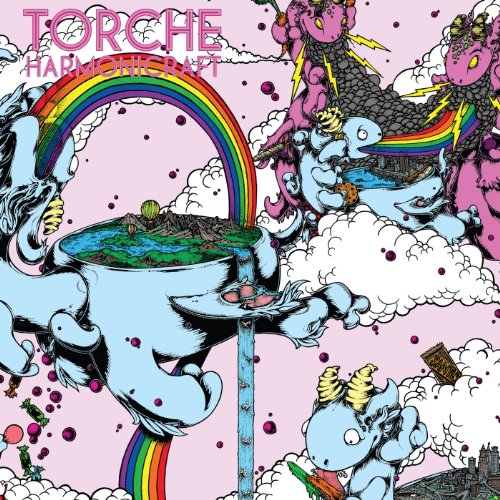
In 2008, I thought of Torche as the most poppy stoner metal on the market. By 2012, the attributes have reversed. You won’t hear anything quite as doomy as Meanderthal’s title track, Pirhaña, or Sandstorm. That crushingly deep guitar still accompanies most of the tracks, it just doesn’t ever become the drawing point of the songs. On Harmonicraft, a catchy melody is job number one, and the results are tremendously effective. From the cover art on down, this is and will likely remain one of the most instantly appealing albums of 2012, and it exhibits a sort of songwriting ethos which hasn’t been very prevalent since the 90s.
Harmonicraft’s introductory song, Letting Go, certainly doesn’t mesmerize the way Triumph of Venus did. But unlike Grenades, Kicking requires no epic lead in:
Kicking
Kicking introduces what will be the style and attitude for the entire album, and it amounts to nothing short of 1990s alternative rock. That occasional Foo Fighters vibe Meanderthal gives off was no accident, but it wasn’t necessarily a product of any direct “influence” either. I think the similarities you might draw to various 90s bands result from Torche’s mindset. Calling Torche “90s rock” is a little ambiguous of course, this being 2012. I suppose one could more directly observe that they took a stoner/post-rock sound and made it bright and bubbly, leading to a sort of “stoner pop” novelty. But when you apply the term “pop” to anything but teen idols you’re being just as vague, and furthermore, though Harmonicraft might seem new from a stoner metal perspective, it feels to me refreshingly nostalgic.
Snakes Are Charmed
Frankly, attempting to categorize Harmonicraft does it a disservice. It’s not a band trying to perfect or expand upon x musical style. It expresses more freedom than that. It harkens back to a time when heavier bands emphasized their own individuality, genres be damned. And that’s why it reminds me of rock in the 90s. I wouldn’t even call it metal, any more than I would call Nirvana or The Offspring punk. And as such, I think it stands at the forefront of music today.
The new standard is synthesis. Metal has been pulling it off lately, especially last year, with bands like Falconer putting a professional gloss on the best of many sub-genres rolled into one, while Liturgy, Deafheaven, and company were forging a more personal if sometimes less formidable approach to the same. Here, Torche are bringing it back to rock. Songs like Snakes Are Charmed have all of the immediate appeal of an instant radio staple, yet rather than repeating something stale, they reinvigorate rock through their more contemporary roots. You hear the stoner/doom and post-rock influences not as those styles, but rather as integrated elements of what it is to be a good rock band. The 90s took the metal and punk subspecies defined in the 80s and made it happen. Now here’s a band getting the job done with musical developments of the last 10 to 15 years.
If there’s any one band I could really compare it to, I’d say Boris.
Walk It Off
I actually forgot that Torche and Boris released a split in 2009 and toured together until after I drew the connection. In Walk It Off the influence is most apparent. Wata’s style is hers alone, but you can definitely feel the sort of inspiration she brings bleeding over into Steve Brooks’ own solos. (Or perhaps Andrew Elstner’s. I don’t actually know who plays lead.) But perhaps even more noteworthy, the more I listen to this track the more I feel that, above all else, the solo really resembles Billy Corgan.
Roaming
And this all amounts to a really awkward way of going about an album review. Sometimes that’s inevitable. No amount of describing Harmonicraft from a metal perspective can do it justice, because it really isn’t a metal album. It is, on the one hand, an immediately and undeniably appealing compilation of catchy tunes which utilize various recent musical movements, mostly within the metal sphere of influence, to accomplish the delivery, and on the other hand, a sign of hope. It excites me to see that this trend towards emphasizing synthesis instead of genre expansion is beginning to spill out of metal and into more accessible rock. I’ll be disappointed if Harmonicraft ends up my favorite album of the year. It’s not that kind of album. It bears no strong message in and of itself–lacks the depth of a masterpiece. But if it could, by some twist of fate, become 2012’s most influential creation, I’d not complain.
Well, here it is mid-June, and I’ve yet to write any album reviews. Getting back into the habit is the hardest part, especially in the wake of one of the finest years for music I can recall. But after half a year of enjoying 2011’s finest fruits, I can no longer pretend that there are no new releases out there. Serpent Sermon seemed like a logical place to begin. Marduk, after all, have been lurking in the shadows for 22 years now, and it’s nice to start things off somewhere familiar.
Video removed by the capitalist pigs at Century Media who don’t want you to sample their products before buying them.
Serpent Sermon
I had very mixed expectations going into Serpent Sermon. The band has gone through a number of transitions over the years, and since the replacement of vocalist Legion with Mortuus in 2004 they just haven’t appealed to me all that much. On the other hand, last year’s Iron Dawn ep was some of the most appealing material they’ve yet released. I read that the band did not intend Serpent Sermon to be a continuation of Iron Dawn, but you never know.
This album kicks off in typical Marduk fashion, with blast beats entering precisely where you expect them and, soon enough, that quintessential Marduk climbing chord progression (around 1:25). The song briefly perks up with a strikingly catchy chorus twenty seconds later, then repeats, with some nuance variations and a particularly tortured howl out of Mortuus towards the end.
It is immediately apparent that, just as the band had stated, Serpent Sermon does not take the same approach as last year’s effort. But where it is headed is hard to say. My love/hate relationship with Mortuus shines in the opening track, where he bores me to tears at 1:10 and 2:20 and then gives me shivers at 3:45. It feels to me as though the singer and the rest of the band aren’t always on the same page. Where they hit it off they’re better than ever, but they just as often seem to be in opposition. Do Mortuus’s twisted vox require a stronger break from standard Marduk riffs than Morgan Håkansson and co are ready to grant, or does he ham it up just a bit too much to lend the songs consistency? Serpent Sermon exemplifies a persistent problem throughout the album: a lot of songs have their greatness broken by sudden lapses into drivel.
Video removed by the capitalist pigs at Century Media who don’t want you to sample their products before buying them.
Messianic Pestilence
The more I listen to the album, the more I am inclined to define it by Mortuus and Håkansson’s successes and failures to engage each other. The album as a whole is widely varied in style, much to its benefit. It provides samples of the various ways in which the band functions together, sometimes for better and sometimes for worse. On tracks like Messianic Pestilence, Mortuus willingly embraces an older school of Marduk with great success, and you get a taste for what they might sound like today if no real stylistic variance had accompanied 2004’s change in lineup. Good stuff, but nothing new.
Video removed by the capitalist pigs at Century Media who don’t want you to sample their products before buying them.
M.A.M.M.O.N.
But M.A.M.M.O.N. is where it really all clicks. From the driving blast-beat opening, erratic deviations into darkness and twisted chaos writhe forth. The initial sudden cessation of aggression is complete, giving Mortuus uncontested center stage, and from the ooze he spews across the soundscape a chaotic torment of guitar fury explodes. The entire song structure repeats, typical of Marduk, but in the end we are treated to a twisted amalgamation of slow, demented guitar tones laid over seemingly incompatible blast beats that give off an air of madness. On this track more than any other, I really feel as though the band has all come together and really accepted their own new sound without any misgivings.
That being said, I must confess that I’ve barely given Marduk’s last few full-length albums the time of day. I listened to them in the background a handful of times at best and quickly lost interest. It is quite possible that what struck me as great on M.A.M.M.O.N. was nothing “new”, and I simply failed to notice it before. But either way, I think it’s Serpent Sermon’s strongest point.
Video removed by the capitalist pigs at Century Media who don’t want you to sample their products before buying them.
Into Second Death
What makes late ’90s/early 2000s era Marduk my favorite is its unrelenting, almost comical brutality. Songs like Christraping Black Metal and Fistfucking God’s Planet are so aurally and lyrically offensive that I can’t help but love them. The whole Swedish black metal sound is perfect for this sort of thing. It’s a style with little room for variation, and it always seems to work best for me when taken to extremes, whether the result is comical, as on Panzer Division Marduk, or gut-wrenching, as on the Iron Dawn ep. I would absolutely love to hear a follow-up of Iron Dawn, but in the meantime, harking back to Panzer Division, let’s not forget that this band has a sense of humor.
If they didn’t, I don’t think Into Second Death would be entirely possible. It’s the most “black and roll” song I’ve heard since Carpathian Forest released Fuck You All!!!! (one of the best things to ever happen to metal), and if Marduk could throw together a full album of it I would be absolutely delighted.
As a whole, Serpent Sermon has a lot of ups and downs. Expect a lot of variation both in style and in quality (at least by Swedish black metal standards). It is no landmark album, but it’s true to Marduk past and present, and as such it’s better than most else out there. At the same time, it leaves me really wondering where the band is headed. It’s a definite to be continued… M.A.M.M.O.N. showed a lot of promise for the path they’re currently on, while the album’s total distinction from Iron Dawn leaves me wondering whether the band has had two separate full lengths in mind all along. On the other hand, you just know they’re going to love playing Into Second Death live, and my biggest hope is that that inspires an album.
Sure, Patrick was a Catholic saint and Ostara, Easter’s namesake, was a pagan goddess, but it’s what you do on a holiday that really marks its significance. So let pious men paint crosses on long-impotent eggs; the damned still have their days. For me, spring begins with a pint of Guinness bright and early on March 17th.
For a few years now I’ve started out Paddy’s Day with the goal in mind of researching and recounting the history of some of my favorite Irish songs, and the spirits of the season have always gotten the better of me. But inebriation brings its own cryptic wisdoms, and this year, as I searched and fumbled through disjointed google results, it was the chronology of the music that really stood out to me. Ireland writes its history in song.
1984: Streams of Whiskey
Every song has an author–a source of origin. Though it may evolve into something entirely unrecognizable, it has to start somewhere, and even when its most distinguishable features are additions, someone has to add them. What distinguishes a traditional song from a cover has a lot to do with the mentality of the individuals copying it, which is in turn dictated in part by the DNA of the song itself. Covers acknowledge authorship–both of the original performer and of the artists performing the new rendition. Traditional songs do not. They are for the masses, and belong to everyone equally. Shane MacGowan and The Pogues authored many traditional songs. Streams of Whiskey, off of their 1984 debut album, can be considered one of their first. Its subject, Irish nationalist, poet, and playwright Brendan Behan, died of alcoholism twenty years prior, but the song is by no means “tragic”.
Last night as I slept I dreamt I met with Behan. I shook him by the hand and we passed the time of day. When questioned on his views–on the crux of life’s philosophies–he had but these few clear and simple words to say: I am going, I am going any which way the wind may be blowing. I am going, I am going where streams of whiskey are flowing.
I have cursed, bled, and sworn, jumped bail and landed up in jail. Life has often tried to stretch me, but the rope always was slack. And now that I’ve a pile, I’ll go down to the Chelsea. I’ll walk in on my feet, but I’ll leave there on my back.
Oh the words that he spoke seemed the wisest of philosophies. There’s nothing ever gained by a wet thing called a tear. When the world is too dark, and I need the light inside of me, I’ll go into a bar and drink fifteen pints of beer.
~1960: Come Out Ye Black and Tans
The Behans were themselves a source of Irish tradition. Brendan’s brother, Dominic, composed two particularly lasting staples: Come Out Ye Black and Tans and The Auld Triangle. Black and Tans recounts their father Stephen’s active role in the Irish War of Independence (1919-1921), and as best I can gather was written by Dominic after his own release from prison for political dissent.
I was born on a Dublin street where the Royal drums did beat, and the loving English feet walked all over us. And every single night, when me dad would come home tight, he’d invite the neighbors outside with this chorus: Come out ye Black and Tans, come out and fight me like a man. Show your wife how you won medals down in Flanders. Tell her how the I.R.A. made you run like hell away from the green and lovely lanes in Killeshandra. Come, tell us how you slew those brave Arabs two by two; like the Zulus, they had spears and bows and arrows. How you bravely faced each one with your sixteen pounder gun, and you frightened them poor natives to their marrow.
1919: Foggy Dew
Stephen Behan’s war officially began in 1919–the same year in which Canon Charles O’Neill wrote Foggy Dew. His song was a reflection on the 1916 Easter Uprising, and a sign of future struggles. The Allies of the First World War’s promise of independence to small nations created previously non-existent nationalist identities around the world, but Ireland’s exclusion from the deal reinvigorated sentiments which had existed for generations. Foggy Dew, and the many songs that appeared alongside it, revitalized a lyrical tradition which, while separated by the 19th century’s period of emigration, was never fully forgotten.
As down the glen one Easter morn to a city fair rode I, there armed lines of marching men in squadrons passed me by. No pipe did hum, no battle drum did sound its dread tattoo. But the Angelus bells o’er the Liffey’s swell rang out through the foggy dew.
Right proudly high over Dublin Town they hung out the flag of war. ‘Twas better to die beneath an Irish sky than at Suvla or Sud-El-Bar. And from the plains of Royal Meath strong men came hurrying through, while Britannia’s Huns, with their long range guns, sailed in through the foggy dew.
Oh the bravest fell, and the requiem bell rang mournfully and clear for those who died that Eastertide in the spring time of the year. And the world did gaze, in deep amaze, at those fearless men, but few, who bore the fight, that freedom’s light might shine through the foggy dew.
As back through the glen I rode again, my heart with grief was sore. For I parted then with valiant men whom I never shall see more. But to and fro in my dreams I go and I kneel and pray for you, for slavery fled, o glorious dead, when you fell in the foggy dew.
~1870: Spancil Hill
Michael Considine was an Irish immigrant to Boston, who moved to California in his early 20s and died shortly thereafter. The history of his song is steeped in myth. It supposedly made its way back to Ireland through family connections and came into the possession of Michael’s six year old nephew, John Considine, who kept it safe for 70 years and confirmed its authenticity upon hearing it performed by a stranger in 1953. Whatever its true story, it preserves a memory of departure after the fact, shedding any semblance of optimism about a land of opportunity.
Last night as I lay dreaming of pleasant days gone by, my mind being bent on rambling. To Ireland I did fly. I stepped on board a vision and I followed with the wind, and I shortly came to anchor at the cross of Spancil Hill.
It was on the 23rd of June, the day before the fair, when lreland’s sons and daughters in crowds assembled there, the young and the old, the brave and the bold, their journey to fulfill. There were jovial conversations at the fair of Spancil Hill.
I went to see my neighbors, to hear what they might say. The old ones were all dead and gone, and the young one’s turning grey. I met with the tailor Quigley, he’s a bold as ever still. He used to make my britches when I lived in Spancil Hill.
I paid a flying visit to my first and only love. She’s as white as any lily and as gentle as a dove. She threw her arms around me saying “Johnny I love you still.” She’s Ned the farmer’s daughter and the flower of Spancil Hill.
I dreamt I held and kissed her as in the days of yore. She said, “Johnny you’re only joking like many’s the time before.” The cock he crew in the morning; he crew both loud and shrill. I awoke in California, many miles from Spancil Hill.
~1850-1860: The Rocky Road to Dublin
D. K. Gavan’s mid-19th century depiction of emigration was a bit more optimistic. It remains persistently playful, presenting an Irish youth’s boastful account of his relocation from Galway to Liverpool as an adventure rather than a loss. Perhaps of some significance towards this end is that it was written by an Irishman who does not appear to have ever left for good or entered into the working class.
In the merry month of May, from me home I started. Left the girls of Tuam so nearly broken-hearted. Saluted father dear, kissed me darling mother, drank a pint of beer, me grief and tears to smother. Then off to reap the corn, leave where I was born, cut a stout black thorn to banish ghosts and goblins. Bought a pair of brogues to rattle o’er the bogs and frighten all the dogs on the rocky road to Dublin.
In Mullingar that night I rested limbs so weary. Started by daylight next morning bright and early. Took a drop of pure to keep me heart from sinking. That’s a Paddy’s cure whenever he’s on the drinking. See the lassies smile, laughing all the while at me darling style, ‘twould leave your heart a bubblin’. Asked me was I hired, wages I required, till I almost tired of the rocky road to Dublin.
In Dublin next arrived, I thought it such a pity to be soon deprived a view of that fine city. Then I took a stroll, all among the quality. Me bundle, it was stole, all in a neat locality. Something crossed me mind, when I looked behind. No bundle could I find upon me stick a wobblin’. Inquiring for the rogue, they said me Connaught brogue wasn’t much in vogue on the rocky road to Dublin.
From there I got away, me spirits never falling. Landed on the quay, just as the ship was sailing. Captain at me roared, said that no room had he. When I jumped aboard, a cabin found for Paddy down among the pigs, played some hearty rigs, danced some hearty jigs, the water round me bubbling. Then off Holyhead. I wished meself was dead, or better far instead on the rocky road to Dublin.
The boys of Liverpool, when we safely landed, called meself a fool. I could no longer stand it. Blood began to boil, temper I was losing. Poor old Erin’s Isle they began abusing. “Hurrah me soul” says I, let the Shillelagh I fly, some Galway boys were nigh and saw I was a hobblin’ in. With a load “hurray” joining in the fray, till we cleared the way on the rocky road to Dublin.
~1820: The Wild Rover
The mere existence of The Wild Rover as a drinking song is a testament to Ireland’s independent spirit, and it marks, perhaps, the tail end of another era in nationalist-themed music. It was originally composed as a temperance song, and the lyrics indeed tell of a repentant alcoholic prepared to give up the drink for good. But with a nuance difference. Early printings of the lyrics (at least, one I read dated between 1813 and 1838) have the subject of the song testing the landlady with money to see if she will sell him whiskey and then refusing to actually drink it, extolling the virtues of sobriety. In the popular, surviving version, the wild rover slips into his old ways just one last time.
I’ve been a wild rover for many a year, and I spent all my money on whiskey and beer. Now I’m returning with gold in great store, and I never will play the wild rover no more. And it’s no, nay, never, no nay never no more, will I play the wild rover. No never, no more. I went to an ale-house I used to frequent, and I told the landlady me money was spent. I asked her for credit, she answered me “nay, such a custom as yours I could have any day.” I took from my pocket ten sovereigns bright, and the landlady’s eyes opened wide with delight. She said “I have whiskey and wines of the best, and the words that I told you were only in jest.” I’ll go home to my parents, confess what I’ve done, and I’ll ask them to pardon their prodigal son. And if they forgive me as ofttimes before, I never will play the wild rover no more.
~1800: Johnny I Hardly Knew Ye
My personal favorite Irish traditional song, Johnny I Hardly Knew Ye, is best known in the United States in its bastardized American Civil War form: When Johnny Comes Marching Home Again. The American version welcomes home a brave warrior, who fought with valor and served his cause dutifully. Life was a bit more realistic in Ireland. This song first appeared some time after the 1798 Irish Rebellion–a movement sparked by the recent American and French Revolutions–at a time when the British Empire was shipping Irishmen off to Sri Lanka to fight their senseless colonial wars. It is a brutally honest depiction of the reality of war that surpasses any modern attempt.
While goin’ the road to sweet Athy, hurrah, hurrah
While goin’ the road to sweet Athy, hurrah, hurrah
While goin’ the road to sweet Athy with a stick in me hand and a drop in me eye
Well don’t you laugh now, don’t you cry
Johnny, I hardly knew ye.
With your guns and drums and drums and guns, hurrah, hurrah
With your guns and drums and drums and guns, hurrah, hurrah
With your guns and drums and drums and guns, the enemy nearly slew ye
Why darling dear, you look so queer
Johnny, I hardly knew ye.
Where are the eyes that looked so mild? hurrah, hurrah
Where are the eyes that looked so mild? hurrah, hurrah
Where are the eyes that looked so mild when you at first me heart beguiled?
What have you done to me and the child?
Johnny, I hardly knew ye.
Where are your legs that used to run? hurrah, hurrah
Where are your legs that used to run? hurrah, hurrah
Where are your legs that used to run when first you went to carry a gun?
Indeed you dancing days are done
Johnny, I hardly knew ye.
Well you haven’t an arm and you haven’t a leg, hurrah, hurrah
You haven’t an arm and you haven’t a leg, hurrah, hurrah
You haven’t an arm and you haven’t a leg. You’re an armless, legless, boneless egg.
You ought to ‘ve been born with a bowl to beg
Johnny, I hardly knew ye.
I’m happy for to see you home, hurrah, hurrah
Back from the island of Ceylon, hurrah, hurrah
I’m happy for to see you home, though indeed you cannot see your home.
Why on earth were you inclined to roam?
Johnny, I hardly knew ye.
~1500s: The Parting Glass
There’s something profoundly assertive in the lot of these songs. They aren’t the mindless jingles for which America is only one of many guilty parties. Even the most seemingly mundane, say, The Wild Rover, carries with it a hidden rejection of artificial restrictions on human nature. Perhaps that’s why they bear such a strong cross-cultural appeal. St. Patrick’s Day isn’t a celebration of Irish tradition; it’s a celebration of what Irish tradition understands best–the human experience. One of my favorite lines in any song comes packaged in the oldest Irish song I know. It could be a simple statement of fact, but I fancy it a tongue-in-cheek play on words. Because Irish tradition understands that loss is not a thing experienced prior to the fact. Preemptive expressions of sorrow are bullshit, and our recognition of that fact in the moment is part of the experience. So, since it falls unto my lot that I should rise and you should not, I gently rise and softly call, good night and joy be with you all.
I want to hop on the bandwagon. It would be a little silly for me to post my real top 10; for one thing, it would include four Krallice tracks. That aside, nearly everything I’d put on it I’ve either posted on this site as a Song of the Day or included in both my review of its album and my top albums post. So to make this a bit different from my past posts, I’m going to limit myself to one song per band, stick to stuff that I imagine might appeal to people who aren’t interested in extreme metal, and keep it on the catchy side. I’ll list a more honest top 10 at the end.
10. Powerwolf – Son of a Wolf (from Blood of the Saints)
As such, my tenth place selection is about as metal as it’s going to get. Powerwolf’s Blood of the Saints might be simple and repetitive, but it’s about the catchiest power/heavy metal album I’ve ever heard. It indulges the same guilty pleasure for me as Lordi and Twisted Sister–two bands that inexplicably pump me up despite being entirely tame. It also offers some amazing operatic vocals and Dracula keyboards, the cheesiness of which can be easily forgiven. Son of a Wolf might be one of the more generic tracks in a sense, but it’s the one most often stuck in my head.
9. Alestorm – Barrett’s Privateers (from Back Through Time)
The only thing I love more than traditional folk and sea chanties is folk punk and metal. When the latter covers the former, I’m in bliss. Alestorm are emerging as the sort of Dropkick Murphys of metal with all their covers lately, and I hope they keep it up. I loved Barrett’s Privateers before what you’re hearing ever happened, and the metal version delights me to no end.
8. The Decemberists – Rox in the Box (from The King is Dead)
The Decemberists really toned it down this year. Where The Hazards of Love could be described as an epic rock opera, The King is Dead sticks to simple, pleasant folk. But Colin Meloy thoroughly researches pretty much every subject he’s ever tackled, and The King is Dead pays ample homage to its predecessors. Rox in the Box incorporates Irish traditional song Raggle Taggle Gypsy with delightful success.
7. Nekrogoblikon – Goblin Box (from Stench)
With a keen eye towards contemporary folk metal like Alestorm and Finntroll, melodic death classics like In Flames and Children of Bodom, and much else besides, former gimmick band Nekrogoblikon really forged their own unique sound in the world of folk metal in 2011. At least half of the album is this good. Stench is the most unexpected surprise the year had to offer by far.
6. Korpiklaani – Surma (from Ukon Wacka)
Korpiklaani almost always end their albums with something special, and 2011 is no exception. The melody of Surma is beautiful, and Jonne Järvelä’s metal take on traditional Finnish vocals is as entertaining as ever.
5. Turisas – Hunting Pirates (from Stand Up and Fight)
I couldn’t find a youtube video that effectively captured the full scope of Turisas’s sound in such limited bitrates, but believe me, it’s huge. Go buy the album and find out for yourselves. Unlike Varangian Way, not every track is this good, but on a select number Turisas appear in their finest form. Adventurous, exciting, epic beyond compare, this band delivers with all of the high definition special effects of a Hollywood blockbuster.
4. The Flight of Sleipnir – Transcendence (from Essence of Nine)
Essence of Nine kicks off with a kaleidoscope of everything that makes stoner metal great, while reaching beyond the genre to incorporate folk and Akerfeldt-esque vocals. A beautifully constructed song, it crushes you even as it floats through the sky. I could imagine Tony Iommi himself rocking out to this one.
3. Boris – Black Original (from New Album)
From crust punk to black metal, there’s nothing Boris don’t do well, and 2011 has shown more than ever that there’s no style they’ll hesitate from dominating. I don’t know what’s been going on in the past few years with this popular rise of 80s sounds and weird electronics. I don’t listen to it, so I can’t relate. But if I expected it sounded anything nearly as good as what Boris pulled off this year I’d be all over it.
2. Tom Waits – Chicago (from Bad as Me)
Bad as Me kicks off with one of my favorite Tom Waits songs to date. It’s a timeless theme for him, but it feels more appropriate now than ever, and his dirty blues perfectly capture the sort of fear and excitement of packing up and seeking out a better life.
1. Dropkick Murphys – Take ‘Em Down (from Going Out in Style)
In a year just begging for good protest songs, Flogging Molly tried really hard and fell flat. Dropkick Murphys, another band you’d expect to join the cause, released perhaps their most generic album to date (still good mind you, but not a real chart topper). Take ‘Em Down is kind of out of place on the album, but it’s DKM to the core, and as best I can gather it’s an original song, not a cover of a traditional track. If so, it’s probably the most appropriate thing written all year. (The video is fan made.)
If you’re interested in my actual top 10, it runs something like this:
10. Falkenbach – Where His Ravens Fly…
9. Waldgeflüster – Kapitel I: Seenland
8. Liturgy – High Gold
7. Endstille – Endstille (Völkerschlächter)
6. Blut aus Nord – Epitome I
5. Krallice – Intro/Inhume
4. Liturgy – Harmonia
3. Krallice – Diotima
2. Krallice – Telluric Rings
1. Krallice – Dust and Light
And that excludes so many dozens of amazing songs that it seems almost pointless to post it.
I never did get around to writing a review of Bad As Me. It’s a shame, because it’s pretty damn good. The old man’s always been in a league of his own, and Tom’s seventeenth studio album feels no less legitimate than anything else he’s created. If anything it’s above average in his discography quality-wise, and that says a lot for someone who released his first album nearly 40 years ago. An entirely accurate representation of his style, here’s 13 anthems to homeless bums, trailer trash, vagabonds, and the starry-eyed refugees of an unforgiving society. I’ve been listening to the closing track, New Year’s Eve, on repeat ever since my deluxe edition pre-order showed up in the mail, and now’s a good day to pass it along.
It’s typical Tom fassion to make the joyous out of the bleak and vice versa. New Year’s Eve might not be as gut-wrenching as Christmas Card from a Hooker in Minneapolis, but it carries on his tradition of looking at the holidays from the perspective of those who’ve got little left in life to celebrate.
The door was open; I was seething
Your mother burst in; it was freezing
She said it looks like it’s trying to rain
I was lost; I felt sea sick
You convinced me that he’d left
You said keep talking, but don’t use any names
I scolded your driver and your brother
We are old enough to know how long you’ve been hooked
And we’ve all been through the war
and each time you score
someone gets hauled and handcuffed and booked
It felt like four in the morning
What sounded like fire works
Turned out to be just what it was
The stars looked like diamonds
Then came the sirens
And everyone started to cuss
All the noise was disturbing
And I couldn’t find Irving
It was like two stations on at the same time
And then I hid your car keys
And I made black coffee
And I dumped out the rest of the rum
Nick and Socorro broke up
And Candice wouldn’t shut up
Fin, he recorded the whole thing
Ray, he said damn you
And someone broke my camera
And it was New Years
And we all started to sing
Should auld acquaintance be forgot and never brought to mind
Should auld acquaintance be forgot for the sake of auld lang syne
I was leaving in the morning with Charles for Las Vegas
And I didn’t plan to come back
I had only a few things
Two hundred dollars
And my records in a brown paper sack
I ran out on Sheila
Everything’s in storage
Calvin’s right, I should go back to driving trucks
Should auld acquaintance be forgot and never brought to mind
Should auld acquaintance be forgot for the sake of auld lang syne



 Through the Shattered Lens