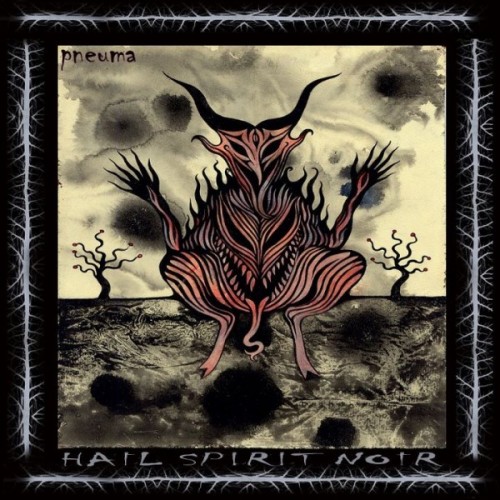
Review: Hail Spirit Noir – Pneuma


Do you know how many albums I’ve reviewed in 2012 so far? One. Comparing that to 2011, when I had pumped out well over 40 by this point in the year, you might say I am a bit behind. It was somewhat inevitable this year, with my video game music project taking up the grand bulk of my free time, but it’s not too late to catch up where I can.

And why not start with the obscure? Hail Spirit Noir is a band from Thessalonika, Greece. The person who introduced me to this album described it as “progressive psychedelic black metal”, which I don’t necessarily agree with but should certainly uh… pique your curiosity.

Mountain of Horror

My apologies for this video. I wanted to include the opening track, and the only copy of it on youtube commits the double idiocy of presenting a fake music video and cutting off the last 30 seconds of the song. While it actually syncs up with the music quite nicely, I have no reason to believe it is anything but a fan project, and it should be duly ignored.

I think there is a general bias among metal fans to label anything black which possesses the slightest traces of the sub-genre. To call Pneuma black metal is a bit of a stretch. The elements of black metal it incorporates are all on the fringe of the genre, and at the end of the day it is far too broad to place any single label on. What you get in “Mountain of Horror” is a combination of that “black and roll” vibe that Peste Noire perfected on Ballade cuntre lo Anemi francor, a heavy dose of 70s prog keyboards, and a progressive black break that falls firmly within the sort of sound Ephel Duath pioneered–more avantgarde than “progressive black” in the sense that recent Enslaved and Ihsahn might call to mind.

Against the Curse, We Dream

And what do you know, another fake music video. Oh well. What you might start to notice as this album progresses is a semblance of stylistic consistency underlining the disorganized madness. Black and roll meets traditional black metal meets psychedelic/70s prog meets avantgarde doodling, mouthful though it may be, is definitely the order of the day.

The Peste Noire vibe is definitely the selling point for me, and in Against the Curse, We Dream it syncs up particularly nicely with the prog synth. The Ephel Duath-esque avantgarde bits leave a lot to be desired, but really, when does avantgarde music ever not leave a lot to be desired? Its presence is at least relatively minimal in the broad range of Pneuma’s sounds. The disorganized nature of the songs is also not particularly problematic, in so far as a standard rock beat sustains to hold the vast majority of it together.

The only thing that kills it a bit for me is the lack of dynamics. From the most break-neck blast beats to the calmest, coolest prog grooves, the album maintains pretty much the exact same level of intensity. It is very much even keel from start to finish. That is more a vice of prog music, which Hail Spirit Noir ultimately choose to place above the metal side of their sound. Much like practically all prog that I have encountered prior to the past ten years, it never opts to overwhelm, feeling relatively dispassionate at the moments where intensity is in highest demand. Consider the staccato break at 5:34 in this video, and how much it could benefit from the level of tension System of a Down applied to similar passages in their early albums. The aggression which follows is somewhat lost to the vibe-killer that the previous passage did not necessarily need to invoke. The avantgarde outro is a disappointing end to a relatively creative song that, enjoyable though it may be, fails to move me to the extent that I feel like it ought to have. This is, of course, to place some unfair stipulations on the band; that the overall atmosphere isn’t what I would have chosen doesn’t mean it fails to capture the vibe Hail Spirit Noir were aiming for.

Haire Pneuma Skoteino

The closing song, Haire Pneuma Skoteino, is by far the most accessible song on the album, and I was pretty surprised by how well I remembered it, having only heard the song one time before, when I first picked up the album half a year ago. I suppose a poppy, catchy outro track is well in keeping with Hail Spirit Noir’s consistent inconsistencies.

At the end of the day, I have mixed feelings about Pneuma. It falls victim to being the first new release I’ve listened to in the better part of a year, and I’m no doubt being a lot more critical than I would have been this time last year, but I just feel like the execution leaves a lot to be desired. On the other hand, it is definitely an impressive and well-informed debut from a band on an obscure label from a country not exactly famous for its metal scene, and the shortcomings I hear suggest I am instinctively holding them to a much higher standard than I would other bands with similar backgrounds. Pneuma isn’t an album I’m likely to revisit, but it has convinced me that this band is a world of potential. I’ll be keeping an eye out for their future releases.

VGM Entry 66: Super Metroid and Donkey Kong Country


VGM Entry 66: Super Metroid and Donkey Kong Country
(Thanks to Tish at FFShrine for the banner)

The release of Star Fox in 1993 was a sign of quite a few great games beyond the RPG/adventure genre to come. The following year would see another visually revolutionary blockbuster, this one completely blowing Star Fox off the map. Rare, a famous name on the Nintendo, held back developing much for the SNES until they were good and ready to take the system by storm.

Donkey Kong Country (Nintendo, 1994) essentially marked the peak of graphics on the Super Nintendo. It never got appreciably better than this, though plenty of other developers would rise to equal it by the end. Considering just how bad the graphics of say, Final Fantasy VII or Super Mario 64 look today, its amazing how well the best of the SNES have stood the test of time. Musically the game did not have quite as big of an impact, but it definitely maintained the cutting edge standard.

Composed by Dave Wise (Wizards & Warriors), Eveline Fischer, and Robin Beanland, the game’s sometimes hoaky jungle themes might be misleading; somewhat silly tunes out of context, they were ideally suited for the gameplay, and they completely defied the limitations of the SNES. I mean, plenty of great musicians were able to craft soundtracks that didn’t sound contrived. They weren’t obligated, as in the 8-bit days, to treat their audio chip as an instrument for any hope of success. But when Nobuo Uematsu added a pseudo-vocal track to Aria Di Mezzo Carattere he wasn’t fooling anybody; the extent to which SNES music could sound performed rather than programmed came in degrees and was not directly relevant to quality. (Final Fantasy VI, Uematsu’s opera included, was one of the best scores of all time despite sounding nowhere near as authentically orchestrated as Yuzo Koshiro’s ActRaiser 2.) But I feel like Donkey Kong Country was remarkably successful in its ability to distance itself from any sense of these limitations.

I mean, it’s electronic music in spirit (or more appropriately ‘new age’, though that is a dangerous term to throw about in so far as the musicians who have defined it share little in common with the finest musicians to have been branded with it) and it should not be compared to attempts at orchestration, but the subtle panning and fading, the outstanding percussion, the appropriate and convincing use of ambient jungle noises in the background… it all adds up to a sound that goes beyond the system, as if they had the nearly limitless possibilities of composers from the Playstation era and beyond.

While Donkey Kong was enjoying his first incarnation as a well-defined, major franchise character, Samus was returning for her third venture, and her first on the SNES. Super Metroid (Nintendo, 1994) was one of the best games on the SNES, presenting a massive, open world for exploration that surpassed its series predecessors and remained unmatched until Castlevania: Symphony of the Night (Konami, 1997). And much like Castlevania, the Metroid series was synonymous with good music. Super Metroid was composed by Kenji Yamamoto and Minako Hamano (Link’s Awakening), and as best I can tell this was very much a joint effort. The ost on vgmdb credits both artists with 11 out of the 24 tracks. (Hirokazu Tanaka is credited for the last two.)

The two had their work cut out for them. While Tanaka’s original was, I think, far more novel in concept than as an actual finished product, his vision of the Metroid sound as carried on by Ryoji Yoshitomi in Metroid II: Return of Samus was nothing short of perfection.

Super Metroid took a slightly different approach from the get-go. The first two games featured eerie yet beautiful intro songs which really captured the conflicting nature of the metroids as morally innocent yet dangerous predators (one of Metroid’s unique features in early gaming is that some of the monsters aren’t evil or lifeless ‘bad guys’, but rather a natural species taken advantage of by, well, evil bad guys). Super Metroid, on the other hand, starts off on a human space station, and the opening conflict is between Samus and the Zebesian Ridley, not a metroid, so a different sort of musical theme was in order. Yamamoto and Hamano effectively captured that with dark and suspenseful music that offered none of the warmth of the first two games.

Furthermore, the majority of the game takes place on Zebes, the home world of the space pirates who are manipulating the metroid species for conquest. The original Metroid took place here as well, but a lot had changed plot-wise since then. The metroid species had been all but exterminated, and Samus at any rate had had a much more intimate encounter with them in Metroid II than would be possible on Zebes. Their presence here was no longer such a significant factor (in setting the mood, though they remained central to the plot), and the Zebesians presented a less mysterious and more sinister threat.

Yamamoto and Hamano wrote some pretty creepy music for Super Metroid, and it served its purpose well, but the bulk of the tunes were earthy in ambiance and more action-oriented, precisely in keeping with the mood of the game.

The SNES had some less famous gems in 1994 too. Demon’s Crest was the third installment in Capcom’s largely forgotten Gargoyle’s Quest series, which was in turn derived from the Ghosts’n Goblins series. It couldn’t have been much of a commercial success in North America; at the height of my teenage game obsession I managed to never even hear of it. It had a unique classical soundtrack which rarely stands out in any single instance but deserves a great deal of praise for its consistency. The composer never gives in to temptation by picking up the pace, keeping an even keel that succeeds in maintaining a sort of Halloween spook to the whole game from beginning to end.

Who composed it? I was about to say Yuki Iwai, because she’s almost universally credited for it, but this is yet another one of those gross misconceptions derived from failure of in-game attribution. Apparently Demon’s Crest has no credits (I never played it), and some time long ago someone decided Yuki Iwai must have composed it because she composed the previous series installment, Gargoyle’s Quest II (Capcom, 1992). Thankfully someone on Wikipedia caught on to this and did some research; a compilation cd of music from the series explicitly credits the score to Toshihiko Horiyama.

And then there’s Live a Live (Square, 1994), composed by the rising star Yoko Shimomura (Gargoyle’s Quest, Street Fighter II, some minor involvement in Breath of Fire). Shimomura left Capcom in 1993 and joined Square, with whom she would maintain a long and productive partnership up through the present day. Chances are you never heard of and almost certainly never played the RPG Live a Live. Even in the present day of classic game redistribution it has never received an official English language port. It’s a shame, because with a lively mix of adventurous western themes and oriental melodies, Live a Live presented one of the most spirited soundtracks on the SNES.

It was also one of Yoko Shimomura’s first independent scores. Though she receives solo credit for a few earlier games–F-1 Dream (Capcom, 1989) for the PC Engine and The King of Dragons (Capcom, 1991) for the arcade for instance–the bulk of her earlier games list joint credits, and these can be pretty misleading. (She only contributed one song to Breath of Fire from what I gather.) Live a Live then might be seen as one of her first really extensive works, and it was definitely a sign of good things to come. With a legendary repertoire to include Super Mario RPG and Kingdom Hearts, Shimomura would be making herself heard in video games for a long time to come.

VGM Entry 65: Follin in the 90s


VGM Entry 65: Follin on the SNES
(Thanks to Tish at FFShrine for the banner)

The average quality of Tim Follin’s compositions seemed to progressively decline with every new improvement to technology. A sort of daredevil musician accustomed to breaking barriers and pushing boundaries, I think the relative freedom of SNES composition forced him to find new forms of inspiration. Sometimes the muses moved him, and quite often they did not. When it did click for him, he showcased the same level of creative aptitude he’d been stirring up the gaming music world with since 1985.

Plok (developed by Software Creations, first published by Tradewest, 1993) was an instance in which Follin most certainly did rise to the challenge. For a goofy little game, here was a simultaneously ridiculous and wonderful score.

Tim and Geoff collaborated on this one, as they had often times before (I may well have falsely credited Tim with Geoff’s work on occasion), and it all came together exceptionally well in this instance. The track beginning at 1:48, “Venge Thicket”, especially exhibits precisely the sort of upbeat prog rock for which Tim excels, with a definite Ghouls’n Ghosts vibe. The track at 5:00, “Cotton Island”, does a delightful job of busting out in trademark over-the-top Follin style while remaining entirely within the corny and fun setting of the game it represents. “Akrillic“, not featured in the above compilation, is more of a smooth, relaxing jazz-prog ride that far exceeds the game for which it was written.

Plok was not the first great Super Nintendo soundtrack by the Follin brothers. Tim and Geoff also collaborated for Spider-Man and the X-Men in Arcade’s Revenge, another Software Creations development, published by LJN in 1992. It was, as it turns out, the only Follin game I actually owned as a kid, and its music was the leading cause in my purchasing it after playing a rental. Tim has supposedly cited Guns N’ Roses as a musical influence, but it’s only on the Arcade’s Revenge title theme that you can clearly hear it.

The whole rock and roll approach to composition was not a one-time go for the Follin brothers, though it was fairly foreign to their pre-SNES games. They would employ a much heavier rock influence throughout most of their SNES catalogue, most obviously on Rock n’ Roll Racing (Interplay, 1993). But it didn’t always work. Arcade’s Revenge was more the exception than the rule. In any case, it was not strictly rock, and the music of the Gambit stages in particular exhibit a wide variety of electronic beats intermixed with rock and prog.

The music to the Spider-Man stages was perhaps the most memorable of the game for me, and not merely because they were the only ones I could consistantly beat. It’s definitely the most diverse song in the game, intermingling prog and classical with some funk and jazz in a subdued sort of way that matched the cool vibe of the opening level, where you infiltrate a high security facility with a smoggy night sky as your backdrop. It made an otherwise tedious game well worth playing. . . . With a Game Genie.

The Follin brothers were mostly committed to the SNES throughout the 1990s, but at least one incursion was made into the world of the Genesis/Mega Drive. To the best of my knowledge Tim is responsible for the title screen music to Time Trax, and he probably wrote it in 1993 or 1994. Its extension from the Arcade’s Revenge sound should be fairly apparent. Unfortunately neither the game itself nor any other songs from it are available. Malibu Games released a SNES version with an entirely different score in 1994, but the Mega Drive version was dropped prior to publishing.

VGM Entry 64: Star Fox and Turrican


VGM Entry 64: Star Fox and Turrican
(Thanks to Tish at FFShrine for the banner)

Fantasy genre gaming alone did not define the Super Nintendo, and it’s time to look again at what was transpiring in more action-oriented fields. Star Fox was probably the most well-known action game of 1993. Super Turrican was perhaps one of the least.

Star Fox launched yet another major Nintendo series still being marketed today, and it was a novel game in many ways. It was the flagship title for Argonaut Games’ new Super FX chip, and as such featured a style of graphics never before seen on the system. It was the must have non-RPG of the year, and I can safely say the music had no factor in selling the game. It was just a wonderful added bonus.

Hajime Hirasawa is not a significant figure in game music composition generally. As best I can tell he only ever scored two games: Time Twist: Rekishi no Katasumi de… (Nintendo, 1991) for the Family Computer Disk System (FDS) peripheral to the Famicom, and Star Fox. (The former, as you might quickly notice, is pretty bad.) Hirasawa left Nintendo upon the completion of Star Fox and, a few small arrangement jobs aside, doesn’t seem to have had any further involvement in the gaming industry. He ranks alongside Yukihide Takekawa as one of the greatest one-hit wonders of the era.

Super Turrican (Seika, 1993) on the other hand marked the Super Nintendo debut (to the best of my knowledge) of a video game music legend. The Turrican series has a long and convoluted history, throughout which Chris Hülsbeck did the grand bulk of the composing, and it is for the first SNES installment that he is most remembered.

There were, as best I understand it, six distinct Turrican games in all, but many of these were ported to wildly different systems and must have underwent some drastic changes. Turrican (Rainbow Arts, 1990) and Turrican II (Rainbow Arts, 1991) were both designed for the Commodore 64 originally, by Manfred Trenz, that dubious developer of The Great Giana Sisters. In the span of about one year–to give you some idea of the wide variety of versions here–Turrican was ported to the Amiga 500 and Atari ST (by Factor 5), the Amstrad CPC and ZX Spectrum (by Probe Software), and the Sega Mega Drive/Genesis, PC Engine, and Game Boy (by Code Monkeys and Accolade.) It would be nice to at least know which of them Chris Hülsbeck was directly involved in, because not all of their music is good. The Game Boy port is especially terrible.

Super Turrican was one of three installments of the series developed in 1993. The first, Mega Turrican, had to be shelved for year for lack of a publisher on the Mega Drive, but it did make it to the Amiga as Turrican 3: Payment Day, resulting in the odd consequence of a port of the game being released a year ahead of the original. The other two were, confusingly, both called Super Turrican. Manfred Trenz and Rainbow Arts developed the Nintendo Super Turrican, based loosely around the original two C64 titles, and got the game published through Imagineer. Factor 5 in the meantime developed the Super Nintendo Super Turrican on the model of the Sega Mega Drive version, which was published by Seika as well as, according to Wikipedia, Hudson Soft and Tonkin House. Whatever all confusion must have surrounded this game, they didn’t forget to bring back the series’ main composer, and Chris Hülsbeck’s Super Turrican stands among the best on the SNES today.

VGM Entry 63: Secret of Mana


VGM Entry 63: Secret of Mana
(Thanks to Tish at FFShrine for the banner)

The Super Nintendo may have been video game music’s finest hour with or without them, but three soundtracks in particular carried this system to an unprecedented level of greatness which has really never been matched since. Each was composed by a different artist, and each was released by Square. The first of these was Secret of Mana.

Here is the track list for garudoh’s compilation:

(0:00) Angle’s Fear
(0:53) selection menu track not featured on the ost
(1:23) Into the Thick of It
(2:17) Colour of the Summer Sky
(2:55) Ceremony
(3:53) Star of Darkness
(4:46) Strange Event
(5:46) Spirit of the Night
(6:22) Eternal Recurrence
(7:29) The Sorcerer
(8:15) Leave Time for Love
(8:44) Dancing Beasts
(9:24) Calm Before the Storm

Hiroki Kikuta was brand new to the world of video game music when he scored Secret of Mana, released in 1993. (Called Seiken Densetsu 2 in Japan, the game was technically the sequel to what we commonly know as Final Fantasy Adventure for the Game Boy.) He had worked on the sound effects for Romancing SaGa in 1992, and beyond that he only had two animes to his credit (The Adventure of Robin Hood and The Legend of Snow White, both released in 1990.) Like the more famous Square composer whose 1995 composition would overshadow Kikuta, his work would emerge from pure inspiration, with almost no past experience upon which to build. He single-handedly made an otherwise fairly average game one of the most beloved titles on the system. I suppose average is an odd way to describe Secret of Mana–it was a very unique game within the adventure genre–but its success hinged entirely on the soundtrack. With limited plot potential and almost zero character development (the playable characters are named Boy, Girl, and Sprite for goodness sake), Secret of Mana‘s success was due entirely to Kikuta’s ability to bring the visual environment to life in fantastic ways.

garudoh chose some odd tracks for this compilation, and judging by the fact that some of the songs fade before they’re anywhere near looping (Leave Time for Love for instance) I have to assume he wasn’t personally very familiar with the music. I’ll offer you some additional tracks that didn’t make it into his mix.

Secret of Mana was a game about elements. This was not integrated in any sort of forced way, as with say, the crystals of earth, water, air, etc in the Final Fantasy series, but rather it was a natural consequence of the games strengths and weaknesses. For instance, I doubt anyone remembers why, plot-wise, you ever end up in a desert, but the experience of being there is a lasting memory.


Secret of the Arid Sands

Kikuta didn’t rely on any stereotypical reference points here. He didn’t give his music a Middle-Eastern vibe or any such nonsense. Instead he chose tones that actually reflected a visual experience of a desert. The accompaniment to the melody here flickers up and down from the bass of the music like boiling bubbles and mirages dancing off the desert sands. It’s largely in these world encounter zones, where the plot was least relevant, that Kikuta’s music is at its finest, because he was at liberty to paint a timeless musical image without any concern for the events taking place there.

This same idea of audio imagery really stands out to me in “Into the Thick of It” (1:23 in the garudoh video), where at the start the plucked sort of harpsichord-guitar line accented by the drum beat and displayed on the backdrop of a simple, confident bass and quiet but encompassing synth creates the image of a forest rushing by. (Much of the drumming is hard to find in the low bitrate youtube sample, with exaggerated alterations in volume obscuring the fact that the staccato metronome-sounding drum hits on every beat.) The bass and synth fill in the earth and sky; the drum sets things in motion; the plucked notes count off the passing tree trunks; the fuzzy guitarpsichord resonance depicts the myriad interwoven branches, tying each note into the next. However pretentious that may sound, and regardless of whether or not it reflects Kikuta’s intentions, I’ve always heard something roughly along these lines in this song. I want to clearly distinguish it from music which captures the sense of being in a forest. This doesn’t tap into emotional reactions to environments so much as it generates an actual physical image of the environment, supported by the game’s graphics proper, upon which the players can impose their own emotional values. It’s fantasy in the purest sense. As “Into the Thick of It” progresses the song flushes out into more obvious visions: woodwinds capturing the blowing breeze and rustling grass, bubbly staccato synth tones depicting passing streams. And this is precisely the graphic environment in which the song is employed.


What the Forests Taught Me

“Into the Thick of It”, where the player is rushing on ahead on a well established path, is nicely contrasted by “What the Forests Taught Me”, in which the game sets you in a much more secluded forest. Here the motion is removed, and you get a standing image of a forest clearing full of life. The calm is a bit more displaced from the gameplay, considering you’re hacking and slashing your way through, but this is entirely in keeping with Kikuta’s tendency in such plotless zones to score music descriptive of the visual environment and allow the players to attach their own value to the events taking place there.


A Wish

The sort of apex to this side of his soundtrack is “A Wish”, which plays in the winter forest combat zones. An environment blanketed in a single, neutral, stagnant substance, full of life but only subtly altered by its motion–Kikuta composed a track perfectly descriptive of what the player, upon taking a break from mechanical combat and visualizing themselves in this fantasy world, would experience. A lot of truly great musicians have attempted to capture this sort of situation–Sigur Rós and George Winston come to mind–but as the nature of video games dictates looping tracks, “A Wish” offers this vision in a uniquely and authentically eternal sort of way.

The mental images in a work of fantasy are not always natural, and for Secret of Mana‘s darker side Kikuta needed to get pretty creative. “Ceremony” (2:55) and “The Sorcerer” (7:29) represent the game’s darkest moments, and the former, though not my favorite track, might be his finest accomplishment in the mix. In a score through which the player is accustomed to deriving physical imagery, Ceremony’s twisted patterns and displaced tones take on added weight. There is nothing natural to latch onto here–no coherent vision, just some disturbing, chaotic mass. It’s got to be one of the creepiest video game songs out there, second on the SNES only to the Final Battle music of EarthBound by Hirokazu Tanaka. “The Sorcerer” is just as if not more disturbing, made only slightly less intimidating in practice by the distraction of having to actually fight a boss while it’s playing.


Steel and Snare

One thing you may have noticed listening through garudoh’s mix is Kikuta’s tendency towards hard-hitting, dominant percussion. It’s one of his strongest consistencies, tying a wide variety of musical styles together under a common feature, and on one of my other favorite tracks, “Steel and Snare”, he really lets it all out. This is one of those songs I’ve wanted to cover in a rock band since the first time I ever heard it, and I remember having the whole thing worked out on bass at one point in my life (along with Meridian Dance; this never really crossed my mind before, but when I first bought a bass it was always Hiroki Kikuta and Ryuji Sasai that I turned to.) The music again drives the setting of the game, with the continuous tone in the background simulating the air around the floating castle, and the drum and bass track giving all of the enemies a decidedly mechanical feel. I don’t actually know that they -were- mechanical. I don’t remember what they looked like precisely. But whatever they were meant to be, the music dictated my memory of the scene.

I’ll leave you with one last song:


Premonition

I’ve managed to maintain this as my ringtone for well over a decade, and it’s become such a continuous occurrence in my daily life that I don’t think I can even intelligibly discuss it in the context of the game anymore, but I was in love with it when I first heard it and I still am now. I suppose I should have featured Meridian Dance here instead, as it seems a bit silly to ignore Secret of Mana‘s most epic track through all this, but I’d rather draw attention to the less commonly featured great ones anyway. Enjoy.

VGM Entry 62: Enix


VGM Entry 62: Enix
(Thanks to Tish at FFShrine for the banner)

Today Square might be remembered as the uncontested kings of Super Nintendo RPGs, but this is not an accurate assumption. As a young kid obsessed with anything approximating the genre, I anticipated every new Enix release with nearly equal glee. What I didn’t realize at the time was that Enix was a publisher. You won’t find games developed by them. While Square’s games emerged in house from the drawing board, Enix released titles developed by a wide variety of companies.

Quintet was the leader of this pack. Quintet is a Japanese video game developer officially founded in April 1989. According to Wikipedia, the first game credited to them is Legacy of the Wizard (Nihon Falcom, 1987), an installment of the Dragon Slayer series. Hence a bit of a to-do is made about their origin, with “June 1987 / April 1989” listed as the ambiguous founding date. The source for their official founding date links to a nearly illegible magazine scan (in English), and I don’t want to give myself a headache trying to decipher it, so I’ll take the Wikipedia editor’s word on that one. (The fact that whoever edited the article noticed an ambiguity in the first place marks them as more attentive than the vast majority of game-related editors.)

But the article and its relevant links lead me to believe the issue isn’t as complex as it seems. Tomoyoshi Miyazaki, director and president of Quintet, was a Nihon Falcom employee (he was involved in developing the first three Ys titles), and it just so happens to be the case that Legacy of the Wizard was released in North America in April 1989. The only real confusion is that Wikipedia suggests that Quintet developed both the Famicom and the NES ports, and that the former was released in 1987. If both were released in 1989, or alternatively if Quintet only developed the NES release (if the division of labor between developer and publisher renders this thought unintelligible, my apologies), then there is no issue. And moreover, if Tomoyoshi Miyazaki was a Nihon Falcom employee, the ambiguity may capture a simple gap in time between Miyazaki beginning to call his development team Quintet and his registering the name as a corporate entity.

Whatever the case may be, Quintet were busy in 1993. Following ActRaiser in 1990 and Soul Blazer in 1992, they managed to pump out two games in a span of two months. This probably wasn’t a great idea in retrospect. Illusion of Gaia, composed by Yasuhiro Kawasaki, was musically pretty shallow (this might account for why I never bought the game after renting it as a kid), and as an installment in the unofficial Soul Blazer Trilogy it was a sad decline from the quality of Yukihide Takekawa’s Soul Blazer. In its subtler moments, 2:49 to 5:35 for instance, it boasts an atmospheric vibe vaguely reminiscent of Jeremy Soule’s Secret of Evermore two years later, but the rest is of poor quality.

ActRaiser 2 on the other hand had an outstanding score, and is a real testament to the diversity offered by Yuzo Koshiro. While I remain unmoved by his more popular Streets of Rage sound, as a classical composer he not only competes outside of the video game spectrum, but makes the Super Nintendo sound like a real symphony with unprecedented professionalism. Nobuo Uematsu is always quick to point out that he had no professional training, and my own musical inclinations lead me to treat such claims with an appreciative nod of respect, but where he did try to emulate an orchestra on the Super Nintendo he never came close to the level of Koshiro. (Indeed, “Dancing Mad”‘s charm is it’s quintessentially SNES sound within the orchestration.)

Koshiro’s work in ActRaiser 2 in contrast might as well have been a live recording. Koshiro is, like Chris Hülsbeck, an artist I’ve I in many ways simply failed to appreciate, but not here. Quintet’s problem in this instance is that Koshiro’s stellar score was ActRaiser 2‘s only redeeming value. I mean, I never played it, but that fact is directly relevant to its commercial failure. In choosing to abandon the simulation side of the gameplay and go for a straight side-scroller they essentially ostracized their entire fanbase and entered a much more competitive field in which the Enix seal of approval meant jack.

Produce was a pretty obscure developer founded in 1990, probably most known for Super Adventure Island (Hudson Soft, 1992) and The 7th Saga. My most vivid memories of The 7th Saga are of the obnoxious pseudo-avoidable encounters that were for all practical purposes random but gave you the sensation of just being bad at avoiding them. Still, as with most Enix titles it was a refreshing change of pace from the Dragon Quest-patterned norm, and perhaps it had a good plot of which I was simply oblivious at the time (I doubt it though.)

What really strikes me though, listening to this video, is that it actually had a really great soundtrack. Norihiko Yamanuki doesn’t even have a vgmdb entry, and he’s surely one of the most obscure SNES composers to have actually accomplished something. There’s nothing really compositionally striking about the music of The 7th Saga, and it doesn’t really surprise me that I overlooked it as a kid. Yamanuki’s accomplishment here is more in the subtle qualities of the arrangement. The bubbly little tapping tones that prevail throughout this collection, most dominantly in the track at 1:00, really give the game a heartwarming sort of appeal; it’s quite pretty.

Ogre Battle was probably the most successful real-time strategy game for the SNES, at least in the United States. It stemmed from a long lineage of similar titles in Japan, but few had found sufficient success for overseas ports. Quest, the developer, had worked on similar projects in the past, though Ogre Battle would be the first in their Ogre series. A game of few settings and themes–the entire plot unfolds within the combat setting, and there are no separate story scenes as in say, Final Fantasy TacticsOgre Battle demanded a whole bunch of tunes well suited for long, drawn-out conflict.

The game did, nevertheless, have a pretty extensive soundtrack. Masaharu Iwata did the bulk of the composition, contributing 24 tracks, while Hitoshi Sakimoto added 12 and Hayato Matsuo added 6 (based on the ost liner notes on vgmdb). If the music sounds a little similar to the score of Final Fantasy Tactics, that’s no coincidence. Masaharu Iwata and Hitoshi Sakimoto composed it too.

VGM Entry 61: The RPG generation


VGM Entry 61: The RPG generation
(Thanks to Tish at FFShrine for the banner)

The Super Nintendo RPG/Adventure legacy didn’t come over night. But ActRaiser (Enix, 1990), Final Fantasy IV (Square, 1991), and The Legend of Zelda: A Link to the Past (Nintendo, 1991) did not necessarily set the stage, either. RPGs had been huge in Japan for quite some time. The Super Nintendo provided both the capacity to carry them and the consistency to focus costs on a single product (imagine the amount of time and resources which must have went into porting PC RPGs to a half-dozen different systems). This didn’t inspire computer gaming companies to switch gears–Nihon Falcom continued to pump out their titles for the PC-9801 all the way up to 1996, slowly switching to Windows with only one Super Famicom title, Ys V: Ushinawareta Suna no Miyako Kefin (1995), to show for themselves in between. But other publishers saw RPGs as a more viable option now, and Capcom, Taito, and Nintendo hopped on the bandwagon while Square and Enix picked up the pace. (Konami held off producing RPGs until the Playstation era.)

The fact that these types of games did not start to appear in abundance on the SNES until 1992 might have been a simple consequence of developers spending most of 1991 making them. 1992 to 1995 were the glory days of SNES fantasy gaming, and perhaps the crowning era in the history of video game music.

Capcom’s first big RPG was Breath of Fire (1993), credited to a long list of composers including Yasuaki Fujita (Mega Man 3), Mari Yamaguchi (Mega Man 5), Minae Fujii (Mega Man 4), Yoko Shimomura (Gargoyle’s Quest, Street Fighter II), and Tatsuya Nishimura. Thankfully track by track authorship is actually available, and we can see that Yasuaki ‘Bun Bun’ Fujita did the grand bulk of the composing, with Mari Yamaguchi contributing five songs and the other three chipping in a song each.

Here’s a track list for the compilation:

(0:00) The Dragon Warrior
(1:24) Fate
(2:54) Starting the Journey ~Breath of Fire~
(4:11) Deep Forest
(5:18) Battling
(6:02) Sand Palace
(7:07) Dejection
(8:05) Fishing

As a series, Breath of Fire was not really all that well noted for its contributions to video game music. I don’t want to blow off the rest of the games here and now before revisiting them, but I distinctly remember playing through most of them with the radio on (I never actually played Breath of Fire V). The original Breath of Fire was definitely more of an exception than than the rule. The soundtrack is peppered with memorable, moody numbers. It’s most famous song, at least in so far as it was carried on in future installments, is Mari Yamaguchi’s overworld theme, “Starting the Journey”. But it is Yasuaki Fujita’s bleaker contributions that really make the game stand out from the crowd. “Deep Forest” and “Dejection” could both easily pass for ending credits themes to some complex plotline defying the good versus evil stereotype–the sort of RPG we all crave but rarely find outside of the Suikoden series. They’re both delightfully dark and finite, screaming “it’s over, but did you really win?”

Of course neither of them are actually credits music, and Breath of Fire was never known for its plot. The series had an incredible knack for being simultaneously completely forgettable and quite fun to play–perhaps a consequence of actually challenging combat (at least, in comparison to the vast majority of turn-based RPGs.) When it came to music, the original was the only one that actually made a lasting impression on me when I played it.

Lufia & the Fortress of Doom, composed by Yasunori Shiono, was another series starter in 1993. There were actually only two Lufia titles in the 90s, and I suspect the later handheld releases came as an afterthought. Taito were prolific producers with a history in the gaming industry dating all the way back to 1973, but they had always shied away from the RPG market. With the cooperation of newly-established developers Neverland Co., Lufia would be their first attempt.

As for the history of Neverland, something on Wikipedia is clearly wrong. It claims Lufia‘s developer was founded on May 7th, 1993, and it claims the game was released on June 25th, 1993. But while Neverland certainly must have had an earlier origin, Lufia does appear to be their first of very few titles. In that regard, the Lufia series was kind of unique. I won’t pretend to know what goes on behind the scenes in the gaming industry (my dream of directing RPGs has always been a total fantasy), but I have to imagine when a producer develops their own game there’s a fairly more intimate degree of interaction between the two sides. Square and Nintendo as of 1993 nearly always developed their own games. The wildcards in the world of non-PC RPGs almost always went through Enix (the most famous developers being Quintet and Chunsoft). Neverland-Taito then seems like a pretty unique pairing–an independent developer working with a producer that had never marketed an RPG.

Lufia & the Fortress of Doom was in every manner a rough draft–a sort of prototype for Lufia II: Rise of the Sinistrals, which was infinitely better and one of the best RPGs in the history of the SNES. Unlike Final Fantasy, Dragon Quest (from what I gather), Breath of Fire, Seiken Densetsu, Quintet’s unofficial ‘Soul Blazer Trilogy’, and Zelda really, the Lufia series was both plot-centric and cumulative, taking place in the same world with a continuous history and related/reoccurring characters. As if in collusion with the rest of the development team’s maturation, Yasunori Shiono’s compositions improved substantially in the second title, but we will get to that later.

Good adventure/RPG music was not limited to the Super Nintendo. The Game Boy was a musical instrument par excellence, with by far the most aesthetically pleasing tones of any system on the market lacking diverse instrument sampling. (I hope that’s a suitable delineation for a technical subject of which I still know absolutely nothing.) The Legend of Zelda: Link’s Awakening is far and wide my favorite score in the Zelda series. It might have nothing on Ryuji Sasai’s work on Final Fantasy Legend III, but Link’s Awakening brings the Game Boy to life in a really beautiful way. Indeed, its only real fault is a failure to employ his three-dimensional stereo effects. The game’s crowning jewel, Tal Tal Heights, appears early in this compilation (0:30), but the whole score merits attention.

Koji Kondo surprisingly had nothing to do with it. Link’s Awakening was a joint effort between Kazumi Totaka, Minako Hamano, and Kozue Ishikawa, all of whom I’ve yet to mention. Kazumi Totaka actually had a pretty long history with Nintendo, providing music for the sort of games you might expect to hear Soyo Oka on (Mario Paint, Wave Race 64, most notably Animal Crossing, which I do hope I remember to feature if I ever get that far). Minako Hamano was responsible for roughly half of the Super Metroid soundtrack, though her name rapidly fades from the pages of history, and Kozue Ishikawa is a virtual unknown. But this motley crew managed to piece together one of the quintessential scores of the Game Boy, and in doing so earn themselves a place in video game music history.

October Music Series: Nokturnal Mortum – Lastivka


And so my month of folk and folk/pagan/black metal indulgence comes to an end. Of course they’re the styles I listen to the most throughout the year, but October always holds a somewhat special status for the genres. It marks the height of fall and the coming of winter, the commencement of the six months of the year I enjoy most, and also the start of the holiday season. Halloween is something of the anti-holiday–an all-encompassing celebration of everything that is not modern Christian/Muslim/Jewish culture. It’s that one break in year-round social norms where people can dress and act in ways that, despite representing the human experience for the vast majority of our species’ existence, are strictly taboo in the today’s world. Sure, plenty of pagan practices may have lurked their way into Christmas and Easter. Sure Thanksgiving, despite its name, remains a fairly uncompromised belated harvest festival. But on Halloween we sugar-coat nothing but the candy, sending our children down the streets as ghouls and ghosts and all sorts of counter-cultural guises, embracing primal human nature with no need for repentance. It might be highly consumer-centric, but a little unrestrained gluttony seems thoroughly appropriate for the occasion. From death and the old gods to vampires and zombies, everything falling beyond the accepted sphere of modern religion has its day on October 31st.

Lastivka, alternatively titled Swallow, is a rather ridiculous rendition of what I gather is a traditional Ukrainian folk song. It first appears on Nokturnal Mortum’s Marble Moon ep, released in 1997. Enjoy.

Happy Halloween Shattered Lens.

October Music Series: Townes Van Zandt


Townes Van Zandt lived a troubled life, characterized by constant alcoholism, drug abuse, and failed relationships. He finally passed away of heart failure in a state of delirium tremens on January 1, 1997, at the age of 52, cryptically 44 years to the day after the death of perhaps his greatest influence, Hank Williams, under similar circumstances. As a song writer his music was inconsistent, but at his finest moments he tapped into his inner demons with an acute awareness that he was living more in dream than reality. He created his own folklore both in life and in song. The latter was quite deliberate, emerging sometimes from scratch and sometimes with attention to older legends. Narrated in the first person, always at night, bridging a gap between sleep and consciousness, he painted strikingly vivid images of personal confrontations with foul spirits and terrifying monsters physically imbued with emotional states which could never take on material form outside of a dream, or a song.

To call Spider Song a metaphor would do it a disservice. Of course it is about overcoming some inner demon, whatever that may be, and yes, through the battle against the spider we gain some insight into Van Zandt’s personal struggles, but that’s trivial. He’s not just beating that old dead horse again. The spider begins “in his dreams”, and at no point does it definitively leave them, yet the song is structured in such a way that Van Zandt’s dreams come to characterize more and more a real, physical monster encountered collectively by the narrator and the audience. What you get is a subtle transition from a nearly explicit metaphor (it’s in his dreams) to, by the end, momentary belief that a real, heroic, pitched battle against a giant spider is about to ensue. You don’t fully forget that the spider originated as a sort of representation of emotional states of fear, depression, or whatever you read into the first few stanzas of the song, but nevertheless here it stands, a menacing physical object. No, this song should not be regarded as a metaphor. Rather, our recognition of metaphor is employed to, over time, trick the senses into visualizing something supernatural.

Our Mother The Mountain is laden with hints at the supernatural from the outset: The woman’s esoteric claim to have come from her mother the mountain, her mysterious medallion, the refrain “singing tu-a-lu-ra-lai-o” with an emphasis on “lu-ra-lai”… “Lorelei”… The music feels like a dream, and the lyrics too, until the narrator stops observing the dream and tries to interact, reaching for her hand. The woman’s response is a manifest nightmare–a completely nonsensical appeal to pure foreboding terror captured in her physical actions. The narrator never sees her again, but he swears that it wasn’t just a dream, and as the listener you can’t help but believe him.

Spider Song

There is a spider in my dreams
Long and silent is his name
Cold as lightning is his smile
Final is his sting

His curse is deep as seven skies
Boys, I wouldn’t tell you lies
The legends say he never sleeps
and he’s never hungry long

He’s got us boys, I believe it’s true
But I’m fighting til he lays me down
Run his foul black body through
Cleave him all asunder

Think of your women, won’t you boys
Think of your mother growing old
Think about your darling son
Spit in the spider’s eye

Up at ease, against him ride
We’ll not take him by surprise
Give a scream down in your dreams
Let him know we’re coming

There is a spider in my dreams
Long and silent is his name
Cold as lightning is his smile
Final is his sting

Our Mother The Mountain

My lover comes to me with a rose on her bosom
The moon’s dancing purple all through her black hair
And her lady’s-in-waiting, she’ll stand ‘neath my window
And the sun will rise soon on the false and the fair
Singing tu-a-lu-ra-lai-o

She tells me she comes from My Mother The Mountain
And her skin fits her tightly, and her lips do not lie
She silently slips from her throat a medallion
Slowly she twirls it in front of my eyes
Singing tu-a-lu-ra-lai-o

I watch her, I love her, and I long for to touch her
The satin she’s wearing is shimmering blue
And outside my window her ladies are sleeping
My dogs are gone hunting; their howling is through
Singing tu-a-lu-ra-lai-o

So I reach for her hand, and her eyes turn to poison
And her hair turns to splinters, and her flesh turns to brine
She leaps ‘cross the room. She stands in the window
and screams that my first-born will surely be blind.
Singing tu-a-lu-ra-lai-o

Then she throws herself out to the black of the nightfall
She’s parted her lips, but she makes not a sound
I fly down the stairway and I run to the garden
No trace of my true love is there to be found
Singing tu-a-lu-ra-lai-o

So walk these hills lightly, and watch who you’re loving
By Mother The Mountain I swear that it’s true
And love not a woman with hair black as midnight
and a dress made of satin all shimmering blue
Singing tu-a-lu-ra-lai-o

My lover comes to me with a rose on her bosom
The moon’s dancing purple all through her black hair
And her lady’s-in-waiting, she’ll stand ‘neath my window
And the sun will rise soon on the false and the fair

October Music Series: Forgotten Woods – The Principle and The Whip


This is by far the most disturbing song of my series, but what’s wrong with this picture is not remotely obvious from a distant, inattentive listen. On the surface you’ve got a pretty dark, melancholic guitar; soft, soothing female vocals; a love song’s refrain; and a slow transition into a sort of Planet Caravan chill out. Relaxing and mournful. Is that all?

But what’s this business about a whip? And what exactly is Anne Lise Frøkedal, frontwoman for Norwegian indie pop band Harrys Gym, saying? And what the hell is she doing singing with Forgotten Woods?

Let me preface this with something else that shouldn’t be remotely obvious. Forgotten Woods are a lo-fi Norwegian black metal band. Don’t just take my word for it. Pause the song and click. The song I’m linking here appears on the same album. (Race of Cain, released in 2007, is also the source of the avatar I’ve been sporting on most sites for the past year or two.)

I hope you clicked. Just in case you didn’t:

Are we good and thoroughly confused just yet? Go ahead, put the song back on again from the start, and pay close attention now. “Indeed, we’ve seen the serpent rise. Six-legged triumphant reptile”? Is that guitar slide just an effect, or is it simulating a bomb falling through the sky? What exactly is this love song about, really?

Founding member “R” had this to say about the song in a Vampiria magazine interview: “The track itself is about discovering your true self, shedding your former suit of denial and fear and simply embrac[ing] the ultimate ego. Individuality, intolerance, indulgence. That’s what it’s all about in that song.”

They’re juxtaposing humanity at its most brutal to humanity at its most tender and calling attention to the similarities. Make what you will of them. The medium as best I interpret it: A woman reflecting on her experiences in the Third Reich with a sense of nostalgia. She acknowledges that it was the total social upheaval, dehumanization, and mass destruction, not the shallow ideologies used to justify them, from which she derived the highest state of personal fulfillment. But she has no regrets.

Indeed, we’ve seen the serpent rise
Six-legged triumphant reptile
Success! Chakra! I love you like no other
Totalitarian regards
The principle and the whip
Silence the mutant mind
Success! Chakra! I love you like no other
Inside, inside this dormant cyst
Outnumbered, writing in his presence
Reinventing the myths
Reversing the symbols
It is inevitable