Now for something completely different and not serious at all. Despite it being established several years prior by Rockwell that somebody is indeed watching you, Tiffany went ahead and covered Tommy James & The Shondells to create the definitive 80’s mall music video. Is there much to say about this? It’s so 80s it hurts. I think the only way this could be more 80s is if this were a post for The Go-Go’s Our Lips Are Sealed.
Yes, I do prefer this version to the original one. Mony Mony and Crimson and Clover are good both ways, but I really do like this one better. As for Tiffany and her sparing partner Debbie Gibson, I prefer Debbie Gibson. Something that is funny about this whole Tiffany and Debbie Gibson nonsense is that Mary Lambert who directed Mega Python vs. Gatoroid (2011) with both of them also directed a few music videos you might know such as Material Girl for Madonna. In other words, we’ll see her again. That, and “Baggage” is spelled “Bag”. You don’t need the rest of the letters any more than Tiffany needs a last name.
Now because there is no good reason that I have it, here is Tiffany’s 1990 appearance on a favorite childhood sitcom of mine called Out Of This World.
This is from the same episode where Maureen Flannigan performs Belinda Carlisle’s Leave a Light On, but that’s for a different post.
I wasn’t going to do a video for today since I wasn’t feeling well the night before, but I couldn’t hold off an extra day to follow up a Johnny Cash song with Straight Outta Compton.
There are numerous issues with the film Straight Outta Compton (2015). The biggest one being the whitewashing of their music. However, something that really pissed me off was any time someone gave a member of the group some sorta line about how no one is going to want to hear about real people’s lives, especially if it isn’t pretty. It was one thing when one of their friends who you could argue was insulated from other types of music said it. I mean the very beginning of the film does try to make you think that the music they normally heard at clubs was essentially Lionel Richie and/or The Commodores. That’s fine, but their manager should have known better and the film even gives us a wall of band names behind his desk to tell us he knows better. Every time I heard it, I was waiting for somebody to say: “Really? Sure sounds like what Johnny Cash was singing about back in the 1960s. All they’ve done is changed the window dressing and are singing about the reality around them, so sit down and shut up.” This song sure doesn’t sound a lot different from Folsom Prison Blues to me.
Remember that scene in Straight Outta Compton when they are trying to help Eazy-E find his voice? They teach him how to take words that may not exactly be his, but the power of of his voice lies in singing them as if they are. The second that clicks, it’s him. I hear that when I listen to a song like Folsom Prison Blues.
As for the music video itself, I think they did a good job of taking the Rapper’s Delight formula of a bunch of rappers shooting from one person to another for their bits, but replacing said bits with meaningful lyrics rather than ones that are just for fun. All of this while the police are omnipresent and on their tail to make sure that not only do the lyrics transport us to a place we may not be familiar with, but are visually transported there as well.
I don’t recommend seeing Ron Howard’s concert film Made in America (2013), but there is an interesting interview with Darryl McDaniels of Run-DMC in it. He talks about how he was a bit of an anomaly as a kid because of where he grew up. He was just enough in one direction or another that he not only picked up the traditionally black stations, but the white ones too. As a result, he said he was exposed to a lot folk music, which resonated with him. Folk music, that just like country, is also tied heavily to rap when you just strip away the surface to reveal the core. Heck, there are even artists that explicitly fuse rap and country into a genre called Hick Hop.
The point is, I thought I couldn’t let this opportunity to try and pass on the power of musical knowledge.
This is another one where the song and video speak for themselves. A beautiful capstone on Johnny Cash’s career that breaks my heart when I hear it. It makes me want to cry when it is combined with the then relics of his life in the music video.
I remember driving to school many years ago and a DJ at our local San Francisco alternative rock station called Live 105 came on the air. He basically said this: “This is going to be kind of weird, but we don’t care. You have to hear what Johnny Cash did to this Nine Inch Nails song.” Then he played it. It was absolutely incredible to me. I don’t know what else to say.
One interesting thing of note outside of the song and the video itself is the director. You better believe we will see Mark Romanek again. He directed music videos like Lenny Kravitz’s Are You Gonna Go My Way and Criminal by Fiona Apple. Just to tie this all in together, he also directed both Closer and Perfect Drug for Nine Inch Nails. More recently, he directed Shake it Off for Taylor Swift. He has also done feature films such as One Hour Photo (2002) and Never Let Me Go (2010).
I figured it was appropriate to follow up Billy Joel’s We Didn’t Start The Fire with this song.
Since I did Pearl Jam’s Do the Evolution yesterday, I thought I’d go back about 10 years to when Billy Joel did something similar. His music video didn’t focus on the worst of humanity, but more like a condensed version of The Wonder Years if it spanned many decades. As the decades fly by, it has Billy Joel in the very fake house looking like he couldn’t care less as he plays with drumsticks or a slinky while the people around him are oblivious to him being there. A very “been there, done that” attitude to what is new to the people in the house. Also, a person waiting for what they know is coming. The titular fire that will leave the house burnt.
I’m sure it was no mistake that they had Joel dressed as the man in black throughout this video. That of course being a reference to Johnny Cash’s song Man in Black. It’s probably why when we get the portions that are devoted to Billy alone at a table with a fire behind him, there is often a disturbing picture behind that fire that stands in contrast to the events inside the house.
I love how at the end, it flashes back over the decades, and the studio that was the house is left exposed just as Mom looks over at Billy for the first time now that she has caught up to his time. We are left with a final shot of the couple from the beginning leaving the house as they entered, just before Joel, sitting at the table, suddenly disappears. Yes, I’m sure the couple is a reference to Brenda and Eddie from Billy Joel’s song Scenes from an Italian Restaurant. In a way, you could call this music video a companion piece to that song.
I’m not sure if the music video is a positive or negative look towards the future. It comes across to me as reminder that a destructive force is always at our backs. It’s not necessarily destroying humanity as a whole, but it does destroy the world as we know it with each passing year as it does the house the people inside thought would never change when they were in the moment. It’s also a force that burns down the walls dividing fantasy from the reality of that room Joel sits inside at a table, or does it?
This is one of those music videos where we not only know the director, but some more people who worked on it. I was kind of hoping to avoid him for a little bit since it’s such a cliche to mention him this early. Unfortunately, he was one of the producers on this music video. That person being prolific music video, feature film, and TV director Russell Mulcahy. You could argue that he invented what we know as the fully-formed music video. He was making them back in the 1970s and even directed Video Killed the Radio Star by The Buggles that kicked off MTV back in 1981. I’m sure we’ll see him again.
You may or may not remember that for a while there Pearl Jam stopped making music videos. I don’t recall off the top of my head if they refused to be in them, or had a blanket ban on having them made using their music. I have to imagine that they totally stopped. I say that they probably stopped entirely because of a famous band from the 80s and several of their videos that they made, but refused to be in themselves. Luckily, Eddie Vedder came to his senses by at least 2002 and went back to appearing in music videos. I’m guessing he was as sick of all those Vedder sound-a-likes that were commonplace in the late 1990s and early 2000s as I was. Before Pearl Jam returned, we got this gloriously dark animated music video taking us through the worst of human history with some of that late-90s Internet paranoia. It was put together by famous animators Kevin Altieri and Todd McFarlane.
I have no idea what year this video was released. Obviously it was early on in the 1980s, but this was an era when MTV was still scared to have blacks on the network. I know the song was released in 1983.
I would imagine a lot of people were introduced to this song via the Rage Against the Machine cover version. I also imagine that a fair amount of people were made aware of Afrika Bambaataa & The Soulsonic Force because of the inclusion of their song Looking for the Perfect Beat on the Grand Theft Auto: Vice City soundtrack. I was in both cases. I do like the Rage Against the Machine version. They stripped it down to the bare bones political portion of the song, which in doing so, made it their own. It’s something to keep in mind watching this video since you’ll see pre-Public Enemy all over it. Unfortunately, there is something else that you can’t possibly avoid having in your head while watching this music video. I mention that at the end.
Rap started at least in what we would call a fully-formed version in the 1970s with artists like DJ Hollywood, but it was never recorded until Rapper’s Delight came along. Then for a short period of a few years in the early 1980s there was a rather experimental period in rap before groups like Salt-N-Pepa, Run-DMC, Public Enemy, Beastie Boys, and N.W.A. among others would standardize it to a certain extent. One of the groups that existed during that period was Afrika Bambaataa & The Soulsonic Force. There’s a lot more to this story too. I know I am oversimplifying here. The group dates back to the 1970s themselves. I’m pretty sure that’s him at the very start before we see him in costume.
This video has just about everything in it. You’ve got the Public Enemy type political lyrics. Afrika Bambaataa himself looks like he is the funky rap child of George Clinton. It starts with kids off the street being drawn towards a 2001-like monolith to be pulled into another world. It is full of life, color, history, and a damn good time. However, I love how it never pretends reality doesn’t exist with it’s beginning and end. It’s in the middle that it takes you to another place that can be lost if you let your mind fill with nothing but what you see with your eyes. This music video takes your mind on an audio-visual tour before dropping you back into your life.
Grandmaster Flash & The Furious Five’s wonderful song The Message tosses you into cold-hard reality. Afrika Bambaataa & The Soulsonic Force picks you up into the air, mesmerizes you with color and sound, delivers its message, and then asks you dance sucka, before letting you return back to reality.
Sadly, from what I’ve read just now on the night before this was scheduled to post, reality, or at least allegations, is exactly what has been coming out all over the place about Afrika Bambaataa. I actually wrote this post back on Tuesday of this week, and only came across it the night before it was scheduled to be posted. Oh, well. Just like anything else, you can’t avoid controversy and reality when talking about anything in the art and entertainment business. *Sigh*
We already looked at a video directed by someone who would then go on to make feature films. Here we have one made by a director who was already well established. That being William Friedkin. He helmed this kinky music video for Laura Branigan’s song Self Control. To my knowledge, it isn’t out there who played the man behind the mask. The video was controversial at the time. Wikipedia says it even had to be have a minor alteration made to it in order to air on MTV, which Branigan was not happy about.
This is also one of those rare videos where we know more than just the director. According to Internet Music Video Database, this was choreographed by Russell Clark who has done a few films you might recognize. The one that jumps out at me is Rockula (1990). The reason is that I reviewed it last October. It’s that other rock based horror film that has Toni Basil in it. He also did some of the choreography for Teen Witch (1989). Sadly, it seems that according to IMDb, it was not the famous Top That scene.
Also according to IMDb, famous Producer and Production Manager Fred C. Caruso produced this music video. He did movies like The Godfather (1972), Blow Out (1981), and Blue Velvet (1986) to name a few.
I can’t speak for everyone, but I was introduced to this song via the Grand Theft Auto: Vice City soundtrack.
Seeing as I did Weezer’s Buddy Holly yesterday, it seemed appropriate to do Nirvana’s In Bloom today. Instead of editing themselves into a retro TV Show, they set themselves into an actual 1960s style variety show as if they were The Beatles. Makes sense considering Dave Grohl and Krist Novoselic would go on to work with Paul McCartney.
I really didn’t watch MTV in the early 1990s. I was certainly listening to Nirvana’s music on an endless repeat, but I wasn’t really familiar with any of their videos beyond Smells Like Teen Spirit and Heart Shaped Box. I like the parody on display of 1960s variety shows. I love the way the host appears oblivious at the end to what was going on onstage. As I recall, the song is about a drug dealer they knew who liked listening to their music, but really didn’t know what it meant. I’m guessing that’s who the host is supposed to represent.
The video would go on to win Best Alternative Video at the MTV Video Music Awards in 1993. That brings me to another argument I’ve had stated to me about why music videos don’t belong in movie databases. The whole thing about them not winning noteworthy awards. Obviously that’s not true, and MTV has as much vested interest in giving out such awards as the Oscars and the Grammys. They even accept music videos at film festivals. That being another argument brought up as reason for the exclusion of music videos. A simple Google search turns up such festivals.
I know I missed April already, but there’s always July 20th to do another Nirvana music video. That will also give me an excuse to link to one of Gary’s reviews as an apology for making him aware of the widely held theory that The Vapors’ Turning Japanese is about masturbation while he was just trying to help me pick out a video for the Japanese holiday Ocean Day.
I guess I’ve mentioned director Godfrey Ho enough over the past year that it’s about time I actually reviewed one of his movies. I know I have explained it in other places, but I’ll do it here once more to have it on an actual Godfrey Ho movie review. Godfrey Ho is a director who worked in mainly in Asia during the 1980s and early 1990s. He was famous for the enormous number of films he created in such a short time using the cut-and-paste technique of making movies. What he would do is get together some caucasian actors and film about 15-20 minutes of footage with them. How specific the footage was to the film you’re reviewing is anybodies guess. Sometimes it does feel like he just filmed a bunch of random fights that would insert into several different films. He would then take an old, unreleased, or unfinished film from the region and splice his footage into it with editing done to the whole thing in order to make a new movie. This was a quick and dirty way to make a lot of films very fast. Ho was also known for lifting copyrighted music for his movies. I’ve heard a bit of Pink Floyd’s On The Run and for some reason he chose to use music from A Clockwork Orange (1971) for a touching reunion between a mother and her daughter. That’s the information you need to know before I review this film. Typically people will review Godfrey Ho movies by splitting the two films from each other into the original film (Movie A) and the Ho footage (Movie B), then talk about them separately while bringing up how the two separate movies are linked together. That’s what I am going to do here. Especially because the link barely exists this time around.
Also, Godfrey Ho used many pseudonyms for his films. This time around the role of director Godfrey Ho will be played by Alton Cheung.
Movie A:
Movie A begins with a bus being robbed. They get the bag they need and drive off to the fortress of badly dubbed Asians who have no idea they are in U.S. Catman: Lethal Track. Inside, we meet a guy who I refer to as One Eye.
He’s our villain for Movie A. What his original purpose was…I have no idea. In fact, that can sum up Movie A in a nutshell: I can tell you what happens, but I have no idea why any of it is happening.
One Eye has received a shipment of weapons. Now we cut to party time!
Unfortunately, the party turns sour when this guy pulls a gun out of his drum.
He kidnaps some people. Who knows their identities and who cares?
We now go to a guy driving on the road who is pulled over by a guy in the road. He tells him something that was probably important in the original film. Here it’s nearly incompressible. Also, why was he flagged down in the middle of the road when the next scene is him being shown the guy who was kidnapped? When you watch Godfrey Ho movies, it’s best not to ask questions like that. Unless you are lucky enough to not only find out what the original film was, but get ahold of a copy, your question will go unanswered.
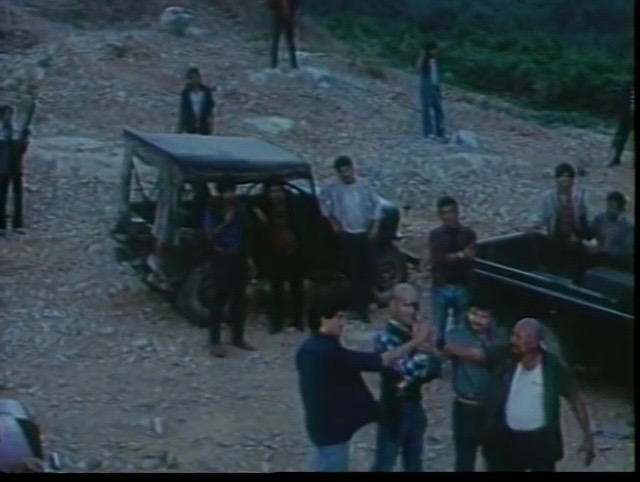
Back with One Eye, they talk for awhile. All you need to know is that they agree they are all brothers.
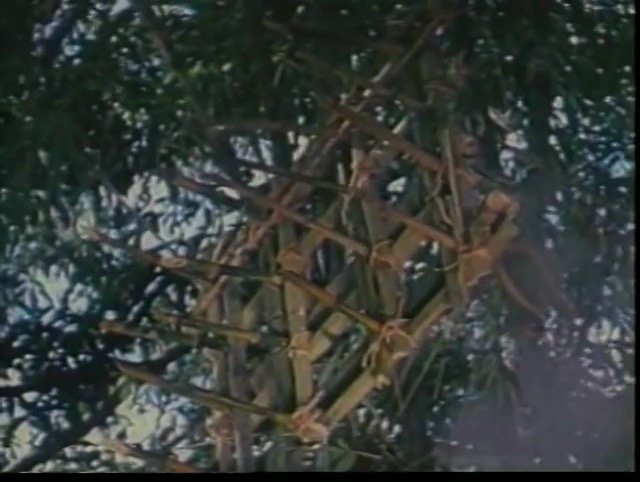
Meanwhile, some guys fall for the old guy hanging on a tree trick while driving along and get themselves kidnapped too.
One Eye is amassing an impressive collection of people for some reason that has to do with his thin as human hair connection to Movie B.
Now we are introduced to motorcycle girl who is posing as a guy.
I’m sure there was an explanation for her existence or why she seems to have it out for One Eye, but here she just seems to be out for him for no particular reason. She introduces herself as Frederick. Gigi here seems to like what she sees.
Then motorcycle girl sits down to be surrounded by some guys and get into a fight. I’m assuming the director of the original film was a fan of the scene from either Come Drink With Me (1966) and/or Django (1966). They have the same scene in them. It’s just that one uses martial arts and the other a gun. You are probably more familiar with the scene from Come Drink With Me since they recreated it for the movie Crouching Tiger, Hidden Dragon (2000). Of course this being a scene in Movie A, it goes absolutely no where. I love the summary on IMDb for Movie A:
“The other half of the movie is a about a whole bunch of Asian people that are just beating each other up for no reason, including a tall guy with an eyepatch and a woman that looks like a man. They have no real purpose in the movie, and seem to just be thrown in.”
That about sums it up.
Motorcycle girl gets a room where some more fighting happens. Also, we get a little comedy bit too. Then something just plain confusing occurs. I mean more confusing than the rest of this film.
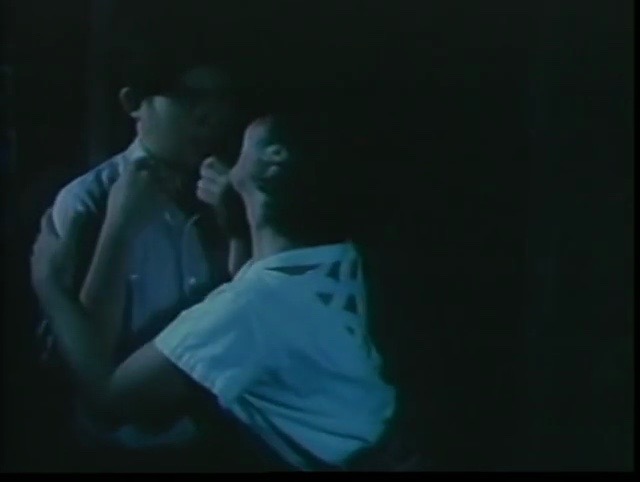
And zoom in with love music playing.
Because of the way Ho cut this all together, these two women appear to have just had lesbian sex. Honestly, the shot is so dark, her face kind of looks different, and her chest looks really flat that unless she’s binding, I have a feeling this is a different character that looked similar enough to the motorcycle girl, so Ho had the same woman dub both people and thus they are the same person. I have not been so confused by a Godfrey Ho movie since Ninja Champion (1985). Ninja Champion is a rape revenge movie that I’m quite sure had no rape in the original movie called Poisonous Rose Stripping The Night (1985). I’m also pretty sure the “retarded” character had those stereotypical retarded sounds just to cover up dialog that would otherwise be silent over moving lips. Let’s just assume that Gigi is a lesbian and motorcycle girl must be too, or just went along with it. It’s never really brought up again.
Back with One Eye, he decides to cut down a woman he has kidnapped and rapes her.
I haven’t gotten around to reviewing Troll 3/Quest for the Mighty Sword (1990), but let’s go ahead and play the rape horn.
Now One Eye pays a visit to a general he has kidnapped. He does this so he can mention the name of a character from Movie B that he apparently is working for in order to overthrow the general’s country. A couple lines like that is all you’ll get in this film as a whole. Believe me when I say that Godfrey Ho usually does go to greater extents to make characters from one movie genuinely appear to know characters from the other film. That usually involves a conversation either over the telephone or thru the magic editing technique of cutting back and forth between two people without including a shot that shows them in the same place together. You’ll see none of that here. Just the occasional name drop.
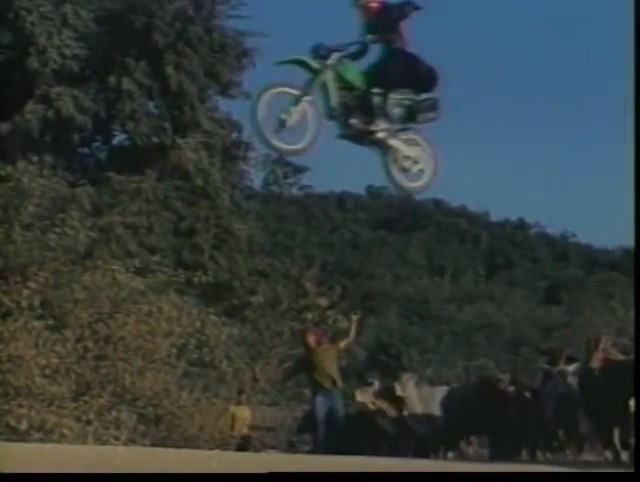
Now motorcycle girl has an action sequence for…um…reasons? I know I ask that in a lot of my movie reviews, but…oh, wait. She has an action sequence so that she can show off her sweet shotgun while on a motorcycle skills.
That’s a good enough reason I’d say. As for who she is fighting, it’s just some random people who stop her in the road. Welcome to Godfrey Ho movies where sense has no place.
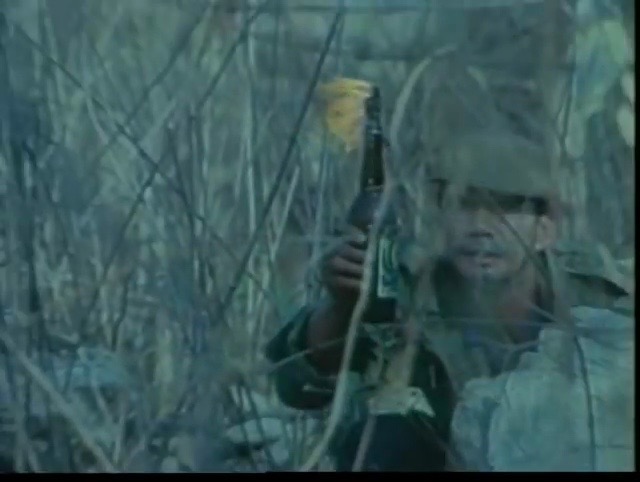
Speaking of no sense, this guy shows up with a Molotov Cocktail and saves her life.
Did that makes sense to you and you’re disappointed? Don’t worry. This film has got you covered because it now cuts to random referee guy who is spying on One Eye’s fortress of badly dubbed Asians.
Too bad for him though because he is soon captured by a movie cliche.
One Eye now tells us his origin story to the referee:
“I killed my father when I was 15. That’s right. He was fucking my girl on my bed. I blew his brains out and he took my eye.”
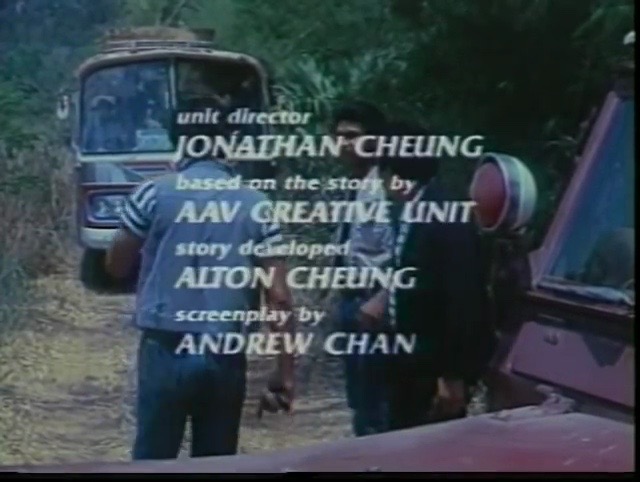
That’s interesting. Not sure how someone takes your eye after you have blown their head off though. I’m sure it’s explained in another part of the story this film is based on by AAV Creative Unit and left out by Godfrey Ho when he developed the story or was removed when Andrew Chan wrote the screenplay.
The next part is rather long. It goes without saying that it is pointless. The guy who rescued her figures out he’s a she. He actually tells her that maybe if she ate a little, then her “tits” would grow. I said it’s never really brought up again, but I’m pretty sure this is the same girl from earlier.
Motorcycle girl smiles at her implying the sex did happen. Also, this girl is happy to see her too. Even other people in the room act like they can see they like each other. That really leads me to believe they had a guy for some, or all of the scenes just dubbed with a woman’s voice.
There’s some escaping, some getting angry, and this guy gets a Rambo trap sprung on him.
Then the movie cuts back to the dumbest thing in Movie B, but we’ll get to that later.
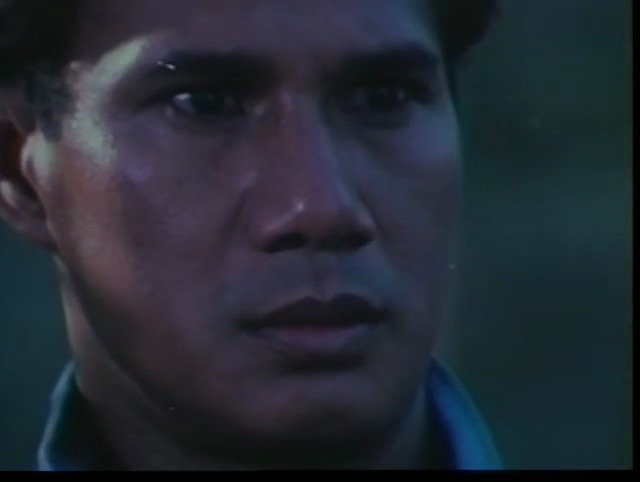
After that, it’s just one long action sequence broken up with Movie B and few lulls in the action. There is one thing to make of note of here. While a guy is just talking to this guy shown below, a sudden music stinger kicks in, it zooms in on his face, and then just cuts back to the other guy talking as if he had just been calmly talking the whole time.
That kind of sudden zoom and music stinger that is out of context with the film seems to be a thing that happens in Godfrey Ho movies as a hazard of splicing two films together.
In the end, One Eye meets his fate.
There’s something weird here too. He shoots him and One Eye appears to fall off the bracing in this barn. We never see his body. It’s just that he fell, and then it cuts to the shooter leaving the barn. I get the feeing that his death didn’t actually happen there in the original film.
End of Movie A!
Movie B:
Now we get to the U.S. Catman part of the movie and how this all links in together.
After One Eye gets his shipment of weapons at the beginning of Movie A, we cut to Movie B to a see a van with a radioactive symbol on it pass Catman and his sidekick.
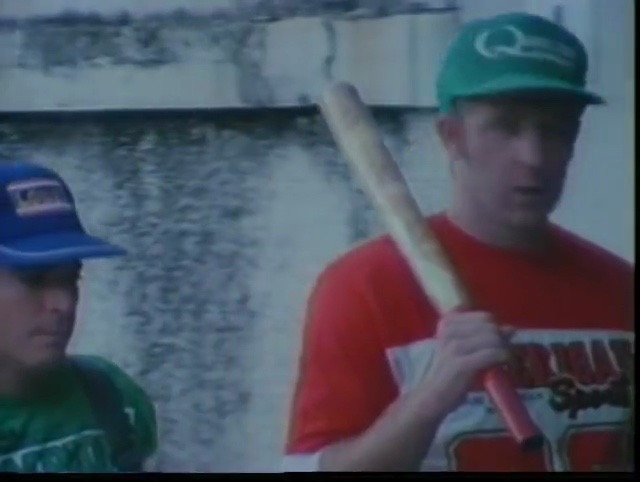
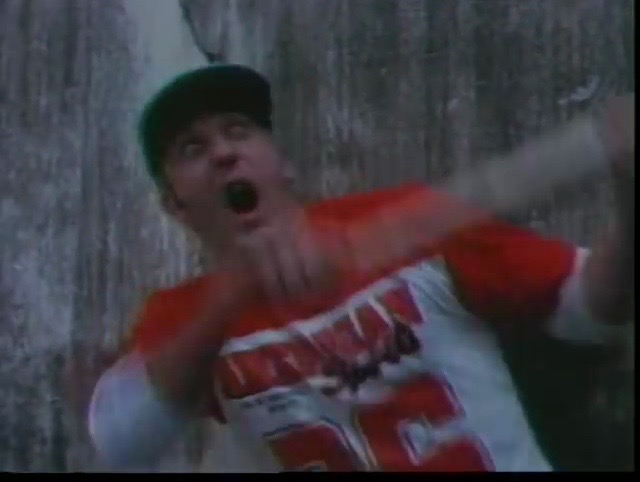
These guys are so American. The sidekick is wearing a Lowe’s hat, Catman is wearing an “American Sports” jersey, and they just got back from playing baseball. Catman’s sidekick is going to be joining the CIA. At least I think that’s what they said. It’s kind of confusing. Then we hear the car drivers talk about the cat, cat piss, and then that one of the drivers has to take a piss as a result of their discussion.
Time to meet two drug addicts who are nearby to all this.
They can talk all they want about needing a hit, but it’s clearly the full screen aspect ratio that is their real problem. They try to rob the truck with the radioactive cat inside. Catman and his sidekick come to the rescue and we discover why the pause button was invented.
As you already have guessed, he gets scratched by the radioactive cat during the fight. I love that they insert ninja sword sound effects for when the bats are swung around.
Now we cut to a graveyard to find out how Movie A and Movie B have any semblance of a connection.
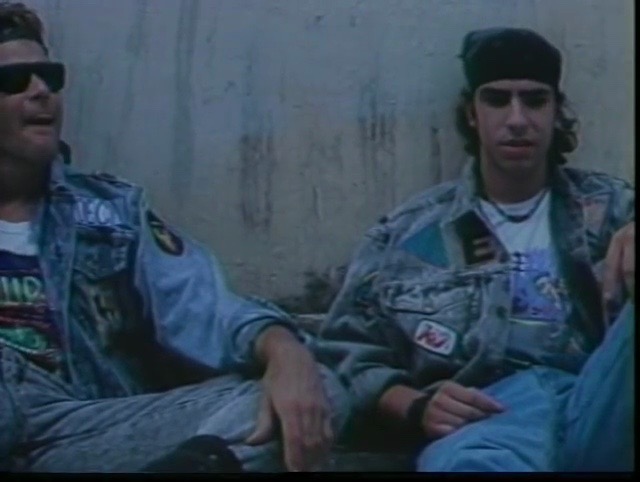
That’s cult leader Cheever. He is meeting with a guy that must be Russian because of his accent. He talks about previous attempts to take over countries such as Afghanistan that have failed. The gist is that Cheever is supposed to get in touch with the folks from Movie A to support them in order to get the people first to then overthrow the government. This, as opposed to going in with force. They drop a couple of names to make sure we know that they know what is going on over in Movie A. They are planning on starting with Thailand since that’s where Movie A happens to take place.
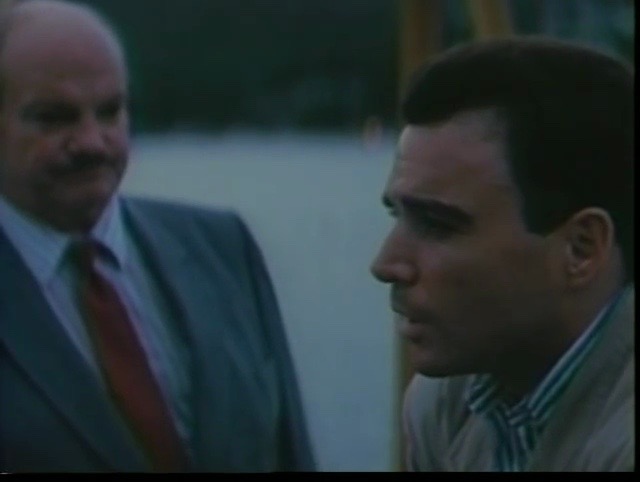
Then we cut to two guys talking about this whole Cheever situation. The one on the left tells the one on the right to check out the Holy Cheever Church. You’ll never see him again. Unless he is somehow Catman’s sidekick even though said sidekick has no idea what the Holy Cheever Church is later on.
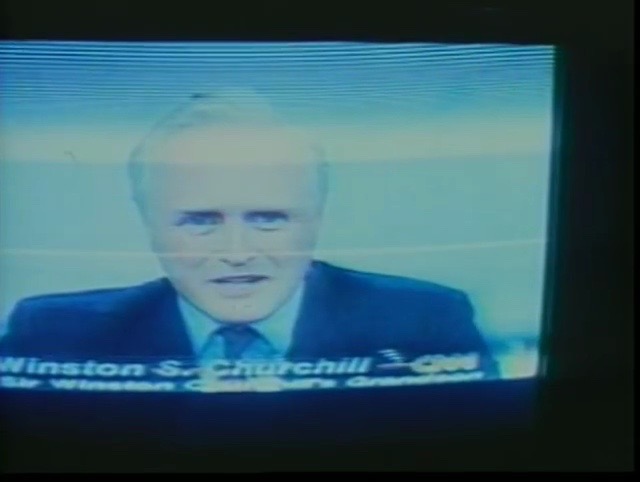
Now Catman is woken up from sleep feeling funny. He discovers that he can touch or seemingly point at electronics and they will turn on. You’ll see him use that power…never in this movie. We do see CNN on TV during this scene, which appears to be talking about Winston Churchill.
Then just as he is getting really happy, his friend walks right in. They’re only working with about 15 minutes of footage here so they have to keep it moving. His friend decides that if he can make electronics turn on, then maybe he can light a cigarette by looking at it. It works of course.
With that out of the way we get: “I feel so strong. I feel I could punch a hole in a fucking wall!”
Clearly he has some sort of super strength. There’s one last thing that needs to be checked.
I’m not kidding when I say they look down wondering if his penis also has super strength too before staring at the hole in the wall again. I guess there is a guy out there who meets up to the standards the girl from Real Genius (1985) has about men she sees. That being a guy who can hammer a six-inch spike through a board with his penis, as she says in that movie. Again, super strength and all are powers that will not really be brought up again.
Time to see Catman in action! The drug addicts from earlier try to rob Catman’s sidekick who is disguised as a road construction worker when Catman shows up to save the day.
No, I didn’t leave anything out. No explanation is ever given about his uniform. Nor is any explanation given how he can deflect bullets with his wrists.
He beats them up and recovers some tube. Not sure what this tube is, but he does mention checking it out using their Cat Computer. You’ll never see it, but they will say it has given them a clue called HCC, which stands for the Holy Cheever Church.
Coming out of church they see a guy just lying around, which means he might know something.
He wants coffee and a hamburger first. Luckily, a neighbourhood 7-Eleven store is nearby.
Now we cut to the Holy Cheever Church. It’s the best part of the movie.
We’ve got our woman strung up onstage.
Then we have a guy juggling, a guy playing with hairspray, a guy hand banging, and a guy training with a punching bag.
They’re the best, or something. Cheever seems pleased which is why he points to something with his cane, it lights on fire, and then it immediately cuts to a woman shampooing her hair. Oh, and the girl onstage was raped by Cheever when she was 13 and has been had by the other guys. I guess that includes the shampooing girl too? She sure seems happy that the woman onstage has been sentenced to death for giving away secrets in what must have been lost footage. She even says, “Kill that bitch!” She’s even chosen to do the decapitation. She really gets into things when her hair is covered with soap. Seriously, what is this?
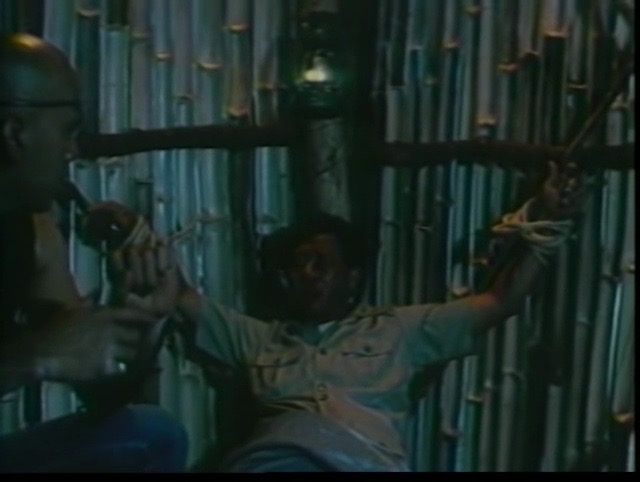
Then Catman shows up. In comes either the sidekick or the guy undercover. Doesn’t matter. They let tied up woman loose and she sprays them both with something that knocks them out. They wake up on the “Don’t Fuck With Cheever” bullseye.
I have to admit that I didn’t notice any of this sidekick and/or undercover agent confusion while watching this movie. Probably because I was trying to make some sense out of Movie A.
Then we are back at Catman’s apartment where he is drawing sketches of the bad guys when Cheever comes on TV to be interviewed. Catman is surprised.
I would be too. He just spent all that time making sketches of the bad guys and then Cheever ruins it all by just coming on TV to announce where he’ll be. I love that Cheever says his special event called “Everybody Go To God” is going to have more than 200,000 in attendance. Catman calls up to get the details. Either this event never exactly happens, or only a couple of people show up.
At this point, One Eye is dead. The movie has 5 minutes left to wrap up the Catman plot line now. Now Catman and his sidekick stumble upon the guy from earlier on their way to the Cheever event, which they are having trouble finding. That’s why they decide this guy probably knows where it is located.
He tries to get away, but there’s no running from Catman and his sidekick. Especially not his sidekick who punches him several times in the stomach. He tells them where the event is, so they split up.
Catman springs into action by running through the camera to change into his outfit.
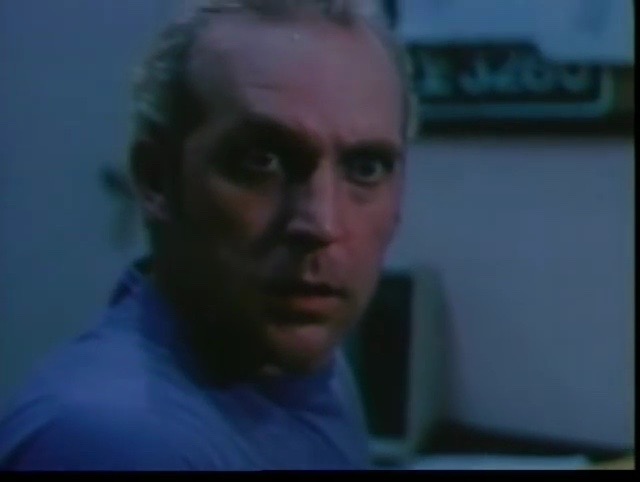
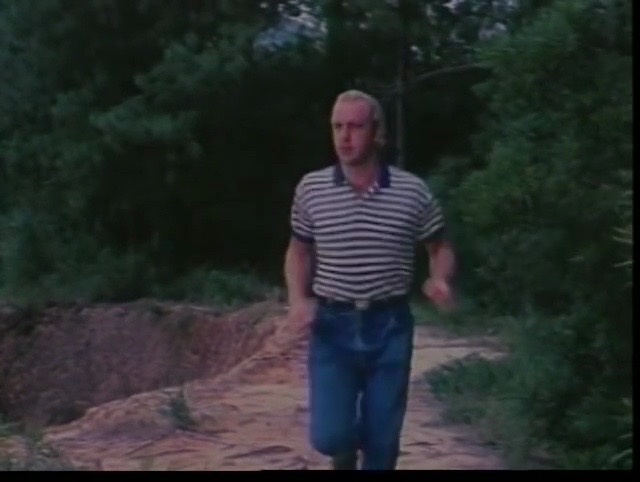
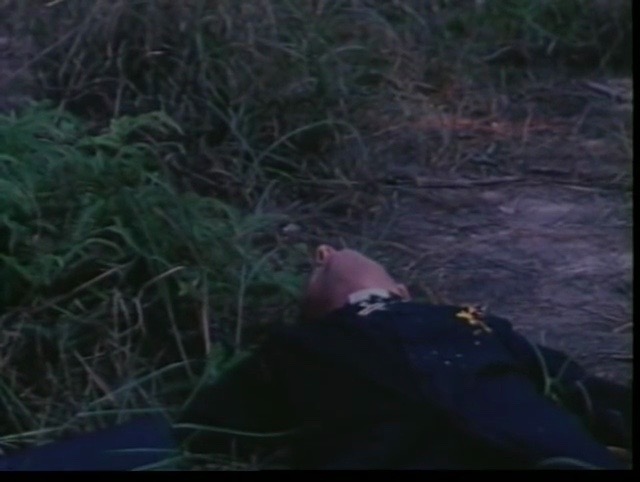
They arrive and I guess the drug addicts are working for Cheever? I don’t know. It doesn’t matter. All you need to know is that Cheever says, “I’m gonna burn you alive. I always liked hot pussy.” Then some fighting happens that kills the sidekick guy. Catman pulls a Batarang style thing from his visor and throws it into the chest of Cheever that kills him. Since it is a Godfrey Ho movie, the second that actor lies down and turns his head slightly, it cuts to “The End.” No time to waste.
Clearly there was just too much mystery here, which is why there is a sequel called U.S. Catman 2: Boxer Blow (1993).
I’m not kidding that there was too much mystery. Apparently his sidekick is back in the sequel. Does he look like he’s alive here?
Again, is he the guy from the beginning? Is he someone else? What happened to the other cult members? They weren’t at the miniature over 200,000 people meeting at the end. What was this “Lethal Track” the title spoke of? This was a real mess.
My final thoughts are that I did like the Catman parts just for how goofy they are, but that the rest worthless. I am looking forward to watching the sequel. However, if you are new to Godfrey Ho, then I recommend one of the Pierre Kirby movies. He’s the best actor he worked with that I have seen so far. They are also less confusing for the most part. Go with something like Thunder of Gigantic Serpent (1988).
What is there to say about this video that everyone doesn’t already know? There was no way I couldn’t eventually hit it. I might as well do it now. It kind of seals the deal on what I do tomorrow seeing as Weezer was hardly the only major band of the era to do this kind of thing. That said, I do have two things to bring up:
1. Spike Jonze is a prime example of a director who got their start in music videos, then went on to make feature films. One of the arguments I have had launched at me for why music videos shouldn’t be in a movie database is because directors like Spike Jonze and Michel Gondry evolved into feature film directors after making music videos. I don’t know how this is different than any other director starting with short films, then moving into features, but it apparently was for this database admin. I guess they were thinking of it like shedding a skin or something. Of course, as I’m sure you’ve guessed or already knew, Spike Jonze and Michel Gondry never stopped making music videos. In fact, he did Weapon of Choice for Fatboy Slim two years after making Being John Malkovich. If anything, I would imagine that it just made them more prized directors to get to direct your music video.
2. Microsoft included this music video on the installation disc for Windows 95 back in the day to show the operating system’s video playing capabilities. I’m pretty sure that was the first time I saw it.
This song and video never really get old to me. If I need a little pick me up, then I put it on.
























 Through the Shattered Lens