Hé
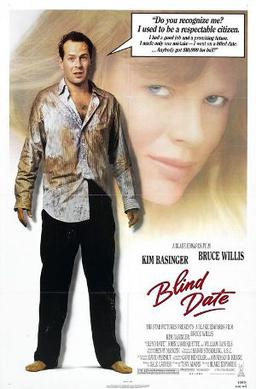
Walter Davis (Bruce Willis) is a workaholic who, in typical 80s fashion, is trying to secure a deal to manage the assets of a Japanese industrialist. When he needs a date to a business dinner, his brother (Phil Hartman) sets him up with his wife’s cousin, Nadia (Kim Basinger). Walter is warned to not let Nadia take a single sip of alcohol. Of course, Walter lets Nadia drink some champagne. It turns out that Nadia loses all of her inhibitions when she drinks and she says exactly what’s on her mind. The dinner turns into a disaster as Nadia convinces the industrialist’s wife to file for divorce. Walter not only loses his job but he now has to get the intoxicated Nadia back home. Making that difficult is that Nadia’s ex, David (John Larroquette), is still obsessed with her. David is also crazy and spends almost the entire night chasing Nadia and Walter.
Blind Date is historically significant because it was both Bruce Willis’s first credited film role (he had previously appeared, uncredited, in The First Deadly Sin and The Verdict) and also Willis’s first starring role. Willis received the role after becoming a sudden star due to his role on Moonlighting and the entire movie is full of television actors. John Larroquette was best-known for Night Court. Phil Hartman had just started on Saturday Night Live. William Daniels appears as Larroquette’s father. At the time Blind Date came out, Kim Basinger was the closest thing that the cast had to a legitimate movie star.
Watching Blind Date today, it’s strange to see Willis playing a nebbish. He’s likable but miscast as a straight-laced executive who needs his sister-in-law to set him up on a date. It’s a role that would have been best-served by someone like John Ritter, who starred in director Blake Edwards’s Skin Deep just two years after Blind Date. As David, John Larroquette is cartoonish but entertaining and he gets most of the best lines. Kim Basinger is beautiful as Nadia but doesn’t always seem to be comfortable performing comedy. There are funny moments but, as with so many of Blake Edwards’s later films, it’s uneven.
Blind Date was a box office hit. (It was the last big hit of Blake Edwards’s career.) The film found its real success on HBO, where it was a mainstay for several years. Luckily, a more appropriate starring vehicle for Bruce Willis was released just a year later. In Die Hard, Bruce Willis brought John McClaine to life and made film history.
 Through the Shattered Lens
Pingback: Lisa Marie’s Week In Review: 3/16/26 — 3/22/26 | Through the Shattered Lens