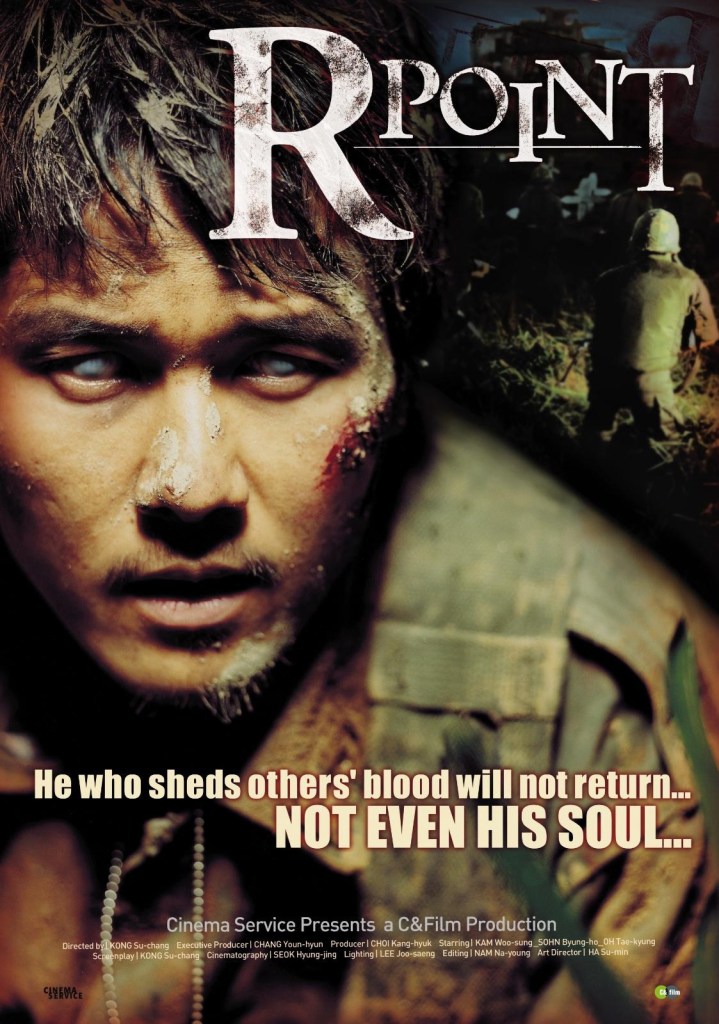
R-Point, a 2004 South Korean war horror film, expertly combines the tension and brutality of a war movie with the eerie, unsettling atmosphere of supernatural horror. Set during the late stages of the Vietnam War, it follows a South Korean military unit sent to investigate the mysterious disappearance of a platoon. The story swiftly transforms into a nightmarish journey as the soldiers confront ghostly apparitions and unexplainable phenomena deep within the thick jungle. The jungle itself acts almost like a living entity—claustrophobic, fog-shrouded, and ominous—intensifying the psychological strain the men endure.
What sets this film apart is its reliance on atmosphere over traditional jump scares, favoring a slow burn of mounting dread that perfectly suits the haunted setting. The cinematography focuses on muted greens and earthy tones, drawing the viewer into a world steeped in decay and menace. This deliberate pace and mood are enhanced by the film’s exploration of the mental and emotional toll of war, making the supernatural elements feel like extensions of the soldiers’ trauma and guilt rather than standalone scares.
The characters are more deeply developed than is typical in horror, with their individual backstories and emotional vulnerabilities slowly unfolding, making their psychological unraveling all the more impactful. Kam Woo-sung’s portrayal of Lieutenant Choi Tae-in offers a nuanced look at a man burdened by leadership and haunted by the realities of combat.
Narratively, R-Point embraces ambiguity—it blurs the lines between what’s real and what might be hallucination or spiritual torment. This ambiguity invites the audience to interpret the haunting either as a literal curse tied to past wartime atrocities or as a metaphorical reflection of psychological wounds. This open-endedness adds depth and leaves a lingering impression far beyond the film’s runtime.
That said, R-Point has its share of flaws that cannot be overlooked. Its deliberate pacing can feel slow, which may frustrate viewers looking for a more tightly paced story. The dialogue sometimes tends toward repetition, and the heavy use of helmets combined with underdeveloped character distinctions can make it difficult to connect with or differentiate the soldiers. Additionally, occasional reliance on familiar horror clichés breaks the tension rather than building it, and the film’s ambiguity, while intriguing, borders at times on confusing rather than compelling. These issues temper the film’s strengths and might limit its appeal for some audiences.
An interesting note is the film’s 2011 DVD re-release under the title Ghosts of War, which helped bring the film to a wider audience and emphasized its unique blend of war and supernatural horror.
Overall, R-Point offers a dark and thought-provoking meditation on war, trauma, and the supernatural. It stands as an evocative piece of South Korean cinema that quietly pushes the boundaries of horror by intertwining the terrors of the battlefield with unseen forces. For those seeking horror rich in atmosphere and substance, R-Point remains a haunting and worthwhile experience despite occasional imperfections.


 Through the Shattered Lens