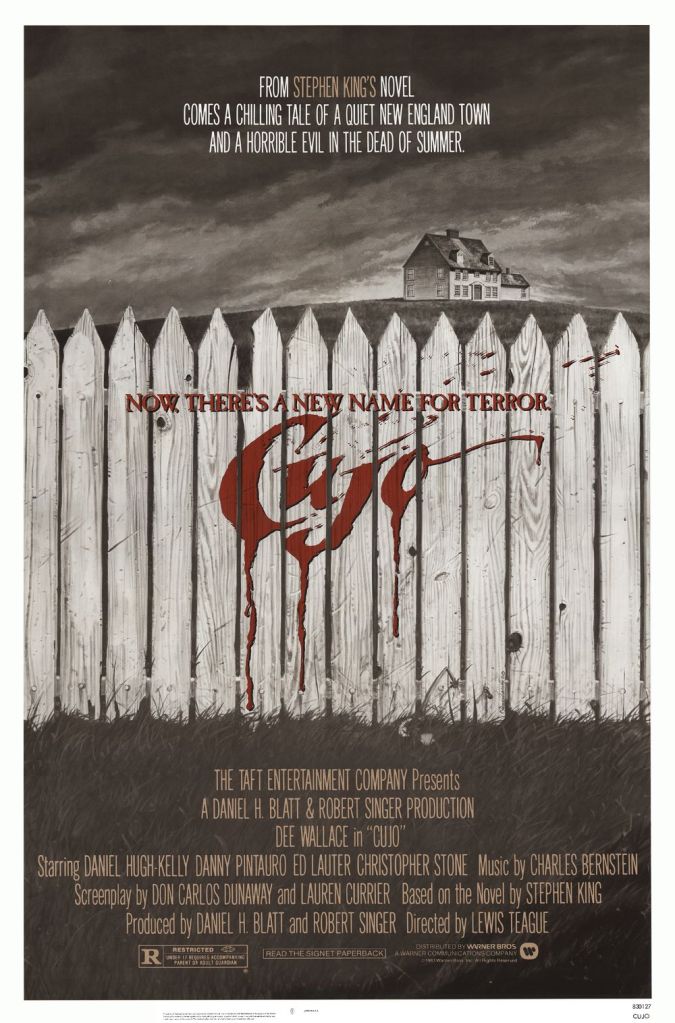
“It’s not a monster. It’s just a doggy.” — Donna Trenton
In the early 1980s, Stephen King’s novels sparked a cinematic gold rush, producing adaptations that ranged widely in style and quality. Among these, John Carpenter’s Christine and David Cronenberg’s The Dead Zone hold special status for their stylish direction and psychological depth. Lewis Teague’s Cujo, released the same year, occupies a different but notable niche. While it lacks the thematic complexity and artistic flair of those films, it outshines much of the era’s horror output, especially during a time when the genre was dominated by slasher films and gory set pieces designed as cheap thrills.
The early 1980s horror market was flooded with low-budget slashers characterized by relentless body counts, masked killers, and formulaic plots. These films leaned heavily on explicit violence and teenage premarital sex, combining graphic killings with salacious content to hook viewers seeking quick, visceral thrills. This formula dominated the home video boom, prioritizing shock value over narrative or character development. Against this backdrop, Cujo took a more deliberate and grounded approach, offering a taut thriller focused on psychological and physical survival rather than gratuitous gore.
Cujo begins with a seemingly mundane family drama. Donna Trenton (Dee Wallace) is struggling with her crumbling marriage, and her son Tad (Danny Pintauro) battles childhood fears. Their ordinary world quickly tilts into horror when Cujo, a lovable St. Bernard owned by local mechanic Joe Camber, contracts rabies and becomes a vicious predator. The film eschews supernatural elements for biological realism, making the terror brutally tangible.
Teague’s direction is restrained but effective. He builds tension through atmosphere and character rather than cheap scares. Dee Wallace delivers a deeply emotional performance, portraying Donna’s terror, resilience, and fierce maternal instinct with authenticity. Pintauro’s natural vulnerability bolsters the emotional weight, grounding the film in relatable human experience.
Cinematographer Jan de Bont’s claustrophobic framing, point-of-view shots from both dog and victims, and the oppressive imagery of the sweltering, stranded car amplify the suffocating dread. The restrained editing and thoughtfully designed soundscape further heighten suspense without resorting to excess.
While the film’s early pacing leans heavily on domestic drama, some subplots—Donna’s affair and marital discord—feel underdeveloped, losing potential narrative resonance. A few moments push the bounds of plausibility, especially Cujo’s extreme aggression, and familiar horror tropes surface near the climax. Additionally, the film’s ending diverges from King’s grimmer novel, opting for a resolution that some find cathartic, others less satisfying but still emotionally charged.
Compared to Carpenter’s Christine and Cronenberg’s The Dead Zone—which embraced symbolic, psychological, and stylistic complexities—Cujo focuses on survival horror rooted in reality. This grounded approach was relatively unusual for the time and gave it a distinctive identity amid the slew of copycat slashers. Where many early 80s titles peddled blood, teenage promiscuity, and spectacle for quick payoffs, Cujo offered slow-burning dread, emotional depth, and an unrelenting focus on human vulnerability.
This ambition helped Cujo stand apart, making it a stronger, more thoughtful film than most of its low-budget contemporaries. It may not match the artistic heights or thematic sophistication of its King-adapted peers, but it carved out a unique place by delivering a visceral, character-driven thriller that leveraged fear’s everyday, primal roots rather than supernatural fantasy or teenage rebellion.
Ultimately, Cujo excels as an intense, claustrophobic horror film powered by standout performances and atmospheric tension. Its power derives from a terrifyingly plausible premise and an empathetic portrayal of survival against merciless odds. It is a gripping reminder that horror need not be lavish or supernatural to be effective—sometimes, the most terrifying monsters are those lurking close to home.
For fans of 1980s King adaptations and horror outside the slasher mainstream, Cujo remains a compelling watch. Its imperfections, including slower pacing and some narrative shortcuts, are overshadowed by its psychological realism and emotional impact. Cujo is a rare early 80s horror film where the primal terror of a loved pet turned threat, family fractured by fear, and nature’s cruel indifference combine to create a haunting, enduring cinematic experience.
 Through the Shattered Lens