“Man is the cruelest animal.” — Friedrich Nietzsche
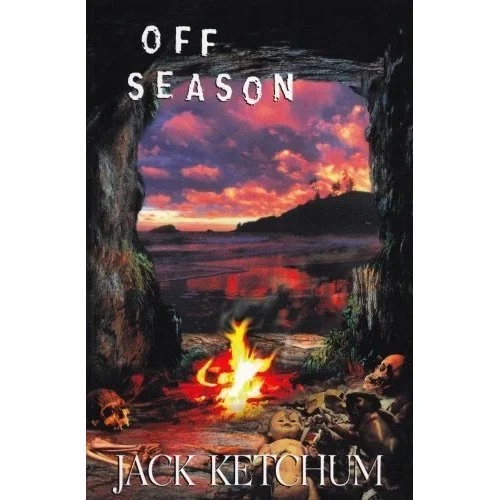
Jack Ketchum’s Off Season wasn’t my first venture into extreme horror, but it was an important stop along the way in my continuing exploration of splatterpunk—those raw, confrontational horror stories that don’t flinch from showing you every grisly detail. I’d already spent time in the grand guignol worlds of Edward Lee, Richard Laymon, Poppy Z. Brite, and Brian Keene, and I thought I’d built up a decent resistance to the genre’s more intense offerings. Then I opened Off Season, and within a few chapters, I realized this was going to hit differently. It’s less a fun horror romp and more of an ordeal—one that leaves you feeling like you’ve just crawled out the other side of something vicious, primal, and deeply unsettling.
Ketchum builds his novel around the infamous legend of the Sawney Beane clan—a family of cannibals who, according to folklore, hunted travelers along the Scottish coast in the 15th century. He strips that story out of its historical setting and drops it into the rocky, isolated coast of Maine, replacing the medieval backdrop with an environment that still feels dangerous and untamed. The setup is simple enough: a group of friends from New York rent a secluded cabin, expecting a peaceful getaway, and instead find themselves hunted by a clan that’s every bit as savage as their legendary counterparts. There’s a vibe here that’s partly Romero zombie survival horror, partly John Carpenter claustrophobic menace, but the big difference is that these villains aren’t supernatural—they’re unsettlingly human, real in their hunger and their primal needs. They do what they do because it sustains them, and somehow that makes them worse than any ghost or monster.
While Wes Craven’s The Hills Have Eyes mined similar ground with a more stylized, exploitation-film aesthetic, Ketchum’s take leans hard into plausibility. His cannibal clan feels like a natural, if disturbing, product of generations of isolation and inbreeding, kept alive through hunting, killing, and eating whoever wanders too close. That realism is what makes the violence hit so hard. Ketchum describes their assaults on Carla, her sister Marjie, and their companions with an unapologetically matter-of-fact tone—no flourish, no dramatics. The worst moments aren’t always the attacks themselves, but what he shows inside the clan’s cave home. Kids scamper across jagged stone like feral animals, gnawing meat straight off the bone. Adults pair up in incestuous “unions” meant only to keep the bloodline going. It’s both grotesque and disturbingly believable.
That refusal to hold anything back is part of why Off Season has been linked to splatterpunk, the horror subgenre that gained fame (and infamy) for pushing gore, moral transgression, and human depravity to the forefront. Some critics wrote it off as “horror pornography,” too focused on shock value, but fans saw it differently. In Ketchum’s hands, it’s not about gore for gore’s sake—it’s about stripping away all the comfort zones and exposing something ugly yet honest. When you finish one of these novels, you’re not left thinking “That would never happen.” You’re left thinking “That could happen. Under the wrong circumstances, that would happen.”
One of Ketchum’s storytelling choices is speed. The pacing is fast—there’s just enough time to understand who the characters are before the horror crashes down. That keeps tension high but also means the victims aren’t deeply fleshed out. They’re more representative than personal, standing in for civilization as a whole rather than pulling us into their emotional worlds. You don’t get many chances to connect with them deeply. Instead, you watch them transform from vacationers into survivors, and in some cases, those survivors become something just as savage as the people hunting them.
That shift happens in the second half, when the remaining characters fight back. The counterattack is satisfying in its own crude way, but Ketchum never dresses it up as righteous victory. The brutality of revenge feels just as ugly and unrelenting as the initial assault. By the end, what’s been preserved isn’t humanity—it’s just the body count in favor of the people we started with. The survivors get out, but they’re not unchanged. It’s not the kind of ending that makes you breathe a sigh of relief. More like an exhale that admits, “We made it, but look at what it cost.”
When Off Season first came out in 1980, it caused an immediate stir. Its content was so graphic that some bookstores wouldn’t carry it, and an edited version had to be released to calm the outrage. Years later, Ketchum went back and put out the uncut edition, restoring everything that had been stripped away. Reading that version today is reading the novel as he intended—nothing softened, nothing taken off the table. And in the world of extreme horror, that kind of authenticity is prized. It’s part of what’s given Off Season its staying power; it’s not just a book, it’s a dare.
Underneath all the blood and carnage is a question that sticks with you: If people were cut off from society long enough—if they lost the rules, the moral codes, the comforts—how far would they regress? Ketchum’s cannibals don’t feel like the spawn of evil forces. They feel like us, just pushed far enough in the wrong direction. Their behavior doesn’t come from cruelty for cruelty’s sake. It comes from basic survival drives—hunger, reproduction, and dominance. That’s why they’re such unnerving villains. They’re an evolutionary throwback you can imagine existing somewhere out there, beyond the maps, waiting for someone else to wander too close.
Finishing Off Season doesn’t give you that neat sense of closure other horror stories sometimes aim for. It doesn’t even give you release. It leaves you worn down, a little grimy, and maybe even unsettled in ways you didn’t expect. That’s the difference between horror built on supernatural scares and horror built on human brutality. The latter lingers; it’s harder to shake because you can’t make it go away just by telling yourself, “It’s only fiction.” With Ketchum, you’re never entirely sure.
As far as splatterpunk milestones go, Off Season earns its reputation. It’s both a challenge and a gut-punch—the sort of book that reminds you horror can still be dangerous. It’s not for every reader—if you’re expecting subtle ghost stories or stylish monster tales, you won’t find them here. What you’ll find instead is a grim, fast-paced nightmare about people who’ve let go of everything we’d call human and replaced it with something primal, something real in their hunger and their primal needs. And in the end, that may be the most disturbing thing about them—they’re not from another world. They’re from ours.
 Through the Shattered Lens