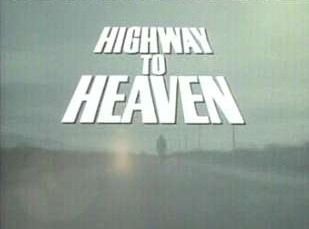
Welcome to Late Night Retro Television Reviews, a feature where we review some of our favorite and least favorite shows of the past! On Thursdays, I will be reviewing Highway to Heaven, which aired on NBC from 1984 to 1989. The entire show is currently streaming on Tubi and several other services!
This week, Mark and Jonathan meet yet another grouchy old man.
Episode 4.14 “Country Doctor”
(Dir by Michael Landon, originally aired on January 13th, 1988)
Grouchy old Dr. Hudspeth (Roscoe Lee Browne) is getting older and his health is suffering but if he retires, who will take over his practice? Jonathan and Mark come together to show Dr. Hudspeth the importance of having faith in other people and also how much everyone in the town has come to love him.
This episode was sentimental in the typical Highway to Heaven way. Grouchy old man are always secretly saints on this show. That said, this episode didn’t do much for me because the doctor was a little bit too grouchy. That’s a polite way of saying that Roscoe Lee Browne yelled almost all of his line and never quite came across as being as great a doctor as he was supposed to be. Browne wasn’t alone. Everyone in this episode overacted, including Michael Landon and Victor French. Considering how over-the-top the show tends to be with everyone delivering their lines normally, having people shout pushed the show over the edge.
In the end, this was Highway to Heaven on autopilot.
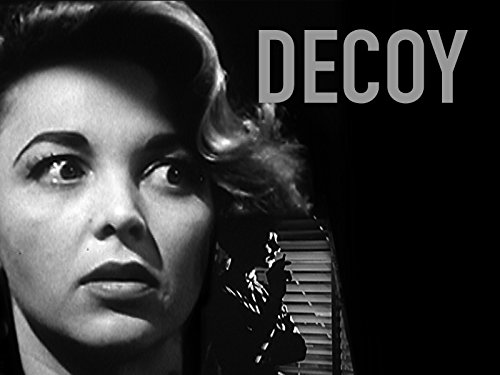
Welcome to Retro Television Reviews, a feature where we review some of our favorite and least favorite shows of the past! On Thursdays, I will be reviewing Decoy, which aired in Syndication in 1957 and 1958. The show can be viewed on Tubi!
This week, Casey investigates a case of insurance fraud.
Episode 1.4 “To Catch A Thief”
(Dir by Teddy Sills, originally aired on November 4th, 1957)
A thief and his girlfriend mug a business owner named Mr. Whitaker (John McGovern). When the police capture the thief, Mr. Whitaker claims that more money was stolen from him than was recovered. Casey is sent undercover to discover whether or not Whitaker is lying or if a cop actually skimmed the cash that they recovered.
Pretending to be the thief’s girlfriend, Casey approaches Mr. Whitaker and tries to blackmail him. When Mr. Whitaker appears to be innocent, his secretary (Mary James) falls under suspicion. Mr. Whitaker, however, is eventually exposed as trying to commit insurance fraud when he has a conversation with his secretary at the police headquarters. Unfortunately, for him, the room was bugged.
This episode bothered me. On the one hand, I didn’t want an innocent police officer to be suspended for stealing money that he didn’t steal. On the other hand, having Casey go undercover as a blackmailer felt almost as if it verging on entrapment. As well, I found it hard to understand why Mr. Whitaker would be fooled into thinking Casey was the one who had robbed him earlier. Didn’t Mr. Whitaker see the people who mugged him?
Many years ago in Southern Oregon, I had a conversation with friends about some of our favorite films growing up. Movies like The Goonies, The Dark Crystal, Watership Down and The Secret of Nimh were all on the list, as well as Disney’s Tron. In our excitement for all these movies, we ended up renting the films from a local video store to relive our childhood. While the nostalgia was nice, we all ended falling asleep halfway through Tron, despite our love for it.
I guess one’s enjoyment of Tron is based on how it’s viewed. I caught the film two years ago at the Museum of the Moving Image, in 70MM. The first thing that caught my attention was the film grain. I’ve grown so used to the clarity of digital film presented in 4K that I couldn’t help but catch the little flicks and “cigarette burns” in at the start. This was life before digital, and it was beautiful to revisit. In a theatre, the film’s 96 minutes blazed by for me. The early 1980s was basically made up of bike rides and video arcades. The little boedga on the corner of my block back home even had a few arcade machines in the front of the store in the first half of the 80s. The Bodega’s still there, the arcade’s now a deli/hot meal area. Times can and do change.
Tron is the story of Kevin Flynn (Jeff Bridges, Bad Times at the El Royale), a former employee at Encom, a major computing and videogame company. Encom’s made some wonderful strides in technology as of late, by 1980’s standards. Encom performs special matter tests in a specialized lab, while the programmers grind away code in their cubicles. All of their work is overseen by the Master Control Program, an operating system of sorts. Granted, the workforce at Encom isn’t too pleased about having the MCP monitor their applications. Alan Bradley (Bruce Boxleitner, Kuffs) and Lori Baines (Cindy Morgan, Caddyshack) also have programs and projects of their own that are being culled. Alan’s program, Tron (also played by Boxleitner) is of particular interest to the MCP, as it acts an a security threat that could bring some serious problems. Kevin tries to hack his way into Encom with the use of a program he created called Clu (also Bridges), but the MCP and the Senior Vice President of Encom, Ed Dillinger (David Warner, The Omen, Teenage Mutant Ninja Turtles II: The Secret of the Ooze) keep Flynn at bay. When Alan and Lori discover what Flynn’s up to, they confront him at his arcade, where he explains that he was the actual creator of Encom’s top games. He only needs the data as proof. This leads to the team breaking into Encom, where the MCP digitizes Flynn and brings him into the computer world. Can Flynn escape and help liberate the programs enslaved by the MCP and its henchman, Sark (both also played by Warner)? Can Flynn find the proof to exonerate him? And just who is this Tron fellow, anyway?
The plot for Tron inside the machine becomes a bit theological. The programs believe in the Users, and that they were each created for a particular purpose. From Ram (Dan Shor, Bill & Ted’s Excellent Adventure) being an Actuarial Program to Tron being a defense against the MCP, it’s kind of interesting once Flynn shows up. As a User, he doesn’t have much more power than a program, save that he can’t really be derezzed and that he can mimic the neon glow of anyone he touched. I always thought they could have given him something cooler to do, though for 1982, repurposing machines does have some benefits. The story slows down a bit in the middle, feeling like it’s somewhat unsure of itself, but picks up in the final act with Tron vs. Sark and the MVP. Though Flynn is important to the outcome, he’s more like Big Trouble in Little China’s Jack Burton, kind of just watching this happen around him. He does have his moments, though.
When I was little, my dad owned a Commodore 64 and a Floppy Disk Drive. He would regularly pick up magazines like Byte! to catch up on new innovations. In most of these magazines, they’d have a program that you could enter in at home to create various effects like making a balloon fly across your screen. Those programs were usually written over a number of pages with hundreds of lines of code. For Tron, there were 3 teams dedicated for the Visual Effects. According to the behind the scenes documentary on the disc, Information International Inc., known as Triple-I, was brought in to handle the major work along with Mathematic Applications Group Inc. (MAGI), who director Steven Lisberger worked for at one point early in his career. Digital Effects of New York handled some of the responsible for some of the original CGI work used in Michael Crichton’s Westworld (considered one of the first CGI movie uses ever) and it’s sequel, Futureworld. For the time, the effects were groundbreaking. Mind you, most of this was all before we ever hit the 8-bit era of Nintendo, the Commodore Amiga or even the high resolution arcade games of Sega’s heyday like Space Harrier, Outrun or Afterburner. In an actual arcade in 1982 had games like Q-Bert or Dig Dug with the kind of graphics you’d never see on home systems.
Kevin Flynn (Jeff Bridges) and others (including a young Michael Dudikoff to his right) watch Tron fight for the users. This would inspire Dudikoff to become an American Ninja.
The designs for the look and feel of the computer world came from Lisberger himself, with a bit of assistance from both futurist Syd Mead and legendary artist Jean “Mobius” Giraud. Both men were extremely popular. Mead was the equivalent of Apple’s former Chief Design Officer Jony Ive, having created the “V’ger” model for Star Trek:The Motion Picture. Ironically, Mead’s work (both on the set design and the flying cars) would be seen by audiences watching Ridley Scott’s Blade Runner just a month shy of Tron’s release. Having worked on Alien years prior, Giraud helped to design and inspire both the clothing and some of the vehicles, such as the weird cradle for Dumont (Bernard Hughes, The Lost Boys) and the Light Cycles.
A film dealing with computers needed a composer familiar with electronic music.It seemed fitting that Wendy Carlos(A Clockwork Orange, The Shining) took on the challenge. Having built a computer at 14, Carlos’ love for music over the years lead her (with Robert Moog) to help develop the Moog synthesizer system. The Moog would go on to be used by Kraftwerk, Giorgio Mororder, Nine Inch Nails, The Prodigy Daft Punk and even J Dilla, among others. The Tron Soundtrack was a mix of orchestra, choir and electronic music. Although the sound may not be as dark and digital as Daft Punk’s score for Tron: Legacy, I felt it worked for the time and moves well with the film. In addition to Carlos’ score, Journey wrote the song “Only Solutions” for the film, which also happens to be a line uttered by Kevin Flynn.
Overall, Tron is one of those movies I can happily rewatch without much in the way of expectation. I enjoy it for its place in Sci-Fi cinema, and the memories it awakens. I don’t think Disney ever fully recognized the full potential of where they could take the story, though the animated Tron: Uprising was a great part of the saga. I’m just hoping Tron: Ares doesn’t stray too far from the fold.
4 Shots From 4 Films is just what it says it is, 4 shots from 4 of our favorite films. As opposed to the reviews and recaps that we usually post, 4 Shots From 4 Films is all about letting the visuals do the talking.
Let’s hop in the cinematic time machine and take a trip to the distant past with these 4 shots from 4 independent films!
Today’s music video of the day features France’s XYZ rocking out in the desert, with the help of some hard-working models.
XYZ was formed in 1978 and, after ten years of playing Europe, New York, and Los Angeles, they finally got a record contract in 1989. The self-titled album was produced by Don Dokken who later said that the experience was difficult because the band’s lead singer had a thick French accent and the other members of the band was incapable of vocally harmonizing with him. This led to Dokken singing backing vocals for most the songs, including this one.
The video was directed by Craig Morse. On the IMDb, this is the only music video that he is credited with directing. Of course, the IMDb often lists music videos without crediting a director so it’s possible that Morse might have a few more videos to his name. Or he might just be a rare example of a one-and-done music video director.
This single was successful enough to XYZ went on tour with Ted Nugent. The band, however, broke up shortly afterwards.


 Through the Shattered Lens