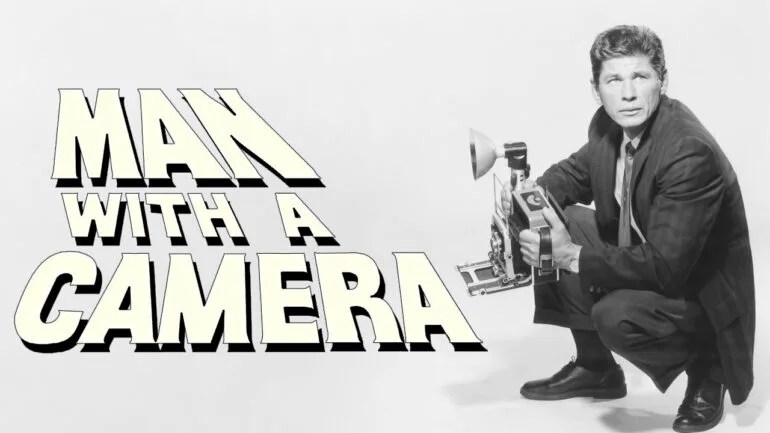
This episode opens with Mike Kovac (Charles Bronson) visiting an illegal gambling den operated by Walter Bradman (Dennis Patrick). Kovac takes a picture of Bradman with a small camera he’s placed inside of a cigarette lighter. You see, an honest lawyer named John Payson (Logan Field) is running for governor on a platform of shutting down these types of criminal establishments, and Kovac thought this might make for an interesting story in the current political environment. But Bradman catches him taking the picture, and just when it looks like he might forcibly take the camera and film from Kovac, Bradman decides to let him go. It seems that Bradman has bigger plans for Kovac as he happens to know that Kovac is going to the Payson’s household to take family pictures the very next day. Bradman has an inside person in the Payson household, his girlfriend Miss Hollis (Phyllis Avery), and he plans to steal the negatives. They will then use Miss Hollis’ ex-con dad Clyde Bosser (Addison Richards) to create fake composite pictures that pretend to show Payson in the gambling den and hanging out with women other than his wife. He’s hoping that a little blackmail might get Payson off his back, but as you might imagine with Mike Kovac on the case, the plan falls apart and nobody is safe!
“Turntable” is a solid episode of MAN WITH A CAMERA. There are several reasons I enjoyed it. The presence of Charles Bronson in the lead is always at the top of the list. His down-to-earth charisma anchors the series and this episode in such a way that there’s always something worth watching on screen. He does get to beat up a couple of guys and that’s very fun for me. Dennis Patrick is good as the den boss. He’s very confident and cocky until his plan starts falling apart. Once he begins to panic, things really start to get interesting. The story is also intriguing, as it deals with doctoring photos for nefarious purposes, a novel concept in 1958, but something that’s all too common these days. The composite pictures created as part of this episode are actually kind of funny to look at, and it makes you wonder how some of them could have fooled anyone! I’ve mentioned before that I like episodes where Kovac’s dad Anton (Ludwig Stossel) has an important part. In this episode, he helps his son put together an important piece of the puzzle so I liked that. On the negative side, I didn’t like the political angle. John Payson’s gubernatorial candidate is made to look like an angel, and we all know how that usually works out in the political arena. Honestly, I’m sick of politics in general, and I like to watch TV and movies to get away from that kind of stuff.
Overall, “Turntable” is a solid episode with an intriguing story, a few good performances, and a scene that actually caught me by surprise. That doesn’t happen very often!
 Through the Shattered Lens
On June 13, 2025, Israel conducted military strikes targeting Iranian nuclear facilities, which has drawn significant international attention and condemnation. The Israeli Defense Forces (IDF) reported that they targeted multiple military sites, including key nuclear facilities, as part of a preemptive strike aimed at neutralizing what they described as a threat posed by Iran’s nuclear ambitions.
In response to these actions, the United Nations has condemned the strikes, emphasizing the need for diplomatic solutions to prevent escalation in the region. The UN ambassador stated that the decision to strike was an “independent Israeli decision,” indicating a lack of consensus on the appropriateness of the military action.
The strikes reportedly resulted in significant casualties, including the death of a senior commander of Iran’s Revolutionary Guards, which has heightened tensions further. Iranian state media has indicated that missile and drone attacks on Israel are expected in retaliation.
In the wake of Israel’s recent military strikes on Iranian nuclear facilities, several major world powers, including Britain, France, Russia, and China, have condemned the actions as “unprovoked.” These nations have expressed deep concern over the escalation of tensions in the region and the potential for further conflict.
The strikes, which occurred on June 13, 2025, targeted multiple sites associated with Iran’s nuclear program, including key military installations. Israeli officials justified the attacks as necessary to prevent Iran from developing nuclear weapons, citing the threat posed by Iran’s nuclear ambitions.
In their statements, the leaders of Britain, France, Russia, and China emphasized the importance of diplomatic solutions and called for restraint from all parties involved. They criticized the Israeli actions as undermining regional stability and violating international norms regarding the use of military force.
In a significant diplomatic move, Britain, France, Russia, and China have collectively withdrawn their ambassadors from Israel in response to the recent military strikes on Iranian nuclear facilities. This decision reflects the escalating tensions and widespread condemnation of Israel’s actions, which these nations have labeled as “unprovoked.”
The withdrawal of ambassadors marks a notable shift in diplomatic relations and underscores the seriousness with which these countries view the situation. They have called for an immediate cessation of hostilities and emphasized the need for a diplomatic resolution to prevent further escalation in the region.
This action follows a series of international criticisms directed at Israel, with various nations expressing concern over the potential for increased conflict and instability. The UN has also been vocal in its condemnation, urging all parties to engage in dialogue rather than military confrontation.
In a reciprocal diplomatic response to the withdrawal of ambassadors by Britain, France, Russia, and China, Israel has also decided to withdraw its ambassadors from these countries. This move reflects the escalating tensions and deteriorating relations following Israel’s military strikes on Iranian nuclear facilities, which have been widely condemned as “unprovoked” by the international community.
The decision to withdraw ambassadors signifies a significant breakdown in diplomatic relations and highlights the ongoing crisis in the region. Israel’s actions have drawn sharp criticism from these nations, prompting them to take a stand against what they perceive as aggressive military actions.
This diplomatic rift is part of a broader context of heightened tensions in the Middle East, with various countries calling for restraint and a return to dialogue to address the underlying issues. The situation remains fluid, and the international community is closely monitoring developments as both sides navigate this escalating conflict.
The UN’s condemnation, backed by the UK, France, Russia, and China, portrays the action as “unprovoked” — a term that reflects political calculus more than legal clarity. Under Article 51 of the UN Charter, a state may use force in self-defense if an armed attack occurs — but preemptive strikes exist in a gray zone. Israel’s argument likely hinges on the “imminence” clause, as articulated in the Caroline case (1837): when the threat is instant, overwhelming, and leaves no choice of means.
Israel’s June 13, 2025 strikes on Iranian nuclear facilities represent a classic case of preemptive self-defense, aligning with the Begin Doctrine — the principle that Israel will not allow enemy states to acquire nuclear weapons. It echoes past operations. (1) Osirak (1981) against Iraq’s nuclear reactor. (2) Operation Outside the Box (2007) against Syria.
Yet the withdrawal of ambassadors by four permanent members of the Security Council — including the two Western nations historically sympathetic to Israel — signals a profound diplomatic rupture, potentially worse than during the 1956 Suez Crisis or 1982 Lebanon War.
But this time, the scope is broader, the stakes are higher, and the diplomatic fallout is far more severe. The reciprocal withdrawals by Israel, we are now witnessing a partial diplomatic isolation of Israel from key global players — a scenario that dangerously echoes the pre-1967 international atmosphere, only now with a nuclear shadow.
The continuity between medieval Church slanders and modern UN blood libels. Iran, a regime openly threatening genocide (e.g., statements by top officials calling for Israel’s destruction), is shielded by powers that once committed or abetted genocide. Those same powers — Britain and France — betrayed Jewish refugees pre-1948, yet now sanctimoniously claim Israel undermines “stability.” Russia, currently engaged in illegal war and nuclear threats in Ukraine, calls Israel’s actions illegal. China, persecutor of Uyghurs and enforcer of state repression, calls for restraint.
These are not neutral arbiters of international law. They are part of a long tradition of holding Jews to impossible standards, demanding “restraint” even when faced with annihilation. The UN has inherited the mantle of Church anti-Jewish theology in secularized diplomatic language. Resolution 3379 (Zionism = Racism) was the modern Inquisition; Today’s condemnation of Israel’s self-defense is the new blood libel; The ICJ’s silence on Iran’s genocidal threats is a political Kiddush Hashem inversion — punishing the victim for refusing to lie still.
Iran will likely retaliate via proxies: Hezbollah, Houthis, and Shi’ite militias in Syria or Iraq. Israel may face multi-front escalation, forcing it into a prolonged regional war.
The Gulf States’ reaction (e.g., UAE, Saudi Arabia) will be critical: they fear Iran, but won’t publicly back Israel under current diplomatic pressure. The US response under the leadership of President Trump contrasts with the European barbaric anti Jewish history.
This is more than a military episode — it’s a constitutional test of Jewish sovereignty. If Israel, as a free Jewish nation, cannot defend itself without being slandered and isolated, then the very post-Holocaust consensus that birthed the UN is shattered. Once again, the Jewish state is punished not for what it does, but for daring to exist — and fight to survive.
LikeLike