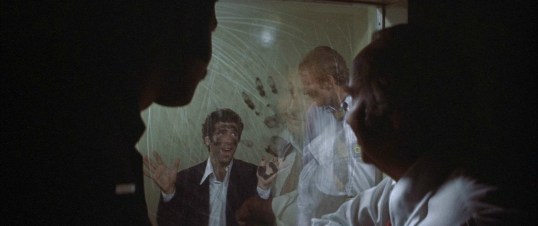
Made-for-TV Movie Review: Nightmare in Chicago (dir by Robert Altman)


Taking place over the course of one very long day and night in December, this 1964 made-for-television movie opens with the discovery of a murdered woman in Indiana.  She is the latest victim of a killer that the press has nicknamed “Georgie Porgie.”

Georgie Porgie, who has killed five blondes in the Midwest, is actually a nondescript man named Myron Ellis (Philip Abbott).  Myron is middle-aged, short, and fairly normal-looking.  That, along with the fact that he’s always moving, is one reason why he has yet to be captured.  The only thing that really stands out about Myron is that, due to a medical condition, he is extremely sensitive to light and always wears dark glasses, even at night.  When Myron isn’t murdering someone or stealing a car, he’s haunted by the voice of his dead sister.

Because he is a nomadic killer, the authorities in Chicago are worried that Myron is coming to their town next and it turns out that they’re correct.  Myron is already in Chicago and he’s looking for his next victim.  In a rather disturbing scene, he strangles a woman that he meets at a strip club, managing to do so without any of the many people around them even noticing.  Myron wanders up and down the streets of Chicago, looking for his next victim.  With his polite manners and his bland appearance, no one suspects that the polite man on the street corner is actually a murderer.

Police Commissioner Lombardo (Ted Knight) and Detectives McVea (Robert Ridgley) and Brockman (Charles McGraw) decide that the best way to catch the killer would be to set up a dragnet on the highway, stopping cars and shining flashlights at the drivers to see who has the weakest eyes.  The only problem is that there is also a nuclear missile convoy scheduled to move through the city at the same time.  With the highways congested and the killer not above wrecking his own car to throw the police off his trail, Lombardo tries to both capture the killer and make sure nothing happens to the convoy.

Nightmare In Chicago is a short and efficient thriller.  It’s well-acted and rather serious in its approach.  Especially when compared to more recent films with similar plots, Nightmare In Chicago deserves some credit for not trying to turn its serial killer into some sort of diabolical mad genius.  Myron, like all serial killers in real life, is a maladjusted and rather stupid person who has only gotten away with his crimes due to pure luck.  He’s not a Hannibal Lecter-style supergenius.  Instead, he’s just a creep who has many, many issues.  The film also does a good job of capturing the manic energy and eventual exhaustion of pulling an all-nighter.  It’s an effective little film with a memorably sordid story.

For modern audiences, probably the most interesting thing about Nightmare in Chicago is that it was directed by Robert Altman and was, in fact, his second non-documentary film after The Delinquents.  At the time he made this film, Altman was largely working in television.  Nightmare In Chicago was one of the first made-for-TV movies and it was a ratings and critical success.  Seen today, it’s easy to spot Altman’s trademark attention to detail in the film.  While it’s far more straight-forward than the majority of his feature films, Nightmare in Chicago still displays the talent that eventually led to Robert Altman become one of Americas most important filmmakers.
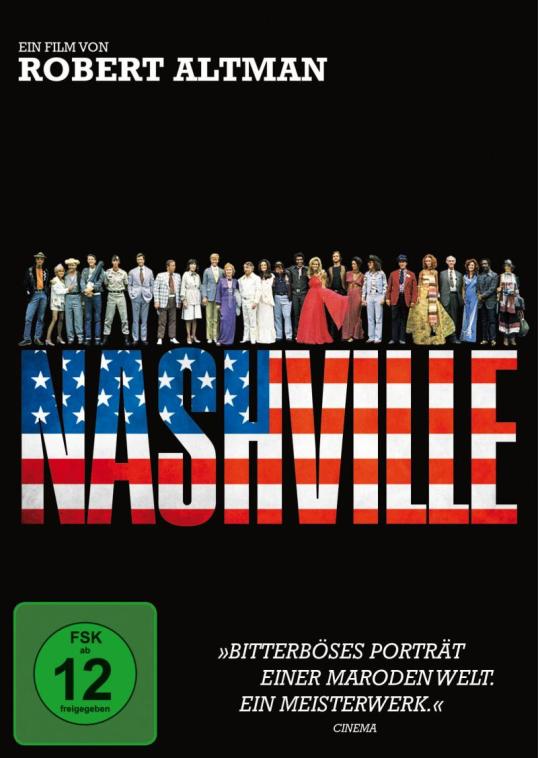
Song of the Day: 200 Years by Henry Gibson


Today’s song of the day comes from the soundtrack of Robert Altman’s 1975 masterpiece, Nashville.

Written and performed by Henry Gibson (who played the role of Haven Hamilton in Altman’s film), 200 Years was meant to be a satire of patriotic country music.  But apparently, Gibson did such a good job capturing the feel of those songs that several patriotic singing groups actually added 200 Years to their repertoire.

Myself, I find the song to be just as heavy-handed in its satire as the song itself is meant to be heavy-handed in its patriotism.  But, perhaps that’s the point.  It’s definitely effective in its way and it certainly fits in with Altman’s stylized portrayal of American culture.  I guess this song is a real Rorschach test.  Some will see it as a commentary on jingoism.  Others will hear it and say, “He’s right, we must be doing something right.”

My mother’s people came by ship
And fought at Bunker Hill
My daddy lost a leg in France
I have his medal still
My brother served with Patton
I saw action in Algiers
Oh we must be doin’ somethin’ right
To last 200 years.‎

I pray my sons won’t go to war
But if they must, they must
I share our country’s motto
And in God I place my trust
We may have had our ups and downs
Our times of trials and fears
But we must be doin’ somethin’ right
To last 200 years.‎

I’ve lived through two depressions
And seven Dust Bowl droughts
Floods, locusts and tornadoes
But I don’t have any doubts
We’re all a part of history
Why Old Glory waves to show
How far along we’ve come ’til now
How far we’ve got to go.‎

It’s been hard work but every time
We get into a fix
Let’s think of what our children faced
In two – ought – seven – six
It’s up to us, to pave the way
With our blood and sweat and tears
For we must be doin’ somethin’ right
To last 200 years.‎

Lyrics: Henry Gibson

Film Review: The Delinquents (dir by Robert Altman)


First released in 1957 and filmed on a $63,000 budget in Kansas City, The Delinquents tells the story of Scotty White (Tom Laughlin).

Scotty is eighteen.  He’s not a bad kid.  He’s just a bit directionless and he’s got a slight rebellious streak.  Today, Scotty would not be considered to be that wild of a teenager but, by the standards of 1957, he’s dangerous.  He’s a criminal.  He’s a rebel.  He’s an outsider.  He’s a degenerate.  He’s a delinquent and it doesn’t matter how in love he and 16 year-old Janice (Rosemary Howard) may be, Janice’s parents don’t want Scotty anywhere near their daughter.  She’s too young to date, they say.  Scott’s got a bed reputation, they say.  Scotty is set to soon leave for college and he’s got his entire future ahead of him.  But it doesn’t seem like much of a future without Janice as a part of it.

Poor guy!  Is it any surprise that he ends up hanging out with two legitimate delinquents, Cholly (Peter Miller) and Eddy (Richard Bakalyan)?  At first, Cholly and Eddy seem like great friends to have.  They even come up with a scheme to allow Scotty to spend some time with Janice.  (The plan doesn’t work, of course.  But it’s the thought that counts.)  However, when the police show up to bust a wild delinquent party, Cholly and Eddy suspect that Scotty might be a rat!  When their attempts to get Scotty drunk enough to confess fail, they end up driving a passed out Scotty into the country so they can dump him on the side of the road.  However, they decide to stop to rob a gas station first.  Believe it or not, this leads to even more trouble.

It also leads to the question of why they couldn’t have waited to rob the gas station until after they got Scotty out of the car.  Watching The Delinquents, I came to suspect that many of the characters just weren’t that smart.  Seriously, how difficult is it to be a delinquent in Kansas City?  But as dumb as Cholly and Eddy were, Scotty was even dumber because he continually got outsmarted by the both of them.  Maybe Janice’s parents had a point about him….

The Delinquents is pretty much a standard youth-in-trouble exploitation film, one that owes more than a little bit of debt to Rebel Without A Cause.  The main reason why anyone would watch the film is because it was not only the directorial debut of Robert Altman but also the acting debut of Tom “Billy Jack” Laughlin.  And let’s give credit where credit is due.  Though I doubt either one of them would have claimed this film as an example of their best work, there is some obvious talent to found in The Delinquents.  Laughlin gives an appealing performance, even though Scotty’s an idiot.  And Altman keeps the action moving and even manages to come up with some visually striking sequences, like the opening jazz performance and the “wild” delinquent party.  Viewed today, The Delinquents is an interesting preview of what was to come for both Altman and Laughlin.  Though the plot is nothing special and it’s hard not to laugh at the portentous narration (which was apparently added by the studio and without Altman’s knowledge), The Delinquents is an energetic exploitation film and a reminder that even Kansas City had its mean streets.

Scenes That I Love: The I’m Easy Scene From Robert Altman’s Nashville


Since today would have been Robert Altman’s 100th birthday, it only seems right that today’s song of the day should come from his best film.  In this scene from 1975’s Nashville, Keith Carradine sings I’m Easy as Altman’s camera finds each of his lovers in the audience, all convinced that Carradine is singing expressly to them.

This song won Nashville it’s only Oscar.  It also made Keith, who wrote the song, the only Oscar winner amongst the fabled Carradine family.


4 Shots From 4 Films: Special Robert Altman Edition


4 Shots From 4 Films is just what it says it is, 4 shots from 4 of our favorite films. As opposed to the reviews and recaps that we usually post, 4 Shots From 4 Films lets the visuals do the talking!

Today, we celebrate what would have been the 100th birthday of the great director, Robert Altman!  It’s time for….

4 Shots From 4 Robert Altman Films

MASH (1970, dir by Robert Altman, DP: Harold E. Stine)

The Long Goodbye (1973, dir by Robert Altman, DP: Vilmos Zsigmond)

Nashville (1975, dir by Robert Altman, DP: Paul Lohmann)

3 Women (1977, dir by Robert Altman, DP: Charles Rosher, Jr.)