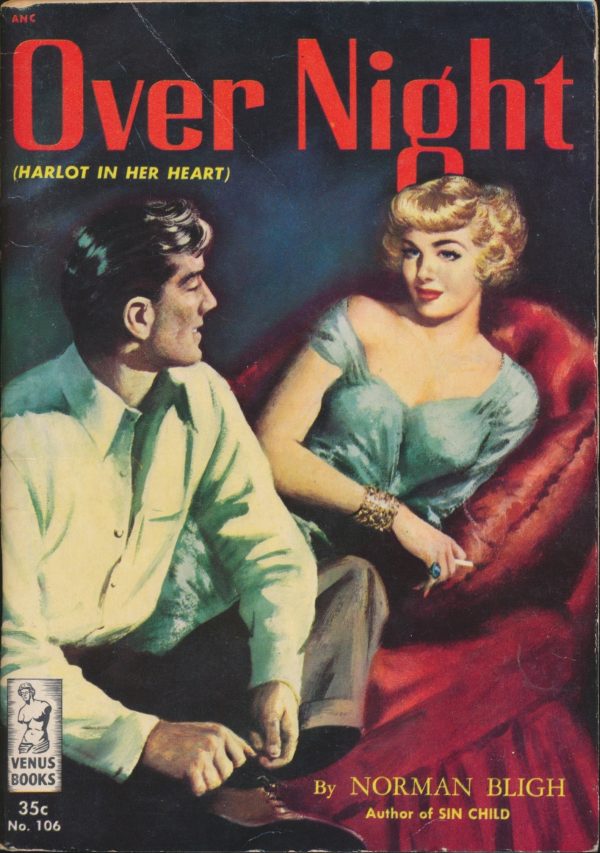
Born in Pennsylvania, Robert Oliver Skemp studied at the Art Students League of New York and also spent some time at the Grand Central Art School in New York. He was also a member of the Merchant Marine, traveling across the world and no doubt picking up inspiration for the tough, two-fisted characters who would later appear in some of his artwork.
Most of Skemp’s career was spent in advertising but he was also a prolific pulp cover artist and portrait painter. Here’s a small sampling of his paperback artistry:
When we look on things a few years from now (assuming we make it that far), there’s a damn good chance that 2020 will be seen as a turning point for small press, self-published, and otherwise independent comics. Not only did we have the “heavy hitters” like Simon Hanselmann’s Crisis Zone and Alex Graham’s Dog Biscuits, we had diary comics galore from any number of cartoonists, as well as a smattering of “lockdown”-themed anthologies — artists, like the rest of us, were looking for anything to keep them sane while they were (by and large) stuck indoors, and new (predominantly digital) distribution methods were utilized, both by choice and necessity, to get their work out there. In many ways, sure, it seems like only yesterday, but in others it seems like a lifetime ago, so completely has the landscape shifted. And the changes to production and distribution that the pandemic engendered have proven to be every bit as resilient as has COVID-19 itself, really — I mean, how many comics are you reading on Instagram these days? I bet it’s more than you were in 2019.
I was somewhat surprised, then, to receive in the mail recently a handsomely-produced little anthology called Isolated, edited and published by Tana Oshima and featuring work produced primarily (with some exceptions) during the “height” of the lockdowns, that is available only in printed form. This is not a complaint, mind you — I made mention of Instagram comics a moment ago, but the truth is I don’t even have an Instagram account myself and prefer to keep things as “old school” as is humanly possible. I’m well aware, however, of what’s happening in the digital comics realm in a general sense, and so the idea of a a collection of pandemic-themed strips that bucks the trends and stays with the tried-and-true is inherently appealing to a stick in the mud such as myself — and even more importantly, so are the comics that Oshima is presenting here.
Of course, how could they not be given the veritable “murder’s row” of international talent she’s managed to put together? Roll call, in order of appearance : Celine Hudreaux on covers, with interior stories by Pedro Pablo Bacallao, E.A. Bethea, Angela Fanche, Ana Galvan, Jessica Garcia, November Garcia, Ness Ilene Garza, Marie Gilot, Kim Lam, Drew Lerman, Lui Mort, Roman Muradov, Hue Nguyen, Weng Pixin, Areeba Siddique, and Lane Yates. Veteran readers of my blathering will no doubt recognize many a cartoonist I’ve sung the praises of included in this list of luminaries, but there are a handful of names that I admit were new to me here as well, and lo and behold, they contribute some of the strongest entries in the book, so that admittedly shop-worn “something old, something new” axiom with regards to putting together a successful anthology? It absolutely rings true in this case.
Everyone is given four pages to work with (apart from Galvan, who only uses two), and as one would expect, pretty much all these strips are autobiographical in nature, but even the ones that aren’t in form are in spirit, given the same thing was resting heavy on everybody’s shoulders all over the world at the time — which rather brings me to my main point here : expect a uniquely unpleasant and harrowing reading experience with this as you look back on a time that absolutely no one is nostalgic for. These are all cartoonists operating at the full height of their considerable powers, so that semi-apocalyptic sense of dread we all felt in 2020? You’re gonna feel it all over again. It hangs over all in Sword of Damocles fashion, even in the strips with a nominally “lighter” tone. So if you’re understandably not yet ready to go down that road, while I’d still strongly urge you to get this book — after all, who knows how many copies are even out there — I’d likewise advise that you put it aside until you really feel up to it. Please. For your own sake.
Speaking for myself (because that’s the only person I’m remotely qualified to speak for in the first place), the predominant sensation this collection evoked in me was the strange dichotomy of those times — we were all going through the same thing, but since we were separated, we all experienced and processed it in highly personal ways. It didn’t help, I suppose, that politics did its level best to wrest control of the situation from science — and I’ll always find it as tragic as it was predictable that the same assholes who lectured us about “coming together” in the wake of 9/11 so they could pursue bloodthirsty and profit-driven wars of conquest abroad were the ones telling us to piss in the face of unity during the lockdowns — but by and large the very nature of isolation itself gave rise to myriad interpretations of both what the lockdowns meant and how best to navigate them. This book, by dint of the wide range of distinctive voices it presents, captures the essence of what it means to individually experience a collective nightmare.
Also worth noting : thanks to the efforts of Oshima and her predecessor on the project Andrew Losowsky, grant funding was secured so that all of the contributors were paid for their efforts — and we all remember how vital that was at the time. You can feel good about buying this comic, then, even if it’s not a “feel-good” collection per se — it is, however, a vital and necessary one, as well as a testament to art’s ability to help us get through the roughest of rough times.
Also, this review is “brought to you” by my Patreon site, where I serve up exclusive thrice-weekly rants and ramblings on the worlds of comics, films, television, literature, and politics for as little as a dollar a month. Subscribing is the best way to support my continuing work, so I’d be very appreciative if you’d take a moment to give it a look by directing your kind attention to https://www.patreon.com/fourcolorapocalypse
That was my thought after I published my review of the first three episodes of Pam & Tommy. Don’t get me wrong. I stand by everything that I wrote in that review. The first three episodes were relatively well-made and they captured as specific point in time and Lily James was likably earnest as Pam.
Instead, my concern came from the fact that, by reviewing the first three episodes, I had now committed myself to watching and reviewing the entire series. And, the more I thought about it, the more I realized that there was no way that Pam & Tommy could remain interesting for a total of 8 hours, not unless the show abandoned its Ryan Murphy-lite approach and did something really unexpected with its recreation of the story. There’s just not enough there. This is a good 2-hour story but Pam & Tommy is an 8-epiosde miniseries. That’s 8-plus hours of Pam getting upset, Tommy acting like a dumbass, and Rand being every creepy guy who has ever approached you in a bar and started asking you about the book you’re reading. (It would, of course, never occur to him that the main reason you’re reading the book is to avoid talking to guys like him.)
Having now watched the fourth episode, it’s hard not to feel that I was very much correct in my concerns. Don’t get me wrong. The fourth episode had its moments. It featured an enjoyably intense performance from Don Harvey as the legendary Hollywood private investigator, Anthony Pellicano. Once Tommy finally discovers that his safe has been stolen and Pam reminds him about the videotape, Pellicano is the man who they approach to track down the perpetrator. This leads to a scene of Pellicano beating the crap out of Rand and it’s fun to watch. Some of that is because Don Harvey is a master of portraying urbane menace. But I have to admit that a lot of it is because Rand himself is such an annoying character. This episode opened with Seth Rogen, as Rand, wandering around a porn set and trying to reconnect with his estranged wife (Taylor Schilling), who significantly was just trying to read Anne Rice’s latest book when he approached her. Just the sight of Rand, with his mullet and his sad-sack facial expression, was so annoying that it was actually cathartic to see him get tossed around his apartment.
The problem is that the show wants us to feel some sympathy for Rand but there’s nothing sympathetic about him. He’s a loser and the fact that he still loves his wife and still wants to take care of her doesn’t make him any less of a loser. He’s a thief, a guy who accidentally stole a sex tape and then decided to put it online. The fact that he later feels guilty doesn’t change the fact that he did it. There’s as scene in the fourth episode where Rand is upset to see someone else selling bootleg copies of the tape. On the one hand, it’s not a bad scene. There’s an enjoyable irony to Rand discovering that someone has essentially stolen the tape from him after Rand went through so much trouble to steal the tape from Tommy. But the show doesn’t seem to be sure whether it wants us to laugh at Rand’s misfortune or to sympathize with him as he realizes that the consequences of his actions are out of his control. As a character, Rand is not compelling enough for both to be an option.
As for the title characters, both Sebastian Stan and Lily James do their best but I get the feeling that we’ve already learned all the we need to know about them. There was one good moment that examined Pam and Tommy’s different reactions to the release of the sex tape but otherwise, neither Tommy nor Pam are really that interesting as characters. I ended the fourth hour of Pam & Tommy very much aware that there were still four more hours to go. What else, I found myself wondering, could be left to be said?
This cover is from 1961. Payment in Sin is one of those paperbacks that would be republished with several different covers over the course of the 60s. At last count, I had found five other covers for Payment in Sin but I believe this is the first one. The artist is unknown.
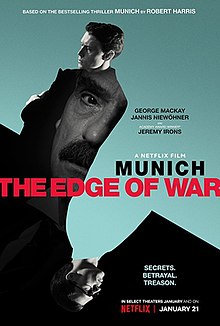
Munich — The Edge of War opens in 1932, at Oxford University, where three graduating students are toasting their futures as a part of the “mad generation” that’s come to age in the aftermath of World War I. Six years later, two of them will reunite as the world appears to be on the verge of another great war.
One of them, Hugh Legat (George McKay), is a secretary to the English Prime Minister, Neville Chamberlain (Jeremy Irons). Chamberlain, haunted by the death and destruction of the Great War, is convinced that Europe can have “peace in our time,” through a policy of negotiation and appeasement. He is aware of the men who have come to power in Italy and Germany and he’s certainly heard the rumors that they are planning on conquering Europe themselves. However, Chamberlain is almost in denial about the reality of the situation, at one point suggesting that Hugh write a polite letter to Mussolini requesting that Mussolini tell Hitler to tone down his rhetoric.
Hugh’s classmate, Paul von Hartmann (Jannis Niewöhner), returned to Germany after graduating from Oxford. At first, he was an enthusiastic backer of Hitler and the Nazi party. He was rewarded with a position as a translator in the Foreign Office. However, Paul has since become disillusioned with Hitler and is painfully aware of the anti-Semitism that has become a part of everyday life in Berlin. Paul regularly meets with a group of generals who are plotting a coup against Hitler. The generals believe that, if they allow Hitler to invade Czechoslovakia, the German people will rise up in order to avoid being led into another war and that they will cheer as the generals march into Hitler’s office and place him under arrest. Paul worries that the generals are being naïve. Adding to Paul’s problems is a former childhood friend named Franz Sauer (August Diehl). Sauer is a new member of the SS and he has a disconcerting habit of showing up anywhere that Paul happens to be, almost as if he is aware that Paul is not the dedicated civil servant that he pretends to be. When Paul receives a stolen document that reveals the details of Hitler’s true plans for Europe, he and Hugh team up to try to keep Chamberlain from singing the Munich Agreement.
Looking over the events that led to World War II, one question that historians frequently ask is why did Neville Chamberlain consistently refuse to stand up to Hitler despite Hitler’s growing acts of aggression. Why did Chamberlain knowingly turn a blind eye to every treaty and agreement that Hitler broke or ignored? Why, with Hitler openly declaring his plans to conquer Europe, did Chamberlain and so many others insist that Hitler’s actions would somehow be different from his words? Was Chamberlain just naïve or was he, like so many others who had been traumatized by the Great War, in willful denial about the inevitability of conflict with Hitler? Was Chamberlain just a politician trying to keep a war-weary public happy or did he truly believe that signing an agreement with Hitler would somehow lead to “peace in our time?” Munich — The Edge of War suggests that all of the above may be true, with Jeremy Irons playing Chamberlain as being an old school establishmentarian, one with sincere intentions but also one who is incapable of truly understanding the new reality that has been brought about by the desolation of World War I. As played by Irons, Chamberlain is occasionally sympathetic but, even more frequently, he’s obstinate in his short-sightedness and his insistence that he alone understands how to deal with Hitler. He’s not necessarily a bad man but he’s definitely not the right man for the times.
Of course, the majority of the film focuses not on Chamberlain but instead on Paul and Hugh. George McKay and Jannis Niewöhner both give good performances as two civil servants who know the truth but find it impossible to get anyone to listen to them. Niewöhner is especially effective as Paul, capturing not only his disillusionment with Germany but also his disgust for himself for having been previously fooled by Hitler’s rhetoric. Like Chamberlain, Paul was also in denial about Hitler’s true beliefs. The difference is that Paul has learned from his mistake and is now desperately trying to reveal the truth, even if no one else wants to hear it.
It’s a good and effective film, one that works both as a historical drama and an espionage thriller. The film is at its best when it focuses on what daily life is like when a nation is living in the shadow of the possibility of war. Hugh comes home to discover his son wearing a gas mask and he has to convince his wife to leave London for the weekend, even though he can’t specifically tell her why. Meanwhile, Paul lives in a Berlin that’s full of imposing architecture and seemingly happy people but with a shadow of menace hanging over every street corner. The city’s new buildings, built to celebrate Hitler’s vision of a new Germany, are all disturbingly pristine, as if they only exist so that evil can hide behind their impressive facades. And in the background of every scene in Berlin, there are the uniformed men with their red armbands and their haughty glares.
It’s said that hindsight is 20/20 and, indeed, it’s easy to look at someone like Neville Chamberlain and dismiss him as just being a tragically failed and foolish politician. And there is definitely an argument to be made that he was. (That’s certainly how I tend to view him.) Still, Munich — The Edge of War does a good job of capturing not only the feeling of a world on the verge of war but also the motivations of those who closed their eyes to what was coming and also to those who did not. That we know that Paul and Hugh’s efforts are ultimately to be for naught adds a poignant sadness to the scenes of them trying to get someone to listen to them but it also makes for a powerful viewing experience. How many eyes were open in the 30s? How many eyes are closed today?
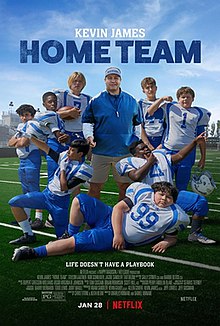
The new Happy Madison production, Home Team, opens with Sean Payton (Kevin James) discovering that life can be difficult when you’re the coach of an NFL team.
On the one hand, Payton coached the New Orleans Saints to a Super Bowl victory and gave hope to a city that was still struggling to recover from the mental, physical, and spiritual damage done by Hurricane Katrina. At a time when David Fincher was bringing everyone’s spirits down with The Curious Case of Benjamin Button, Sean Payton was raising them up with excellent football.
On the other hand, it was later discovered that the players were being paid extra to deliberately injure their opponents.
The NFL reacts to this scandal by suspending Payton for a year. Payton abruptly goes from having a luxurious office in New Orleans to living and working out of a hotel suite in Argyle, Texas. He spends his suspension trying to reconnect with his son, Connor (Tait Blum). And when he discovers that Connor is playing football for his sixth grade team, Sean can’t stop himself from stepping up and trying to help Troy (Taylor Lautner) and Mitch (Gary Valentine) coach the team. Soon, Payton actually is coaching the team himself! And though he’s winning games, he’s also pushing the players too hard. Can Sean Payton rediscover the simple love of doing your best and being a member of a team or is he destined to return to New Orleans and continue to hand out bonuses for injuring other players? What do you think?
Now, I’ll just be honest and admit that I’m not a football fan. I don’t really know much about Sean Payton or the whole targeting scandal. I do know about CTE and the dangers of suffering multiple concussions in a short period of time so I do feel safe in assuming that the implications of the targeting scandal were a bit more serious than the way they’re portrayed in the film. But, then again, this is a football film that was produced by Adam Sandler’s production company. Was anyone expecting it to be a serious examination of the dangers of playing pro or even amateur football? Instead, it’s a film that pretty much features every cliché in the book, from the team of underdogs that no one believed in to the down-and-out coach who has something to prove to both the doubters and to himself. There’s the usual mix of sentimental drama and equally sentimental comedy. Surprisingly for a Happy Madison production, there’s only one glaring case of gross-out humor. For whatever reason, there’s apparently a lot of people who find projectile vomiting to be entertaining. I’ve never cared much for it myself but, just as I have to be honest about not knowing much about Sean Payton, I should probably also be honest about the fact that I’m not this film’s target audience.
Kevin James is a likable actor, though his talents are definitely better served by television than by the movies. He gives a rather subdued performance here, one that was no doubt influenced by the fact that Sean Payton is still alive. Even when he rediscovers the joy of playing football and realizes that there are things more important than winning, James-as-Payton still comes across as being strictly business. You get the feeling that, with the exception of his son, the film’s Sean Payton will probably have no further contact with the kids he coached once he returns to New Orleans. In the film, it just comes across as something for him to do to pass the time.
Home Team is a fairly forgettable sports movie. It’s not particularly good but it’s not particularly terrible either. Instead, it’s typical of the adequate but not extremely memorable films that Netflix specializes in when no one is looking to win an Oscar.
Toward the tail end of last year, a nice-looking squarebound anthology arrived my way courtesy of its editor, Chad (In Amsterdan) Bilyeu, and to say its contents lived up to its impressive presentation is putting it mildly — probably far too mildly, at that. Co-published by Bilyeu’s own Bistro Books imprint in association with De Stichting Openbare Bibliotheek Amsterdam (who lists one Gabriel Ercicia as the project’s “Executive Producer”), Megillah #1 eschews a central theme in favor of a central idea – giving six artists eight pages each to do with as they see fit. Did I mention already the results are impressive? I believe I did.
Underneath the appealingly disturbing cover by EKS Graphics/Iva Spasojevic we find stories that well and truly run the gamut from memoir to slapstick superhero revisionism to surreal caper to just plain old surreal, each distinct in its “stand-alone” nature, yet all combining to form a makeshift tapestry that, to drag things back to the cover, “stitches together” in a kind of haphazardly fluid fashion. Aside from the length of each contribution, they don’t have a hell of a lot of similarities other than being good, but in the end, that’s what an anthology — in this critic’s humble (I hope) estimation — should do : provide an expansive view of what’s happening in the various corners of the indie comics world and let the chips fall where they may. As a primer of sorts, then, this is about as polished as they come, and anyone new to “the scene” is sure to discover a couple of artists (at least) whose work they feel sufficiently compelled to track down more of.
“Ah,” you say, “but what about us grizzled veterans?” Never fear, our particular needs and whims are catered to, as well — I mean, who’s going to say no to new, exclusive work from favorites like James The Stanton, E.S. Glenn, and even the legendary Bernie Mireault? And while fellow contributors Eryc Why, Maia Matches, and Larie Cook are not, as yet, “household names” for many of us, they all demonstrate the chops to make a solid case that one day they will be. Yes, of course, some stories are better than others, that’s to be expected, but I kid you not in the least when I state for the record that I don’t consider there to be so much as a single, solitary “clunker” in the bunch.
If unique auteur visions are your bag, this package offers six of them, all at various points along the curve in terms of their tethering to consensus reality — what they unquestionably have in common, though, is that they’re all exceptionally well-drawn, make the most of the book’s top-quality production values (the coloring on each and every strip will impress the shit out of you), and understand how to make the most of the unique opportunities afforded by the short-form comics story. There’s some wild stuff on offer, sure, you’ve probably already figured that much out, but each is narratively-based and formally recognizable as a discrete entities unto itself — what Bilyeu has done that further sets this apart from other anthologies, though, is that he’s arranged them in a de facto “running order” that ensures for smooth transition from one to the next even when their themes don’t necessarily logically “mesh” in any concrete way. All of which is me saying read this thing cover to cover without skipping around — you’ll be glad you did.
According to the definition provided on the inside front cover, a Megillah is a “long, involved story or account,” and while some of these strips do pack a lot into a comparatively tight space, I’d be lying if I said any of them felt “long” because, well, they aren’t. What they most assuredly are, though, is involving in the extreme, to the point where you won’t be ready for some to end. That’s okay, though, right? I mean, it’s preferable to any of them over-staying their welcome, that’s for sure. And besides, you can always go back and re-read any or all as you see fit — as I’ve done myself. Twice so far. With more to come, I’m sure.
Count me as a true believer, then — and a firm one, at that — in what Bilyeu is doing here, and I’m curious (as well as anxious) to see where this project goes next. I’d love to see a rotating cast of returnee artists with newcomers mixed in, but hey — it ain’t my show. I’m more than happy to trust our tour guide. And you should be more than happy to take this inaugural trip. Bring on number two, please!
Also, this review is “brought to you” by my Patreon site, where I serve up exclusive thrice-weekly rants and ramblings on the world of comics, films, television, literature, and politics for as little as a dollar a month. Subscribing is the best way to support my continuing work, so I’d be very appreciative if you’d take a moment to give it a look by directing your kind attention to https://www.patreon.com/fourcolorapocalypse








 Through the Shattered Lens