Film Review: No Exit (dir by Damien Power)


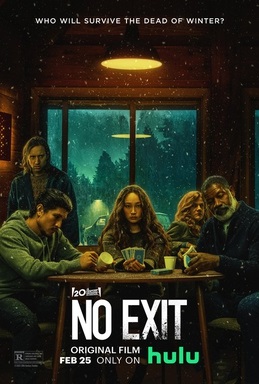
After she learns that her mother is in the hospital and possibly on the verge of death, Darby (Hannah Rose Liu) breaks out of drug rehab, steals a car, and starts driving to Salt Lake City.  However, what Darby doesn’t know is that she’s also driving straight into a blizzard.  Soon, Darby is forced to take shelter at a nearby state park visitors center.

Darby isn’t the only person seeking shelter that night.  There’s a married couple, Ed (Dennis Haysbert) and Sandi (Dale Dickey).  Ed is a veteran of the Marine Corp while Sandi is a nurse.  There’s Ash (Danny Ramirez), who has the friendliest smile to ever be seen in the middle of a blizzard.  And then there’s Lars (David Rysdahl), who is distinguished by his long hair and his nervous mannerisms.  When Darby first enters the visitors center, Lars is curled up in a corner and loudly snoring.

And then there’s Jay (Mila Harris).  Jay is a child who happens to be bound and gagged in one of the vehicles parked outside.  When Darby discovers her, she has to not only save the child’s life but also figure out which one of the people in the visitors center is responsible for kidnapping her.

Clocking in at a brisk 90 minutes, No Exit is full of twists and turns.  I’ll do my best to keep spoilers to a minimum in this review.  Not all of the film’s twists work, of course.  There’s a few moments that, in hindsight, didn’t exactly make sense.  After watching the film, you could spend hours debating why certain characters did the things that they did, assuming that you were so inclined and that you could actually find anyone else willing to sit through your analysis.  However, the film itself is so quickly paced and well-directed that it doesn’t matter that the story itself is occasionally a bit implausible.  From the minute Darcy breaks out of that rehab, the film captures the viewer’s attention and it doesn’t let go until the final credits start to roll up the screen.  This is an entertaining B-movie, one that makes good use of its isolated location and its talented cast.  Havana Rose Liu especially deserves a lot of credit for her sympathetic lead performance as Darby.  Darby is a cynic and a survivor but she still has enough humanity inside of her to risk her life for a stranger.

The film looks great, with its scenes of cars driving through the raging snow storm and the film’s cast gathered in the somewhat tacky visitors center.  All of the snow falling reminded me of i’m thinking of ending things and I have to admit that a part of me kept expecting there to be some sort of a metaphysical twist towards the end of the film.  I found myself wondering if the visitors center would be revealed to be Hell, which wasn’t a totally outlandish idea when one considers that the film shares the same name as Sartre’s famous play.  But no, No Exit is a thriller that deals with concerns that are very much earthbound.  It’s an well-executed thriller and an entertaining way to spend 90 minutes.  It can currently be viewed on Hulu.
Music Video of the Day: The Freshmen by The Verve Pipe (1997, directed by Mark Neale)


For the life of me, I cannot remember what made me think Everything Zen by Bush was the worst song of the 90s while this song exists.

I guess I forced The Freshmen out of my head, despite the fact that it was inescapable in 1997.  When the song came out, everyone assumed that it was about a rape that was followed by a suicide but the The Verve Pipe’s lead singer later said that the song was inspired by his girlfriend getting an abortion when they were younger and that the lyrics about Valium were poetic license.  (The amount of valium mentioned in the song would not be fatal.)  Abortion is a serious subject matter and there’s been a lot of good songs written about that very topic.  Of course, this derivative dirge isn’t exactly one of them.

A quick google search revealed that there are a lot of people who are under the impression that the “I can’t be held responsible” line is meant to be taken literally.  Though I’m not a fan of the song, I will say that I don’t think we’re necessarily meant to agree with the all of the lyrics.  I think that the “Can’t be held responsible,” is just something the song’s narrator is telling himself as a way to deal with his guilt.  That this fairly obvious point was missed by both critics and fans says more about them than it does the song.

This video is pure 90s angst, from the room with the one light bulb to the band slowly appearing behind the lead singer.  Angst was big in the 90s, though there was eventually enough of an angst backlash that it led to the era of the boy bands and pop queens.  Still, those of us who grew up in the 90s can’t be held responsible.  We won’t be held responsible.  People listened in the first place.

Enjoy!

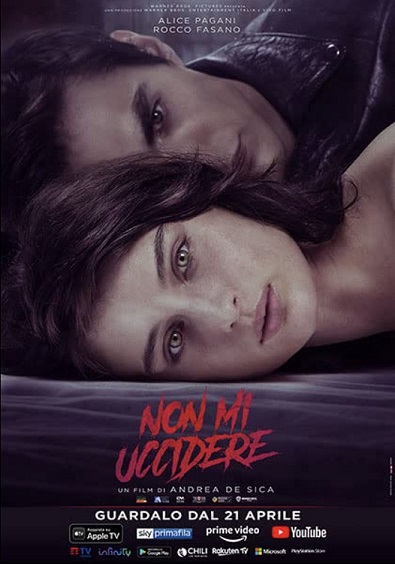
International Film Review: Don’t Kill Me (dir by Andrea De Sica)


Don’t Kill Me, an Italian film that is currently available on Netflix, opens with two teenagers in a car.  Robin (Rocca Fasano) is driving.  His girlfriend, Mirta (Alice Pagani), is in the passenger’s seat.  Robin is driving fast and erratically.  In fact, he nearly crashes the car more than a few times.  This is because Robin is driving with his eyes closed, forcing Mirta to shout directions at him.  It’s almost as if Robin wants Mirta to come to a violent end.

Eventually, they end up in a quarry.  Having taken a break from attempting to crash the car, Robin wants Mirta to take a drug with him.  Mirta’s never tried the drug before.  She’s nervous, even though Robin assures her that it will be a wonderful experience.  Mirta finally agrees but requests, “Please don’t kill me.”

Yeah, good luck with that.

Of course, Mirta dies.  Mirta’s body is sealed up in her family’s vault.  A few hours after the funeral, a very confused and angry Mirta smashs her way out of the vault.  Dazed, she wanders back to her old house.  She’s definitely not alive but she’s not completely dead either.  Instead, she is one of what the film calls “the Overdead.”  She’s nearly immortal.  At one point, she gets shot several times and, while it’s not a pleasant experience, it also doesn’t come anywhere close to killing her.  She still has her memories of what life was like before she died and, to judge from the other members of the Overdead who she meets, it appears that she won’t ever age.  Unfortunately, being one of the Overdead also means that if she doesn’t regularly drink the blood of the living, she’ll start to decay.  Starvation is the only way to destroy a member of the Overdead.  There’s a secret group of men who have spent centuries tracking down and starving the Overdead.  Those men are soon chasing after Mirta.

Don’t Kill Me is at its strongest during its first half, when the film skips through time and the emphasis is on atmosphere and ennui.  The scene where Mirta breaks through the crypt carries hints of Jean Rollin’s Living Dead Girl and, much like Rollin’s best films, the first half of Don’t Kill Me often focuses on both the importance and the mystery of how we recall things.  Meanwhile, the scenes of Mirta wandering through the countryside and prowling the clubs for food are reminiscent of Jess Franco’s Female Vampire.  The first half of the film feels like a tribute to the wonderful Eurohorror of the past.  Unfortunately, the film starts to lose its way once Mirta is captured by the secret society that’s trying to destroy her.  In its second half, it just becomes another film about escaping from a military base.  Don’t Kill Me is based on a YA novel and it’s obviously meant to be the first in a series of films about Mirta’s life as one of the Overdead.  As a result, the film’s ending is a bit unsatisfactory.  For all the build-up, it sputters to a “to be continued” style conclusion.

That said, there was enough that worked about Don’t Kill Me that I’m willing to forgive what didn’t work.  I may be alone in that as most of the online reactions that I’ve seen towards this film have been overwhelmingly negative.  Well, so be it.  There was enough atmosphere to keep me interested.  Alice Pagani gave a pretty good and sympathetic performance as the conflicted Mirta and Fabrizio Ferracane, as the man determined to capture and starve her, was enjoyably villainous.  Don’t Kill Me may not be for everyone but it worked for me.

How ‘Bout Them “Apples”?


Desmond Reed is a New England cartoonist whose work I’d been borderline fascinated with since first coming across his self-published debut, Those Dark New Hampshire Woods, some years ago, but it was his later ‘zine The Funnies that pushed that fascination over the border — in fact, it’s fair to say the short-form adventures of his eminently-flexible coterie of lovable goofballs positively hooked me, and so I was gratified to see their return in his latest (also self-published) mini, Apples, which builds on the strengths of its predecessor without in any way appreciably upsetting the — errrrmmmm — apple cart. Sorry.

Don’t get me wrong, I’m all for breaking with formula and tradition, but when you’ve got a good thing going, seriously — what’s the point? And so our fictitious friends Wallace T.J., Mona Gertrude, Ralph Jonathan, Gil Christopher, and Henrietta Susan are back, and doing what they do best, which is to say, serving as lovable comedic ciphers to the shit we all went through at one point in our lives — or may still be going through, if you’re fortunate enough to be a couple of decades younger than your curmudgeonly critic here.

Nominal personal growth appears to have occurred among our cast since their last go-’round, but it’s kinda hard to tell, and not especially relevant either way — which sounds like a “diss” (or whatever) but isn’t, given that it’s their relatable reactions to exaggerated situations and/or exaggerated reactions to relatable situations that give this comic its charm aplenty, so “character arcs” of any sort are rather surplus to requirements here. Quick-fire vignettes about popular themes like drug use, depression, co-habitation, shit jobs, and everyday life’s little highs and lows are the order of the day, then, and while that may not sound terribly ambitious, few do them better than does Reed, so seriously — check your coolness at the door and just relax and have fun.

Ah, yes — that dread word. Some time back certain quarters of the comics community (those who take it upon themselves to police the medium’s general trajectory for reasons known only to themselves) decided that “fun” was an outmoded concept and that cartoonists should be aiming their sights “higher,” but I’ve never gotten on board with myself that since fun is, ya know, fun. I’m pleased to report Reed appears to have ignored this unspoken dictate as well, and has instead honed his comedic chops and gently acerbic sense of timing to its full potential and is now ready to stand as one of the more unique funnybook-makers in the contemporary scene. The self-appointed “intelligentsia” may consider that to be a truly trivial pursuit, but who the hell cares? Around these parts, we ain’t ashamed to admit that good times are a good thing.

Which isn’t to say this comic doesn’t skirt around the edges of “heavier” material, but it does so in a way that’s still designed, ultimately, to be more reflective of the struggles of its readership (and perhaps even its creator) than it is downright exploratory, to offer sympathy and reassurance via commonality of experience rather than to take deep dives into deep issues and deep problems. This is a comic that knows who you are, or were, and is here to meet you on the home turf you share with it. There’s a time and place for taxing and challenging work, absolutely, but when you need a break from all that but still don’t care to be condescended to? You can’t do a whole lot better than this.

It’s no exaggeration to say I’m flat-out enamored with Reed’s squiggly world and hope to have a chance to visit again soon — until then, though, I’m content to re-read this comic whenever I could use a pick-me-up. Even knowing all the gags, punchlines, and twists of fate, a visit with old friends is still, and always will be, well worth a person’s time.

******************************************************************

Apples is available for $5.00 from J.T. Yost’s Birdcage Bottom Books distro at https://birdcagebottombooks.com/products/apples?variant=41000348811440

Also, this review is “brought to you” by my Patreon site, where I serve up exclusive thrice-weekly rants and ramblings on the worlds of comics, films, television, literature, and politics for as little as a dollar a month. Subscribing is the best way to support my continuing work, so I’d be very appreciative if you took a moment to give it a look by directing your kind attention to : https://www.patreon.com/fourcolorapocalypse

TV Review: Pam & Tommy 1.6 “Pamela in Wonderland” (dir by Hannah Fidell)


Yes, I’m still reviewing this.

If the earlier episodes of Pam & Tommy seemed to owe a huge debt to the aesthetic of Ryan Murphy, the latest episode feels more indebted to the style of Aaron Sorkin.  The entire episode centered around Pam testifying at a deposition.  While being asked increasingly intrusive and sexist questions about her career as a model and how she and Tommy came to make the infamous the sex tape, Pam flashed back to her past.  We saw how she was discovered at a Canadian Football game and how she eventually ended up up posing for Playboy.  Hugh Hefner (played by Mike Seely) showed up, wearing his stupid red robe, and puffing away on his pipe.  In typical Sorkin rip-off fashion, the episode featured the attorneys asking a lot of questions and the only person of color to be seen was the unnamed court stenographer whose only line of dialogue was to briefly give Pam some encouragement.

Compared to the other episodes of Pam & Tommy, Pam In Wonderland actually worked fairly well.  It helped that it largely focused on Lily James, whose performance as Pam is probably the strongest thing that this show has going for it.  This is the second episode in a row not to feature the character of Reed Gauthier and the show was definitely better off without his presence and the attempts to somehow convince us that there’s any reason to portray him as being a sympathetic character.  With no Reed and Tommy reduced to appearing in flashbacks, this was the first episode that was fully told from Pam’s point of view and, when the attorneys suggested that Pam was somehow to blame for what had happened because of her past as a model or just the fact that she allowed herself to be filmed in the first place, every woman watching could relate to what Pam was going through because we’ve all heard the same condescending tone and we’ve all been told that somehow, the bad things that happen to us are actually our fault.  Lily James did a wonderful job of portraying Pam’s struggle to keep smiling and just get through the worst day of her life.  I knew what she was going through.  Again, Lily James is the best thing that this show has going for it.

And yet, I have to be honest that I still found myself wondering just what exactly the overall point of the show is.  For all of the episode’s strong points, it’s still hard to see why this story needs to be told as an 8-hour miniseries as opposed to a 90-minute film on FX.  The first three episodes did a good job of fitting this story into the early days of the Internet and the culture of the late 90s.  But the subsequent episodes haven’t added much to that initial impression.  It’s also worth noting that Pam herself has repeatedly distanced herself from the program and said, even before the show started shooting, that she didn’t want anything to do with it.  One could argue that, as a show, Pam & Tommy is as intrusive and exploitive as the attorneys at the disposition.  With each new episode, it become difficult to deny that this is a show that seeks to exploit the very same thing that it claims to be condemning.

One final thought on this episode and culture in general: how did people not realize that Hugh Hefner was creepy as Hell before he died?  Today, of course, A&E is airing an entire TV series dedicated to exploring what an asshole Hugh Hefner actually was.  But, just 11 years ago, Hefner was still being portrayed as some lovable old lothario in a sailor’s cap.  NBC even tried to air a Mad Men-style show about how great life was at The Playboy Club.  Remember that?  Creepy old Hef even provided the narration at the start of the first episode.  Last night’s episode of Pam & Tommy presented Hef as being essentially a benevolent (if manipulative) father figure.  It felt oddly tone deaf, though that may indeed be how Pam herself saw the old man.

Seriously, though …. did no one ever tell him how stupid he looked in those red pajamas?

Music Video of the Day: Stina live by Okean Elzy (2013, dir by Volodymyr Shkliarevskyi and Victor Priduvalov)


This is Okean Elzy.  They may not be a household name here in the States but in Ukraine, there are one of the country’s oldest and most popular rock bands.  Today’s music video of the day is about a lot more than just honoring a band.  

To Boldly Go — : Alexander Laird’s “Oubliette”


Purely as physical objects, Alexander Laird’s self-published comics are things of exquisite beauty : lovingly riso-printed, uniquely formatted, conceptualized to a degree that’s flat-out exacting, they stand as a testament to both dedication and determination in equal measure, their execution representing an inherently harmonious marriage with the singular creative vision behind them. I honestly don’t know of any cartoonist who works as hard at holistically integrating the creative with the technical, whose inner artist is so “in tune” with their outer artisan. Each of Laird’s books has the look and feel of an object carefully made by hand.

That being said, anything that is presented this well needs, by default, to feature content that lives up to its presentation, and that can be tough when you’re pulling out all the stops as far as production values go. Laird’s latest, Burg Land 1 : Sleemore Gank, certainly earned high marks across the board from me, but his earlier effort, Oubliette, leaves perhaps a bit to be desired on that score — but is still plenty fascinating as a prima facie example of a legit autuer finding their footing as they go along and developing the themes that would come to be regarded as central concerns in their work.

Stated less pretentiously, this feels like a “warm-up exercise” for ideas and approaches that would eventually end up becoming fleshed out more fully later. And there’s absolutely nothing wrong with that — in fact, it’s crystal clear that Laird’s been in firm possession of a vision for what he wants to achieve in this medium from the outset, it’s simply that this largely-wordless tale of explorer/academic Jest The Scholar venturing through the ruins of a thought-lost civilization and having to survive a monstrous onslaught of, well, monsters is, all told, a less-thoroughly-realized version of what this same cartoonist would do next.

Which, I admit, makes this review something of an unfair exercise on its face — after all, if I’d read this first, I might very well have been blown away by it, rather than “merely” being mightily impressed. On the plus side, though, there’s no question that I did still find it mightily impressive, so if Laird happens to read this at some point, trust me when I say : a win is a win. I still found this to be a remarkable work in the truest sense. And while I may not recommend it as highly as Burg Land 1: Sleemore Gank, I think its status as a kind of blueprint for that comic means that it could very well especially be of interest to those who, like myself, read the latter first.

Or am I wrong about that? I mean, if you’re a Laird “newbie,” this is certainly a great place to start and it gives you a flavor for his utterly unique methodologies and sensibilities. By turns frightening and fun, and drawn in a style that both reflects and magnifies the ultimately-optimistic outlook of its insatiably curious protagonist, it’s a comic about learning and exploration that learns and explores the medium’s formalities and, more importantly, its possibilities in unison with its narrative. I invoked the term “holistic” earlier, and there’s absolutely no doubt that this is a breathtaking working example of that principle writ — and drawn — large.

Lest there be any misunderstanding, then : this is not a recommendation tempered by any sort of caution — it’s an enthusiastic and unreserved one. Sure, I liked Burg Land 1 : Sleemore Gank a bit more, but so what? I liked that more than just about anything I’ve read recently, and the list of “stuff I didn’t like quite as much” includes a lot of damn fine comics. This is one of them and, furthermore, one of the better ones at that.

************************************************************

Oubliette is available for $12.00 from Alexander Laird’s website at https://sensitiveathletes.bigcartel.com/product/oubliette

Also, this review is “brought to you” by my Patreon site, where I serve up exclusive thrice-weekly rants and ramblings on the worlds of comics , films, television, literature, and politics for as little as a dollar a month. Subscribing is the best way to support my continuing work, so I’ve be very appreciative indeed if you’d take a moment to give it a look by directing your kind attention to https://www.patreon.com/fourcolorapocalypse

The TV Set (2006, directed by Jake Kasdan)


Mike Klein (David Duchovny) is a scriptwriter who suffers from chronic backpain and whose wife (Justine Bateman) is pregnant.  Mike has developed an autobiographical TV dramedy about a young man trying to come to terms with the suicide of his brother.  He’s sold it to one of the networks but, when he tries to shoot the pilot, he watches as his original concept is continually compromised and diluted by Lenny (Sigourney Weaver), the president of the network.  After rejecting Mike’s choice for the lead role because the actor had a beard, Lenny forces him to cast Zack Harper (Fran Kranz), a mugging young actor who lets pre-stardom go to his head.  Lenny continues to change Mike’s concept until he can barely even recognize his pilot.  Will Mike be able to retain his vision or will network TV continue to be dominated by shows like Slut Wars?

Occasionally, you’ll see a film that was obviously made by a writer/director who was obviously looking to settle some old scores with the studio execs that he had to deal with in the past.  Christopher Guest’s first film as a director was The Big Picture, a sharp and clever satire with Kevin Bacon as a film student who discovers there’s little he won’t compromise on to get his film made.  Before Guest’s film, Blake Edwards lost a fortune making a film called S.O.B. because he wanted to get back at the people who he blamed for ruining Darling Lili.  Continuing the tradition of those films but moving the action to the networks, The TV Set was directed by Jake Kasdan, the son of Lawrence Kasdan.  Jake worked on a number of TV shows with Judd Apatow (most famously, Freaks and Geeks) and The TV Set feels like his chance to get revenge on any number of real-life studio execs.  It’s an insider’s view of what’s wrong with television but sometimes it becomes such an insider’s view that it becomes hard to relate to Mike and or really care about his show, which sounded pretty bad even before the network suits got involved.  Too often, it feels like the movie itself is more about settling personal grudges than saying anything about the state of television.

The TV Set has got a large cast, some of whom manage to create an interesting character despite Kasdan’s overstuffed script.  I especially liked Judy Greer, who played Mike’s always-positive agent.  I got the feeling that we were supposed to be as annoyed with Greer’s character as Mike often was but Greer gives such an energetic performance that it’s impossible to dislike her, no matter how far she went in her attempts to always put a positive spin on the bad news coming from the set of Mike’s pilot.  I also like Fran Kranz and Lindsay Sloane, who played the two actors forced on Mike by the studio.  Indeed, probably one of the film’s biggest problems is that all of the characters that we’re supposed to find annoying are played such likable actors that it’s hard to really sympathize with Mike when he starts complaining about them.  David Duchovny sleepwalks through the role of Mike but he’s not helped by a script that can never seem to decide if Mike’s supposed to be a visionary or just a hopeless naïve victim of the industry.

The TV Set, which was made a few years before the start of the streaming revolution, ends with a warning that television will soon be full of shows like Slut Wars and there won’t be any room for artists like Mike Klein.  The TV Set wasn’t wrong but what it failed to predict was that there would soon be other platforms on which the Mike Kleins of the word could broadcast their shows.