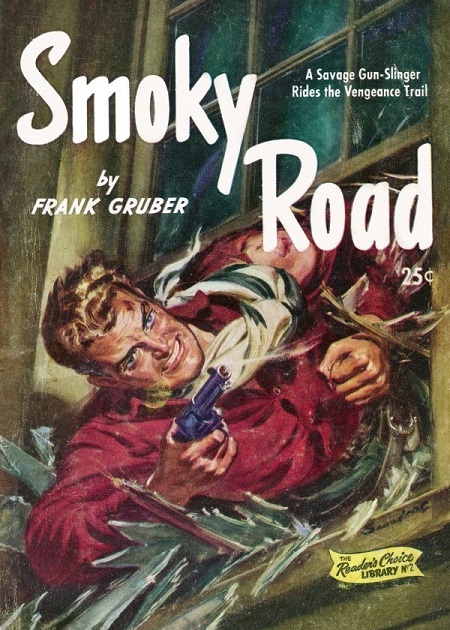
by Norman Saunders
This exciting cover is credited to Norman Saunders, who has been featured many times on this site.
by Norman Saunders
This exciting cover is credited to Norman Saunders, who has been featured many times on this site.
Enjoy!
With the Cannes film festival underway in France, I’ve decided to spend the next few days watching and reviewing some of the films that previously won the Festival’s top prize. In 1952, what would eventually become the Palme d’Or was known as Grand Prix du Festival International du Film and it was actually awarded to two separate films. One of those films was Renato Castellani’s Two Cents Worth of Hope. The other was Orson Welles’s adaptation of Othello.
Oh, Othello. Where to begin, with this well-made Shakespearean adaptation that, by today’s standards, many would consider to be problematic?
Othello is one of Welles’s most important films, not just because of its quality but also because it was one of the first films of his European exile. It was also the first Welles’s production to last for over a year. In this case, it took three years to finish filming Othello. As Welles himself often pointed out, one of the film’s key sequences began in Morocco but ended in Rome. Working with a low budget, Welles would take roles just to have enough money to shoot another few feet of film. (Reportedly, his salary for The Third Man went right into Othello.) Pieces of scenes would be filmed years apart, often with the actors speaking to the camera as opposed to another performer. Actors regularly became unavailable and were replaced. And yet somehow, Welles managed to edit all of the seemingly random bits and pieces into a coherent and frequently powerful film. Over the years, the chaotic production of Othello would become the norm for Welles and he would become as known for the films he was forced to abandon as he was for the films that he had made. But, in 1952, Welles’s perseverance and his determination to bring his vision to the screen were still appreciated and the Cannes jury, headed by author Maurice Genevoix, saw fit to honor his achievement.
At the same time, this is also the film in which the white Orson Welles played the Moor of Venice. Of course, in 1951, it was still pretty much a tradition that every Shakespearean would eventually play Othello and that he would wear dark make-up while doing so. Welles opts for a light bronzer, one that makes him appear to have a deep tan. While it’s undeniably jarring to see Orson Welles playing a North African, it’s still not quite as jarring as seeing what Laurence Olivier did in his Oscar-nominated version of the play.
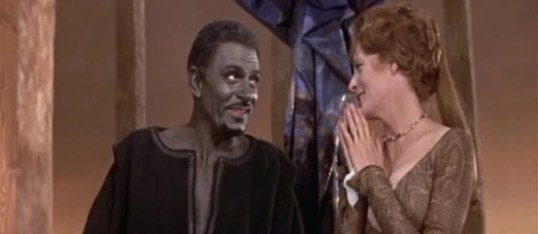
Laurence Olivier’s Othello
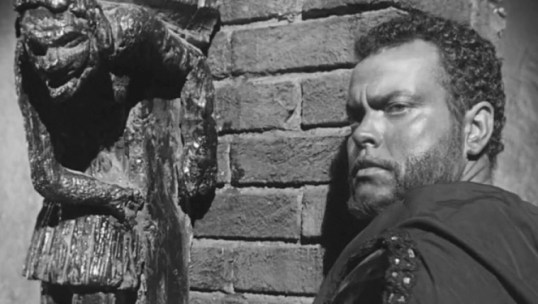
Orson Welles’s Othello
I have to admit that I held off on seeing this film precisely because I didn’t want to watch a film featuring Orson Welles, a director who I greatly admire, in blackface. Many people are probably never going to see this film for precisely that reason and that’s certainly understandable. In the end, it’s a decision that everyone will have to make for themselves. That said, having watched the film, I can now say that Orson Welles gives one of his best performances as Othello, playing him as a brilliant warrior who knows that, because of his background, he will never be fully accepted by the people of Venice. They’ll expect him to fight their battles for him but, when he marries the white Desdemona (Suzanne Cloutier), he is still expected to prove that he’s not some sort of savage. In fact, the only thing that prevents him from being brought up on charges is that Venice needs him to fight in another battle. Being a permanent outsider leaves Othello open to the manipulations of the evil Iago (Michael Mac Liammor), who pretends to be a friend but who instead views everyone around him with contempt and jealousy. Welles captures Othello’s anger but also his emotional vulnerability. As a permanent outsider, Othello is so used to being betrayed that it doesn’t take much from Iago to push him over the edge.
Welles directs the film like a film noir, filling the screen with menacing shadows and framing the film’s tragic finale like a horror film. He makes the film’s low-budget works to its advantage. As opposed to the grandeur that one normally associates with Shakespeare, there’s a seediness to the locations in Welles’s version of Othello. As Othello’s jealousy and paranoia grows, Venice itself appears to become more cluttered and cramped. It’s as if the viewer is seeing the location through Othello’s eyes, a once imposing city that, with each little secret or lie, edges closer to death. As both a director and an adapter of Shakespeare’s original text, Welles tells the entire story of Othello in less than 90 minutes, a pace that reflects Othello’s quick decent into irrational paranoia.
Admittedly, it’s not a perfect film. Mac Liammor was reportedly the best Irish stage actor of his time but his inexperience with film acting is obvious and it makes him a less than ideal Iago. Traditionally, Othello is usually dominated by whichever actor plays the role of Iago, as it’s Iago who pushes the story forward and narrates the action. However, Welles removes the moments when Iago narrates and speaks to the audience. Welles gives us an Othello that is clearly about the title character and this production is less interested in the reasons behind Iago’s betrayal than in what happens to Othello as a result. (Othello becomes yet another Welles film that is ultimately about the importance of friendship and loyalty.) Not surprisingly, with the film firmly centered on Welles’s performance, the rest of the cast struggles to make as strong of an impression. Only Suzanne Cloutier, cast as Desdemona, manages to give a performance that escapes from Welles’s shadow.
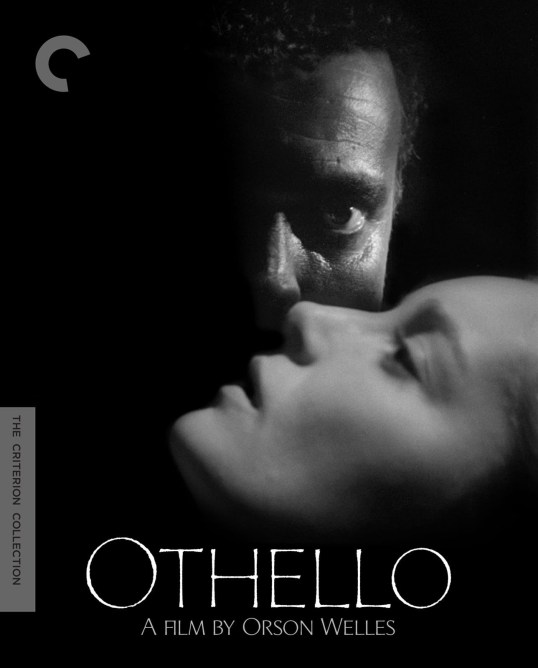
At Cannes, Othello defeated, among others, An American In Paris, Detective Story, Umberto D., and Viva Zapata. As often happened with Welles’s later films, it didn’t get much of an initial release in America but it has since been rediscovered by film connoisseurs. Needless to say, the Criterion release is the one to check out.
4 Or More Shots From 4 Or More Films is just what it says it is, 4 shots from 4 of our favorite films. As opposed to the reviews and recaps that we usually post, 4 Shots From 4 Films lets the visuals do the talking!
125 years ago, on this date, Frank Capra was born in Sicily. Capra was six years old when his family immigrated to the United States and, for the rest of his long life, he would often talk about seeing the Statue of Liberty from the deck of a boat sailing to Ellis Island. Capra went on to become a director whose work celebrated the ideals and the promise of America. He not only gave us the holiday classic, It’s A Wonderful Life, but he also directed one of the few political films that matteed, Mr. Smith Goes To Washington. And let us not forget that the first two comedies to win the Oscar for Best Picture were directed by Capra, It Happened One Night and You Can’t Take It With You.
In honor of a great career and legacy, here are….
6 Shots From 6 Films

Ladies of Leisure (1930, dir by Frank Capra, DP: Joseph Walker)
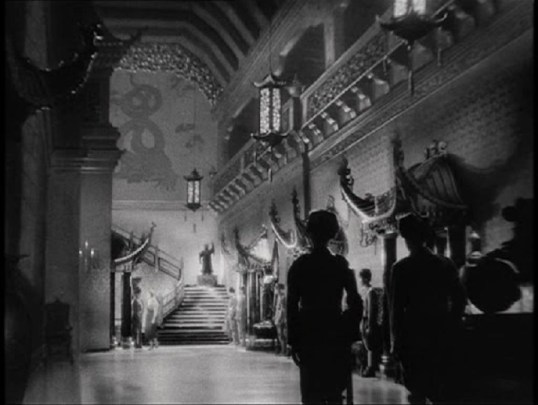
The Bitter Tea of General Yen (1932, dir by Frank Capra, DP: Joseph Walker)
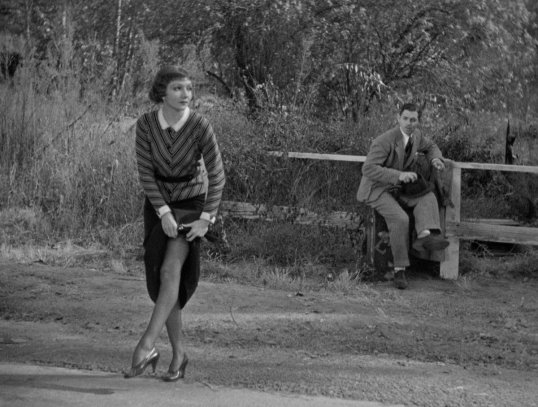
It Happened One Night (1934, dir by Frank Capra, DP: Joseph Walker)
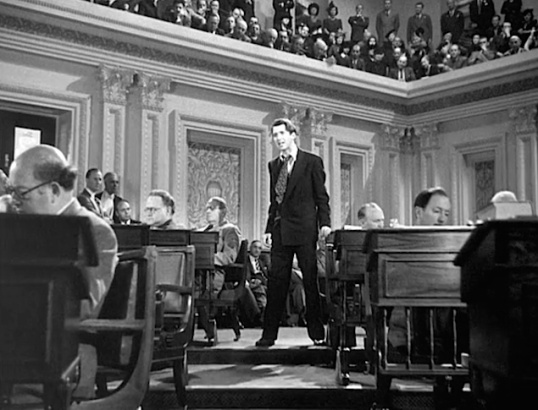
Mr. Smith Goes To Washington (1939, dir by Frank Capra, DP: Joseph Walker)

It’s A Wonderful Life (1946, dir by Frank Capra, DP: Joseph Walker and Joseph Biroc)
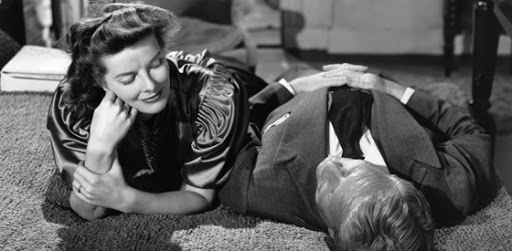
State of the Union (1948, dir by Frank Capra, DP: George J. Folsey))

by P.J. Monahan
As you can see on the cover, this is from 1926. Is she supposed to the maid’s twin sister? Or was she once the maid herself? The answers are within.
There’s a lot of pink in this video so I like it.
Enjoy!
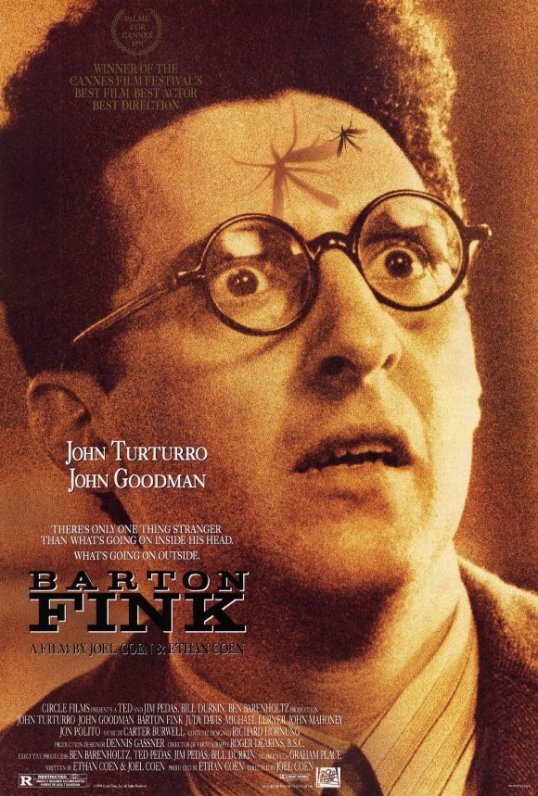
With the Cannes Film Festival underway in France, I decided that I would spend the next few days watching and reviewing some of the previous winners of the Palme d’Or. Today, I got things started with the 1991 winner, Barton Fink.
Directed by the Coen Brothers and taking place in the mythological Hollywood of 1941, Barton Fink tells the story of a writer. Played by John Turturro, Barton Fink is a playwright who has just had a big hit on Broadway. We don’t see much of the play. In fact, we only hear the final few lines. “No,” one the actors says, in exaggerated “common man” accent, “it’s early.” From what we hear of the reviews and from Barton himself, it seems obvious that the play is one of those dreary, social realist plays that were apparently all the rage in the late 30s. Think Waiting for Lefty. Think Hand That Rocks The Cradle. Think of the Group Theater and all of the people that Elia Kazan would later name as having been communists. These plays claimed to tell the stories of the people who couldn’t afford to see a Broadway production.
Barton considers himself to be the voice of the common man, an advocate for the working class. He grandly brags that he doesn’t write for the money or the adulation. He writes to give a voice to the voiceless. When his agent tells him that Capitol Pictures wants to put Barton under contract, Barton resists. His agent assures Barton that the common man will still be around when Barton returns from Hollywood. There might even be a few common people in California! “That’s a rationalization,” Barton argues. “Barton,” his agent replies with very real concern, “it was a joke.” Barton, we quickly realize, does not have a sense of humor and that’s always a huge problem for anyone who finds themselves in a Coen Brothers film.
In Hollywood, Barton meets the hilariously crass Jack Lipnik (Oscar-nominated Michael Lerner). Lipnik is the head of Capitol Pictures and he is sure that Barton can bring that “Barton Fink feeling” to a Wallace Beery wrestling picture. Barton has never wrestled. He’s never even seen a film. The great toast of Broadway finds himself sitting in a decrepit hotel room with peeling wallpaper. He stares at his typewriter. He writes three or four lines and then …. nothing. He meets his idol, Faulknerish writer W.P. Mayhew (John Mahoney), and discovers that Mayhew is a violent drunk and that most his recent work was actually written by his “secretary,” Audrey (Judy Davis). He seeks help from producer Ben Geisler (Tony Shalhoub), who cannot understand why Barton is having such a difficult time writing what should be a very simple movie. Barton sits in his hotel room and waits for inspiration that refuses to come.
He also gets to know Charlie Meadow (John Goodman). Charlie is Barton’s neighbor. Charlie explains that he’s an insurance agent but he really sells is “peace of mind.” At first, Barton seems to be annoyed with Charlie but soon, Barton finds himself looking forward to Charlie’s visits. Charlie always brings a little bottle of whiskey and a lot of encouragement. Charlie assures Barton that he’ll get the script written. Barton tells Charlie that he wants to write movies and plays about “people like you.” Charlie shows Barton a wrestling move. Barton tells Charlie to visit his family if he’s ever in New York. Charlie tells Barton, “I could tell you some stories” but he never really gets the chance because Barton is usually too busy talking about his ambitions to listen. Charlie tells Barton, “Where there’s a head, there’s hope,” a phrase that takes on a disturbing double meaning as the film progresses. Just as Barton isn’t quite the class warrior that he believes himself to be, Charlie isn’t quite what he presents himself to be either. Still, in the end, Charlie is far more honest about who he is than Barton could ever hope to be.
When it comes to what Barton Fink is actually about, it’s easy to read too much into it. The Coens themselves have said as much, saying that some of the film’s most debated elements don’t actually have any deeper meaning beyond the fact that they found them to be amusing at the time. At its simplest, Barton Fink is a film about writer’s block. Anyone who has ever found themselves struggling to come up with an opening line will be able to relate to Barton staring at that nearly blank page and they will also understand why Barton comes to look forward to Charlie visiting and giving him an excuse not to write. It’s a film about the search for inspiration and the fear of what that inspiration could lead to. Towards the end of the film, Barton finds himself entrusted with a box that could contain his worst fears or which could cpntain nothing at all. There’s nothing to stop Barton from opening the box but he doesn’t and it’s easy to understand why. To quote another Coen Brothers film, “Embrace the mystery.”
There’s plenty of other theories about what exactly is going on in Barton Fink but, as I said before, I think it’s easy to overthink things. The Coens have always been stylists and sometimes, the style is the point. That said, I do think that it can be argued that Barton Fink’s mistake was that he allowed himself to think that he was important than he actually was. Self-importance is perhaps the one unforgivable sin in the world of the Coen Brothers. Like most Coen films, Barton Fink takes place in a universe that is ruled by chaos and the random whims of fate. Barton’s mistake was thinking that he could understand or tame that chaos through his art or his politics. Barton’s mistake is that he tries to rationalize and understand a universe that is irrational and incapable of being explained. He’s a self-declared storyteller who refuses to listen to the stories around him because those stories might challenge what he considers to be the “life of the mind.”
Barton Fink is a film that people either seem to love or they seem to hate. Barton, himself, is not always a particularly likable character and the Coens seem to take a very definite joy in finding ways to humiliate him. Fortunately, Barton is played by John Turturro, an actor who has the ability to find humanity in even the most obnoxious of characters. (As obnoxious as Barton can be, it’s hard not to want to embrace him when he awkwardly but energetically dances at a USO club.) Turturro has great chemistry with John Goodman, who gives one of his best performances as Charlie. It’s putting it lightly to say that most viewers will have mixed feelings about Charlie but the film makes such great use of Goodman’s natural likability that it’s only on a second or third viewing that you realize that all of Charlie’s secrets were pretty much out in the open from the start. Michael Lerner deserved his Oscar nomination but certainly Goodman deserved one as well. The rest of the cast is full of Coen Brothers regulars, including Jon Polito as Lerner’s obsequies assistant and Steve Buscemi as Chet, the very friendly front deskman. And finally, I have to mention Christopher Murney and Richard Portnow, who play two of the worst cops ever and who deliver their hardboiled dialogue with just the right mix of menace and parody.
Barton Fink won the Palme d’Or at Cannes, defeating such films as Spike Lee’s Jungle Fever and Lars Von Trier’s Europa. It also won awards for the Coens and for John Turturro. It’s perhaps not a film for everyone but it’s one that holds up well and which continues to intiruge. Don’t just watch it once. This isn’t a film that can fully appreciated by just one viewing. This isn’t a Wallace Beery wrestling picture. This is Barton Fink!

by Everett Raymond Kinstler
This cover is from 1952. When the going gets strange, you want Space Detective on your side!
Today’s music video of the day is this atmospheric video from Noah Cyrus. I always enjoy videos that look like they could be dreams.
Enjoy!
you are overly sensitive so i won’t say much
but, my heart gets pulled into pieces whenever you’re poured up
you are malevolent and benevolent
you are the devil that i revel in
i barely recognize you when you wake up in the morning
must be someone else’s eyes that i look into every night
you’re only kind when you’re all fucked up
you’re only mine til your high is gone
But,
i wish you’d still love me when your drugs wear off in the morning
i come second to every Percocet that you take
And I know you want someone to worship the worst of your mistakes
you are malevolent and benevolent
you owe me nothing and everything
i barely recognize you when you wake up in the morning
Must be someone else’s eyes that i look into every night
you’re only kind when you’re all fucked up
you’re only mine til your high is gone
but,
But i wish you’d still love me when your drugs wear off in the morning
You (x8)
i barely recognize you when you wake up in the morning
must be someone else’s eyes that i look into every night
you’re only kind when you’re all fucked up
you’re only mine til your high is gone
So,
Maybe I should leave before your drugs wear off in the morning
Today’s scene that I love is a fairly recent one.
On Sunday’s episode of HBO’s Barry, hitman-turned-actor Barry Berkman (played by Bill Hader) accepted a contract to blow up a house and the Bolivian gangsters within. He was given a bomb which had been purchased on the Dark Web and which, unfortunately, had been programmed to continually repeat a phrase in Japanese. He was also given the Detonator App (developed by KABOOM), which would allow him to remotely detonate the bomb.
The only problem is that the app didn’t seem to be working and as Barry tried to figure out why, some of the gangsters heard the bomb “speaking” underneath the house. Meanwhile, Fernando — who was not supposed to be in the house when the bomb went off — showed up to talk to his father-in-law. While Fernando discovered that his own secrets were no longer secret, Barry wondered if he would even be able to get the bomb to go off.
Customer service to the rescue!
As I said, I saw this scene on Sunday and, as Monday comes to a close, I’m still laughing about it. It almost makes me want to get a job at Kaboom. This is a wonderfully executed and detailed scene and one of the best that I’ve seen so far this year.
“Alright, sounds like we were successful….”
 Through the Shattered Lens