Meow!
Monthly Archives: June 2022
How The West Was Fun : Nate Garcia’s “Gecko”
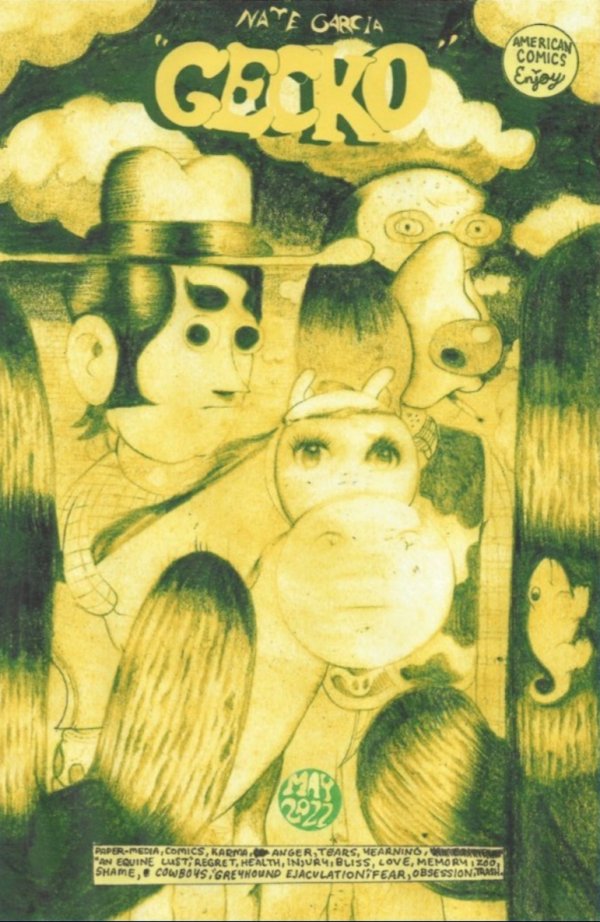
It may not be today, and it may not be tomorrow, but the law of averages dictates that one of these days, Nate Garcia is just gonna take this whole thing too far. His comics about tennis-shoes-wearing cowboy Alanzo Sneak, his horse Sheena for whom he harbors an unhealthy longing and/or obsession, and their anthropomorphic dog pal Huff Deely have consistently straddled the fence between humorously cheesy and downright queasy (with generous side helpings of sleazy and uneasy for good measure), but he’s got this uncanny ability to take you right to the edge and then reel you — and his characters — back in. There’s a frisson of real tension that undercuts these intentionally lame (and, therefore, hilarious) humor strips, but he’s managed to keep the darker impulses of both himself and his coterie of less-than-lovable losers in check. Still, he’s only 21 years old or something — give him time.
And I have to admit, speaking for myself, that I’m curious to see what his iteration of “too far” is going to look like. The overtly “cartoony” nature of his — well, of his cartooning — more or less guarantees that sharp edges are blunted upon delivery, but in a weird way that makes his shit seem even more amoral : like, this is a guy who probably could show a man and a horse making the old beast with two backs (or should that be bestiality with two backs?) and somehow find a way to make the whole thing seem as hysterical as it would be nauseating.
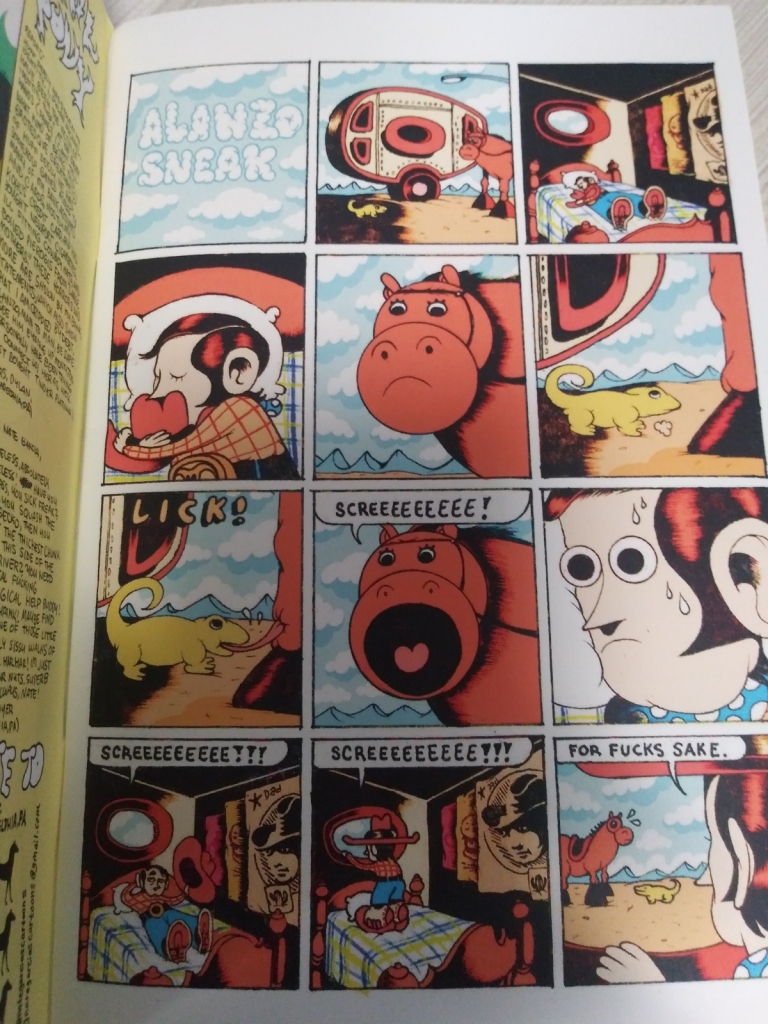
Still, why worry about future eventualities when the present offers such damn good strange fun? And Garcia’s latest, Gecko, certainly is that — not a whole lot happens story-wise, it’s true, but that’s entirely beside the point. Garcia (with a one-page assist at the back of this one from Goiter‘s Josh Pettinger) is more about atmospherics and tonality than narrative ambition, more about the cohesive experience than its reductive elements. The whole has always been greater than the sum of its parts with this Philly-based enfant terrible, and that’s as true as ever here — although those parts deserve special mention.
Specifically, with this new comic Garcia has thrown off the yoke of the magazine format (not that we object to said format around these parts, mind you, but it’s nice to see a self-publishing cartoonist venture out of their comfort zone sometimes) in favor of the old-school A5 (I think, at any rate) ‘zine, and this time he’s opted for a riso-printed cover and full-color interiors. Purely as a physical object, then, this both looks great and feels good to flip through — which rather belies its decidedly modern origins as an Instagram “swipe-though” comic. In fact, petty as it makes me sound, I sorta hope this thing looked like shit on Instagram (I didn’t see it since I don’t have an account on there), because this feels like exactly the right “delivery method” for this material.
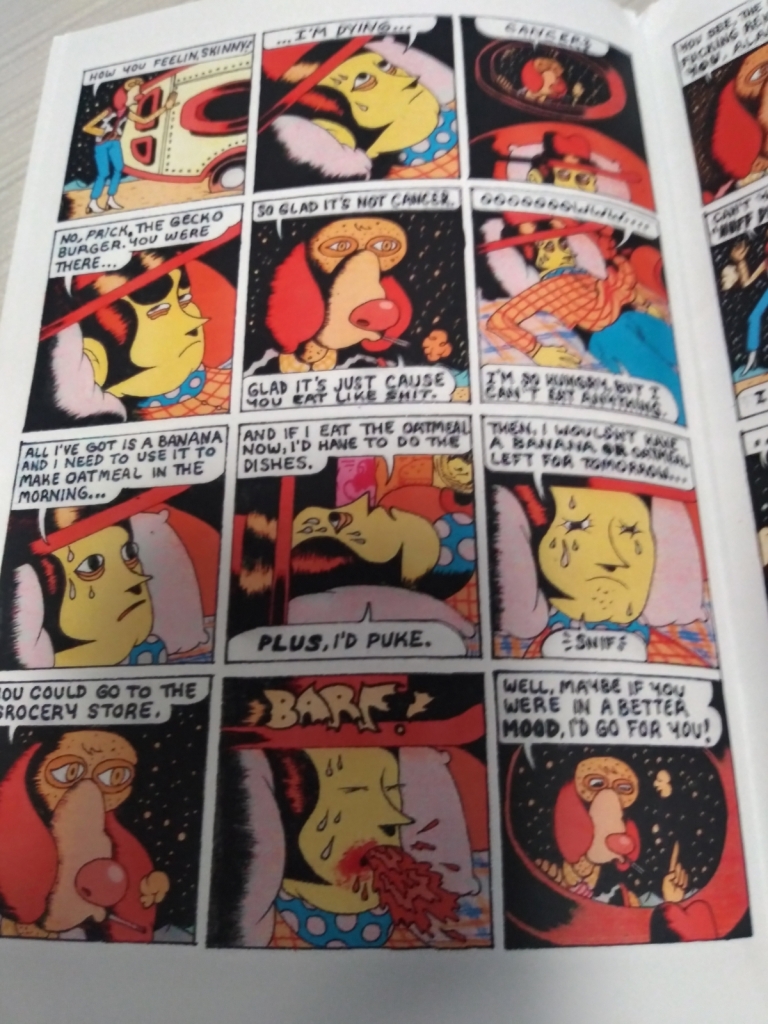
As far as what that material consists of, in short : Alanzo stomps on a Gecko, an anthropomorphic Gecko who works at a hamburger stand takes exception to this act of brutality against one of its brethren and — ya know what, I don’t want to give away the fucked-up “joke” that comes after that, so let’s just say Alanzo ends up sicker than hell and leave it at that. And if all that sounds like flimsy grounds to extrapolate a 20-plus-page story from, well — technically speaking you’re absolutely right, but Garcia’s led an extremely charmed life up to now in his still-nascent cartooning career, and that pattern holds true here. There are a couple of punchy little backup strips, as well, so all in all it’s gotta be said that reading this — and oohing and aahing at the art — is a great time.
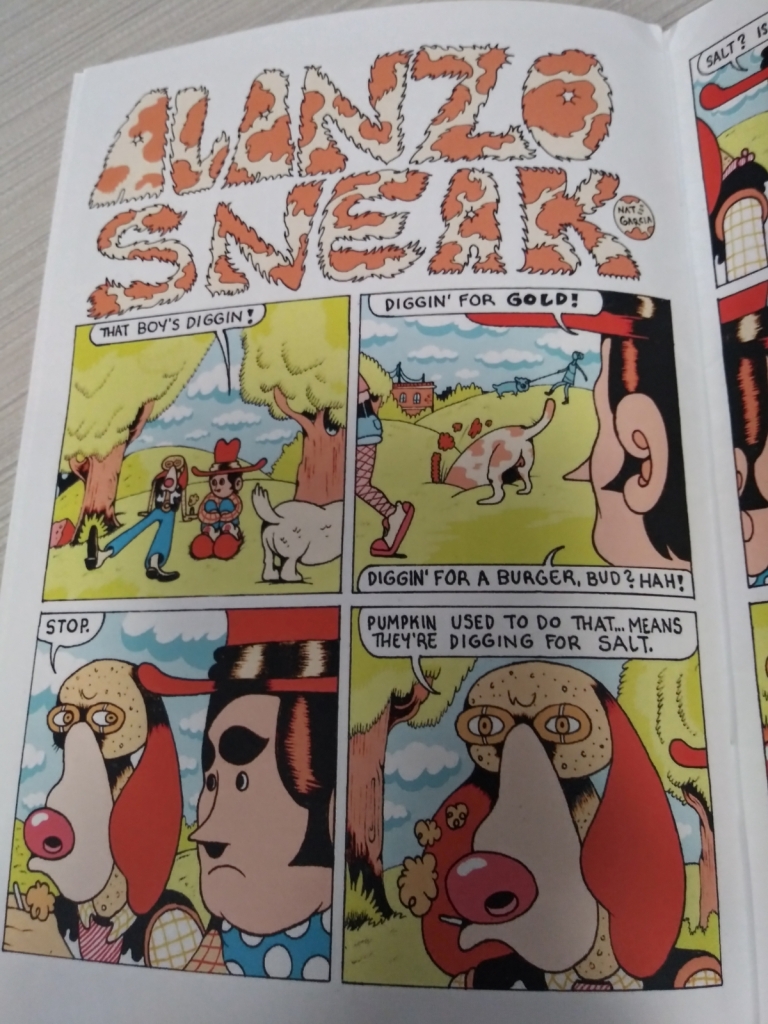
So go on, pick it up and have precisely that. Nate Garcia is one of our weirder and more wonderful comics auteurs of the moment, and there’s no reason to feel the least bit guilty about liking his impeccably-drawn, curiously folksy bizarre surrealist humor. Not yet, at least.
***************************************************************************************
Gecko is available for $10.00 from Nate Garcia’s Bigcartel site at https://nategarcia.bigcartel.com/product/gecko
Also, this review is “brought to you” by my Patreon site, where I serve up exclusive thrice-weekly rants and ramblings on the worlds of comics, films, television, literature, and politics for as little as a dollar a month. Subscribing is the best way to support my continuing work, so I’d be very appreciative if you’d give it a look by directing your kind attention to https://www.patreon.com/fourcolorapocalypse
Short Film Review: A Little Dead (dir by Ben Richardson)
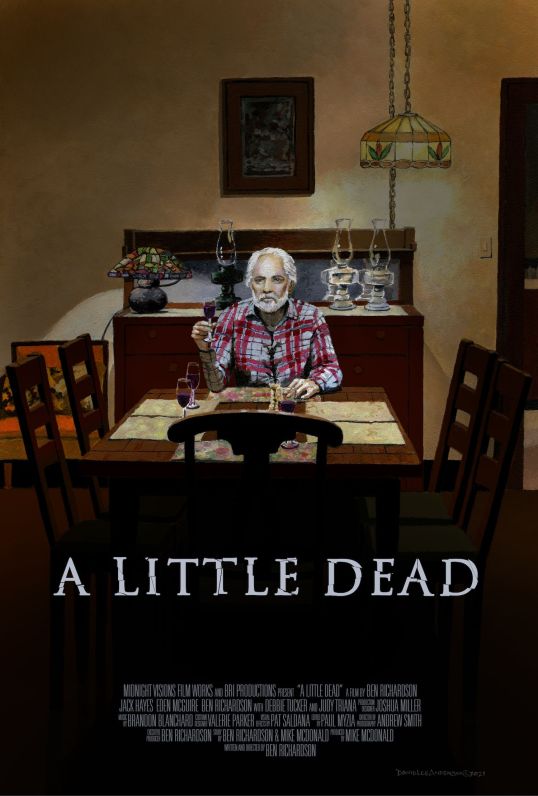 On a farm in Oklahoma, an old man who we get know as being Grandpa (Jack C. Hays) sits at a dinner table. Though he seems to be alone, he’s got three glasses of wine sitting in front of the other chairs, along with with a glass for himself.
Things haven’t been easy for Grandpa since Grandma passed away. His two grandchildren, Hailey (Eden McGuire) and Kevin (Ben Richardson, who also directed the film) arranged for a caretaker to live with him but, when they stop by for a visit, they discover that the caretaker has vanished and Grandpa seems to be convinced that there are people sitting at the table with him. When his grandchildren try to clean up the table, he snaps at them not to touch anyone’s drinks. There’s a ritual going on and his well-meaning grandchildren better not interrupt it. At times, Grandpa seems to be perfectly lucid. At other times, he expresses surprise when Kevin tells him that it’s not a good idea to keep a big box of rat poison with all of the cereal. Is Grandpa losing it or is there something else happening that only he can understand?
Clocking in at a little over 10 minutes (not including the end credits) and deliberately paced without ever being slow, A Little Dead is a nicely atmospheric piece of country gothic. On the one hand, it is a story of a man who may or may not be living with spirits. On the other hand, I think it can be argued that the film is also a metaphor for the mixed emotions that many people have about the feelings of responsibility that they feel towards older relatives and the guilt that comes from feeling that maybe they were not there as much as they should have been. There’s a lot of people like this film’s Grandpa, who are living alone and who are only occasionally visited by younger family members who are, for the most part, checking in to see if they still have their mind and if they’re still capable of taking care of themselves. Is Grandpa talking to actual “people” at the table or is he just talking to the lingering memories of the people who used to be there? And are his grandchildren correct to be concerned about him or are they just dealing with their own feelings of guilt?
A Little Dead is also an enjoyable little horror story. It’s the type of story that you would might expect to find in an old horror comic book, complete with a nice little twist at the end. The film makes good use of that old farmhouse and the desolate country landscape. If you have spent anytime in the rural midwest, you will immediately recognize the film’s milieu. If there were ghosts to be found, that’s definitely where they would probably be living.
This is one to keep an eye out for. Pour yourself a glass and relax with A Little Death.
Artwork of the Day: Thrilling Wonder Stories (by Earle Bergey)

by Earle Bergey
Giant flies, men with knives, and women in bubbles, it’s definitely the work of Earle Bergey.
Music Video of the Day: I Was Neon by Julia Jacklin (2022, dir by Julia Jacklin)
Meow!
An Atypical Wreck : Steven Arnold’s “Perry Midlife”

Speaking as someone who’s been there, done that, and is still doing it, trust me when I say that the existential dread that comes with aging is as serious as a fucking heart attack. Certainly, it has to qualify as a “first world problem” — there are any number of countries in the process of being ground under economically, militarily, or both where simply living to see another day is reason enough to be grateful regardless of how many ticks of the calendar one has endured — but that doesn’t mean those of us who have the privilege of even being able to worry about such things aren’t terrified by our own mortality once we hit the point where logic dictates we likely have more yesterdays than we do tomorrows.
Steven Arnold — or, as he credits himself in the work we’re here to look at, S.R. Arnold — gets it. He knows the slow-burn sense of impending doom that the middle-aged person feels is equal parts well-placed and ridiculous, justifiable and self-indulgent, and in the handsomely-formatted pages of the magazine-sized Perry Midlife (the sixth release from his Philly-based H.O.T. Press Comics imprint, and as far as I know his first “solo” work, in that it was done without the assistance of writing partner Michael Kamison), he regales us with the tale of a typically hapless underachiever having anything but a typical time of things — even if, again, this is a decidedly typical set-up on its face.
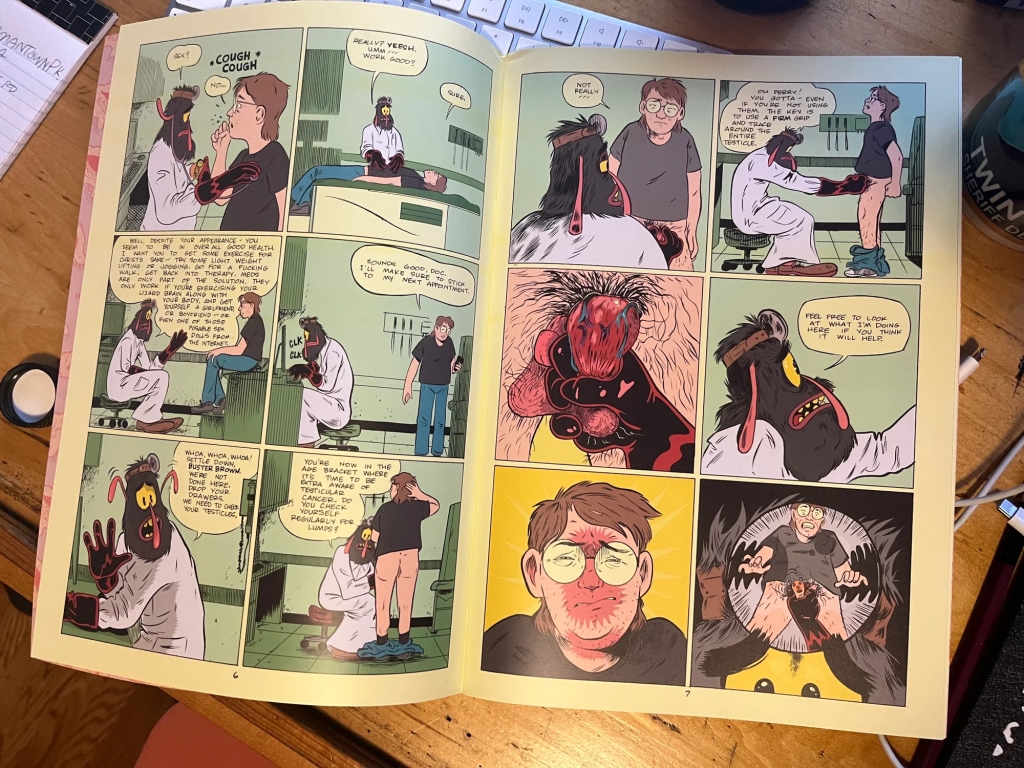
Anyway, how much of what’s happening on the lavishly-colored pages here is “real” or not is beside the point, I suppose, what’s of greater import is the overall relatability of both our titular Perry and his befuddled mindset, and Arnold absolutely nails that. Admittedly, there’s a bit of “high weirdness for its own sake” on offer here — check out our man’s doctor, pictured above, for instance — but if you can’t wrap your head around the concept of a perpetually-annoying fake ornithological species called a cowbird, what can I say? This ain’t the comic for you — but it’s only yourself that you’ll be depriving.
Okay, fair enough, “depriving of what?” is the natural enough follow-up question here, and the answer is a complicated one. Of enjoyment? To a degree, absolutely — I mean, this is a funny comic. But it’s not necessarily an easy one to enjoy, depending on one’s internal wiring. Mine is hopelessly skewed, so I did have a fair amount of fun with this, but there are times when Arnold’s personal flights of fancy can fairly be said to blunt the impact of otherwise-strong narrative “beats” and where he gets the delicate real/surreal balance he’s playing with throughout just a bit wrong — these instances are notable, though, which is as good an indicator as any that most of the time, at any rate, he’s getting things exactly right.
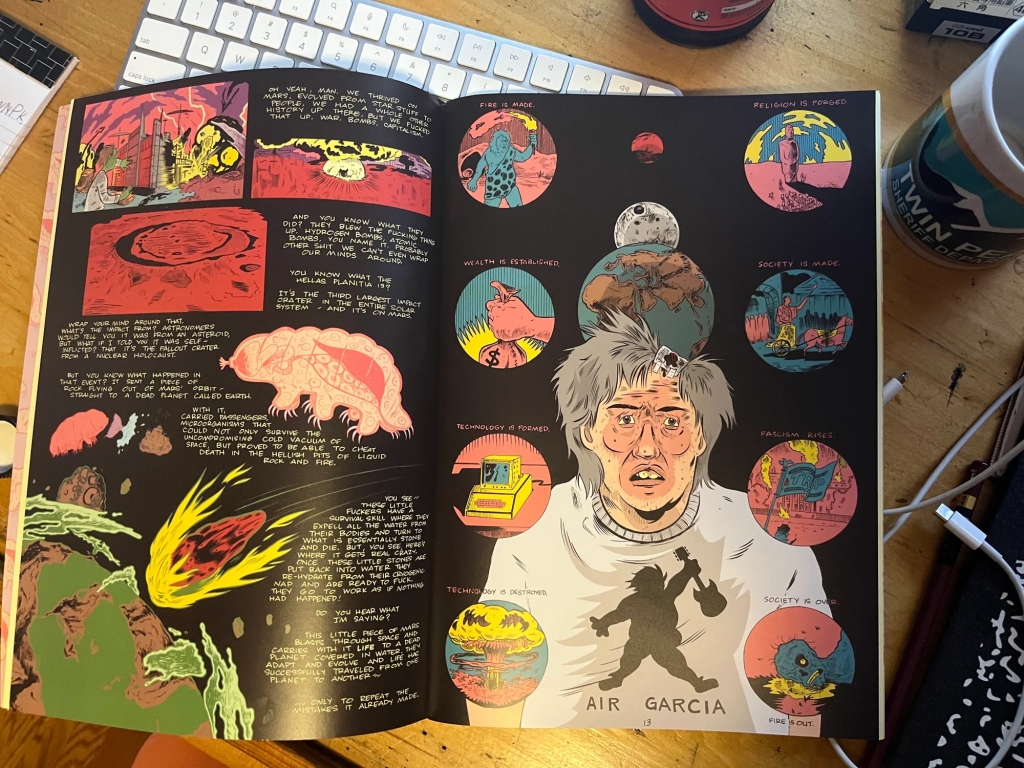
It helps, of course, that Arnold is such a great fucking cartoonist — his compositions are crisp and imaginative, his figure drawing is technically near-flawless, and his layouts run the gamut from standard-issue to pretty damn far-out with gusto and aplomb. He’s not afraid to challenge himself either conceptually or concretely, and the results speak for themselves : the guy is in full command of some fairly considerable creative powers, and stands out as one of the bright lights in what is arguably America’s most vibrant local cartooning scene. You pass on his stuff at your peril.
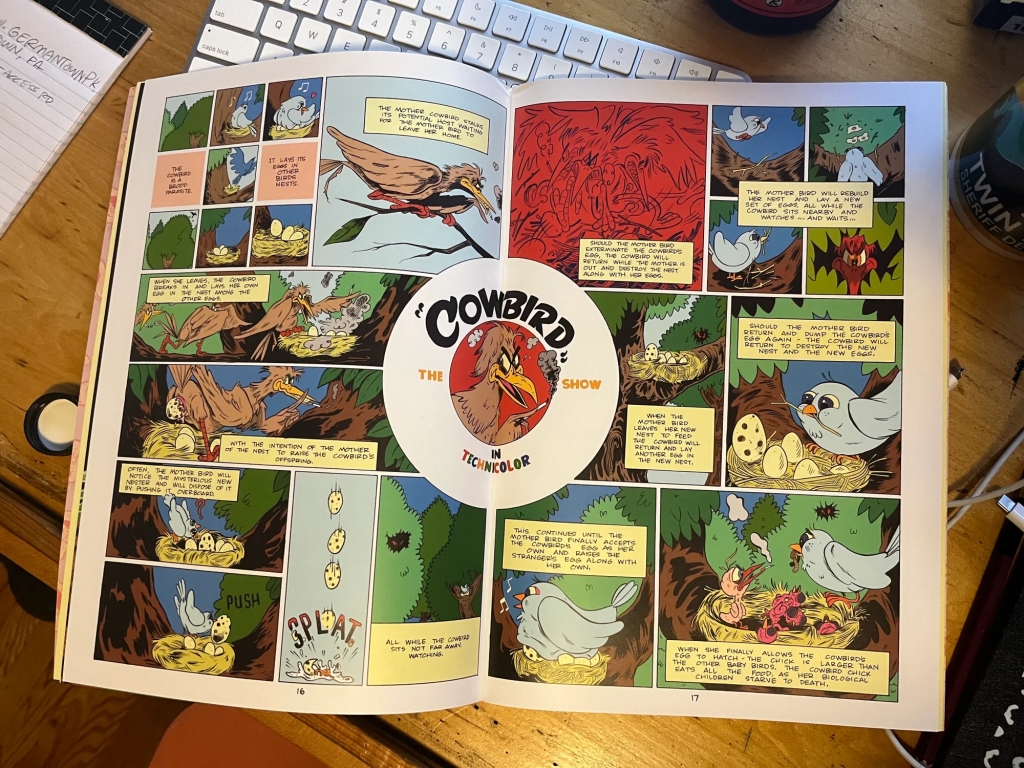
What’s not to like, then? Well, not much, if we’re being totally honest here — and we always are. Tonally, Arnold might be struggling to break free from the Clowes/Ware paradigm, at least to an extent, but his outlook and approach are unique unto himself, even if his overall set of concerns here isn’t. I’m anxious to see where he goes next, absolutely — but for purposes of this review, I’ve gotta say I’m quite impressed with where he is right here and right now.
********************************************************************
Perry Midlife is available for $12.00 from the H.O.T. Press Comics website at https://hotpresscomics.bigcartel.com/product/perry-midlife
Also, this review is “brought to you” by my Patreon site, where I serve up exclusive thrice-weekly rants and ramblings on the worlds of comics, films, television, literature, and politics for as little as a dollar a month. Subscribing is the best way to support my continuing work, so I’d be very appreciative if you’d take a moment to give it a look by directing your kind attention to https://www.patreon.com/fourcolorapocalypse
Artwork of the Day: Astounding Science Fiction (by Hubert Rogers)

by Hubert Rogers
As it is says on the cover, this is from 1948. He probably should be keeping an eye on the robots. We all should.
Music Video of the Day: So Good by Halsey (2022, dir by Alev Aydin)
Meow!
There’s No Such Thing As Ordinary : Alex Nall’s “Town & County” #1
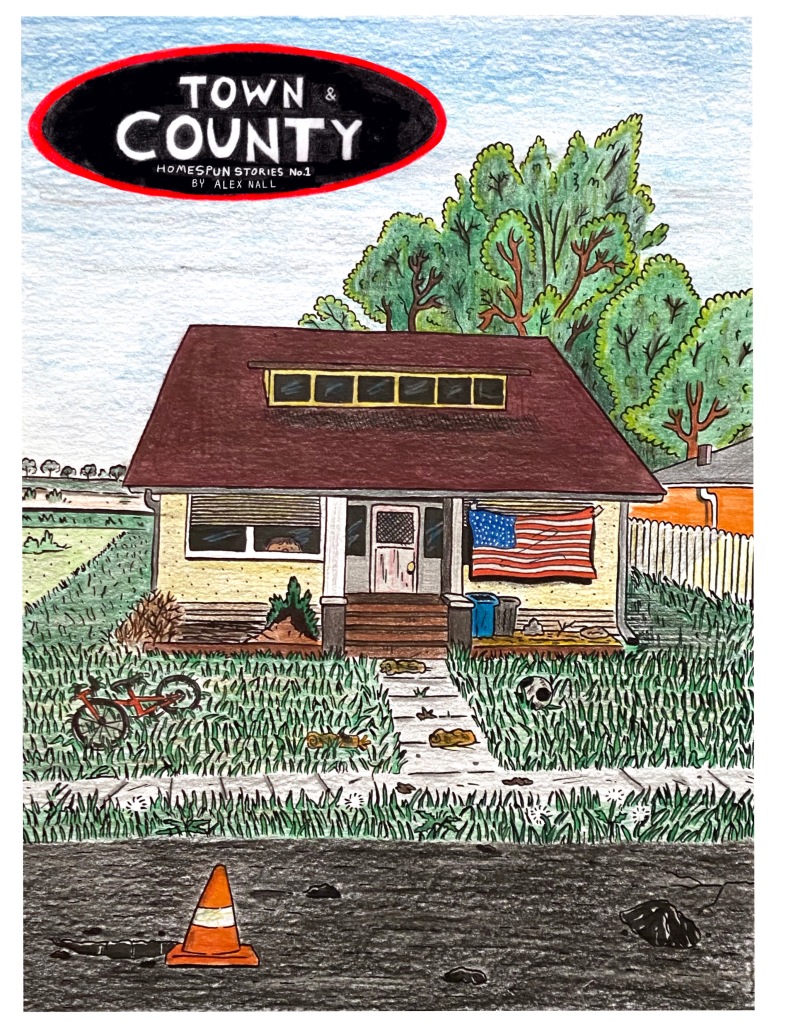
If you’ll cast your mind back to the admittedly dark later days of 2016, you’ll recall that there were two common reactions from the so-called “coastal elites” with regard to the electoral college victory of a certain syphilitic game show host who is now, according to his closest former aides, living in some kind of thick bubble of reality denial (as if he wasn’t back then) : one was to give his voters in the so-called “heartland” the old fly-under-a-magnifying glass treatment, thereby subjecting readers of the New York Times and other outlets to one interminable series of profiles after another, ostensibly designed to provide “insight” into the lives of “the forgotten men and women of middle America,” while the other was to quickly glom onto this supposedly-ascendant subset of Americans and portray Trump’s rather flukey (if we’re being completely honest) win as “the revenge of flyover country.”
Both entirely-manufactured points of view did the REAL men and women of small town and rural America a disservice, of course, in that they forced them to be either curious holdovers of a bygone era or hard-working “salt of the Earth” types fed up with supposedly being talked down to by their self-appointed social “betters,” but they also both had the curious effect of letting the real culprits for the rise of neo-fascism off the hook, in that neither editorially-dictated point of view bothered to look at the simple, oft-repeated precedent of history, to wit : people who have been screwed over by the rich have always been easy prey to do the bidding of those selfsame rich folks as long as you can direct their anger somewhere other than where it belongs. Don’t blame the billionaire class for raising your health insurance premiums astronomically, looting your formerly-secure pension fund, shuttering the factory you used to work at and opening one in Mexico the following week, or gouging you at the grocery store checkout line. Blame, uh — well, whoever else you can, from transgender athletes to starving migrants fleeing war-torn countries to gay school teachers to supposedly “violent” inner-city youths. Yeah, there you go — your problems are their fault.
Lost in the sudden urge to either attack this so-called “real” America, embrace it, or manipulate it for political gain, however, is the simple fact that “these people” are still real people, and not all of them are easily reduced to the role of pawns in a game. Hell, even those who are still have hopes, dreams, and aspirations like anyone else, and while none of this — I repeat, absolutely none of it — excuses the petty prejudices at the heart of Trumpism (to say nothing of the whopping prejudices that animate its virulent offshoot movements such as QAnon, The Proud Boys, The Oath Keepers, and the Three Percenters), there is, I think, a real danger in focusing only on prejudice when talking about how “middle America” came to find itself in the state it’s in.
Is it really that hard to blame greedy rich bastards for the mess they’ve left in their wake? In America, apparently, it is. But I digress —
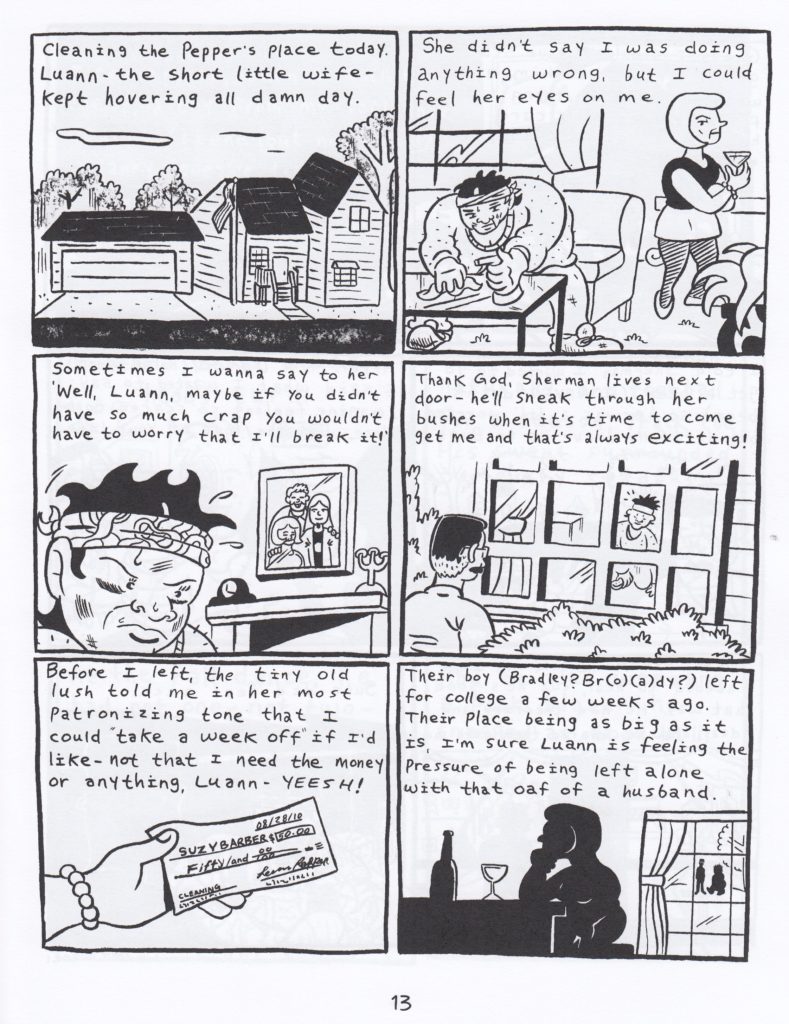
Still, while the journalistic class may have lost sight of much of the richness of small-town life, our cartoonists have not : Sean Knickerbocker and his coterie of contributors are delineating its highs, lows, and in-betweens in the fine Rust Belt Review anthology series, for instance, and Alex Nall has shown an uncanny ability to communicate its quiet idiosyncrasies in the pages of Lawns, Kids With Guns, and the first magazine-sized issue of his new ongoing project, Town & County — which liberally drops references to, and even borrows concepts from, the pair of earlier comics just mentioned, while crafting something new and substantial that requires no intimate knowledge of either of them. In other words, if this is your first step into what we’ll call, with apologies to the author, the “Nall-verse,” you needn’t worry : the welcome mat is rolled out for you.
Which rather strikes me as apropos of the general attitude of the citizenry of the fictitious-in-name-only Clydesdale, Illinois, the “everyday America” setting of the four interconnected vignettes that comprise this debut issue. Longing for something better — or at least for something else — is something all of our protagonists (a lonely widower, a nosey housecleaner, a tortured insomniac, and a low-rent drug dealer) have in common, and while I have no practical experience with “rural Americana” myself, being a lifelong (and, for the record, damn proud) inner city resident, I found all these folks easy to identify with because that tug that exists in the space between wishing for a return to the familiar and yearning for even modestly new vistas of experience is pretty well universal in nature.
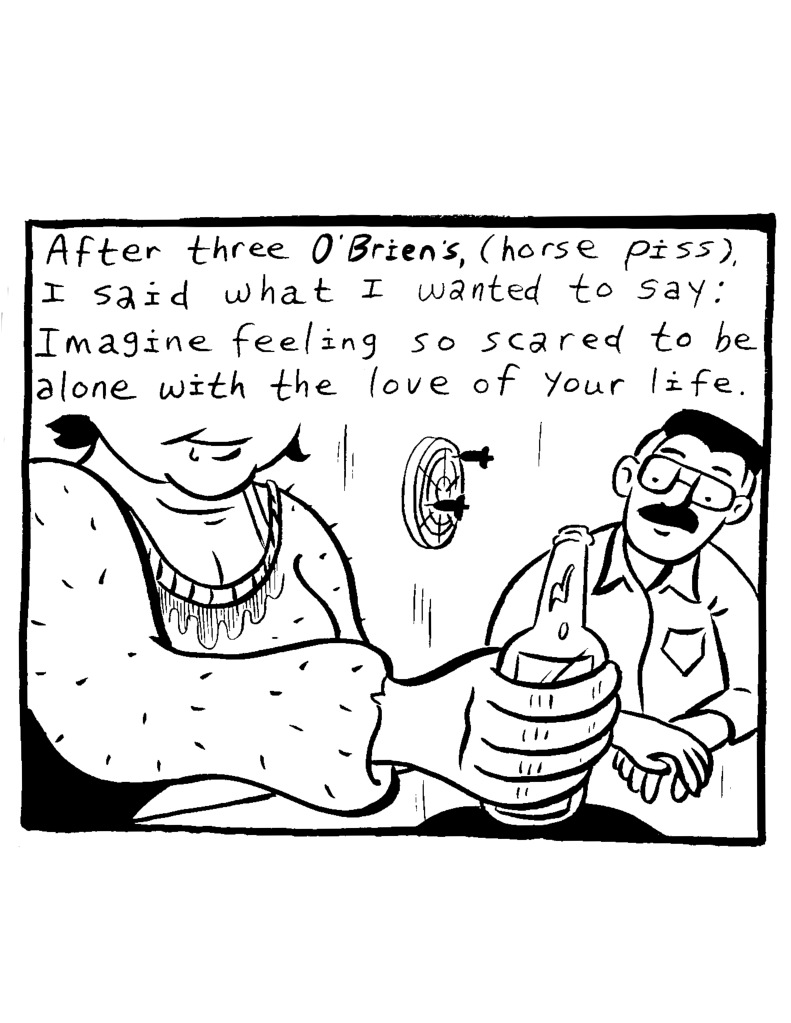
Nall, for his part, just so happens to be able to put that dichotomy into words and images better than most — hell, better than almost any of his contemporaries, and he’s got a project here that plays to all his strengths : authentic dialogue paired with rich inner monologue, clean expressive figure lines paired with rough-hewn, entirely unglamorous backgrounds/locales. There’s a push and pull sub rosa tension that animates both writing and art here, and why the hell wouldn’t there be? That pretty much sums up the lives of his characters in a nutshell, whether they consciously realize it or not.
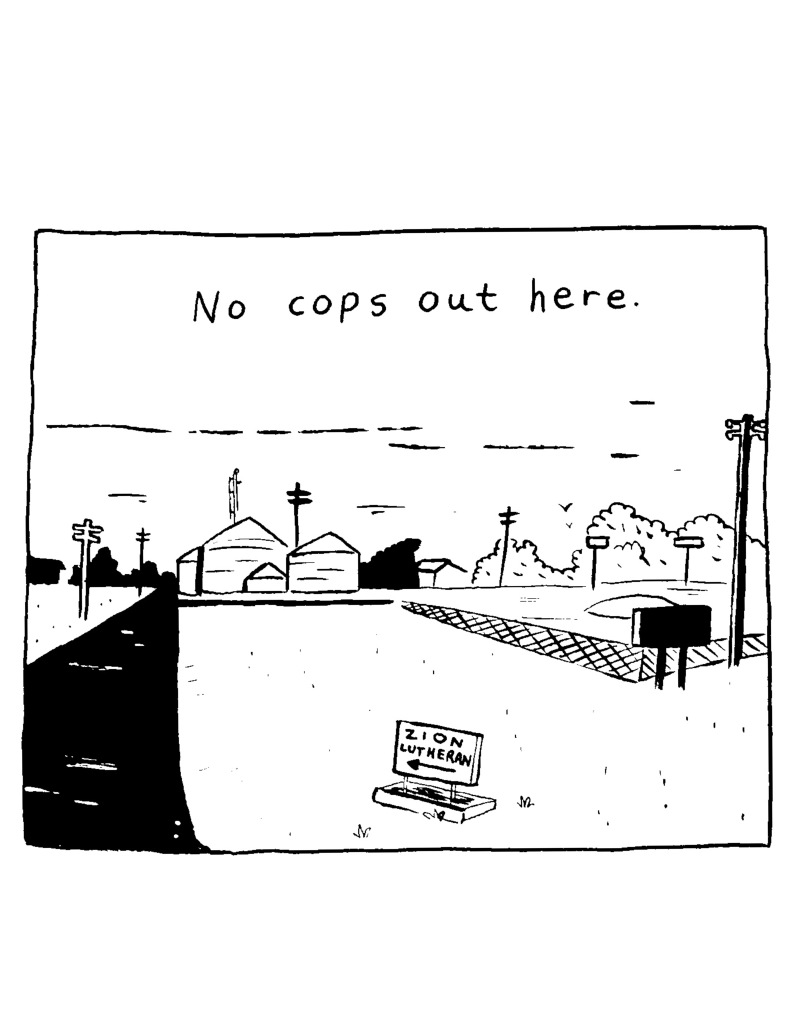
This, then, really is what you think it is going in : a comic about a town and its people — one that eschews the easy trappings of both Norman Rockwell cliche and anti-Rockwell “darkness on the edge of town.” This is a place where bathtub meth slingers and broken-hearted oldsters coexist while inhabiting entirely different personal realities. Where 2nd Amendment militia nuts fill their gas tanks at the same place as frightened mothers who would do anything to protect their kids from the next school shooter. Where the John Deere plant that was the source of everyone’s employment, either directly or indirectly, has shut its doors and left whatever survivors stuck around scrambling to find a new way forward. Where the end of the world has already happened and any promise — no matter how ephemeral and/or fraudulent — to bring back the “good old days” is better than nothing. It’s a place like thousands of others, sure — but that doesn’t mean it’s anything other than utterly unique.
***********************************************************************
Town & County #1 is self-published by Alex Nall under the auspices of his Ivy Terrace Press imprint and is available for $8.00 from his Storenvy site at https://alexnallcomics.storenvy.com/products/35138617-town-county-no-1
Also, this review is “brought to you” by my Patreon site, where I serve up exclusive thrice-weekly rants and ramblings on the worlds of comics, films, television, literature, and politics for as little as a dollar a month. Subscribing is the best way to support my continuing work, so I’d be very appreciative if you’d take a moment to give it a look by directing your kind attention to https://www.patreon.com/fourcolorapocalypse
Artwork of the Day: Flying Aces (by August Schomburg)
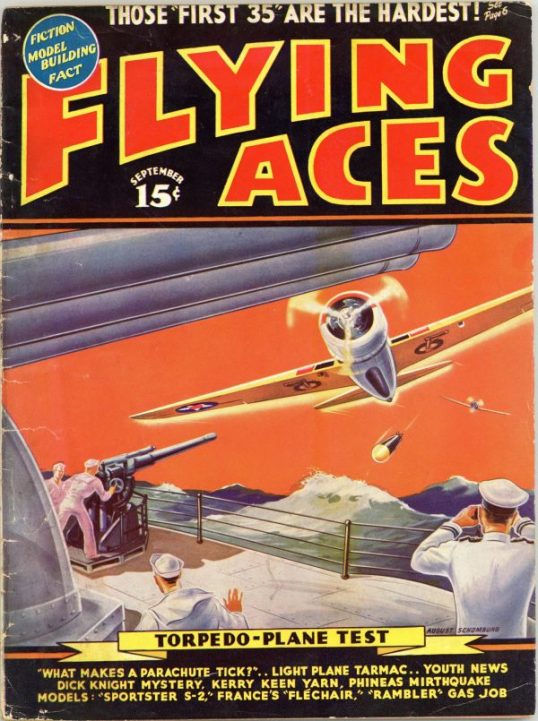
by August Schomburg
This is from 1939.
 Through the Shattered Lens